Neoclassical Growth with Physical and Human Capital
Our next task is to incorporate human capital investments into the baseline neoclassical growth model. This is useful both to investigate the interactions between physical and human capital, and also to generate a better sense of the impact of differential human capital investments on economic growth.
Physical-human capital interactions could potentially be important, since a variety of evidence suggests that physical capital and human capital (capital and skills) are complementary, meaning that greater capital increases the productivity of high human capital workers more than that of low skill workers. This may play an important role in economic growth, for example, by inducing a “virtuous cycle” of investments in physical and human capital. These types of virtue cycles will be discussed in greater detail in Chapter 21. It is instructive to see to what extent these types of complementarities manifest themselves in the neoclassical growth model. The potential for complementarities also raises the issue of “imbalances”. If physical and human capital are complementary, the society will achieve the highest productivity when there is a balance between these two different types of capital. However, whether the decentralized equilibrium will ensure such a balance is a question that needs to be investigated.The impact of human capital on economic growth (and on cross-country income differences) has already been discussed in Chapter 3, in the context of an augmented Solow model, where the economy was assumed to accumulate physical and human capital with two exogenously given constant saving rates. In many ways, that model was less satisfactory than the baseline Solow growth model, since not only was the aggregate saving rate assumed exogenous, but the relative saving rates in human and physical capital were also taken as given. The neoclassical growth model with physical and human capital investments will enable us to investigate the same set of issues from a different perspective.
Consider the following continuous time economy admitting a representative household with preferences

where the instantaneous utility function u (∙) satisfies Assumption 3 and p > 0. We ignore technological progress and population growth to simplify the discussion. Labor is again supplied inelastically.
We follow the specification in Chapter 3 and assume that the aggregate production possibilities frontier of the economy is represented by the following aggregate production function:

where K (t) is the stock of physical capital, L (t) is total employment, and H (t) represents human capital. Since there is no population growth and labor is supplied inelastically, L (t) = 392
L for all t. This production function is assumed to satisfy Assumptions 10 and 20 in Chapter 3, which generalize Assumptions 1 and 2 to this production function with three inputs. As already discussed in that chapter, a production function in which “raw” labor and human capital are separate factors of production may be less natural than one in which human capital increases the effective units of labor of workers (as in the analysis of the previous two sections). Nevertheless, this production function allows a simple analysis of neoclassical growth with physical and human capital. As usual, it is more convenient to express all objects in per capita units, thus we write
1269" class="lazyload" data-src="/files/uch_group77/uch_pgroup317/uch_uch7364/image/image1267.jpg">
where
are the physical and human capital levels per capita. In view of Assumptions 10 and 20, f (k, h) is strictly increasing, continuously differentiable and jointly strictly concave in both of its arguments. We denote its derivatives by fk, fh, fkh, etc.
Throughout, we assume that physical and human capital are complementary, that is, fkh (k, h) > 0 for all k,h > 0.We assume that physical and human capital per capita evolve according to the following two differential equations

and

where ik (t) and ih (t) are the investment levels in physical and human capital, while δ∣, and δh are the depreciation rates of these two capital stocks. The resource constraint for the economy, expressed in per capita terms, is

Since the environment described here is very similar to the standard neoclassical growth model, equilibrium and optimal growth will coincide. For this reason, we focus on the optimal growth problem (the competitive equilibrium is discussed in Exercise 10.12). The optimal growth problem involves the maximization of (10.19) subject to (10.20), (10.21), and (10.22). The solution to this maximization problem can again be characterized by setting up the current-value Hamiltonian. To simplify the analysis, we first observe that since u (c) is strictly increasing, (10.22) will always hold as equality. We can then substitute for c (t) using this 393
constraint and write the current-value Hamiltonian as

where we now have two control variables, i⅛ (t) and ⅛ (t) and two state variables, k (t) and h (t), as well as two costate variables, μk (t) and μh (t), corresponding to the two constraints, (10.20) and (10.21). The necessary conditions for an optimal solution are
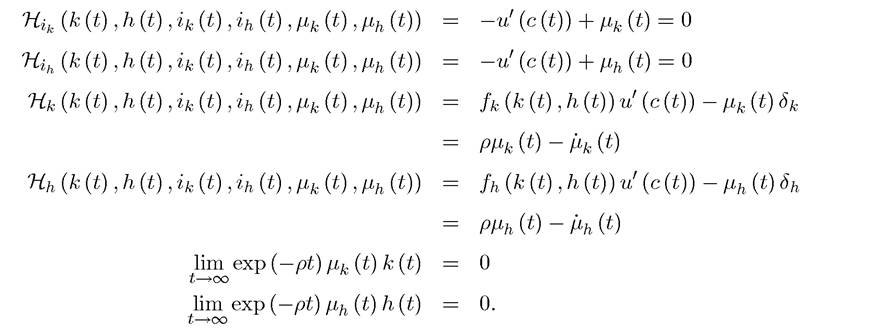
There are two necessary transversality conditions since there are two state variables (and two costate variables).
Moreover, it can be shown that is concave given the costate variables μk (t) and μ⅛ (t), so that a solution to the necessary conditions indeed gives an optimal path (see Exercise 10.9).
The first two necessary conditions immediately imply that

Combining this with the next two conditions gives

which (together with fkh > 0) implies that there is a one-to-one relationship between physical and human capital, of the form
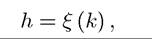
where ξ (∙) is uniquely defined, strictly increasing and differentiable (with derivative denoted by see Exercise 10.10).
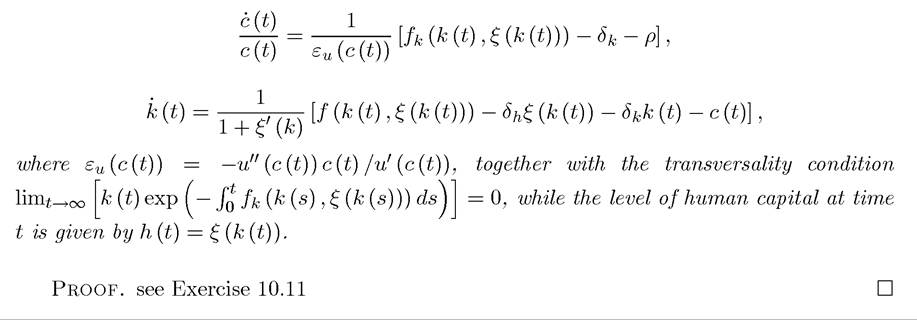
This observation makes it clear that the model can be reduced to the neoclassical growth model and has exactly the same dynamics as the neoclassical growth model, and thus establishes the following proposition:
PROPOSITION 10.1. In the neoclassical growth model with physical and human capital investments described above, the optimal path of physical capital and consumption are given as in the one-sector neoclassical growth model, and satisfy the following two differential equations
What is perhaps more surprising, at first, is that equation (10.24) implies that human and physical capital are always in “balance”. Initially, one may have conjectured that an economy that starts with a high stock of physical capital relative to human capital will have a relatively high physical to human capital ratio for an extended period of time.
However, Proposition 10.1 and in particular, equation (10.24) show that this is not the case. The reason for this is that we have not imposed any non-negativity constraints on the investment levels. If the economy starts with a high level of physical capital and low level of human capital, at the first instant it will experience a very high level of i^ (0), compensated with a very negative i⅛ (0), so that at the next instant the physical to human capital ratio will have been brought back to balance. After this, the dynamics of the economy will be identical to those of the baseline neoclassical growth model. Therefore, issues of imbalance will not arise in this version of the neoclassical growth model. This result is an artifact of the fact that there are no non-negativity constraints on physical and human capital investments. The situation is somewhat different when there are such non-negativity or “irreversibility” constraints, that is, if we assume that 0 for all t. In this case, initial
 imbalances will persist for a while. In particular, it can be shown that starting with a ratio of physical to human capital stock (k (0) /h (0)) that does not satisfy (10.24), the optimal path will involve investment only in one of the two stocks until balance is reached (see Exercise 10.14). Therefore, with irreversibility constraints, some amount of imbalance can arise, but the economy quickly moves towards correcting this imbalance.
Another potential application of the neoclassical growth model with physical and human capital is in the analysis of the impact of policy distortions. Recall the discussion in Section 8.9 in Chapter 8, and suppose that the resource constraint of the economy is modified to

where τ ≥ 0 is a tax affecting both types of investments. Using an analysis parallel to that in Section 8.9, we can characterize the steady-state income ratio of two countries with different policies represented by τ and τ0.
In particular, let us suppose that the aggregate production function takes the Cobb-Douglas form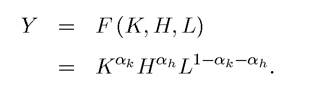
In this case, the ratio of income in the two economies with taxes/distortions of τ and τ0 is given by (see Exercise 10.15):

If we again take α⅛ to be approximately 1/3, then the ability of this modified model to account for income differences using tax distortions increases because of the responsiveness of human capital accumulation to these distortions. For example, with α⅛ = α⅛ = 1 /3 and eightfold distortion differences, we would have
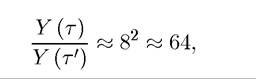
which is a huge difference in economic performance across countries.
Therefore, incorporating human capital into the neoclassical growth model provides one potential way of generating larger income per capita differences. Nevertheless, this result has to be interpreted with caution. First, the large impact of distortions on income per capita here is driven by a very elastic response of human capital accumulation. It is not clear whether human capital investments will indeed respond so much to tax distortions. For instance, if these distortions correspond to differences in corporate taxes or corruption, we would expect them to affect corporations rather than individual human capital decisions. This is of course not to deny that in societies where policies discourage capital accumulation, there are also barriers to schooling and other types of human capital investments. Nevertheless, the impact of these on physical and human capital investments may be quite different. Second, and more important, the large implied elasticity of output to distortions when both physical and human capital are endogenous has an obvious similarity to the Mankiw-Romer-WeiFs approach to explaining cross-country differences in terms of physical and human capital stocks. As discussed in Chapter 3, while this is a logical possibility, existing evidence does not support the notion that human capital differences across countries can have such a large impact on income differences. This conclusion equally sheds doubt on the importance of the large contribution of human capital differences induced by policy differences in the current model. Nevertheless, the conclusions in Chapter 3 were subject to two caveats, which could 396
potentially increase the role of human capital; large human capital externalities and significant differences in the quality of schooling across countries. These issues will be discussed below.
10.5.