NUMERICAL PROBLEMS
1. Suppose the interest rate on a one-year bond today is 6% per year, the interest rate on a one-year bond one year from now is expected to be 4% per year, and the interest rate on a one-year bond two years from now is expected to be 3% per year.
The term premium on a two-year bond is 0.5% per year and the term premium on a three-year bond is 1.0% per year. In equilibrium, what is the interest rate today on a two-year bond? On a three-year bond? What is the shape of the yield curve?2. Money demand in an economy in which no interest is paid on money is 
a. Suppose that P = 100, Y = 1000, and i = 0.10. Find real money demand, nominal money demand, and velocity.
b. The price level doubles from P = 100 to P = 200. Find real money demand, nominal money demand, and velocity.
c. Starting from the values of the variables given in Part (a) and assuming that the money demand function as written holds, determine how velocity is affected by an increase in real income, by an increase in the nominal interest rate, and by an increase in the price level.
3. Jason has wealth of $100,000 that he invests entirely in money (a checking account) and government bonds. Jason instructs his broker to invest $50,000 in bonds, plus $5000 more in bonds for every percentage point that the interest rate on bonds exceeds the interest rate on his checking account.
a. Write an algebraic formula that gives Jason's demand for money as a function of bond and checking account interest rates.
b. Write an algebraic formula that gives Jason's demand for bonds. What is the sum of his demand for money and his demand for bonds?
c. Suppose that all holders of wealth in the economy are identical to Jason. Fixed asset supplies per person are $80,000 of bonds and $20,000 of checking accounts.
Checking accounts pay no interest. What is the interest rate on bonds in asset market equilibrium?4. Assume that the quantity theory of money holds and that velocity is constant at 5. Output is fixed at its full-employment value of 10,000, and the price level is 2.
a. Determine the real demand for money and the nominal demand for money.
b. In this same economy the government fixes the nominal money supply at 5000. With output fixed at its full-employment level and with the assumption that prices are flexible, what will be the new price level? What happens to the price level if the nominal money supply rises to 6000?
5. Consider an economy with a constant nominal money supply, a constant level of real output Y = 100, and a constant real interest rate r = 0.10. Suppose that the income elasticity of money demand is 0.5 and the interest elasticity of money demand is -0.1.
a. By what percentage does the equilibrium price level differ from its initial value if output increases to Y = 106 (and r remains at 0.10)? (Hint: Use Eq. 7.12.)
b. By what percentage does the equilibrium price level differ from its initial value if the real interest increases to r = 0.11 (and Y remains at 100)?
c. Suppose that the real interest rate increases to r = 0.11. What would real output have to be for the equilibrium price level to remain at its initial value?
6. Suppose that the real money demand function is
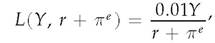
where Y is real output, r is the real interest rate, and πe is the expected rate of inflation. Real output is constant over time at Y = 150. The real interest rate is fixed in the goods market at r = 0.05 per year.
a. Suppose that the nominal money supply is growing at the rate of 10% per year and that this growth rate is expected to persist forever. Currently, the nominal money supply is M = 300. What are the values of the real money supply and the current price level? (Hint: What is the value of the expected inflation rate that enters the money demand function?)
b.
Suppose that the nominal money supply is M = 300. The central bank announces that from now on the nominal money supply will grow at the rate of 5% per year. If everyone believes this announcement, and if all markets are in equilibrium, what are the values of the real money supply and the current price level? Explain the effects on the real money supply and the current price level of a slowdown in the rate of money growth.7. The income elasticity of money demand is 2/3 and the interest elasticity of money demand is -0.1. Real income is expected to grow by 4.5% over the next year, and the real interest rate is expected to remain constant over the next year. The rate of inflation has been zero for several years.
a. If the central bank wants zero inflation over the next year, what growth rate of the nominal money supply should it choose?
b. By how much will velocity change over the next year if the central bank follows the policy that achieves zero inflation?
►
More on the topic NUMERICAL PROBLEMS:
- Arab and Zionist institution-building
- REVIEW OF FORENSIC ASSESSMENT INSTRUMENTS
- Functional forms for the model components
- The Ukrainian Diaspora
- Omitting intermediate entities in models of indirect interactions
- REVIEW OF FORENSIC ASSESSMENT INSTRUMENTS
- Discussion
- More Vague Propositions than Sentences
- PRELIMINARIES: DIMENSIONS, INDICATORS, AND WEIGHTS
- Hospital Care