Stochastic Euler Equations
In Chapter 6, Euler equations and transversality conditions played a central role. In the present context, instead of the standard Euler equations, we have to work with stochastic Euler equations.
While this is not conceptually any more involved than the standard Euler equations, stochastic Euler equations are not always easy to manipulate. Sometimes, as in the permanent income hypothesis model we will study in Section 16.5, the stochastic Euler equation itself may contain enough economics to be useful. In other instances, our interest will be with the characterization of optimal plans. Although this is typically a non-trivial task, the combination of stochastic Euler equations and the appropriate transversality condition can sometimes be used to determine certain qualitative features of optimal plans.Let us follow the treatment in Chapter 6 and also build on the results from Section 16.1. Let us use *,s to denote optimal values and D for gradients. Then using Assumption 16.5 and Theorem 16.6, we can write the necessary conditions for an interior optimal plan as  where x ∈ Rk is the current value of the state vector, z ∈ Z is the current value of the stochastic variable, and
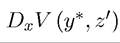 denotes the gradient of the value function evaluated at
next period’s state vector y*. Now using the stochastic equivalent of the Envelope Theorem for dynamic programming and differentiating (16.5) with respect to the state vector, x, we obtain:

Here there are no expectations, since this equation is conditioned on the realization of z ∈ Z.
Note that y* here is a shorthand for π (x, z). Now using this notation and combining these two equations, we obtain the canonical form of the stochastic Euler equation
where as in Chapter 6, DxU represents the gradient vector of U with respect to its first K arguments, and DyU represents its gradient with respect to the second set of K arguments. Writing this equation in the notation more congruent with the sequence version of the problem, the stochastic Euler equation takes the form

How do we write the transversality condition in this case? The transversality condition essentially requires the discounted marginal return from the state variable to tend to zero as the planning horizon goes to infinity. In a stochastic environment, we clearly have to look at expected returns. The question is what information to condition upon. One idea might be to condition on the information available at date t =O, i.e., z (0) ∈ Z. However, this transversality condition would cover variations from the viewpoint of time t = 0. More generally, we would need the transversality condition associated with this stochastic Euler equation to take the form

The next theorem generalizes Theorem 6.10 from Chapter 6 to an environment with uncertainty. In particular, it shows that the transversality condition together with the transformed Euler equations in (16.18) are sufficient to characterize an optimal solution to Problem A1 and therefore to Problem A2.
Theorem 16.8. (Euler Equations and the Transversality Condition) Let X C
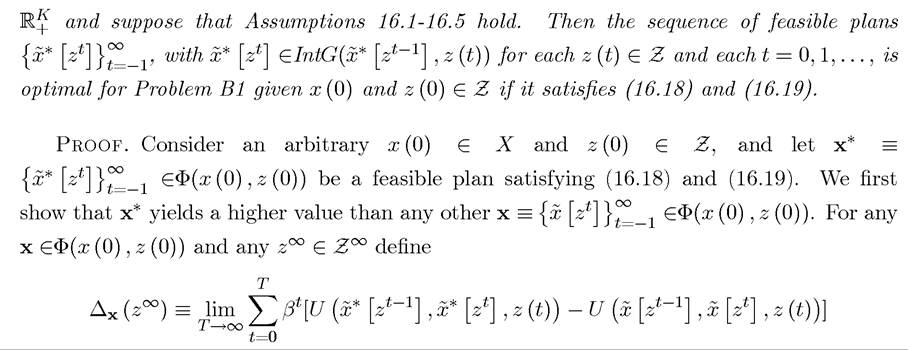
as the difference of the realized objective function between the feasible sequences x* and x.
From Assumptions 16.2 and 16.5, U is continuous, concave, and differentiable, so that for 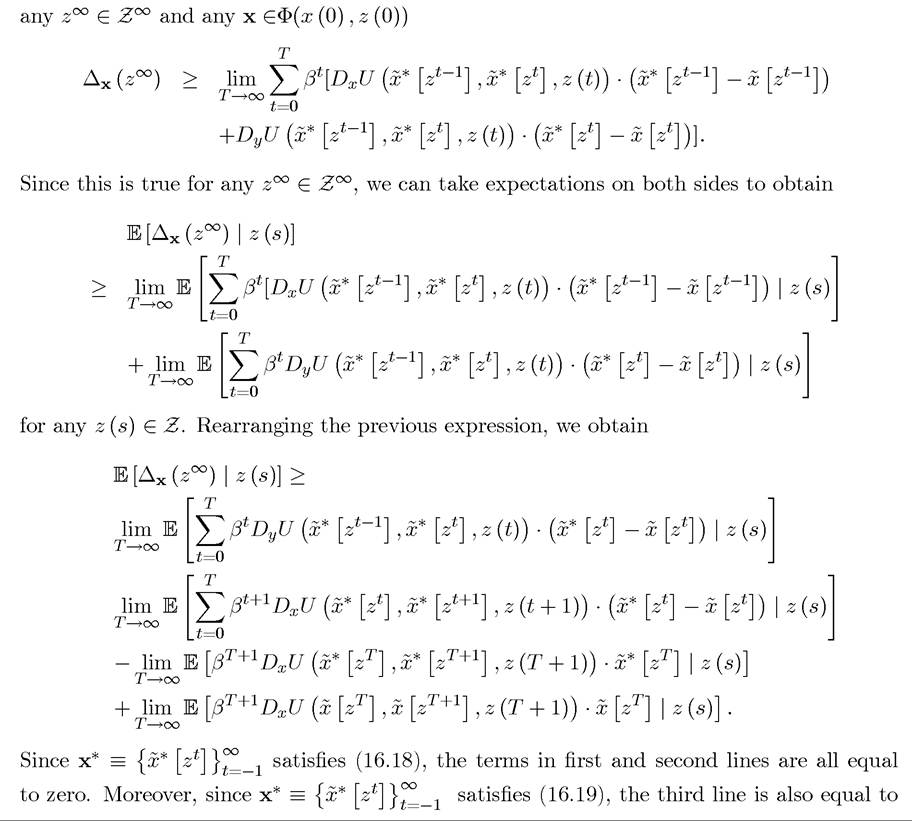 628
628

16.4.