The Behavior of Unemployed Job Seekers
Equations (18.8) and (18.17) do not suffice to determine the three endogenous variables u, w, and θ. To determine the real wage, we must now examine the behavior of prospective workers (i.e., the unemployed job seekers).
The typical worker earns a real wage w when employed and is looking for a job when unemployed. For the duration of search, she has an instantaneous real income z, which depends on unemployment benefits and any other income or benefit from the use of free time. For simplicity, let us call z the unemployment benefit.
We define U and W as the corresponding present values of expected income for an unemployed and an employed worker, respectively.
18.4.1 The Permanent Income of an Unemployed Job Seeker
An unemployed job seeker has an instantaneous real income equal to z and an instantaneous probability of finding a job equal to θq(θ). As a result, the expected instantaneous income of an unemployed job seeker is equal to

From (18.19), the present value of the expected instantaneous income of an unemployed job seeker is defined by

The permanent income of an unemployed job seeker is thus given by

18.4.2 The Permanent Income of an Employed Worker
In contrast, an employed worker has an instantaneous real income w, the real wage, but at each instant also faces the risk of losing her job with probability λ. Therefore, the present value of her expected income W is equal to

From (18.22), the permanent income of an employed worker is thus equal to

18.4.3 Comparing the Permanent Income of the Employed and the Unemployed
Equations (18.21) and (18.23) can be solved for the permanent income of the unemployed and the employed:
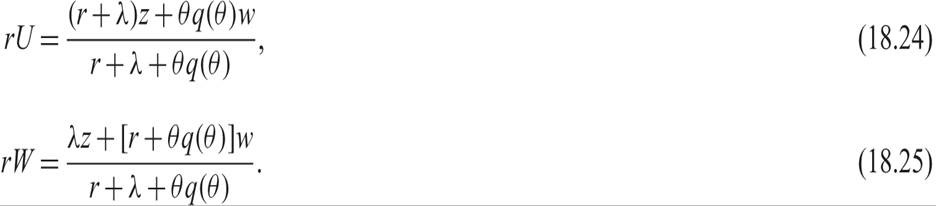
It is straightforward to see from (18.24) and (18.25) that if w ≥ z, then W ≥ U, and the permanent income of an employed worker cannot be lower than the permanent income of an unemployed job seeker.
In what follows, let us assume that w exceeds z, which indeed turns out to be the case in equilibrium.If w exceeds z, no employed worker has an incentive to leave their job voluntarily and become unemployed, while all the unemployed workers would accept any job offer at the prevailing real wage. If the condition w > z is satisfied, unemployment is involuntary. The present value of the expected income of an unemployed job seeker is lower that the present value of the expected income of an employed worker. This holds, even though the workers who are employed may, with some probability, lose their jobs and become unemployed. Thus, unlike the competitive real business cycle (RBC) model, unemployment is involuntary in this model, and the unemployed are worse off than the employed.
18.5