The Ben-Porath Model
The baseline Ben-Porath model enriches the model studied in the previous section by allowing human capital investments and non-trivial labor supply decisions throughout the lifetime of the individual.
In particular, we now let s (t) ∈ [0,1] for all t ≥ 0. Together with the Mincer eq. (10.12) (and the model underlying this equation presented in the previous section), the Ben-Porath model is the basis of much of labor economics. Here it is sufficient to consider a simple version of this model where the human capital accumulation equation, (10.2), takes the form
where δh > 0 captures “depreciation of human capital,” for example because new machines and techniques are being introduced, eroding the existing human capital of the worker. The individual starts with an initial value of human capital h (0) > 0. The function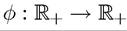 is strictly increasing, differentiable and strictly concave. Furthermore, let us simplify the
397
analysis by assuming that this function satisfies the Inada-type conditions,

The latter condition makes sure that we do not have to impose additional constraints to ensure s (t) ∈ [0,1] (see Exercise 10.6).
Let us also suppose that there is no non-human capital component of labor, so that ω (t) = 0 for all t, that T = ∞, and that there is a flow rate of death v > 0. Finally, let us assume that the wage per unit of human capital is constant at w and the interest rate is constant and equal to r. We also normalize w = 1 without loss of any generality.
Again using Theorem 10.1, human capital investments can be determined as a solution to the following problem

subject to (10.13).
Let us next set up the current-value Hamiltonian, which in this case takes the form

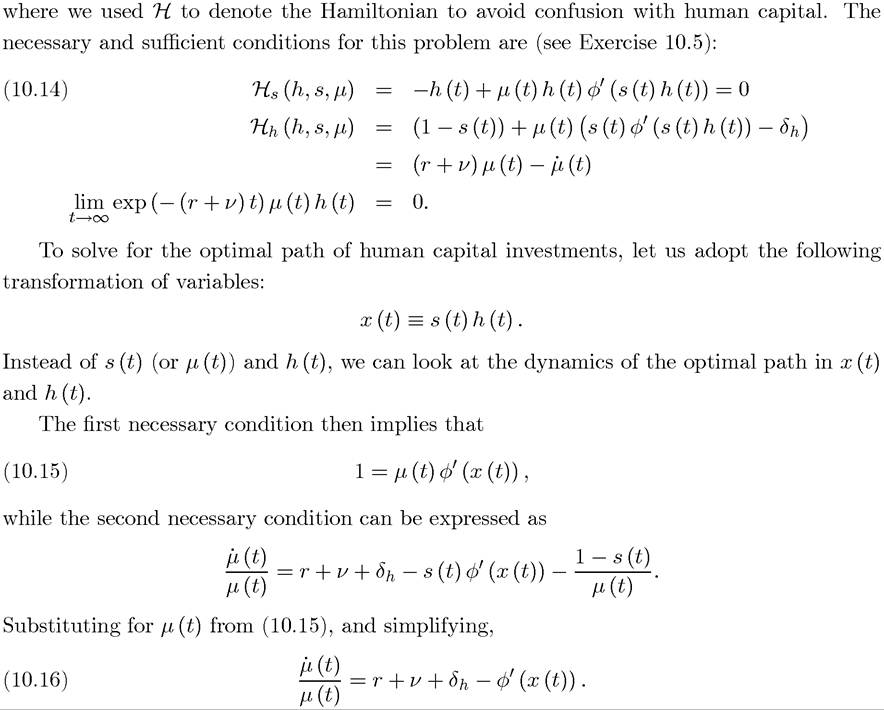

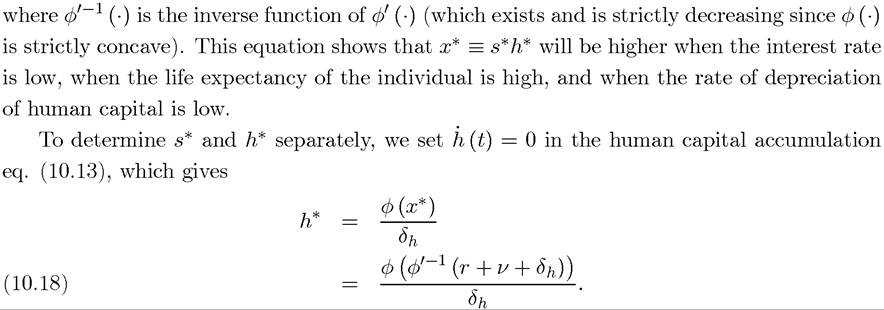
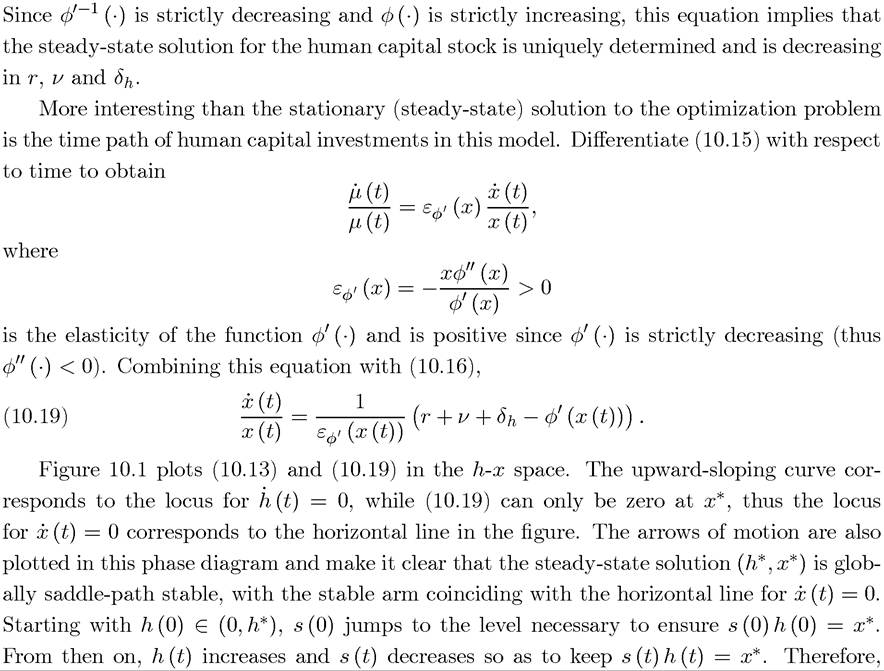
the pattern of human capital investments implied by the Ben-Porath model is one of high investment at the beginning of an individual’s life followed by lower investments later on.
In our simplified version of the Ben-Porath model this all happens smoothly. In the original Ben-Porath model, which involves the use of other inputs in the production of human capital and finite horizons, the constraint for s (t) ≤ 1 typically binds early on in the life of the
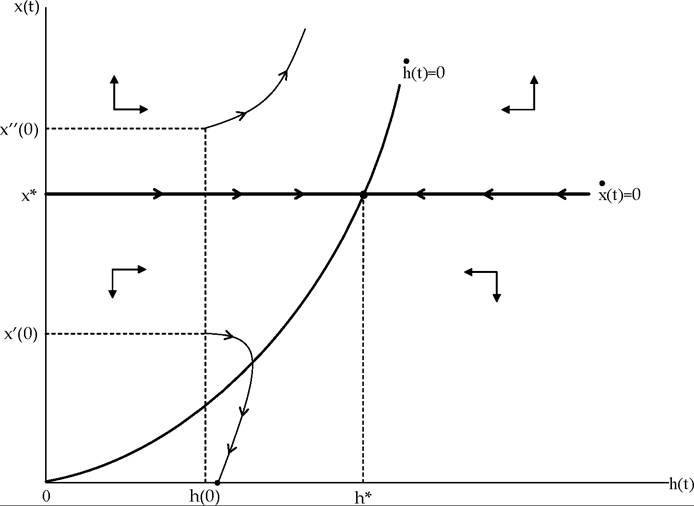
Figure 10.1. Steady state and equilibrium dynamics in the simplified Ben Porath model.
individual, and the interval during which s (t) = 1 can be interpreted as full-time schooling. After full-time schooling, the individual starts working (s (t) < 1). But even on-the-job, the individual continues to accumulate human capital (s (t) > 0), which can be interpreted as spending time in training programs or allocating some of his time on the job to learning rather than production. Moreover, because the horizon is finite, if the Inada conditions were relaxed, the individual could prefer to stop investing in human capital at some point. As a result, the time path of human capital generated by the standard Ben-Porath model may be hump-shaped, with a possibly declining portion at the end (see Exercise 10.7). Instead, the path of human capital (and the earning potential of the individual) in the current model is always increasing as shown in Figure 10.2.
The importance of the Ben-Porath model is twofold. First, it emphasizes that schooling is not the only way in which individuals can invest in human capital and there is a continuity between schooling investments and other investments in human capital. Second, it suggests that in societies where schooling investments are high we may also expect higher levels of on-the-job investments in human capital. Thus there may be systematic mismeasurement of the amount or the quality of human capital across societies.
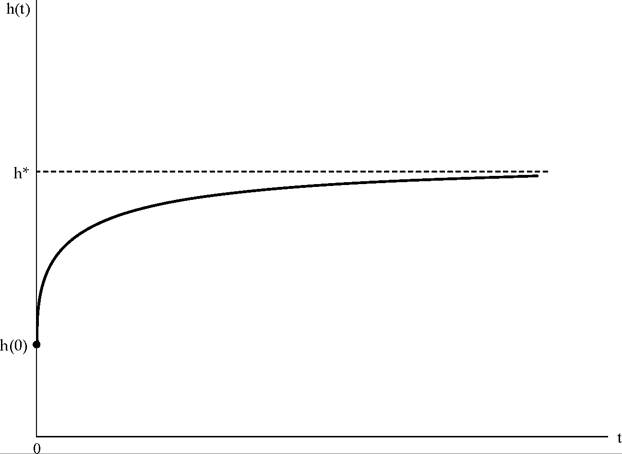
Figure 10.2. Time path of human capital investments in the simplified Ben Porath model.
10.2.