The Role of Policy
In the above model, the rate of growth of per capita consumption and output per worker (per capita) are determined exogenously, by the growth rate of labor-augmenting technological progress.
The level of income, on the other hand, depends on preferences, in particular, on the intertemporal elasticity of substitution, 1∕θ, the discount rate, ρ, the depreciation rate, δ, the population growth rate, n, and naturally the form of the production function f (∙).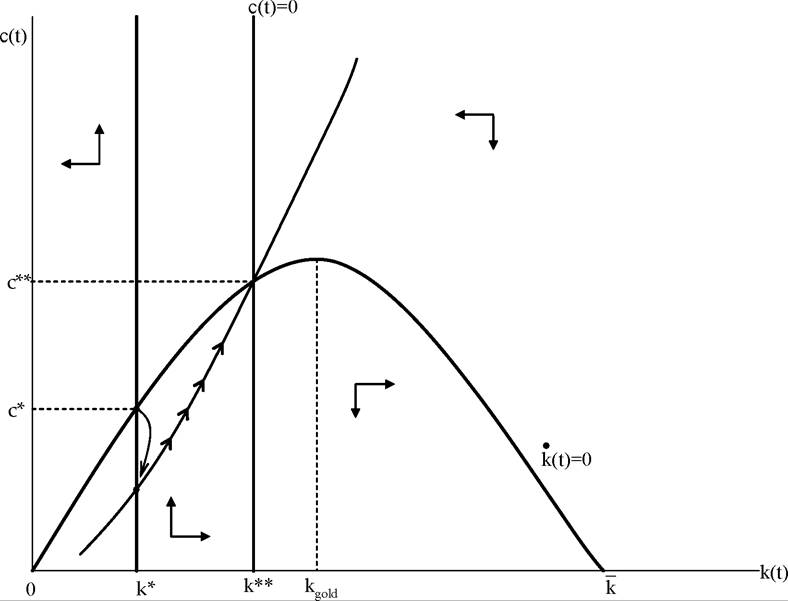
Figure 8.2. The dynamic response of capital and consumption to a decline in the discount rate from ρ to ρ' < p.
If we were to go back to the proximate causes of differences in income per capita of economic growth across countries, this model would give us a way of understanding those differences only in terms of preference and technology parameters. However, as already discussed in Chapter 4, and we would also like to link the proximate causes of economic growth to potential fundamental causes. The intertemporal elasticity of substitution and the discount rate can be viewed as potential determinants of economic growth related to cultural or geographic factors. However, an explanation for cross-country and over-time differences in economic growth based on differences or changes in preferences is unlikely to be satisfactory. A more appealing direction may be to link the incentives to accumulate physical capital (and later to accumulate human capital and technology) to the institutional environment of an economy. We will discuss how institutions might affect various investment decisions in detail in Part 8 of the book. For now, it is useful to focus on a particularly simple way in which institutional differences might affect investment decisions, which is through differences in policies.
To do this, let us extend the above framework in a simple way and introduce 331linear tax policy. Suppose that returns on capital net of depreciation are taxed at the rate τ and the proceeds of this are redistributed back to the consumers. In that case, the capital accumulation equation, in terms of normalized capital, still remains as above:

but the net interest rate faced by households now changes to:

because of the taxation of capital returns. The growth rate of normalized consumption is then obtained from the consumer Euler equation, (8.31), as
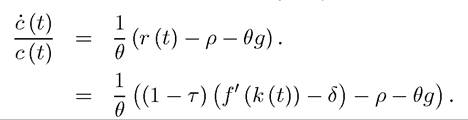
An identical argument to that we have used above immediately implies that the steady-state capital to effective labor ratio is given by
(8.37)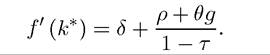
This equation shows the effects of taxes on steady-state capital tp effective labor ratio and output per capita. A higher tax rate τ increases the right-hand side of (8.37), and since from Assumption Therefore, higher taxes on
capital have the effect of depressing capital accumulation and reducing income per capita. This shows one channel through which policy (thus institutional) differences might affect economic performance. We can also note that similar results would be obtained if instead of taxes being imposed on returns from capital, they were imposed on the amount of investment (see next section). Naturally, we have not so far offered a reason why some countries may tax capital at a higher rate than others, which is again a topic that will be discussed later. Before doing this, in the next section we will also discuss how large these effects can be and whether they could account for the differences in cross-country incomes.
8.9.