Transitional Dynamics in the DiscreteTime Solow Model
Proposition 2.2 establishes the existence of a unique steady-state equilibrium (with positive activity). Recall, however, that an equilibrium path does not refer simply to the steady state, but to the entire path of capital stock, output, consumption and factor prices.
This 50is an important point to bear in mind, especially since the term “equilibrium” is used differently in economics than in physical sciences. Typically, in engineering and physical sciences, an equilibrium refers to a point of rest of a dynamical system, thus to what we have so far referred to as the steady state equilibrium. One may then be tempted to say that the system is in “disequilibrium” when it is away from the steady state. However, in economics, the nonsteady-state behavior of an economy is also governed by optimizing behavior of households and firms and market clearing. Most economies spend much of their time in non-steady-state situations. Thus we are typically interested in the entire dynamic equilibrium path of the economy, not just its steady state.
To determine what the equilibrium path of our simple economy looks like we need to study the “transitional dynamics” of the equilibrium difference equation (2.16) starting from an arbitrary capital-labor ratio, k (0) > 0. Of special interest is the answer to the question of whether the economy will tend to this steady state starting from an arbitrary capitallabor ratio, and how it will behave along the transition path. It is important to consider an arbitrary capital-labor ratio, since, as noted above, the total amount of capital at the beginning of the economy, K (0), is taken as a state variable, while for now, the supply of labor L is fixed. Therefore, at time t = 0, the economy starts with k (0) = K (0) /L as its initial value and then follows the law of motion given by the difference equation (2.16).
Thus the question is whether the difference equation (2.16) will take us to the unique steady state starting from an arbitrary initial capital-labor ratio.Before doing this, recall some definitions and key results from the theory of dynamical systems. Consider the nonlinear system of autonomous difference equations,

Such a x* is sometimes referred to as “an equilibrium point” of the difference equation (2.23). Since in economics, equilibrium has a different meaning, we will refer to x* as a stationary point or a steady state of (2.23). We will often make use of the stability properties of the steady states of systems of difference equations. The relevant notion of stability is introduced in the next definition.

51
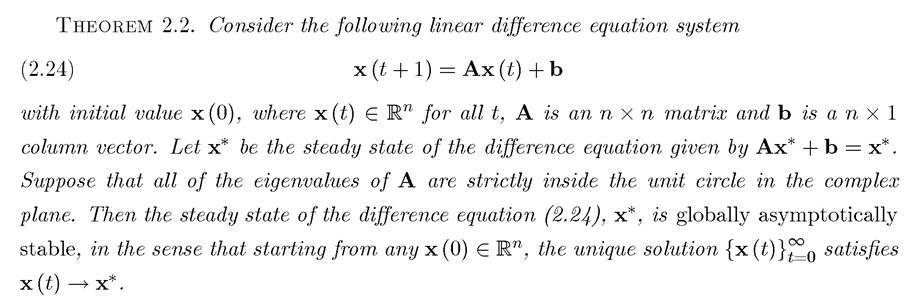
The next theorem provides the main results on the stability properties of systems of linear difference equations. The Chapter B in the Appendix contains an overview of eigenvalues and some other properties of differential equations, which are also relevant for difference equations. Definitions and certain elementary results the matrix of partial derivatives (the Jacobian), which we will use below, are provided in Appendix Chapter A. The following theorems are special cases of the results presented in Appendix Chapter B.
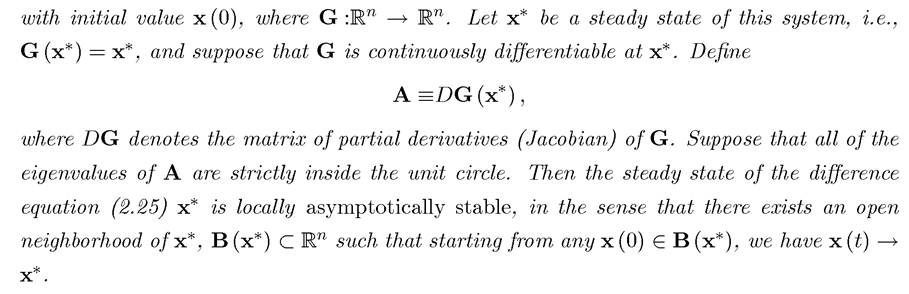
Next let us return to the nonlinear autonomous system (2.23). Unfortunately, much less can be said about nonlinear systems, but the following is a standard local stability result (see Appendix Chapter B).
Theorem 2.3. Consider the following nonlinear autonomous system
(2.25)
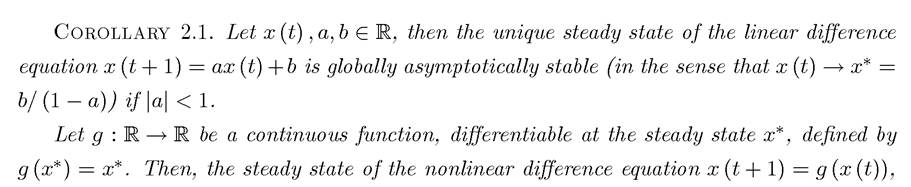
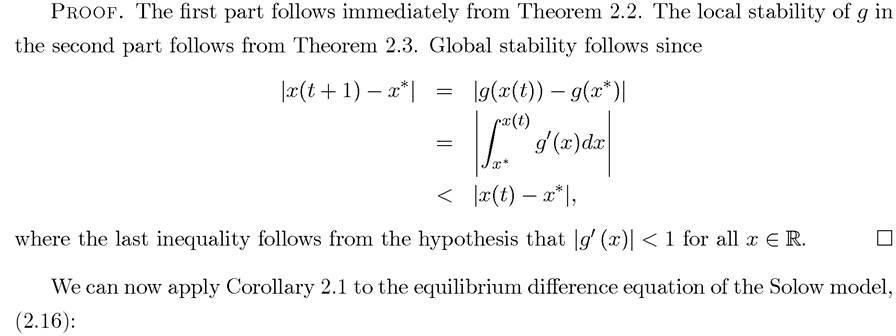
An immediate corollary of Theorem 2.3 the following useful result:
52

PROPOSITION 2.5.
Suppose that Assumptions 1 and 2 hold, then the steady-state equilibrium of the Solow growth model described by the difference equation (2.16) is globally asymptotically stable, and starting from any k (0) > 0, k (t) monotonically converges to k*.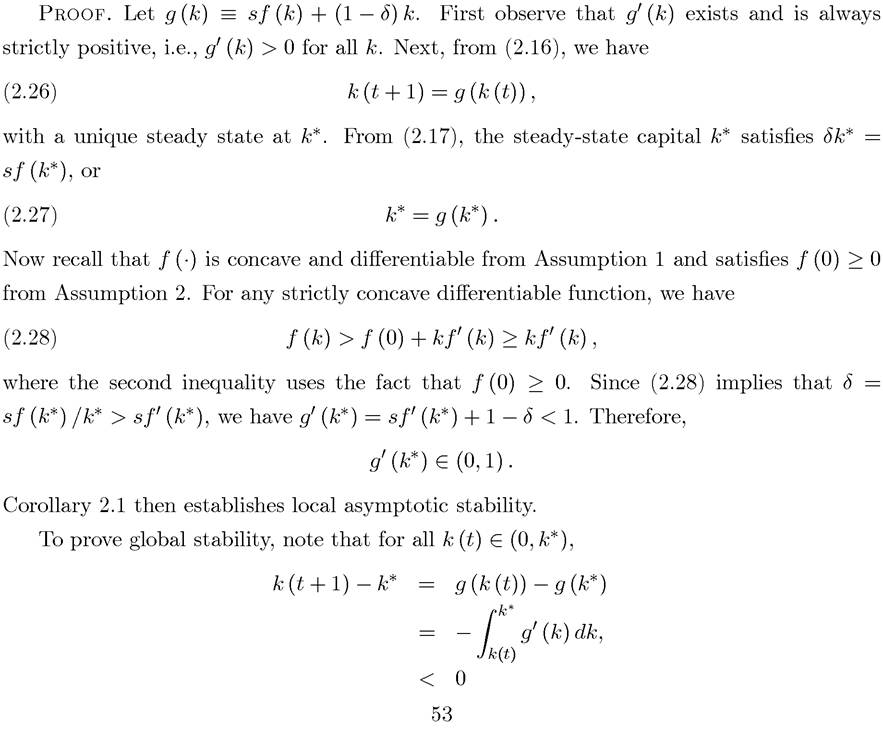
where the first line follows by subtracting (2.27) from (2.26), the second line uses the fundamental theorem of calculus, and the third line follows from the observation that g' (k) > 0 for all k. Next, (2.16) also implies
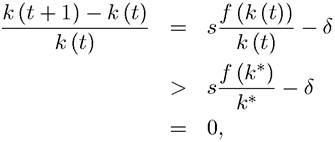
where the second line uses the fact that f (k) /k is decreasing in k (from (2.28) above) and

This stability result can be seen diagrammatically in Figure 2.7. Starting from initial capital stock k (0), which is below the steady-state level k*, the economy grows towards k* and the economy experiences capital deepening—meaning that the capital-labor ratio will increase. Together with capital deepening comes growth of per capita income. If, instead, the economy were to start with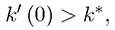 it would reach the steady state by decumulating
capital and contracting (i.e., negative growth).
The following proposition is an immediate corollary of Proposition 2.5:

Proof. See Exercise 2.7. ?
Recall that when the economy starts with too little capital relative to its labor supply, the capital-labor ratio will increase. This implies that the marginal product of capital will fall due to diminishing returns to capital, and the wage rate will increase. Conversely, if it starts with too much capital, it will decumulate capital, and in the process the wage rate will decline and the rate of return to capital will increase.
The analysis has established that the Solow growth model has a number of nice properties; unique steady state, asymptotic stability, and finally, simple and intuitive comparative statics. Yet, so far, it has no growth. The steady state is the point at which there is no growth in the capital-labor ratio, no more capital deepening and no growth in output per capita. Consequently, the basic Solow model (without technological progress) can only generate economic growth along the transition path when the economy starts with k (0) < к*. This growth is not sustained, however: it slows down over time and eventually comes to 54
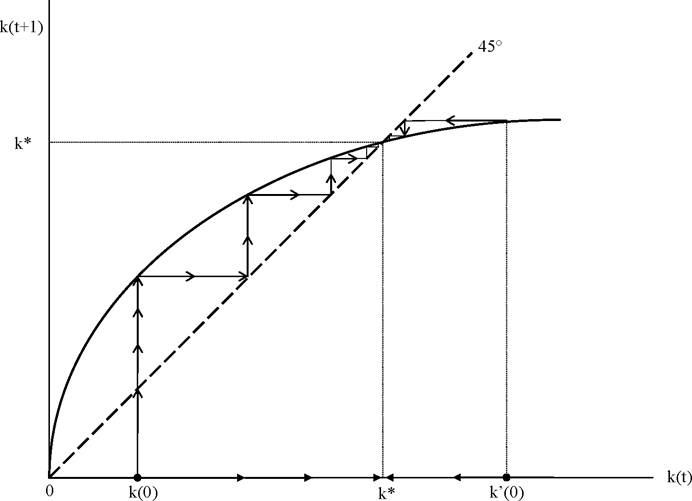
Figure 2.7. Transitional dynamics in the basic Solow model.
an end. We will see in Section 2.6 that the Solow model can incorporate economic growth by allowing exogenous technological change. Before doing this, it is useful to look at the relationship between the discrete-time and continuous-time formulations.
2.4.