The Solow Model in Continuous Time
2.4.1. From Difference to Differential Equations. Recall that the time periods could refer to days, weeks, months or years. In some sense, the time unit is not important. This suggests that perhaps it may be more convenient to look at dynamics by making the time unit as small as possible, i.e., by going to continuous time.
While much of modern macroeconomics (outside of growth theory) uses discrete time models, many growth models are formulated in continuous time. The continuous time setup in general has a number of advantages, since some pathological results of discrete time disappear in continuous time (see Exercise 2.14). Moreover, continuous time models have more flexibility in the analysis of dynamics and allow explicit-form solutions in a wider set of circumstances. These considerations motivate a detailed study of both the discrete-time and the continuous-time versions of the basic models.Let ns start with a simple difference equation

This equation states that between time t and t + 1, the absolute growth in x is given by g (x (t)). Let us now consider the following approximation

for any ∆t ∈ [0,1]. When ∆t = 0, this equation is just an identity. When ∆t = 1,it gives (2.29). In-between it is a linear approximation, which should not be too bad if the distance

(however, you should also convince yourself that this approximation could in fact be quite bad if you take a very nonlinear function g, for which the behavior changes significantly between x (t) and x (t + 1)). Now divide both sides of this equation by ∆t, and take limits to obtain

where throughout the book we use the “dot” notation
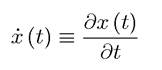
to denote time derivatives.
Equation (2.30) is a differential equation representing the same dynamics as the difference equation (2.29) for the case in which the distance between t and t + 1 is “small”.2.4.2. The Fundamental Equation of the Solow Model in Continuous Time. We can now repeat all of the analysis so far using the continuous time representation. Nothing has changed on the production side, so we continue to have (2.5) and (2.6) as the factor prices, but now these refer to instantaneous rental rates (i.e., w (t) is the flow of wages that the worker

while consumption is given by (2.10) above.
Let us now introduce population growth into this model for the first time, and assume that the labor force L (t) grows proportionally, i.e.,

The purpose of doing so is that in many of the classical analyses of economic growth, population growth plays an important role, so it is useful to see how it affects things here. We are not introducing technological progress yet, which will be done in the next section.

which implies that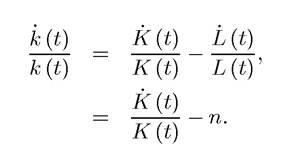
From the limiting argument leading to equation (2.30) in the previous subsection, the law of motion of the capital stock is given by

Now using the definition of k (t) as the capital-labor ratio and the constant returns to scale properties of the production function, we obtain the fundamental law of motion of the Solow model in continuous time for the capital-labor ratio as

where, following usual practice, we wrote the proportional change in the capital-labor ratio on the left-hand side by dividing both sides by k (t).3
Definition 2.5. In the basic Solow model in continuous time with population growth at the rate n, no technological progress and an initial capital stock K (0), an equilibrium path is  by (2.5) and (2.6).
As before, a steady-state equilibrium involves k (t) remaining constant at some level k*.
It is easy to verify that the equilibrium differential equation (2.32) has a unique steady state at k*, which is given by a slight modification of (2.17) above to incorporate population growth:

In other words, going from discrete to continuous time has not changed any of the basic economic features of the model, and again the steady state can be plotted in diagram similar to the one used above (now with the population growth rate featuring in there as well). This is done in Figure 2.8, which also highlights that the logic of the steady state is the same with population growth as it was without population growth. The amount of investment, sf (k), is used to replenish the capital-labor ratio, but now there are two reasons for replenishments.

We still have a fraction δ of the capital stock depreciating. In addition, the capital stock of the economy also has to increase as population grows in order to maintain the capital-labor ratio constant. The amount of capital that needs to be replenished is therefore (n + δ) k.
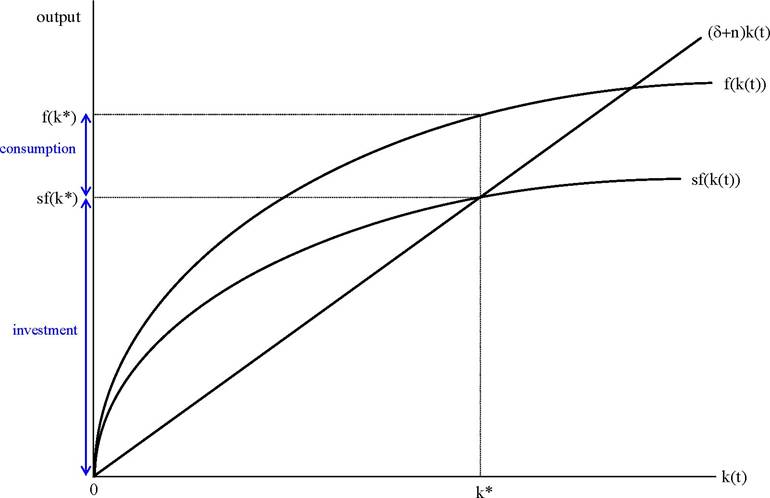
FIGURE 2.8. Investment and consumption in the state-state equilibrium with population growth.
Therefore we have:
PROPOSITION 2.7. Consider the basic Solow growth model in continuous time and suppose that Assumptions 1 and 2 hold. Then there exists a unique steady state equilibrium where the capital-labor ratio is equal to k* ∈ (0, ∞) and is given by (2.33), per capita output is given by 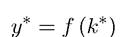 and per capita consumption is given by

Proof.
See Exercise 2.3. ?Moreover, again defining f (k) = af (k), we obtain:
58
PROPOSITION 2.8. Suppose Assumptions 1 and 2 hold and f (k) = af (k). Denote the steady-state equilibrium level of the capital-labor ratio by k* (a, s, δ, n) and the steady-state level of output by y* (a, s, δ, n) when the underlying parameters are given by a, s and δ. Then we have

Proof. See Exercise 2.4. ?
The new result relative to the earlier comparative static proposition is that now a higher population growth rate, n, also reduces the capital-labor ratio and output per capita. The reason for this is simple: a higher population growth rate means there is more labor to use the existing amount of capital, which only accumulates slowly, and consequently the equilibrium capital-labor ratio ends up lower. This result implies that countries with higher population growth rates will have lower incomes per person (or per worker).
2.5.
More on the topic The Solow Model in Continuous Time:
- Solow Model and Regression Analyses
- Comparative Dynamics
- We are now ready to start our analysis of the standard neoclassical growth model (also known as the Ramsey or Cass-Koopmans model).
- We are now ready to start our analysis of the standard neoclassical growth model (also known as the Ramsey or Cass-Koopmans model).
- A key feature of the neoclassical growth model analyzed in the previous chapter is that it admits a representative household.
- The representative household model is based on the assumption that all households are identical and that they internalize the welfare of future generations.
- Conclusion
- Taking Stock
- References and Literature
- This part of the book is a preparation for what is going to come next. In some sense, it can be viewed as the “preliminaries” for the rest of the book.