What Is a Business Cycle?
Define and describe the business cycle.
Countries have experienced ups and downs in overall economic activity since they began to industrialize. Economists have measured and studied these fluctuations for more than a century.
Marx and Engels referred to "commercial crises," an early term for business cycles, in their Communist Manifesto in 1848. In the United States, the National Bureau of Economic Research (NBER), a private nonprofit organization of economists founded in 1920, pioneered business cycle research. The NBER developed and continues to update the business cycle chronology, a detailed history of business cycles in the United States and other countries. The NBER has also sponsored many studies of the business cycle: One landmark study was the 1946 book Measuring Business Cycles, by Arthur Burns (who served as Federal Reserve chairman from 1970 until 1978) and Wesley Mitchell (a principal founder of the NBER). This work was among the first to document and analyze the empirical facts about business cycles. It begins with the following definition:Business cycles are a type of fluctuation found in the aggregate economic activity of nations that organize their work mainly in business enterprises. A cycle consists of expansions occurring at about the same time in many economic activities, followed by similarly general recessions, contractions, and revivals which merge into the expansion phase of the next cycle; this sequence of changes is recurrent but not periodic; in duration business cycles vary from more than one year to ten or twelve years.[128]
Five points in this definition should be clarified and emphasized.
1. Aggregate economic activity. Business cycles are defined broadly as fluctuations of "aggregate economic activity" rather than as fluctuations in a single, specific economic variable such as real GDP.
Although real GDP may be the single variable that most closely measures aggregate economic activity, Burns and Mitchell also thought it important to look at other indicators of activity, such as employment and financial market variables.2. Expansions and contractions. Figure 8.1—a diagram of a typical business cycle—helps explain what Burns and Mitchell meant by expansions and contractions. The dashed line shows the average, or normal, growth path of aggregate economic activity, as determined by the factors we considered in Chapter 6. The solid curve shows the rises and falls of actual economic activity. The period of time during which aggregate economic activity is falling is a contraction or recession. If the recession is particularly severe, it becomes a depression. After reaching the low point of the contraction, the trough (rT), aggregate economic activity begins to increase. The period of time during which aggregate economic activity grows is an expansion or a boom. After reaching the high point of the expansion, the peak (P), aggregate economic activity begins to decline again. The entire sequence of decline followed by recovery, measured from peak to peak or trough to trough, is a business cycle.
Figure 8.1 suggests that business cycles are purely temporary deviations from the economy's normal growth path. However, part of the output losses and gains that occur during a business cycle may become permanent.
Peaks and troughs in the business cycle are known collectively as turning points. One goal of business cycle research is to identify when turning points
FIGURE 8.1
A business cycle
The solid curve graphs the behavior of aggregate economic activity over a typical business cycle. The dashed line shows the economy's normal growth path. During a contraction aggregate economic activity falls until it reaches a trough, T. The trough is followed by an expansion during which economic activity increases until it reaches a peak, P.
A complete cycle is measured from peak to peak or trough to trough.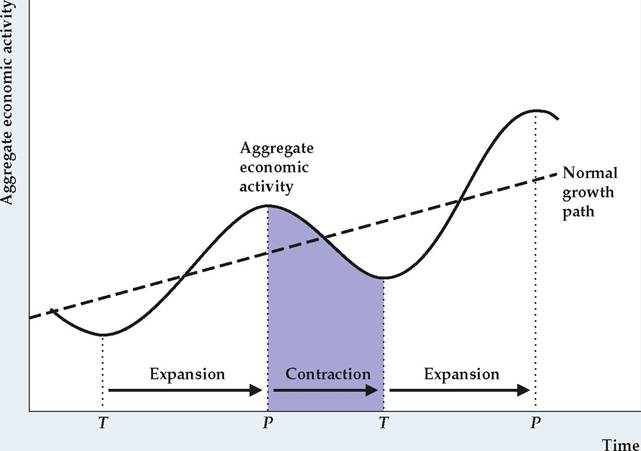
occur. Aggregate economic activity isn't measured directly by any single variable, so there's no simple formula that tells economists when a peak or trough has been reached.[129] In practice, a small group of economists who form the NBER's Business Cycle Dating Committee determine that date. The committee meets only when its members believe that a turning point may have occurred. By examining a variety of economic data, the committee determines whether a peak or trough has been reached and, if so, the month it happened. However, the committee's announcements usually come well after a peak or trough occurs, so their judgments are more useful for historical analysis of business cycles than as a guide to current policymaking.
3. Comovement. Business cycles do not occur in just a few sectors or in just a few economic variables. Instead, expansions or contractions "occur at about the same time in many economic activities." Thus, although some industries are more sensitive to the business cycle than others, output and employment in most industries tend to fall in recessions and rise in expansions. Many other economic variables, such as prices, productivity, investment, and government purchases, also have regular and predictable patterns of behavior over the course of the business cycle. The tendency of many economic variables to move together in a predictable way over the business cycle is called comovement.
4. Recurrent but not periodic. The business cycle isn't periodic, in that it does not occur at regular, predictable intervals and doesn't last for a fixed or predetermined length of time. ("In Touch with Data and Research: The Seasonal Cycle and the Business Cycle," discusses the seasonal cycle—or economic fluctuations over the seasons of the year—which, unlike the business cycle, is periodic.) Although the business cycle isn't periodic, it is recurrent; that is, the standard pattern of contraction-trough-expansion-peak recurs again and again in industrial economies.
5. Persistence. The duration of a complete business cycle can vary greatly, from about a year to more than a decade, and predicting it is extremely difficult. However, once a recession begins, the economy tends to keep contracting for a period of time, perhaps for a year or more. Similarly, an expansion, once begun, usually lasts a while. This tendency for declines in economic activity to be followed by further declines, and for growth in economic activity to be followed by more growth, is called persistence. Because movements in economic activity have some persistence, economic forecasters are always on the lookout for turning points, which are likely to indicate a change in the direction of economic activity.
8.2