Article 7.5 Islamic finance: by the book
By Robin Wigglesworth
Financial Times May 25, 2014
London wants to be a global centre in the fast-growing industry despite fierce competition.
This spring, a clutch of politicians, civil service mandarins, bankers and overseas dignitaries gathered in the gilded halls of the UK Foreign Office's Lancaster House in west London.
Unusually for such a gathering, there was not a glass of wine in sight.For this was a reception designed to celebrate London's credentials as an aspiring hub for Islamic finance - a niche but fast-growing industry that meshes modern capitalism with Muslim religious principles. The speeches were brief and toasted with glasses of still water and mango juice rather than alcohol from the Foreign Office's cellars. The reception was interrupted briefly for evening prayers in an adjoining room prepared for the occasion.
The UK government last year announced plans to become the first western country to issue an Islamic bond, or sukuk - a security structured to adhere to the Muslim prohibition on interest. For industry insiders, it was further confirmation that Islamic finance had arrived.
‘The UK is one of the world's biggest and most established economies, and it is saying Islamic finance is good to go,' says Afaq Khan, head of Saadiq, Standard Chartered's Islamic arm. ‘It's a vote of confidence and sends the signal that the UK is open to Islamic finance.'
Some sceptics may blanch at the government rolling the red carpet out for a little- understood industry that adheres to sharia, or Islamic, law. Yet the attractions are obvious. From humble beginnings just a few decades ago, the global Islamic finance industry is expected to hit $2tn this year - extending to banks, mutual funds, insurance, private equity and even some (contentious) hedge funds.
The gambit is part of a wider government strategy to ensure that the City of London continues to enjoy its lucrative but sometimes contentious status as a freewheeling
entrepot for global finance in the 21st century.
Bolstering Islamic finance is an important aspect of this, especially if, as the government hopes, it triggers an accompanying wave of investment from appreciative Muslim countries and financiers.The UK is stepping into a crowded field, however. The biggest Islamic finance markets are Malaysia, Iran and Saudi Arabia. But Iran is in effect cut off from the rest of the industry by international sanctions and different sharia interpretations, leaving the other two centres as the leading powerhouses.
Saudi Arabia and Malaysia have the size and depth to act as regional centres of gravity for the Middle East and Asia, and aspirations to lead the global industry.
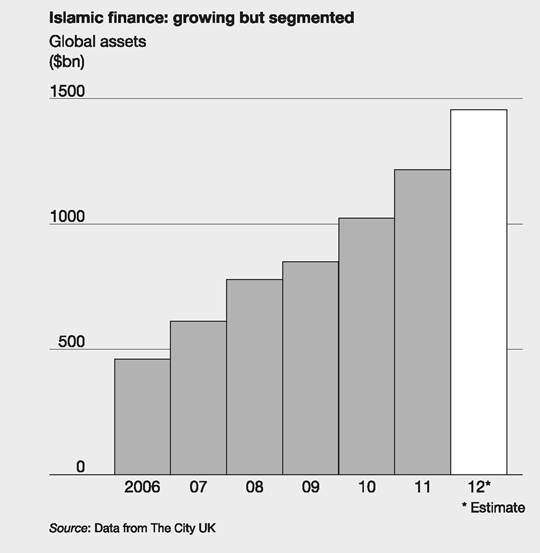
Then there are established offshore hubs, led by Bahrain - one of the industry’s pioneers - but with ambitious Dubai increasingly asserting itself. Bahrain has a head start, but Dubai has already stolen its crown as the Middle East’s financial centre and hopes to become the capital of the emerging ‘Islamic economy’ as well.
London is the leading western centre but Luxembourg, Hong Kong and South Africa are now competing with the UK to become the first non-Islamic country to issue a sovereign sukuk to make themselves stand out.
Several factors came together to nurture an industry now courted by a host of countries. Growth came quickly after devout Arab merchants established a handful of Islamic banks in the 1970s and 1980s, with many Muslims attracted to the promise of having access to financial services without breaking their religious principles. Malaysia began promoting Islamic finance after setting up its sharia- compliant financial institution in 1983.
Essentially, bankers, lawyers and clerics who are well versed in Islam's financial tenets work together to use one or a combination of permissible concepts in sharia to get around bans on fixed interest rates and pure monetary speculation. They also need to fulfil injunctions for real assets to back transactions and for profit-and-loss sharing investments.
Still, the industry has its detractors. Some Muslim critics feel it is merely a means to give conventional finance a veneer of sharia, following the letter of Islamic law rather than its spirit.
Critics charge that the industry fails in the area that some proponents like to hold up as its prime selling point: Islam's injunction for profit-and-loss sharing equity investments, rather than usurious debt. In practice, however, Islamic finance often deviates little from its conventional counterpart.
Tarek El Diwany, a derivatives trader turned Islamic finance proselyte, is a particularly fierce critic of the modern industry. He argues it has simply copied the institutional framework and products of conventional banking. ‘That's not just a failure of vision, it's often completely counter to the objectives of Islamic law,' he says.
Some proponents feel that Islamic finance has occasionally compromised its principles in its efforts to grow. That has led to periodic pushback from the ‘sharia scholars', the specialist clerics who act as guardians of the industry's religious foundations.
In 2007 Sheikh Muhammad Taqi Usmani, one of the most distinguished sharia scholars, indicated that some prominent sukuk structures strayed too far from the spirit of Islamic law. Briefly, ‘a cold sweat broke out across the industry', recalls Harris Irfan of EIIB-Rasmala, an Islamic investment bank, but standards were quickly tightened and growth was revived.
Many Muslims are simply agnostic on Islamic finance. Despite high hopes, Islamic retail banking has failed to take off in the UK, for example. Even in Egypt, a populous bastion of the Muslim world, the industry has failed to establish firm roots.
Western banks have also largely withdrawn after profitability disappointed. Most damningly, HSBC, which helped spearhead the industry's growth, decided to cut back its sharia-compliant Amanah arm two years ago, ending its retail services everywhere but Malaysia and Saudi Arabia.
While it remains active in Islamic investment banking, the diminution of Amanah was a blow to the wider industry.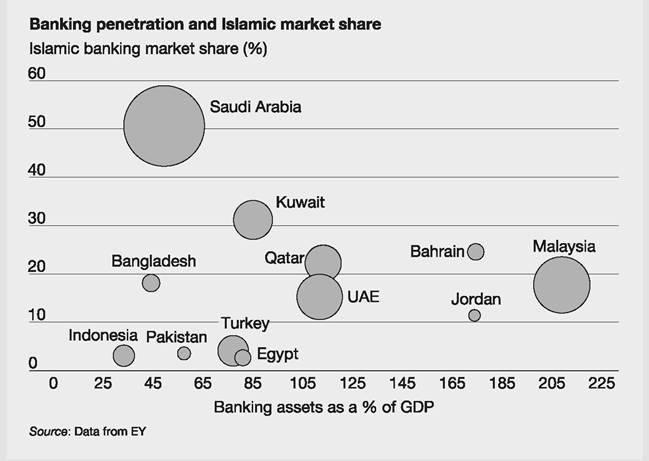
Source: Wigglesworth, R. (2014) Islamic finance: by the book, Financial Times, 25 May. © Financial Times Limited 2014
FT
As well as Shell, Tesco and Toyota have both issued ringgit sukuk (both musharakah) in Malaysia. In a further development in November 2009, General Electric (GE) became the first large western corporation to expand its investor base into this arena with the issuance of its $500 million ijarah sukuk. The assets underlying this sukuk are GE's interests in aircraft and rental payments from aircraft leasing. The London Shard building was partly financed with sharia-compliant funds. As the importance of Islamic finance grows, it is thought that more European and US companies will enter this market and tap the vast investment resources available. The UK government raised £200 million by issuing a sukuk in 2014, hoping that this would be a catalyst for corporates to follow suit. Being the first western country to do so has helped to reinforce London's position as the dominant western hub for Islamic finance. As well as Islamic banks it already has Islamic insurance, murabaha for commodities, mortgages, car loans and a secondary market for sukuk. Many other countries are expected to issue their first sukuk soon - see Article 7.6.