Certificates of deposit (CDs)
In some places CDs are issued at face value and interest is charged on them, so that at maturity the holder will receive the face value plus interest. In other places the value at maturity is called the face value.
Example 14.11
Certificate of deposit
A £75,000 CD is issued on 15 March for two months at 1.04% (expressed as an annual rate, even though the money is deposited for a mere two months, often called the coupon rate). Using an actual/365-day count, this means that the holder will receive the following at maturity, including accumulated interest:

If the CD is sold to another investor with 16 days left to maturity, its present value (at the time of sale) if annual rates of interest on 16-day CDs are 1.04% is:
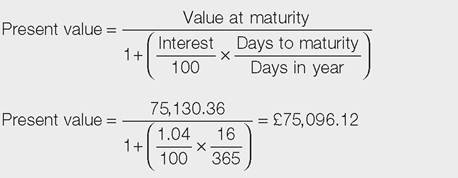
Thus, the second holder of the CD will pay £75,096.12 now and receive £75,130.36 from the holder if they keep it for another 16 days.
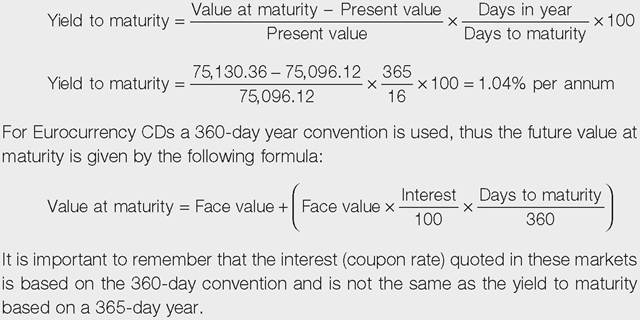
The annualised yield to maturity of this CD held for 16 days is:
Example 14.12
Eurocurrency CD
If the quoted rate based on a 360-day year is 3% for a CD with a present value of $10 million with 92 days to maturity, the value at maturity is: 