CHAPTER FIVE The Beginnings of a Modern Administrative State
In Barnum's America, the sanctions associated with antifraud statutes and common-law proscriptions constrained dishonest business practices only lightly. But from the Civil War through the 1920s, waxing concerns about deceptions and frauds prompted bureaucratic innovation.
Much of this experimentation occurred inside the divided American state, on both the state and national levels, but a good deal of it also took place within several new quasipublic or nongovernmental organizations that possessed close affiliations to the business establishment. The next four chapters trace the emergence of new antifraud regulations that further confined the impulses of caveat emptor, as well as the construction of new institutions dedicated to combating economic duplicity.Chapter Five begins this exploration with a survey of government antifraud efforts. In some contexts, including the oversight of Civil War military contracting or postbellum grain marketing, battles against fraud drew on longstanding strategies of public inspection. But in other domains, such as fertilizer regulation, supervision of corporate accounting and securities marketing, the Post Office's efforts to stem the tide of mail fraud, and the broad arena of advertising regulation, policymakers fashioned transformations in administrative governance. Before the early twentieth century, these endeavors remained patchy, leaving large swaths of commercial speech regulated chiefly by informal public discourse. A few regulatory initiatives also ran into the judicial buzz saw of Gilded Age constitutionalism. Nonetheless, these antifraud policies helped to lay the groundwork for the modern American regulatory state, predicated on technocratic expertise rather than artisanal rules of thumb.
Ambitious would-be regulators tended to loom large as architects of the new antifraud institutions.
They not only conceptualized potential institutional strategies, but also cobbled together political constituencies to bring their plans to fruition. In at least some cases, such as the creation of mail fraud as a new legal category, regulatory entrepreneurs were motivated as much by a desire to vindicate the reputation of their organizations or emerging professions as they were by any broader economic or moral objectives. In others, such as fertilizer regulation, reforms depended on scientific advances that made regulatory schemes feasible.Antifraud initiatives in the late nineteenth and early twentieth centuries sought to address problems created by wrenching processes of industrialization. An integrated national economy generated a higher percentage of commercial and financial transactions taking place at a distance, often between strangers. With an ever more dense web of railroad tracks, telegraph lines, and eventually radio stations; with the related expansion of manufacturers and mercantile firms operating on a regional or continental basis; with the deepening of a national capital market and the emergence of mass advertising; with all of these forces remaking American livelihoods, parties to economic transactions more frequently confronted wide differences in access to economic information. Eastern investors who invested in a Western mining company after reading a prospectus, like rural consumers persuaded by a catalogue to place an order from a far-off distributor, had limited capacity to investigate the claims that convinced them to part with their money. Recognition of pervasive informational asymmetries encouraged adjustments in how the American state tried to resolve the tension between honoring entrepreneurial freedom and discouraging marketing practices that played fast and loose with the truth.
Such adjustments, however, did not resolve the dilemma of how to distinguish unacceptable deception from the pardonable exaggerations and enthusiastic dissembling that so often characterized efforts by new firms to establish a commercial foothold.
This enduring quandary has been especially prevalent in sectors at the forefront of economic change, where technological uncertainties abound, and norms about legitimate modes of competition have yet to be settled. Chapter Six examines this phenomenon and its implications for the enforcement of prohibitions against mail fraud, a process that sometimes depended at least as much on assessments of social respectability as it did on evaluation of candor in marketing techniques.Structural economic transformations, institutional inventiveness, and, in some contexts, advancements in scientific inquiry all were necessary preconditions for the emergence of new antifraud bureaucracies. The entrenchment of these institutions depended as well on the sponsorship of some influential group that viewed fraud as an ongoing threat to its interests or the moral health of the wider society. Chapter Seven homes in on this dynamic, focusing on a decades-long campaign by key figures in urban commercial communities to build a nationwide movement against deceptive business practices, centered on pleas for “Truth in Advertising.” In part, the leaders of this campaign sought statutory reforms, such as new state laws against false advertising and deceit in applications for commercial credit. They focused, however, on creating robust organizations of business self-regulation, none more important than a mushrooming network of Better Business Bureaus (BBBs). The BBBs built capacities for public education, monitoring, and enforcement that rivaled those of local, state, and even national authorities.
Whether inside, outside, or on the always-fuzzy boundary that separated the domains of American government from those of American society, late nineteenth- and early twentieth-century antifraud institutions fashioned tactics predicated on aggressive application of discretionary power. The practitioners of business fraud did not stop being an elusive bunch. They could set up shop quickly and move on to new territory whenever regulatory authorities gained a fix on them; they could adjust marketing campaigns to skirt specific enforcement actions; when confronting legal challenges, the more successful among them could and still did retain high-powered legal representation.
To make headway against commercial and financial deception, the new antifraud regulators turned to summary modes of enforcement, such as bans from the use of the mails. This flexing of administrative power in turn prompted angry complaints about how antifraud efforts violated longstanding principles of due process. Chapter Eight examines both the nature of these critiques and a series of reforms that tried to infuse antifraud regulation with greater procedural protections.To retrace these varied streams of American regulatory innovation and reaction is to confirm the strengths of several prevailing approaches to the study of political economy in the modern industrial world. The economic theory of politics and administrative regulation points to the pivotal role of interest groups in driving many antifraud initiatives.1 Ideas from within political science about bureaucratic entrepreneurship have great relevance for understanding the origins and evolution of much agricultural regulation, as well as the Post Office's decades-long campaign against mail fraud.2 Sociological analyses of business self-regulation suggest how the seriousness of private antifraud efforts depended on credible threats of governmental action.3 Historical analysis of social movements furnishes instructive tools for interpreting the early twentieth-century business community's wide-ranging embrace of “Truth in Advertising” as a rallying cry.4 But each of these conceptual approaches captures only some elements of modern America's multifaceted struggles with commercial and financial deceit.
Like the establishment of regulatory policies with regard to environmental issues, labor conditions, public health, and public morality, the construction of modern American regulatory institutions to fight business fraud was a messy, protracted affair.5 Occurring across many fronts over many decades, this process spawned diverse regulatory strategies, sometimes in fits and starts.
There are overarching patterns in this narrative, but readers will find no single grand theory of regulatory politics. Instead, they will encounter the historian’s penchant for methodological and conceptual scavenging—the borrowing of interpretive approaches that help to make sense of strands in a tangled past. Some patterns did tend to reappear across many of the tangles, though. As American business owners, consumers, investors, journalists, elected officials, and regulators grappled with the problem of commercial misrepresentation during the seven decades that followed the outbreak of the Civil War, they drew interrelated lessons about the centrality of confidence to modern capitalism. Healthy capitalist markets rested on widespread faith in the trustworthiness of commercial communication. That foundation of confidence, in turn, required broadly accepted communal norms about fair dealing, which had to adapt to the rapidly changing circumstances of capitalist innovation. And finally, this process of adaptation depended on a web of regulatory institutions, often public but, in the American case, often quasi-public or even private, that cultivated norms and gave them tangible meaning. Modern capitalism depended on a complex ecology of norms, standards, rules, laws, and the institutions that gave them life and force.Extending the Realm of Inspection and Licensing Regimes
During the frantic efforts to raise and equip armies following Fort Sumter, the Union war effort was hampered by wide-ranging contracting frauds. The biggest scandals involved the purchase from Northeastern manufacturers, at high prices, of poorly made uniforms, shoes, blankets, and tents that proved unequal to the demands of military conflict. These incidents led the New York Herald to popularize the term “shoddy” as a way to describe inferior goods. Other exposes revealed overpriced contracts for ships to transport goods from New York City to the Virginia front lines, for construction of fortifications in Missouri, for horses in Kentucky that turned out to be emaciated and diseased, and for adulterated foodstuffs.
Contracting problems resulted in part from state-based mobilization, which led to intense competition among purchasing agents. But in many instances military contracts were sweetheart deals arranged by longtime political operatives, without competitive bidding or the most cursory monitoring to ensure quality or fair value, and abetted by inspectors with close ties to suppliers.6As details of the cheats and swindles came to light through journalistic and legislative investigations, pressure for action intensified. Democratic politicians highlighted every instance of apparent Republican malfeasance, demanding an end to corruption.7 Well-established Northern manufacturers insisted that the rush to initiate military purchasing had disadvantaged them, allowing unprincipled contractors to bilk the government.8 Republican publications hurled editorial thunderbolts at the shameless “plunderers” who profited from deceptive practices as brave soldiers risked life and limb.9 Wartime antifraud discourse echoed longstanding complaints about the disreputable trickery of middlemen. One early (1862) poem that appeared in Harper’s Weekly cast contractors as “Leeches,” chronicling the perfidy of the sort who “loves his dear old country's flag, and Yankee Doodle Dandy / And so he shows his love for them / By selling poisoned brandy.”10
Amid the crisis of civil war, such critiques paved the way for stringent antifraud policies. The most draconian proposal called for trials of alleged fraudulent suppliers in military courts and imposition of the death penalty on those convicted. Despite popular support for this Napoleonic approach to military justice, it did not become law, partly out of concern that the prospect of such extreme penalties would complicate enforcement efforts.11 But the Lincoln administration did institute a series of auditing committees, which reexamined early supply contracts and imposed reductions on scores of contractors. During the winter of 1861-62, the US Army also consolidated and regularized military purchasing. It placed supply logistics in the hands of a professional Quartermaster Corps, whose purchasing agents and inspectors proved far less susceptible than politically appointed state agents to corruption and insider dealing. In addition to developing rigorous specifications for military supplies, the Corps required sealed bids and imposed payment discounts on deliveries of substandard goods.12
Aware of mounting public anger, Congress further enacted legislation in March 1863 “to prevent and punish Frauds upon the Government.” This statute gave informants the right to institute proceedings in federal court against military contractors they could show had made false claims, and to receive one-half of any funds or fines recovered through their evidence. It further defined all military suppliers as subject to the jurisdiction and terms of military justice, while exempting court-martialed contractors from capital punishment.13 Motivated by the desire to create a credible deterrent, military judge advocates initiated at least twenty prosecutions under this law in the final two years of the war, and used the threat of prosecution to force several contractors out of business. Northern publications hailed these attempts: after the first conviction under the 1863 law, the New York Times editorialized that “our prison doors gape for just such knaves.”14 They tended to gape only, however, for suppliers who lacked political connections and high social standing. When contractors with pull faced fraud allegations, they either avoided court-martial through some form of settlement or had guilty verdicts overturned through appeals.15
Civil War policies to thwart contracting swindles thus had some key features in common with antifraud law that had been prevalent in the United States since Independence. Like earlier state inspection regimes, wartime regulation of military contracting revolved around assessments of goods quality by public inspectors. Enforcement of the 1863 Frauds Act also continued the easy treatment of defendants with elite social status. But there was a significant departure as well. By placing authority in the hands of the Quartermaster Corps and a new group of military judicial advocates, Congress and the Department of War empowered a bureaucracy with an esprit de corps based on tough- minded opposition to fraud. In several arenas, the stresses associated with industrialization and the inventiveness of antifraud reformers encouraged even greater divergence from longstanding regulatory practices.
One crucial site of regulatory change involved the postbellum introduction of compulsory grain inspection in Illinois. Reform of the Chicago grain markets was driven by merchants, farmers, and city boosters. Members of this coalition worried about the private grading practices of the Chicago Board of Trade, which were both greatly influenced and easily evaded by grain warehouses. The operators of warehouses occupied a choke point in the grain trade, which they used to control the grading process. Critics alleged that numerous abuses resulted from this state of affairs, ranging from untrustworthy grading and weighing, to the use of inside information as a basis for commodity speculation, to the issuance of warehouse receipts far in excess of actual grain in storage. They also argued that the funny business occurring in Chicago grain elevators had undermined the confidence of Eastern and European buyers, leading to lost business and reduced prices. To restore the reputation of Chicago wheat and corn, the Illinois legislature enacted a comprehensive inspection law in 1871, acting under the instructions of the new 1870 state constitution. Although this statute furnished an initial definition of grades for all major grains in the Chicago market, it vested authority for implementing an inspection system in a new Railroad and Warehouse Commission. One of the first in a new breed of independent regulatory agencies, the Commission had responsibility to adjust grade definitions as needed, as well as power to appoint and oversee a corps of grain inspectors.16
Public grain inspection in Illinois became a basic element of the Midwest's economic infrastructure. By the mid-1870s, a department of more than thirty inspectors examined tens of millions of bushels of grain each year, assigning grades in accordance with the Railroad and Warehouse Commission's standards. One group performed “in-inspections,” as grain arrived at Chicago railroad depots, a second group “out-inspections,” as it left warehouses for points east. In 1877, merchants questioned grading decisions just 0.2 percent of the time, with only one-third of the appeals leading to revised grades. This approach to monitoring and quality certification restored Chicago's primacy as a transshipment center. The grading system stimulated trust among American and European purchasers, a development ratified by the adoption of Illinois grading standards by traders throughout the North Atlantic economy. As annual reports from the Railroad and Warehouse Commission documented, each year brought greater harvests to the city's grain elevators and warehouses. These results led Midwestern states to follow Illinois's lead, instituting independent agencies to regulate grain inspection.17
Despite the congratulatory tone of officialdom, day-to-day operations of state grain inspectors generated periodic grousing within the trade. According to many grain receivers, ambiguities in grade definitions still gave inspectors too much latitude. As the Chicago Tribune, a longtime advocate of public inspection, conceded in 1879,
the requirement that grain must be “reasonably clean” in order to obtain admission to a designated grade is open to a wide range of interpretation by different individuals and even the same individual at different times. The eating of an overdone steak at breakfast, or a wakeful hour during the night caused by a crying baby, may be sufficient to cause even an honest man to veer in his judgment of what is “reasonable” to the extent of two or three cents a bushel.
This observation conveyed a growing dissatisfaction with indefinite rules of thumb. Even if a grain inspector was not corrupt or a partisan hack—even if he was “an honest man”—his methods remained haphazard. The Tribune suggested that inspectors relied more on samples that indicated the minimum quality for a particular grade as a means of ensuring consistent judgments. One member of the state legislature took this impulse even further, calling for specification of the amount of moisture allowed for various grades, and scientific testing whenever shippers chose to appeal grading determinations.18
By the early 1880s, complaints intensified amid perceptions that upward adjustments in fees constituted an unjust tax on grain traders and that inspectors shifted their standards depending on market conditions. Extensive investigations by the Chicago Grain Receivers' Association and by a special 1881 state legislative committee led to charges similar to those that had bedeviled earlier American inspection bureaucracies. Many inspectors, critics alleged, lacked expertise in the grain markets; a former chief inspector had improperly pocketed over $23,000 in fees; the current chief inspector did not “possess any special knowledge of the grain business” and had treated the position mostly as a sinecure, furnishing weak oversight of the inspectorate. Although attempts by a rump faction of grain receivers to return inspection to the Board of Trade failed, the partisan 1885 appointment of an unqualified chief grain inspector led to renewed complaints about unjustified variations in grading, which threatened Chicago's “standing and... name before the world.”19
Late nineteenth-century debates in this area concerned not the question of whether to have state-mandated grain inspection, but rather how to ensure that inspection retained integrity and technical competence. Among grain dealers, support for the return of inspection authority to the Board of Trade remained strong throughout the 1880s, though the legislative clout of rural representatives precluded such a move. Two other common proposals were to give the Board of Trade a role in nominating a slate of potential candidates for chief inspector, and to impose “ ‘civil-service' rules” on the inspector corps—a move that Minnesota had taken in 1889.20 Illinois did not introduce civil service examinations as a basis for selecting grain inspectors until 1910, but as early as 1904, it created a “school of instruction for the inspectors,” which “by the use of type samples of the different... grades,” attempted “to instill in the [inspectors'] minds a greater degree of uniformity and accuracy.” The inspectorate further implemented a system in which track inspectors took samples from railroad cars, and warehouse inspectors from shipments leaving grain elevators, and then brought them to a central office. This innovation facilitated rigorous comparison of samples by the most experienced inspectors, ensuring greater consistency in grading.21
The themes of professionalism, expertise, and bureaucratic system as checks on deceptive marketing emerged with even greater force in the movement to subject fertilizers to state inspection. Bogus commercial fertilizers plagued American farmers from the 1840s, when manufacturers began to produce phosphate-based products and merchants introduced Latin American guano. Assessment of the quality of a given batch of fertilizer depended on complex chemical analysis of its phosphate and nitrogen content, as well an appreciation for the applicability of chemical compositions to soil types. Without technical expertise, agricultural purchasers had little capacity to evaluate compounds for sale. These circumstances created openings for vendors of adulterated or spurious products. “The farmer,” Yale chemistry professor Samuel W. Johnson concluded in an 1855 lecture to the Connecticut State Agricultural Society, “is entirely at the mercy of the manufacturer, or dealer.”22
Outcry from farmers who had purchased worthless fertilizers led seaboard states to enact inspection laws for imported guano in the late 1840s and early 1850s. These statutes mandated that appointed seaport inspectors analyze samples from shipboard cargoes to ascertain their “per centage of ammonical and
phosphatic compounds,” and then publicize results. But inspection quality often proved to be poor, for most appointed inspectors “knew nothing of chemistry.” Early enforcement practices also proved easy for merchants to circumvent, either by adulterating guano after inspection or recycling used bags with an inspector’s mark. The rapid growth of domestic fertilizer manufacturing presented yet more regulatory challenges. Because early producers of artificial manures relied on different inputs and made divergent claims about their products’ purported chemical makeup and agricultural performance, assessments required more sophisticated testing than with guanos. Some manufacturers also produced high-quality fertilizer to gain endorsements from private chemists and build reputations, but then adulterated products in subsequent seasons to pad profit margins.23
Conceptualizing institutional remedies for these problems required genuine scientific expertise. As a result, the key figures in shaping regulatory responses to deceptive fertilizer marketing were nascent professional chemists, such as Yale’s Samuel Johnson, James Bennett Chynoweth, a Philadelphia scientist who had worked for numerous fertilizer companies and who coauthored a touted compendium on manures in 1871, and Dr. H. C. White, a Georgia professor and national leader of academic chemists. These individuals framed misrepresentations by fertilizer companies as tantamount to the basest forms of fraud. Maryland’s state agricultural chemist, Philip T. Tyson, stressed in 1860 that in such cases, “people are punished criminally” for obtaining money “under false pretences.” Was it not, he asked, “equally criminal in morals, if not in law,” to advertise “certain proportions of valuable matter in a manure,” and then sell goods with far less potency? Roughly a decade later, Chynoweth decried the “wholesale Peter Funks” who had flooded farms with “bogus compounds.” Depicting their actions as a “national calamity,” because they perpetuated “deserved prejudices... against the use of commercial fertilizers,” he insisted that scientists had a duty to bring fraudulent firms “to justice and punishment.”24
In addition to building a rhetorical case against fertilizer frauds, the emerging group of agricultural chemists advocated practical strategies to make fertilizer advertising more accurate. From the late 1850s through the 1870s, chemists focused on how the state might improve information disclosure. One recurring suggestion called for the states to appropriate funds for widespread testing of “the articles actually received by the farmer.” By sampling products at retail stores or in use on farms, governments could uncover those firms that had evaded inspection at ports of entry or domestic manufactories, or adulterated products after inspection. Testing, moreover, had to be undertaken by “competent and honest chemists,” who had the knowledge and scientific technique to evaluate the composition of guanos and artificial manures. Those independent scientists would inform the public of findings through regular notices in the press. Some chemists advocated legislation that would require fertilizer companies to furnish a “guaranteed analysis” of their products, and that firms should “be liable to prosecution if their manures fall short of the guaranteed standard.”25
The key ideas for regulating fertilizers came from Europe, as had the techniques for making artificial guanos. Many leading chemists who took a public stand against adulterated composts had been trained at German universities, which exposed them to both the latest ideas about chemical analysis and the close relationship between scientists and the regulatory apparatus of governments. Chynoweth made the German source of his proposals explicit, celebrating the stringent inspection rules in force within the principality of Baden, which compelled manufacturers to provide detailed information about the chemical composition of their products, imposed regular testing of samples, offered free testing of any samples furnished by farmers, and mandated monthly publication of all testing results. “As a result of the rigid German inspection laws,” Chynoweth instructed his rural readership, “purchasers are protected.”26
By forging close relationships with agricultural societies, state boards, and legislatures, chemists put regulatory ideas into practice. The first step involved scientific analyses of leading commercial fertilizers, as with the studies that Samuel Johnson undertook for the Connecticut Agricultural Society and Board of Agriculture from 1857 through 1869. After receiving local fertilizers “without their names or any mark except a number,” Johnson evaluated their nitrogen and phosphate content. Such analyses received widespread attention from state agricultural departments.27 Once chemists had demonstrated the ubiquity of low-grade fertilizers masquerading as high-quality products, they pressed for legislative enactment of state-mandated inspection requirements based on German practices, along with appointment of respected scientists as fertilizer inspectors.28
Agricultural chemists faced headwinds in persuading postbellum state governments to follow their suggestions. Waxing skepticism about the capacities of state inspection regimes led some commentators to depict proposals for scientific “police surveillance” of fertilizers as efforts by ambitious chemists to gain “a place for individual advancement,” a dig that contained some truth. Rather than rely on scientific guardians, these observers retained faith in the principle of caveat emptor, which placed the onus on manufacturers to establish brands known for “a standard of quality.” This argument found favor with the occasional official, including the secretary of Maine's Board of Agriculture, who instructed farmers to search out “honest manufacturers and dealers” rather than trust to unwieldy, unreliable, and expensive inspection regimes. Through the mid-1870s, moreover, many fertilizer firms opposed new regulations as unjust impositions on their commercial liberty.29
Despite these critiques, postbellum farmers and the agricultural press proved receptive to the chemists' arguments, especially in regions facing problems with soil exhaustion. The debate over fertilizer inspections occurred amid the waxing agrarian indictment of transportation companies, banking institutions, and manufacturing interests, all of which farming organizations viewed as hiding behind expansive definitions of property rights and the supposed virtues of illusory market competition. In a rural America that looked to Populist organizations such as the Grange for political and economic guidance, appeals to commercial reputation as a sufficient check on chicanery fell flat. As one farmer insisted in response to an 1878 plea that fertilizer purchasers place their faith in a seller's reputation, the opportunity “for deception in the sale of a piece of calico is not comparable to a compound like a commercial fertilizer.”30
In state after state, fertilizer regulation premised on scientific testing gained ground, though details varied. Georgia adopted a typical inspection bureaucracy through a pair of mid-1870s laws. These statutes mandated inspection of fertilizer samples before sale by six regional offices, required sellers to provide full disclosure of chemical composition and guarantees of represented contents, prohibited sale of fertilizers whose key ingredients fell below stipulated floors, and required appointment of “an experienced and competent chemist, to analyze the fertilizers” sampled by the inspectors. In addition to creating misdemeanors for violation of these provisions, the Georgia laws enabled farmers to send fertilizer samples to the state chemist for analysis, and empowered the Commissioner of Agriculture to establish additional regulations to implement the inspection service.31
In almost every state that established fertilizer inspection, governments tapped well-regarded scientists to implement the new regulations, usually professors of agricultural chemistry at land grant universities. Most of these chemists had studied in Germany or with American professors trained in Germany. They eagerly compared the marketing claims of fertilizer companies with the chemical composition of their products. Season after season, thousands of samples of commercial manures poured into state laboratories, sometimes provided by manufacturers, sometimes by inspectors, and at other times by farmers. Month after month, bulletins poured out, reporting on fertilizer composition and estimating commercial value per ton, based on regional prices for component chemicals.
State chemists rarely turned to the penal features of fertilizer laws, which often lacked bite. In Indiana, officials fretted that they were hamstrung by the law's reliance on lawsuits by purchasers as a means of punishing deceptive fertilizer companies. This policy, the state's chemist reported in 1892, had proven ineffective, for “the farmers are not willing to file complaints after fraud is shown” because of the time and effort required to defend the public against imposition. Official chemists also gave manufacturers opportunities to rectify outright mistakes, such as not furnishing mandated samples or marginally misrepresenting product components, “in a quiet way.” The central focus of regulation was to improve the flow of public information about product quality, most commonly by educating farmers, and in some cases manufacturers, about appropriate standards for commercial manures and the best practices for assessing their value. Nonetheless, state chemists did not shy away from publicly upbraiding unscrupulous firms, nor, where they possessed the authority, from initiating legal proceedings to chase them out of their jurisdictions.32
Fertilizer inspectorates, like the postbellum agencies that graded Midwestern grain, shored up commercial confidence. Across the eastern half of the United States, state officials judged that regulation had improved fertilizer quality and stimulated demand. In Ohio, the Secretary of Agriculture reported in 1883 that the state's publication of results from rigorous fertilizer testing had “greatly diminished fraud,” led the producers of “ten low-grade brands” either to improve their products or abandon the state, and “greatly increased the sale of high-grade fertilizers.” A few years later, Georgia's chief chemist observed with pride that out of 845 annual inspections, only one fertilizer did not measure up to its purported quality, adding that the state's rigorous monitoring made it “nearly impossible to impose a fraudulent fertilizer upon the farmers” of the state.33 State chemists had every incentive to exaggerate their effectiveness. But the agricultural press, occasional legislative investigations, and foreign observers agreed with these assessments. “Wherever this official chemical inspection is once begun,” the Maine Farmer observed in the mid-1880s, “it increases in usefulness as it is continued from year to year,” directing farmers to high-value commercial manures. The British Vice-Consul stationed in Wilmington, North Carolina, similarly observed in 1888 that due to the “vigorous enforcement” of fertilizer regulations in that state, “the trade in fertilizers has been remarkably free of evasions of the law.” Encouraged by regulatory constraints on deceitful marketing, the American fertilizer market grew by a factor of almost ten between 1869 and 1889.34
Manufacturers also testified to the positive impact of fertilizer regulation. Once states adopted fertilizer inspections, several producers wasted little time in boasting that their goods bore the esteemed stamp of scientific officialdom. Thus Georgians reading the Macon Telegraph learned in March 1881 that “the State Chemist” had rated Pendleton’s Guano “higher in commercial value than any other in the market.” Often firms felt no need to communicate anything other than the reported test results. What better demonstration of respectability and comparative value than a government scientist’s declaration that one’s product cost $33 per ton, but was worth a full $4.67 more? By 1889, fertilizer inspection had become so essential to the infrastructure of the industry that a New England fertilizer manufacturer could instruct an annual meeting of Vermont farmers that purchasers of commercial artificial manures should “consult your State Chemist... and the admirable tables which he publishes, to know what the different things contain.”35
Such indications of beneficial regulatory impact did not free late nineteenthcentury fertilizer regulation from all controversy. Even though implementation remained in the hands of professional scientists, early inspection practices elicited complaints from manufacturers analogous to the ones that many dealers leveled at the system of grain grading—that there was too much inconsistency in inspection methods. Throughout the 1870s and early 1880s, fertilizer companies griped that inspectors did not use the same techniques in taking samples and that state chemists employed different analytical approaches, reaching frustratingly different results. Manufacturers further opposed the tendency of many official chemists to offer assessments of fertilizers’ commercial value based on estimates of prices for active ingredients. These estimates, producers maintained, were often inaccurate and so unfairly harmed reputations.36
State chemists recognized the threat that “the inconsistencies of agricultural chemical analysis” posed to their as-yet fragile public standing. “There is no doubt,” one leading chemist noted in 1884, that such variable results “pinch all of us.” These regulatory innovators quieted complaints about their work by adopting an even more ambitious strategy for engendering uniformity in inspection than the one later adopted by the Illinois Department of Grain Inspection. In the mid-1880s, through the auspices of a new national organization, the Association of Official Agricultural Chemists (AOAC), state regulators hammered out a consensus about best practices in fertilizer analysis, based on peer-reviewed appraisals of prevalent techniques. These communal endeavors shored up the new organization’s prestige, which its leaders used to foster national harmonization of state fertilizer regulation.37
Over the subsequent quarter-century, state chemists leveraged their expertise to bring about a dramatic expansion in regulatory authority.38 Experience with commercial manures offered a model for how to assert novel regulatory jurisdiction. Developing chemical tests for the purity of food, drugs, herbicides, and pesticides required skills and techniques analogous to those the chemists already possessed. As scientists with access to the resources and research communities at universities and experimental agricultural stations, they put their technical capacity to new uses, assessing the relative purity of butter or identifying the contents of a given medicine. In the parlance of later economic theorists and business strategists, they took advantage of opportunities to develop economies of scope.39 They had built a technocratic recipe for cleaning up problems of adulteration and misrepresentation. As highly regarded state officials, moreover, they enjoyed connections to leading politicians and positions from which to construct alliances with interest groups such as agricultural societies, consumer groups, and manufacturers of high-quality products. They also possessed a powerful precedent on which they and their allies could rely in political debate.
Official agricultural chemists set their sights on ambitious augmentation of their regulatory responsibilities almost from the moment they had secured their position as arbiters of legitimacy in the fertilizer industry. In 1885, the president of the Ohio Board of Agriculture, Professor I. W. Chamberlain, traveled to Pennsylvania to address that state's Dairymen's Association. In addition to offering general suggestions about animal husbandry, he launched a stinging attack on systematic “adulteration” resulting from the introduction of factory methods to dairying. The Ohio official chemist proposed legislation that would compel manufacturers of dairy products such as oleomargarine and non-cream cheeses to inform consumers of their composition, and then create a scientific inspection regime to hold them to their claims. “The law,” he intoned,
should prescribe heavy penalties for false or insufficient branding, and provide for inspection, with powers and funds for chemical analysis, and for prosecution, as is now the case in regard to commercial fertilizers. If chemistry and law are made to help the manufacturer of counterfeits, they should be made to protect the producer of honest milk, butter, and cheese.
Four years later, John A. Myers, then Mississippi's state chemist and president of AOAC, used his address to the organization to make a similar argument. Municipalities and states, Myers noted, were passing legislation to combat the adulteration of dairy products, liquors, and “other agricultural products offered for sale.” So long as the AOAC retained its “proper conservative attitude and strict adherence to scientific principles,” he predicted that “the time is not far distant when... its conclusions will virtually become the law regulating the sale of nearly every agricultural and food product offered in our cities.” His belief was that organized scientific endeavor would snuff out the cheats and adulterations so prevalent in American consumer markets.40
The vision sketched by Chamberlain and Myers came to pass, though in the end mostly through scientific bodies within the federal government. Several states did enact inspection regimes for dairy products and foods such as sugar, with New York, New Jersey, and Massachusetts taking the lead in 1881-82.41 But regulation in these areas expanded enormously in 1906, when Congress responded to journalistic exposes about adulteration of food and medicines by passing the Pure Food and Drug Act. This law prohibited the sale of falsely labeled or misbranded foods and pharmaceuticals in interstate commerce, and vested oversight powers in the Department of Agriculture’s Bureau of Chemistry. The key figure in the law’s passage and its initial enforcement was Harvey Wiley, who served as the Agriculture Department’s chief agricultural chemist from 1883 until 1912. Wiley’s office conducted a stream of studies to determine the extent of adulteration in food and medicine, and then coordinated lobbying efforts that culminated in the 1906 Act.42 Some of his earliest regulatory experiences, however, occurred in his capacity as Indiana state chemist during the late 1870s and early 1880s, when he led campaigns against bogus fertilizers. The path to regulatory curbs on worthless patent medicines and adulterated foodstuffs ran through chemical laboratories that scrutinized the contents of guano bags and loads of phosphates.43
Even more so than with fertilizer regulation, the more vigorous oversight of food and drugs fostered expectations that public testing for adulteration should rest on reproducible, standardized methods. To rid marketplaces of swill passing for milk or spurious patent medicines, the American state required not only administrative authority, but also scientific capacity. It needed state-of-the-art laboratories. It needed leading scientists who could engage in sophisticated chemical analysis, help to forge clear national standards, and hold businesses accountable through the regular testing of samples.
One can see the power of these assumptions at work in the evolution of grain market regulation. During the 1890s and 1900s, a growing number of politicians from grain-growing states advocated the imposition of federal grain inspection. Supporters portrayed this policy as a means to overcome periodic disputes between counterparties in different regions, who sometimes differed in interpreting grading definitions. They also alleged that large-scale Chicago grain elevator companies, in cahoots with the Chicago Board of Trade, had regained control over the inspection process. As a result, the elevator combination could once again manipulate grades as they had done before the 1871 grain grading reforms. Renewed European concerns over uneven US grading practices served as an additional impetus, especially in light of the emergence of significant foreign competition from the wheatlands of Australia and Argentina.44
The farmers and Populist politicians who campaigned for federal grain inspection confronted opposition from many grain traders and commercial elites, who preferred local grading institutions and who worried about the creation of new avenues for political patronage.45 But advocates of centralized inspection found allies within the Agriculture Department’s Bureau of Chemistry, which carried out intensive studies of grain grading from the mid-1900s through 1914. This research enabled the Bureau’s chemists to propose far more precise grades, based on a sample’s percentages of moisture, damaged grain, cracked kernels, and foreign substances. It also led to the development of tests for the use of sulfur or other bleaching agents and detailed instructions for effective sampling of large shipments of grain.46 In 1916, Congress bent to political pressure and administrative expertise, passing the Grain Standards Act. This statute not only instituted federal grading for interstate shipments, but also placed it on a scientific basis under the auspices of a new National Grain Standards Board within the Agriculture Department. This board had the power to devise and implement new standards, as well as to license and supervise local inspectors, whether they worked for local exchanges or state inspection bureaus.47
Under the new system, federal inspectors had to pass an examination. In light of the heightened premium on scientific understanding and technique, the Agriculture Department encouraged state universities to create courses of study that would enable individuals to qualify under the new rules.48 To facilitate public acceptance, its officials instituted a massive education campaign through demonstrations at county and state fairs, which instructed farmers about new grading techniques. By 1920, federal oversight of grain grading had become so stringent that a number of inspectors had lost their licenses for poor performance, and sufficiently accurate that it had won the support of associations of grain dealers as well as farmers.49 The baseline for quality certification of commodities now presumed policy formulation by government experts who had the scientific knowledge to pierce the farmer’s or manufacturer’s veil, and so could identify grain properties with great precision.
Toughening up Corporate Accounting
After the Civil War, many states also took steps to combat fraud in local securities markets. Several legislatures constrained how corporations could raise capital, requiring that they use proceeds of stock offerings to expand tangible assets. Some state constitutional conventions further mandated that corporations open their books to interested shareholders and only raise additional capital after explicit shareholder consent.50 Two episodes stand out as more far-reaching administrative efforts to curb fraud: California’s 1880 enactment of new rules governing financial reporting by mining companies, and New York’s 1881 passage of a regulatory regime for life insurance companies. As with state-mandated regimes of grain and fertilizer inspection, both of these reforms were preceded by several years of critical news coverage and deepening complaints among market participants. Unlike those contemporaneous extensions of American regulatory authority, the forays into public accounting regulation were triggered by dramatic scandals and business failures rather than just an accumulating sense of injustice.
In California, pleas for stricter reporting rules were prompted by the endemic machinations of mining capitalists and large-scale speculators on the San Francisco Stock Exchange.51 Without regular flows of public information about labor activity or the quantity and quality of output, mining insiders could quietly buy or sell shares on the basis of inside information, as well as engage in charades to move markets either up or down. One of the more elaborate frauds involved the staged “shutdown.” Because information about deeplevel Western mining strikes was at such a premium, mine-owners closed down the exit points of shafts whenever workers began to develop a new part of the mine. By restricting miners’ ability to pass word of a new ore vein to the neighborhood and wider world, the owners hoped to be able to buy up company shares on the cheap. This practice soon taught speculators to watch out for shutdowns, which possibly signaled big mineral strikes. In response, one set of unscrupulous owners initiated a shutdown in 1872 despite a lack of new mining activity. After speculators inferred that this action presaged an ore strike and piled into the mine’s stock, insiders dumped their own shares through confederates. In other cases, mining executives conveyed false information in annual reports, skimmed off profits by channeling ore to their own privately owned mills, or sold mine assets to business associates for pennies on the dollar.
Such manipulations bilked outside investors, sometimes precipitated fullblown company failures, and undermined public confidence in the San Francisco market for mining stocks. By comparison, the skullduggery that went on inside grain elevators or fertilizer manufactories exacted only minor tolls on the marts of trade. As early as 1870, the San Francisco Board of Brokers developed formal recommendations for state legislation that would mandate regular information disclosure by mining companies. Like their elevator warehouse counterparts in Chicago, however, Western mining magnates tenaciously opposed challenges to their freedom of action. When pressures mounted for state regulation in 1874, mine-owners deflected the most far-reaching proposals, conceding only that mining corporations would have to abide by the informational requirements of their own bylaws, whatever those might be, and that minority shareholders had the right to inspect mine property.
Only in 1880 did a more robust statute clear the legislature and statehouse, after several additional scandals and bankruptcies, a number of market busts, a relentless reform campaign by San Francisco newspapers, and the emergence of a competing New York City mining exchange. This legislation made insider looting more difficult by requiring that corporate officers receive approval from two-thirds of shareholders before selling, leasing, or mortgaging company assets. It also required regular reporting to stockholders of expenses, labor, and output, according to uniform accounting standards. Shareholders also gained the right to bring along a geological or mining expert when visiting mines. Nonetheless, California required neither regular reports to a state bureaucracy nor independent audits. The focus of regulatory action was empowering shareholders to obtain better information so that they could better protect themselves.
New York's life insurance reforms followed a spate of bankruptcies in the wake of the Panic of 1873. The sector grew quickly in the late 1860s, fuelled by new products from mutual companies that gave policyholders the prospect of speculative gains, as well as far more aggressive sales techniques. The establishment of state insurance departments in places such as New York and Massachusetts also reassured many policyholders about the industry's safety. Strong demand encouraged the entry of new insurance providers, including incorporated stock companies, incorporated mutual companies (owned by their policyholders) and, after the mid-1870s, scores of nonprofit fraternal associations. This last group eschewed strict actuarial methods, assessing members for payments to make good on promises after a death.
Many of the new insurers took a “high-pressure” route in the scramble for policyholders. They opted for cut-rate premiums and generous commissions to agents, encouraged aggressive selling tactics, and invested assets speculatively, in the search for sufficient returns to meet burgeoning obligations. Managers at several underwriters engaged in blatant self-dealing, deceptive accounting, and embezzlement. Even before the Panic of 1873, a few of the more dodgy life insurers failed. After the Panic, crashing asset values and plummeting demand exposed financial vulnerabilities, with more than thirty companies and fraternal organizations careening into insolvency and nearly twice that number winding up their affairs. Even after insolvency, predatory behavior continued, as corporate insiders gained positions as receivers and either wasted assets or arranged for mergers with other overextended firms on terms that disadvantaged policyholders.52
Subsequent investigations by the New York Insurance Department exposed the depth of managerial abuses, as did a string of fraud prosecutions (attempts that, as we have seen, almost always failed to put insurance executives in jail). These inquiries and court proceedings were all seized upon by the Northeastern press. Journalists and editors took particular umbrage because of the demographic groups hurt by life insurance company failures. Unlike duplicity in the market for mining stocks, which hurt speculators and gamblers, the life insurance depredations had victims more worthy of sympathy. To The Independent, a weekly that catered to the Northern Protestant middle class, the behavior of failed insurance companies constituted “fraud of the worst stripe, because it was the swindling of dependent families.” Once again, fraud against the innocent and vulnerable elicited heightened concern from the arbiters of public opinion.
Against this backdrop of public concern, a New York State legislative committee held lengthy hearings into life insurance, drafting a bill that brought the new and heretofore unregulated fraternal insurance schemes under state regulation. Incorporated stock companies already had to submit annual reports and deposit $100,000 in assets with the insurance department as a reserve fund. The new legislation required that “charitable” organizations receive a license from the Insurance Department before opening. Like the stock-based companies, cooperative organizations would now also have to submit detailed accounts of their business to the state regulators; they would be subject to liquidation if regulators found their operations in gross violation of members' interests.53
The goal of this legislation, state Superintendent of Insurance Charles Fairman explained, was to safeguard both New York policyholders and legitimate insurers from “swindling frauds designed to enrich... managers and owners under the garb of benevolence and charity.” The “legitimate and honorable associations,” Fairman added, had supported reform because they realized that the threat that they faced from
unknown and irresponsible associations without assets and without capital, worse than the wildcat banks of Michigan or the bubbles of the South Sea, which promise fabulous endowments in fifty years hence out of impossible reserves calculated in total disregard of all mathematical or mortality tables.
Protection would come from the staff of Fairman’s department, who would bring dispassionate actuarial science to bear on the applications and reports that came across their desks.54
By raising barriers to entry, the 1881 New York insurance reform law prevented the most rapacious frauds by New York life insurers. It was followed by several other reforms, sometimes emerging in legislation, sometimes resulting from judicial opinions in legal challenges to insurance company practices. The most important of these changes imposed surrender values for policyholders whose premium payments had lapsed, held companies liable for actions by sales agents, and streamlined the process to close down duplicitous insurance companies or associations.55
These reforms, however, did not touch many misrepresentations and financial abuses. Later investigations, such as the New York Legislature’s 1905 Armstrong investigation, demonstrated that managers at the largest insurers were still lining their own pockets through high salaries and the channeling of investments into businesses in which they had an interest; they also used company funds to curry favor with legislators and other public officials. Reliance on expensive sales commissions continued as well, encouraging “twisting”—a practice in which sales agents contacted policyholders of other companies and misrepresented contractual terms to convince them to switch insurers, a move that incurred high and undisclosed transaction costs.56
The Armstrong revelations spurred yet more regulatory action, including limits on executive compensation, prohibitions on speculative insurance contracts and speculative company investments, constraints on excessive commissions to agents, prohibitions against twisting, and the adoption of more rigorous accounting standards. This last reform mandated not only detailed tracking of selling costs, mortality payouts, and investment returns, but also independent audits and regular reports to the Department of Insurance and policyholders.57 As the headquarters for America’s largest insurance companies, New York set a national regulatory tone. Numerous states followed its lead, imposing analogous accounting regimes over local companies and fraternal organizations.58
During the first two decades of the twentieth century, a further rash of corporate frauds prompted new state-level administrative mechanisms to oversee securities markets. In California, the impetus for reform came from swindles that took advantage of the state’s early twentieth-century oil boom. Elsewhere, concern arose from a wider slate of fraudulent promotions, from mining and real-estate companies to banking and manufacturing enterprises, as well as recurrent exposes of transportation and utility companies’ stock-watering (that is, floating additional shares to pay for new capital investments at inflated valuations). Because a growing number of Americans had begun to invest in stocks and bonds, the resulting financial losses reached more deeply into farming communities and the urban middle class. Throughout the first three decades of the twentieth century, muckraking journalists turned a spotlight on the “pirates of promotion” who roiled securities markets. Over the same decades, financial elites became more anxious about fraudulent stock operators. In agricultural states, commercial bankers fretted about losing deposits to the siren call of the stock market and the insistent pleas of get-rich-quick artists. From 1911 through 1932, almost every state responded to the resulting political pressures, adopting laws that targeted shady stock promoters and deceitful brokerages. The predominant impulse was to create a regulatory filter for the investment markets.
Kansas's legislature led the way in 1911, enacting a statute that required corporations that sold stocks or bonds in the state to submit extensive financial data to the Bank Commission. This agency would grant a license to market securities so long as the firm was a legitimate enterprise that offered investors a “fair promise” of a return and had prepared truthful prospectuses and advertising materials. Most states soon followed Kansas's lead. Some placed responsibility for licensing securities with their banking commission, others with a new Bureau of Corporations or a Division of Securities within the Secretary of State's office. Some legislatures created new licensing requirements for brokerage firms operating within their borders and gave the relevant state agency power to sue for injunctions against misleading marketing campaigns. These “blue-sky” laws—so named for their goal of checking stock pitches without any basis other than the azure vistas surrounding their unscrupulous promoters—gave state officials authority to distinguish firms with viable business plans from those that lacked decent prospects or represented pure swindles.
New York, by contrast, eschewed prospective administrative approaches. Confronting intensive opposition to blue-sky approaches from Wall Street, Albany legislators instead enacted a new criminal fraud statute, the 1921 Martin Act. This legislation, pushed by a new association of the largest nationwide securities underwriters, the Investment Bankers of America, created specific prohibitions against financial frauds and enabled the state attorney general to seek injunctions to stop ongoing fraudulent promotions. It further gave that official extraordinary investigative authority, including wide subpoena power and the capacity to compel testimony from corporate executives and stock promoters. To enforce the statute, the attorney general's office established a separate fraud division that would investigate and prosecute fraud committed by promoters who operated outside established stock exchanges.59
The flurry of antifraud regulation in financial services represented an important shift in thinking about the state's responsibility to protect investors and policyholders. Blue-sky laws and creation of antifraud bureaucracies reflected the presumption that government had the obligation to ensure truthful communication in these markets. In states with a strong current of Populism, this impulse extended even further, embracing the provision of more detailed guidance to Americans in their choice of investments.
Inventing Mail Fraud
Late nineteenth- and early twentieth-century American inspection regimes took their lead from counterparts across the Atlantic, hewing closely to European examples of close cooperation between scientists and public regulatory institutions. The development of corporate accounting regimes and requirements of greater transparency from life insurance companies also borrowed to some extent from British examples.60 By contrast, the legal construction of postal fraud was very much an American invention. Yet in this context, too, the key sculptors of regulatory policy were ambitious officers of the state.
The continental economy that emerged during the lifetime of P. T. Barnum depended on revolutions in both transportation and communications, including rapid improvements in the mails. Dependable, affordable postal service, whether reliant on stage, canal, or rail, encouraged business owners to expand their geographic horizons. It eased the gathering of commercial intelligence and opened a channel to faraway customers without the intercession of local middlemen. For thousands of manufacturers, merchants, and promoters, the Post Office facilitated regional or national marketing strategies. These firms sent out circulars through the post that described products or investments; they received and filled orders the same way.
But mail-order business also attracted deceptive practices, for it could not rely on checks available to participants of a neighborly economy. As soon as legitimate enterprises began to work out mail-based marketing schemes in the 1850s, unscrupulous ones developed mail-based scams. Some of the most prominent involved fake lotteries and gift enterprises. After compiling addresses from directories, these concerns mailed tens of thousands of circulars that stressed the excellent odds associated with their drawings. Many recruited postmasters as local selling agents and persuaded country editors to place advertising bombast. All too often, replies surged into post offices as far-flung Americans took the bait. Occasionally, proprietors of these businesses would distribute paltry tokens to some wagerers. Usually, they sent word that participants had not won this time, but encouraged them to try again. Thousands of other fraudulent businesses pretended to offer cheap goods or profitable business opportunities as a means of separating “the public from its superfluous cash.”61
After customers of these fly-by-night firms received shoddy products or realized that no goods or legitimate employment opportunities would be forthcoming, most suffered their losses in silence. But some wrote to the police or the mayor where the fraudulent business claimed to be located, pleading for assistance. Once city governments got wind of fraudulent mail-order firms, they often assigned detectives to investigate, who sometimes arrested clerks responsible for receiving and responding to incoming mail orders.62
But successful fraud prosecutions of swindlers who relied on postal transactions turned out to be even rarer than in false pretense cases that involved local defendants and complainants. As with any fraud case, prosecutors confronted the enduring problem of defendants who skipped bail, as well as the perennial challenge of amassing evidence to satisfy the rigorous standards of American criminal law. There were even thornier prosecutorial obstacles in cases of fraudulent schemes operating via the mail. Victims had to expend time and money to institute formal criminal proceedings in distant courts. In light of the small sums at issue, few dupes were willing to follow through with the requirements of the criminal justice system. Even clear-cut cases might fail because “none of the actually swindled persons” were present in the city “to enter a formal complaint.”63 The principals of nineteenth-century mail scams, moreover, often lurked in the shadows, far away from the metropolitan addresses listed on marketing literature. If urban police managed to track down these elusive figures, they often took advantage of local networks to evade legal process. As a result of such barriers, few criminal investigations into postal swindles progressed to actual trials. On those rare occasions in which detectives forced fraudulent proprietors to close businesses, they proved adept at shifting their base of operations and starting anew.64
Faced with limited avenues for exacting punishment, city governments turned mail fraud incidents into opportunities for public education. After the New York police shut down one swindle in 1858, they returned outstanding letters, enclosing whatever sums they had contained. An explanatory note informed senders that the would-be recipient had “been arrested in this city” and advised them to “be on your guard against gift enterprises, lotteries, and other bogus businesses, as they are designed to defraud the unwary.” A decade later, New York City mayor A. Oakley Hall mobilized the nation's newspapers for a more systematic educational campaign. Frustrated by scores of complaints about the city's mail-order businesses, Hall distributed a “Caution” to editors around the country. The message warned rural readers against mail- related swindles emanating from New York City, imploring them to steer clear of “dollar stores, or any other possible scheme whereby property... is promised greater than the price asked to be paid.”65 Such endeavors multiplied the earlier official signs outside mock auction houses that instructed strangers to “BEWARE OF PETER FUNKS,” now warning greenhorns against the frauds that might seek them out, via the mail, in the comfort of their own homes.
Such episodic attempts to inoculate consumers from mail-order impositions struck postal officials as inadequate to the task at hand. Swindling through the mails was becoming a more common occurrence, and the Americans who fell for these scams had begun to direct their ire at the Post Office itself, which they often assumed was responsible for losing letters or shipments. Some savvy swindlers encouraged this conclusion by denying that they had received orders or insisting that they had long ago mailed the goods in question. One serial perpetrator of mail frauds informed disgruntled correspondents that because the New York Post Office was so rife with theft, he had “discontinued his box”; he then suggested that customers send all monies by express. Such tactics generated an avalanche of official complaints from defrauded Americans who attributed “their losses... to the defective organization of the Post Office Department.” Through poses of innocence, one postal official observed, sharpers had managed to transfer “the odium of the fraud... to the government.”66
Post office leaders viewed this situation as an unacceptable affront to institutional reputation. One promising option was to take an expansive view of a postal rule that prohibited letter delivery to fictitious addressees. The postmaster general, Joseph Holt, had instituted this regulation in 1857; the next year, he ordered all officeholders to interpret it broadly as a way to curb fraudulent schemes. Enforcement of the rule temporarily shut down fraudulent lotteries, gift enterprises, and other assorted scams in cities such as New York, Albany, and Philadelphia. Once police received complaints about bogus mail-order firms, they asked local postmasters to send any mail addressed to those concerns to the Dead Letter Office. This action enabled the police, in conjunction with postal workers, to return funds to at least some duped customers.67
Such a broad exercise of federal authority, however, did not sit well with the businessmen who lost access to the mails, some of whom challenged its legality. It also attracted scathing criticism from Democratic editors, who worried that making postmasters into censors would lead to “abuse which may seriously infringe upon the rights of innocent parties.” In light of these complaints, Postmaster Holt requested a formal legal opinion about his policy from Attorney General J. S. Black. In an October 1860 letter, Black reasoned that “the right of the Post Office to make a regulation which will prevent the service from being prostituted to purposes of fraud, has never been denied.” But he also noted that postal officials did not possess “any authority to carry on an extended inquiry into private affairs of persons who receive letters by mail” To justify denial of access to letters, he suggested that “the fraudulent intent ought to be clear”68
This opinion created ambiguity about the extent of postal authority. It also gave protection to fraudulent businessmen who did not hide behind false names. In the midst of the Civil War, such issues receded far into the political and bureaucratic background. But with the fall of the Confederacy, they reemerged in the shape of a formal 1866 request that Congress expand the Post Office's regulatory power. The proposed legislation would allow postal officials to intercept mail sent to individuals or businesses engaging in intentional schemes “to deceive and defraud.” It also criminalized use of the mails to further fraudulent lotteries or gift enterprises. These proposals were endorsed by New York's mayor and police chief, who saw no other way to curb the interstate swindles that left them inundated with complaints.69
Although the impetus for anti-mail fraud reforms came from a federal bureaucracy intent upon protecting its own standing, it found support among Northern evangelicals. For social conservatives, postal regulations constituted an attractive vehicle to impose censorship on a rapidly changing society in danger of losing its religious moorings. Northern moralists viewed lotteries, investment swindles, and commercial frauds as part of a larger assault on public morals by illegitimate businesses, including purveyors of abortifacients, prostitution, and pornography. All of these enterprises had used the mails to forge national markets and circumvent state and local regulations. All of them supplied, in the words of the Philadelphia Age, “intelligence of a highly improper character... to young men,” leading “them into crooked and questionable paths” With the right kind of postal regulations, and the right kind of enforcement, evangelicals believed that they could redeem the emerging national marketplace, expelling corrosive lines of trade. The need, the American Agriculturist explained in an 1866 discussion of fraudulent lotteries, was for the “strong arm of the law to crush these pests of society” Such confidence reflected the national government's recent triumph in eradicating the evil of slavery, a powerful example of how national authority could remake economic institutions and social norms.70
Despite warm advocacy by Northern reformers, the mail fraud bill lacked the political backing to make it through Congress, even one stacked with Republicans supportive of vigorous articulations of federal power. As a result, the proposal languished in the Postal Committee for more than five years. But starting in late 1870, Congress undertook an overall codification of postal law, which offered a legislative vehicle for prohibition of mail fraud. Enacted in the spring of 1872 without fanfare, the postal revision statute gave the department the authority to close the mails to “any person, firm, or corporation” that ran a “fraudulent lottery or gift enterprise,” or that otherwise operated “any other scheme or device for obtaining money through the mails by means of false or fraudulent pretences, representations, or promises.” So long as the postmaster general received evidence “satisfactory to him,” he could issue a fraud order that took away access to registered mail and postal money orders. The law also created a new misdemeanor for anyone using the mails as part of a “scheme or artifice to defraud.”71
One potential limitation of the reform law concerned enforcement. Without a corps of dedicated inspectors to investigate allegations of mail fraud, the statute would have minimal impact. The department had more than fifty postal inspectors in 1872, but they had their hands full with mail-theft rings and embezzling postmasters. As soon as Congress enacted the new postal statute, however, several evangelical reformers figured out how the Post Office could flex its administrative muscles without further taxing the federal budget. This group was led by Anthony Comstock, a young New York City salesman with a strong commitment to conservative Protestant theology and social values, several years of informal leadership within the Young Men's Christian Association, and a mission to rid Victorian America of disreputable commerce. Comstock saw the new postal law as a cudgel to use against immoral businesses, which he viewed as grave threats to the souls of young urban dwellers who had lost their moorings amid the corruptions of the fast-paced metropolis. Within months of its passage, he helped to found the New York Society for the Suppression of Vice (NYSSV), receiving financial backing from a group of evangelical business elites. He then offered his services to the Post Office as a special agent, without pay, since the NYSSV would provide him with a salary. Similar arrangements soon emerged in Boston, St. Louis, Chicago, and San Francisco, with the leaders of new private antivice organizations taking on official roles as investigators of interstate mail-order businesses. These individuals beefed up the ranks of postal inspectors and infused the department with a deep commitment to do battle against mail frauds.72
The mandarins of late nineteenth-century fertilizer regulation and early twentieth-century food and drug regulation were professional scientists who could make uncontested claims to technical expertise, so long as they spoke with one voice. By contrast, the self-appointed guardians of the United States mail possessed no such foundation of technical knowledge. Instead, they constructed regulatory authority out of moral indignation, the willingness to experiment with enforcement practices, and, over time, an accumulated understanding of swindling schemes and swindlers’ social networks. Rather than sitting back to wait for complaints to find them, Comstock and his fellow inspectors developed more aggressive investigatory tactics. They scoured the nation’s publications for advertisements that bore the telltale marks of duplicity. They then replied to those ads, often sending letters of inquiry under fictitious names so as to occasion no suspicions. Thus, after learning in early 1877 of a fraudulent Hoboken, New Jersey, business that had advertised for sales agents, Comstock arranged for a decoy letter of inquiry to be sent from a nonexistent person in Pittsburgh.73 This mode of proceeding allowed Comstock and his fellow postal inspectors to collect evidence that would sustain fraud orders or prosecutions.
During the 1870s and 1880s, postal officials directed investigations toward fraudulent lotteries, gift enterprise schemes, and “green goods” operators who offered to sell counterfeit currency. These businesses struck the mail inspectors as especially grave threats to the country’s moral health. Interstate investment swindles received close attention as well, as did purveyors of quack medicines, mail-order firms that sent customers “goods of greatly inferior value to what they represented” in ads, and advance-fee scams that promised employment or educational opportunities.74 By the mid-1890s, the postal authorities issued roughly two hundred fraud orders each year; they also pursued criminal prosecutions. Anthony Comstock and several subordinates made hundreds of fraud-related arrests from the 1870s through the close of the century and investigated many more fraudulent schemes, often convincing their proprietors to cease operations through threats of legal proceedings.75
At several junctures, moreover, postal inspectors went after and shut down large-scale enterprises with political clout. Campaigns against the nation’s largest lotteries from the 1870s through the early 1890s stood out in this regard, as did a crackdown on bogus brokerage firms in the late 1870s and early 1880s, and a concerted effort in the mid-1890s to close patent medicine and cosmetics firms operating out of South Bend, Indiana.76 The maneuvers against fake brokerage firms deserve more extended discussion, as they illustrate both the enduring obstacles to fraud prosecutions and how bureaucratic innovations could clear some of them away.
During the mid-1870s, several New York City investment firms blanketed the country with newspaper ads for investment pools that promised to combine funds from small investors and place them under the control of insiders who could safely navigate the arcane, risky world of Wall Street. By reporting excellent returns, they played on the tendency of investors to give great credence to recent events when making financial decisions. These tactics persuaded thousands of Americans to invest, always to their detriment. After a month of two of paper gains, the brokerages informed customers that unexpected market fluctuations had resulted in disastrous losses. Having never invested the pools of capital in the first place, the firms used the funds to pay for marketing expenses and pocketed the remainder.
Complaints about these early, if fake, versions of mutual funds soon inundated Orange Judd's American Agriculturist, the financial press, the New York City police, and the New York Stock Exchange (NYSE). Worried about the impact that “combination” brokerages were having on popular sentiment toward financial markets and more respectable firms, the NYSE's Law Committee hired outside legal counsel to investigate the bogus brokerages in 1878. The Committee charged attorney Ralph Oakley to amass “all the information possible concerning the firms that were using the mails and the press to defraud the public by means of fake transactions in stocks, and to use all legal means to secure the convictions of the offending parties.” As this statement indicates, the NYSE hoped to overcome the collective action problems that stymied most nineteenth-century fraud prosecutions.77
Oakley had little difficulty collecting circumstantial evidence against the cuckoo brokerage firms. Through surveillance of offices, he showed that they did not send runners out to place sell or buy orders, as legitimate brokerage firms did, and that their clerks did nothing but receive and send mail. After placing newspaper ads asking for information from disgruntled investors, he received ample examples of marketing circulars that promised “golden harvests,” as well as correspondence that reported initial paper profits and then catastrophic losses. But he struggled to obtain more direct substantiation of intentional misrepresentations that would underpin criminal prosecution in the face of determined legal defenses. Finding a stationer who was owed a debt by one of the firms, Oakley persuaded him to file a collection suit, hoping to force a judicial order for examination of its books. When asked by the court to file an indemnification bond, however, the stationer balked, withdrawing his action. Like so many other would-be prosecutors, Oakley struggled to find individuals who were willing to lodge criminal charges. Most unhappy investors, he, found, “refused to... sacrifice themselves” by undertaking such a timeconsuming endeavor. Instead, like Oscar Moltke, a resident of Yorkville, South Carolina, who lost $211 with the firm of Lawrence & Co., they remained focused on getting back the funds that were “justly due” to them. As Moltke stressed in a December 1879 letter to the Wall Street Daily News, his priority was to attain redress of a private grievance, to gain assistance for a “poor man” who was “in absolute need of the money” that Lawrence & Co. had tricked out of him. This white Southerner did not care a fig for the vindication of a public wrong. In the few instances in which defrauded investors initiated criminal process against proprietors of bogus brokerage firms, they accepted settlement offers. Finding himself “balked at every point,” Oakley chose not to bring fraud prosecutions.78
The mail fraud statute, however, gave Oakley an alternative mode of proceeding. The legal standard to ban firms from the mails was far less stringent than criminal proceedings, for postal inspectors only had to furnish evidence that the postmaster general ascertained to be “satisfactory.” In late 1879, the lawyer gave Anthony Comstock his evidence; the latter then initiated a separate inquiry, visiting eight brokerages that received and sent hundreds of letters a month, but that appeared to transact no stock trades. These firms refused to give Comstock access to their books, to substantiate claims that they had thousands of satisfied investors, or to demonstrate that they had generated profits for any single investor. Comstock’s report convinced the postmaster general to issue fraud orders, which shut down these firms.79 A few years later, an investigation of the multi-million-dollar Chicago-based Fund W pyramid scheme culminated in both fraud orders and criminal convictions of two fund managers.80
Enforcement of the postal fraud statutes did not eradicate misrepresentations by American mail-order firms. Criminal mail fraud prosecutions encountered many of the same problems that bedeviled fraud prosecutions in state courts. Coordinating the testimony of distant complainants and developing sufficient evidence against ringleaders turned out to be difficult. If indicted mail-order swindlers did not make themselves scarce, they often drew on the talents of the defense bar’s most accomplished members. Local juries also sometimes viewed duplicitous mail-order firms sympathetically, as they brought much-needed business to a town or city. For years, there was no way to gain guilty verdicts against the managers of the Louisiana Lottery in New Orleans or its agents in Washington, DC.81 Federal convictions, when they occurred, also tracked outcomes in state fraud trials. Prison sentences for the largest postal swindles rarely exceeded eighteen months, with even those terms sometimes cut short by pardons, as occurred in the Fund W case.82 Several operators of fraudulent lotteries came to view fines for mail fraud, which could not exceed $500, “as nothing more than a mild license which an agent of the Lottery could well afford to pay once in every thirty days.”83
Administrative fraud orders also had important limitations. Postal officials conceded that many recipients of these directives restructured their businesses around reliance on express companies or changed the names and locations of their firms to maintain access to the regular mails. As Anthony Comstock himself admitted, American “swindlers were the hardest people in the world to run down.... They have so many aliases and addresses.”84 Several of the largest lotteries responded to fraud orders by moving to locales in Mexico, Canada, or the Caribbean, from which they returned to the business of flooding US mailboxes with circulars.85 Such adjustments, however, did not necessarily protect dodgy operators from subsequent fraud orders. They also increased the fixed costs associated with deceptive marketing practices, and so helped to stem their incidence.86
By the early twentieth century, the federal government had built up a corps of career inspectors, special agents, and attorneys who had spent years, and in several instances decades, investigating postal frauds. This experience conveyed a wealth of knowledge about the pivotal figures among the nation's duplicitous mail-order enterprises and their most effective tactics. Congress periodically furnished these officials with additional enforcement tools. In 1890, it prohibited the mailing of any promotional materials related to lotteries, gave postal inspectors the authority to arrest suspects without warrants, and permitted prosecution of mail fraud where its perpetrators sent mail, as well as where it originated. An 1895 statute gave the postmaster general power to bar firms from sending or receiving mail, whether registered or not, and also outlawed the sending of illicit materials by express.87 Together, the cultivation of a seasoned inspectorate and extensions of regulatory authority allowed the Post Office to mount nationwide campaigns against prevalent business frauds. These crackdowns targeted fraudulent bond investment schemes in the 1890s, quack medical treatments early in the new century, and bogus Texas and California oil companies in the 1910s and 1920s. Each of these operations closed down scores of firms and resulted in high-profile convictions, despite the stilldaunting obstacles that faced fraud prosecutions.88
The Post Office's assault against deceptive marketing extended well beyond efforts to bar swindling firms from the mails or to deter misrepresentation through criminal actions. In addition to deploying coercive power, postal officials sought to forestall frauds through public education. One key policy targeted the nation's corps of postmasters. Swindlers had long recognized the pivotal role that postmasters played in the national circulation of goods and ideas, and so often solicited their assistance in marketing schemes.89 After the Civil War, officials in Washington sought to keep pace with duplicitous mail-order firms. They distributed circulars so that postmasters might in turn alert their customers, in the case of one 1866 handbill, to “TAKE WARNING! Beware of Jewelry and Lottery Swindlers!” To keep track of peripatetic miscreants, the Department maintained a running list of those accused of mail fraud, which it published, along with aliases and descriptions of schemes, in its monthly Postal Guide. In addition, officials fired several “colluding postmasters” who abetted business frauds.90
Not content with internal audiences, postal officials jumped into the extensive public discourse about business fraud. No individual took on this task with more gusto than Anthony Comstock. In addition to publishing Frauds Exposed (1880), a book that chronicled the depredations of mail-order swindlers and valorized his ongoing struggles against them, Comstock cultivated close relationships with journalists and editors close to the Republican Party and the Protestant establishment. These connections allowed him to place dozens of magazine articles about his crusades against fraud and obscenity, and to attract hundreds of newspaper accounts of his work as a postal inspector.91
The close nexus between postal officials and the print media further transformed enforcement actions into means of public education, as the issuance of fraud orders or the filing of criminal charges triggered extensive news coverage of duplicitous business practices. In the first two decades of the mail fraud law, the press focused on large-scale cases, such as those against the Louisiana Lottery or the Fund W scheme. By the 1890s, an accelerating tempo of mail fraud actions was matched by more systematic appearance of journalistic accounts, which in turn stimulated popular awareness of the Post Office as a regulatory minder of commercial speech. Waxing popular consciousness in turn generated more lodged grievances against mail-order firms, from working-class urban neighborhoods and rural homesteads alike. Comstock had encouraged such communication in Frauds Exposed, pleading with “every reader” of the volume “to co-operate, by sending any knowledge or information in the shape of circulars, or otherwise, of any scheme to rob or defraud the people.” The nation’s editors echoed this call, redirecting fraud inquiries to postal officials. Thus, in 1904, The Youth’s Companion pleaded with its hundreds of thousands of subscribers “to call the attention” of local postmasters to any “fraudulent schemes afloat,” and to suggest that the postmasters notify superiors in Washington. “To do this in every suspicious case,” the magazine explained, “is a duty which every honest man owes to his neighbor as well as to himself.”92 These appeals mirrored the calls for coordinated vigilance against deception made by trade journal and newspaper editors such as Friend Root, but now instructed the country’s neighborly sentinels to direct their information to the public monitors of the mail service.
Thousands of Americans heeded this advice. Some wrote to the Post Office Department to inquire about the legality of a particular business’s methods, much as they had sought out the advice of trusted magazine editors. Others sent in evidence of what they viewed as deceptive marketing, usually to ask for
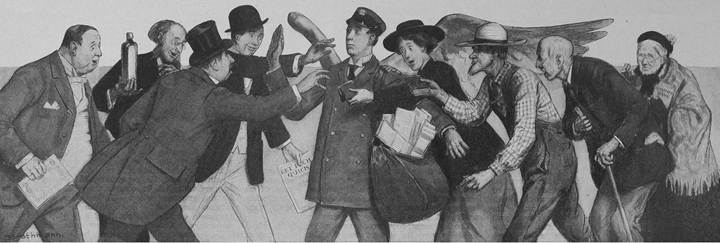
Figure 5.1: The Post Office Department as “guardian angel” to the “easy.” Harper’s Weekly, Jun. 10, 1911, courtesy of David M. Rubenstein Rare Book & Manuscript Library, Duke University.
assistance in obtaining refunds and occasionally to demand that the Post Office pursue enforcement actions. On the eve of World War I, the federal government received over thirty thousand inquiries and allegations annually.93 This torrent of grievances testifies to the expanding sense of rights consciousness among Americans, as well as the tendency to look to the federal government as guarantor of those rights. A 1911 illustration in Harper’s Weekly (Figure 5.1) captured the growing inclination of American investors and consumers to look to the Post Office for redress. Pictured in the center of the illustration is an upstanding postman, in rigidly starched attire, with an angel's wings. Behind him, held back by a strong left arm, are four disgruntled citizens leaning forward with either imploring hands or clenched fists—a prim middle-class woman, perhaps a schoolteacher; a farmer, maybe the victim of a patent right scheme; an elderly gentlemen with a handkerchief falling loosely out of his pocket, as if it had been picked; and an elderly woman clutching a bankbook, emblematic of devastating losses. In front of the guardian postman, ignoring the plea of his stiffly bent right arm, are four grasping swindlers, one holding up a patent medicine bottle, another a “Get Rich Quick” circular, a rotund businessman holding firmly to a “no doubt dubious stock certificate,” and a fourth pitchman of some indeterminate scheme.
American postal regulation of commercial speech had its origins not in such acts of social protection, but rather in institutional self-defense. The Post Office took on this task because its officials wished to safeguard their own reputations from the lies of deceptive mail-order businesses. This impulse remained a leading regulatory motivation for many years. In 1883, the New York Times could insist that because Americans were “not living under a paternal Government,” the object of mail fraud enforcement “is not so much to protect the people as it is to protect the mail service.” As late as 1890, postmaster general John Wanamaker pleaded for tougher legislation against lotteries on the grounds that the flouting of existing rules by the Louisiana Lottery had “humiliated” and “demoralized]” his department.94
With the injection of Protestant moralism into the department by Anthony Comstock and his fellow special agents, and the greater incidence of public requests for fraud investigations, the rationale behind mail fraud policy more commonly referenced harms to consumers and investors. In Frauds Exposed, Comstock evinced concern for those “honest and simple-minded persons” duped by “the multitudinous schemes and devices of the sharper”—the “verdant” Americans who were taken in by green goods men, unscrupulous danglers of nonexistent commercial agencies, and pitchmen for worthless patent medicines and bogus investments. Six years later, another long-t ime postal inspector described the department’s antifraud work as a reflection of “paternal solicitude... to protect the ignorant, the weak, and the unwary from the wolves who stand ready to devour them.”95 By the early twentieth century, this perspective suffused official pronouncements about mail fraud. As Woodrow Wilson settled into the White House, the Post Office Department’s solicitor proclaimed that “the old rule of caveat emptor cannot apply to mail-order sales.” Given the way that “the conditions of business in this country have been revolutionized,” with “sales being made at a great distance from the purchaser,” the state had to embrace its role as policeman of national commercial speech. Such talk percolated down the ranks. One of the Post Office’s pivotal duties, the superintendent of the mails at Trenton, New Jersey, explained in a May 1914 newspaper article, was to “protect the public from itself,” to safeguard “the people from the temptation to become a victim of fraud.”96
****
The Post Office’s expansive endeavors against mail fraud, such as the state inspection regimes and the legislative moves against duplicitous corporate reporting, gained an institutional footing during an era in which American courts cast a skeptical eye on many regulatory endeavors. Drawing on aversion to legislatively bestowed economic privileges that dated back to the Jacksonian period, late nineteenth-century American judges struck down numerous exercises of regulatory authority that they characterized as “class legislation.” If litigants could show that the intended purpose of a regulatory policy was to benefit narrow interests, and that it imposed burdens on firms engaging in interstate commerce, federal judges would often void the legislation as unconstitutional.97 Sometimes regulation that proponents depicted as antideception measures ran afoul of this standard. Licensing requirements aimed at out-ofstate salesmen, for example, tended to raise judicial hackles, even if they targeted fly-by-night commercial sharks. Thus federal courts struck down Minnesota and Alabama laws that required the licensing of agents for out-of-state tree nurseries, despite a clear pattern of misrepresentations and outright fraud, because they did not impose the same standard for local agents.98
American judges, however, proved to be at least as respectful of regulatory efforts to curb business fraud as they were of most exercises of police power on behalf of public health, public safety, or communal morals. Despite many legal challenges, the federal judiciary upheld the constitutionality of administrative mail fraud proceedings and almost always rejected challenges to criminal mail fraud convictions.99 State grain grading, fertilizer inspection, and life insurance regulation similarly passed constitutional muster. So too did statutes that prohibited the sale of oleomargarine colored to resemble butter, antiadulteration laws that targeted compromised medicines and swill milk, and occupational licensing laws that claimed to protect American society from quacks, pettifoggers, and other unqualified riffraff masquerading as professionals. The courts accepted arguments that endemic duplicity threatened the confidence that floated so much commercial activity. As a result, judges held that the public interest in fostering honesty in economic transactions gave a wide berth of action to legislatures, including the delegation of rule-making and enforcement powers to administrative agencies.100
Postbellum courts manifested the same concerns in trademark enforcement. The basic structure for its regulation was set, like mail fraud's, by a Reconstruction-era congressional statute. Rather than looking to a bureaucratic mode of enforcement, however, the Trademark Act of 1870 created a means for businesses to sue infringing competitors in the federal courts. Over the following four decades, the enterprises with national brands that sought to protect their marks found sympathetic ears on the federal bench. In fashioning a conceptual framework for trademark cases, federal judges carved out a significant exception from the norms of caveat emptor. When it came to deciding whether competitors had closely mimicked the names or packaging of Pillsbury Flour or Dr. C. MacLeans Celebrated Liver Pills, the courts did not presume that consumers were careful or discerning. Instead, they treated them as “unwary purchasers”—often harried, distractible, inclined to rely on quick appraisals of how an item appeared on the store shelf, and so liable to make errors when they made choices on the basis of brand preferences. This approach did not guarantee victories for plaintiffs. Judges sometimes ruled that the degree of similarity between names or logos did not justify damage awards, because they did not believe that ordinary purchasers would be led astray. But trademark law remained hospitable terrain for business complaints against imitators.101
As with other nineteenth-century legal exceptions to the precepts of caveat emptor, the intellectual assumptions guiding trademark law reflected judicial prejudices about social types. The familial arbiters of urban consumption by the 1880s and 1890s tended to be women, a group of economic actors whom judges viewed as requiring paternalistic assistance. Yet the character of litigants mattered at least as much. Many federal judges were disposed to respect the large-scale businesses that filed trademark actions. These companies, like the Chicago meatpackers whose lawsuits upended local regulatory statutes requiring local inspection of live beef, also hired top legal talent who developed compelling legal strategies and pursued them through a series of cases.102
Judicial deference accorded to antifraud initiatives gave state and federal bureaucrats room to construct expansive policies during the five decades following the Civil War. The result was not a single cohesive plan for responding to economic deceit, but rather a diverse set of institutional strategies, each tailored to the dilemmas of specific markets, each shaped by the ambitions and ideologies of key regulatory protagonists. With army contracting, grain grading, fertilizer inspection, and reporting requirements for insurance companies and the sale of corporate securities, the goal was improved information disclosure. Purchasers of these goods and financial instruments demanded disinterested assessments of quality, which a growing number of Americans believed could only occur through the auspices of the state. With mail fraud, officials placed an administrative turnstile in front of the country's primary channel of communications, allowing them to block access to those firms and individuals whose business practices sullied the Post Office's reputation and threatened public morals.
In all of these regulatory contexts, the architects of antifraud policies paid close attention to mechanisms of coercion, defining new crimes and administrative penalties and building up enforcement mechanisms. But their most far- reaching impacts turned as much on redirecting social norms as on fashioning credible shows of regulatory force. The regulations that sought to constrain commercial misrepresentations entailed the fashioning of new standards—for the quality of grain and fertilizers, or the obligations that mining and life insurance companies had to investors and policyholders, or the limits of acceptable puffery in mail-order marketing. This process built on informal regulatory communities already established through the nation's print culture. State and federal regulators looked to the press to spread the news of rule-making and enforcement actions, an expectation generally met by the trade journals and newspapers with fraud beats. Many regulators replicated the relationships that fraud-fighting editors had forged with subscribers, soliciting intelligence about business frauds and emphasizing public education. These endeavors solidified the legitimacy of antifraud regimes, strengthening the position of officials now charged with policing the line between forceful salesmanship and shameless imposition, and reinforcing social mores against rank duplicity.
Appeals to individual self-reliance did not disappear in the face of this coordinated assault on commercial tricksters. Among American sharpers, this sensibility remained commonplace. One young mail-order entrepreneur who ran afoul of the new postal law a few years after its passage typified this defiant stance. This twenty-two-year-old widely advertised the sale of a “low priced seven-shooter” made possible by economies of scale in manufacturing, but then filled orders with cheap popguns. Upon being confronted by a postal inspector, the young promoter explained that he had “read Barnum's life, and accepted the doctrine that the American people like to be humbugged.” Observing that his ads had said nothing about supplying an actual firearm, he insisted that “if anybody is green enough to suppose I meant a revolver, that's his lookout.”103 The question of how to demarcate the boundaries of business fraud continued to be a vexing problem, nowhere more so than with regard to innovative firms that operated on untested commercial ground, and that shared the young popgun seller's aggressiveness in marketing.