CHAPTER FOUR Channels of Exposure
Opportunities for fraud exist in any economy. But they were particularly salient in the nineteenth-century United States, where technological breakthroughs, transformations in finance and business organization, and the rapid creation of an integrated national economy sparked a series of economic booms, and where migration and the shifting boundaries of social class loosened traditional forms of communal authority.
These conditions encouraged the flowering of a booster ethos suffused with thoroughgoing optimism and celebration of the rapid accumulation of wealth; they also fostered the emergence of pervasive information asymmetries. Optimism bred credulousness and willingness to take on risk. Profound differences in access to market intelligence limited the ability of investors and consumers to assess the claims of the parties with whom they contemplated doing business. This combination increased the payoffs and lowered the costs associated with fraud.1Such conditions, along with the de facto legal environment of caveat emptor, led many business owners who felt victimized by some commercial imposition or financial fraud to engage in modes of self-help, a strategy long enshrined in Anglo-American law and social practice. Instead of turning to lawsuits, British and other European importers of falsely packed cotton might demand monetary compensation from their American mercantile correspondents, who often complied, realizing that a delay in payment would gravely damage important long-term economic relationships.2 Rather than rushing to the police after being taken by a mock auctioneer, visitors to the big city occasionally sought, and sometimes received, redress through a personal show of force.3 Sometimes fraud victims banded together in larger social actions to voice their displeasure. Thus, in 1835, hundreds of working-class Baltimore depositors, outraged by the Bank of Maryland’s failure after brazen managerial speculations, initiated a full-scale riot.
Animated by a centuries-old tradition of crowd action as a means of vindicating popular moral economy, these disgruntled casualties of bank fraud destroyed the homes of several bank directors.4The problem of business fraud led greater numbers of nineteenth-century Americans to explore preventative strategies. One common impulse was to cultivate networks of commercial intelligence that gave businessmen access to more than their own eyes and ears as they assessed the trustworthiness of people, goods, and intangible assets. Within communities, webs of local knowledge fixed reputations, as with one shifty Cincinnati storekeeper, whose establishment was described by a judge in a midcentury legal controversy as “fairly hedged in by information. Eshelby, looking from his shoe store over the way, sees rascality; Rooney, a very quiet man, knows all about it; the sheriff is on his guard, and creditors are besieging the premises.” The image here is striking—a proprietor with proclivities for trickery, fenced in by the shared observations and suspicions of neighbors.5 The Eshelbys and Rooneys had their counterparts in every village, hamlet, and urban commercial district across the North American continent.
Local surveillance, however, proved far less effective as the scale and scope of impersonal economic relationships in the United States expanded, prompting entrepreneurs to develop several institutional strategies to cope with the threats posed by fraud. These usually had the goal of reducing information differentials between counterparties or between principals and their agents, or of providing some form of insurance against fraud-related losses. Some of these approaches encompassed the development of entirely new business niches, including confidential credit reporting, the provision of credit insurance, and the emergence of investment banks as mechanisms to discipline corporate managements. Others entailed the fashioning of new methods of monitoring within large-s cale corporations, such as stiffer internal accounting controls to limit opportunities for forgery or embezzlement, and innovations in marketing, such as the cultivation of brands or the provision of money-back guarantees.6
There was also a complementary if more diffuse nineteenth-century response to fraud as an economic dilemma—a growing realm of public commentary about commercial and financial deceit.
The constant reminders to Americans to beware of all the goods, services and opportunities floating around them encouraged demand for public information about prevailing deceptions. A group of self-appointed commercial policemen among the nation's journalists, writers, and publishers took it upon themselves to meet this demand. These guardians surveyed the American marketplace for swindles and swindlers and then tried to warn “the public”—in some cases targeting the broader marketplace and society, in others seeking out participants in a single industry or sector. As a result, the era's newspapers, magazines, and bookshops teemed with commentary about frauds and fraudsters. In the resulting public discourse about imposition and humbug, Barnum's contemporaries, and Barnum himself, devised their most substantial, if still quite imperfect, regulation on behalf of truthful commercial speech. Ironically, the resulting public discourse about fraud soon reverberated through American business culture, prompting the evolution of ever more sophisticated modes of economic deceit, and buttressing, for a good many decades, middle-class and elite commitments to the premises of caveat emptor.Making Markets for Fraud Intelligence
Public discourse about economic deception had roots in the colonial period, when newspapers and pamphleteers tracked the exploits of tricksters and confidence men.7 With the growth in complex economic relationships based on impersonal trust, nineteenth-century writers explored a widening set of issues about business fraud. The most extensive investigations, particularly in urban newspapers and national periodicals, concerned large-scale financial scandals. When a leading American entrepreneur such as Benjamin Rathbun became embroiled in charges of financial malfeasance—in Rathbun's case because of allegations that he had propped up his real-estate developments in mid-1830s Buffalo by forging endorsements—local and national press closely followed the events.
Later scandals, such as Robert Schuyler's fraudulent overissue of New Haven & New York Railroad Company stock in the early 1850s, the Credit Mobilier contracting scandals of the 1860s, and the financial collapses of a series of fraudulent New York City life-insurance companies during the 1870s, attracted even more intensive reporting and analysis.8 This close attention reflected competition among a multiplying number of news outlets, as well as the increased economic fallout of large-scale fraud. American journalists also emulated the example of their British peers. Instances of corporate malfeasance, such as those associated with the railway promotions of the 1840s, the bank and insurance failures of the 1850s, or the stupendous collapse of the Overend and Gurney bank in 1866, generated massive coverage from Fleet Street.9Public surveillance of allegedly duplicitous commercial activities, whether in Britain or America, reached far beyond retrospectives on the most consequential frauds and defalcations. The urban press provided a fraud blotter. Day after day, month after month, readers learned about embezzling bookkeepers and bank tellers, the discovery of forgery rings, efforts to launch bogus banks and insurance companies, and arrests or trials related to criminally prohibited misrepresentations. When private complaints or police investigations identified swindlers who had escaped the porous constraints of the legal system, publications such as the National Police Gazette further made a habit of publishing their physical descriptions or photographs, a nineteenth-century precursor of the all-points bulletin.10
Coverage of specific frauds also prompted more general reflections about how employers, customers, suppliers, creditors, policyholders, or investors could detect it. Articles on one incident recalled analogous dodges and articulated rules of thumb for spotting duplicitous marketing, fraudulent investments and credit applications, or employee behavior that signaled looming defalcation.
As early as the 1830s, demand for such commentary supported the emergence of pamphlets and books that detailed the tactics of unscrupulous merchants, stockbrokers, and company promoters. In subsequent decades, publishers produced a steady supply of book-length fraud exposes. Some were memoirs of personal encounters with suspect practices in one segment of the American economy. Others offered up general catalogues of trickery that advised readers how to avoid the fate of the fleeced.11Antifraud discourse, then, had a broad footprint in America from 1830 onward, taking up space in just about every newspaper, the commercial press, and more specialized trade journals, as well as on the shelves of book dealers. Of course, it shared that space with an enormous amount of puffery that all too often abetted fraudulent practices or schemes. Local newspapers in areas greatly desirous of outside investment capital became notorious for boosterism that buoyed the extravagant claims of associated land speculators and corporate promoters. Trade journals manifested a promotional outlook and a willingness to tout the virtues of leading businesses within the relevant industry. Organizers of midcentury gift enterprises—firms that disposed of hard-to-sell goods through promotional premiums—paid rural editors to place favorable “news items” about their businesses. Some even created separate newspapers or magazines as thinly veiled marketing vehicles. Up into the 1890s, many papers and journals remained heavily dependent on advertising from the makers of patent medicines, and so displayed scant concern over the fantastic nature of those concerns' assertions and promises.12
Commodity and securities speculators also concocted all manner of schemes to use news channels as an element of their strategies for manipulating price movements in the nation's markets. Early efforts along these lines involved planting stories in the press that, in combination with coordinated campaigns to circulate rumors, would likely move stock prices in a desired direction.
Nearly every Western mining boom of the 1860s and 1870s was accompanied by heavily managed promotional campaigns in local newspapers. In his 1872 account of the previous decade's gold and silver booms, Roughing It, Mark Twain explained the basics of journalistic corruption. Reporters received shares in new mining ventures as a matter of course, and returned the favor with optimistic accounts that “frothed at the mouth as if a very marvel in silver discoveries had transpired,” all to feed the speculative temper of outside investors.13 By the latter decades of the century, some speculators published their own tip sheets and financial newspapers to gain a stronger hold on the financial rumor mill. The large-scale speculator Jay Gould went so far as to purchase a respectable publication, the New York World, to facilitate his maneuvers in the stock market. Through the World, Gould could engineer support for his takeover attempts by having the paper run stories that encouraged investors to dump the stocks of the companies in which he was interested.14Behavior of this sort horrified the nation's Protestant establishment. In 1854, a Philadelphia clergyman, Henry Boardman, published a collection of sermons/lectures that gave voice to religious concerns about prevailing commercial ethics. The Bible in the Counting-House meticulously flayed the duplicitous behavior of American merchants, expressing contempt for efforts to justify cheating through appeal to commercial customs. Boardman's goal was to contrast prevailing deceptions and the mores that tolerated them with the demands of Christianity, thereby convincing the nation's businessmen to subordinate their Machiavellian instincts to the higher norms of Jesus' teachings. In a country in which “young men will flock, as they have done, to the marts of business,” and in which those marts set the key patterns for society and culture, the only way to secure religious truth and national honor was to “go directly into the abodes of commerce, and publish to the great army of traffickers, the high requisitions of Christianity.” In other words, in Barnum's America, as went the spiritual lives of the merchants, so would go the spiritual life of the country.15
The great majority of cautions about fraud in this period were rooted in far more prosaic considerations. Most obviously, the sentinels of commercial flimflam and financial skullduggery perceived a vibrant demand for their reporting, evaluations, and advice, and hoped to profit from that demand. In a commercial world filled with tricks and masquerades, discussion of the latest forgery or confidence game furnished compelling copy, particularly for the penny dailies and popular weekly sheets such as the New York Herald and the National Police Gazette, which catered to mass readerships. Fraud helped to sell papers. For decades, the Police Gazette titillated its readers with the daring exploits of notorious quacks, sharpers, and confidence men, giving their most prominent place to the counterfeiters or swindlers who demonstrated a knack for eluding police or escaping from jail, and exhibiting particular fascination for female con artists or male swindlers who managed to gain the trust of social elites. As in so many other cultures, incidents in which a trickster fooled the high and mighty resonated with less-prosperous readers, who in this case had the disposable income to consume tales of comeuppance through commodified newsprint.16
The pecuniary impulse to gain from public announcements of swindles and humbugs, however, took on an array of manifestations, and these patterns suggest intriguing conflicts over cultural authority within the American marketplace. One important impetus for public warnings about fraud came from well-entrenched businesses whose managers worried about deceptions that siphoned off demand for their offerings. Manufacturers of branded goods were the most important targets of imitations, and by the late nineteenth century, they increasingly fought them through trademark infringement suits.17 But legal action required the expenditure of significant resources and often entailed risks. As a result, aggrieved businesses often responded to counterfeit goods by engaging in a form of self-help. They placed advertisements that put the members of the public on their guard.
Thousands of such advertisements appeared in nineteenth-century newspapers and periodicals. The pleas were to “Beware of Fraud!” when purchasing Hyde Winship & Co. Soap, because a Baltimore distributor was passing off “common White Soap, cut into very thin flakes, and a small quantity of perfume applied to the outside” as the genuine product; or to “LOOK OUT FOR FRAUD” when searching for Blake's Patent Fire Proof Paint, because its popularity had enticed “scores of unprincipled individuals” to “throw... into the market all kinds of worthless, counterfeit stuff, much of it no better than dirt from the street”; or to purchase the Ostermoor Elastic Felt Mattress only from the manufacturer via mail-order, because in retail establishments, “only frauds are offered—not the Ostermoor."18 Little changed in this advertising genre over three-quarters of a century, aside from the occasional introduction of basic graphics and the eventual references to unauthorized dealers selling knockoffs.
More communal impulses toward economic self-defense also prompted public commentary about swindling and systematic deceit. A nineteenthcentury newspaper sometimes gave intense coverage to fraud allegations out of concern that endemic misrepresentations were damaging its city's standing in regional, national, or international trade. This concern drove an effort by the New York Times during the mid-1850s to prod the city's Corn Exchange to implement new rules to govern the inspection of flour. After the prohibition of state offices for goods inspection by the 1846 state constitution, a system of private inspection emerged in Manhattan, in which those shippers who desired some kind of quality determination paid for inspection firms to rate their flour. But the system was so riddled with conflicts of interest that the quality of flour shipped from New York deteriorated, leading the Times to spearhead efforts to improve standards of private grain grading.19
On other occasions, public analyses of fraud represented still-subtler forms of commercial self-protection. Businessmen who faced questions about the legitimacy of their business practices, or even of their core business model, sometimes responded to this kind of criticism by trying to redirect the public spotlight onto even more disreputable enterprises, a version of the strategy of deflection. P. T. Barnum serves as a case in point. Throughout the first few decades of his career, Barnum had to contend with recurring complaints about the more outrageous of his stunts and exhibitions. Many leading social and religious figures denounced Barnum's offerings as swindles, characterizing them as barefaced misrepresentations that gave the visitors to Barnum's American Museum nothing of value in return for the price of admission.
This criticism reached a crescendo in the aftermath of Barnum's 1854 autobiography, and of his personal insolvency just over a year later. To the Southern Quarterly Review, Barnum's reflections on his life were those of a “thimblerigger who has cheated the public” and who had the effrontery to seek more profits from “an exposition of his own roguery.” The New York Times complained that the only difference between Barnum's systematic dependence on false pretenses and those of common counterfeiters was that the former had not learned “the advantage of doing things on a grand scale and with the flourish of trumpets.” Religious commentators were equally scathing. The reviewer for the Christian Examiner condemned the proprietor of the American Museum as having made “quackery” a fine art, and as possessing an extraordinary “vulgarity of aims” and “a low and unscrupulous cunning.” One contemptuous English commentator encapsulated all of these attacks in 1859. Barnum, a writer in the British Advertiser thundered, had raised himself up as a false prophet, a dangerous cultural icon who
tells us that to cheat is no longer a wickedness, that to lie is no longer a condemned expedient; that to gull the public is the beginning and the end of all wisdom; ... that mammon worship is the true devotion, and that hypocrisy, deceit, lying, perjury, and fraud are the legitimate arts of worship.
By the eve of the Civil War, Barnum had become a lightning rod for transatlantic anxieties about the impact of modern capitalism on social mores.20
The impresario's spectacular insolvency in January 1856 only heightened this dynamic. Barnum failed because he agreed to serve as an endorser for a Connecticut clock manufacturer that, unbeknownst to him, was on the verge of bankruptcy. After he found himself unable to pay hundreds of thousands of dollars of the manufacturer's notes, many of which Barnum alleged were forged, editors across the country happily crowed about a deceitful scoundrel getting his comeuppance. “The deposed King of Humbug,” one Albany paper wrote, had been able to “evade the law” and “delude the clergy” but his relentless attempts to gain “notoriety without paying for it” had finally and appropriately “exploded” in his face.21
Barnum anticipated most of these attacks in his first autobiography, insisting that he provided his customers with excellent value. In addition to the genuine curiosities and quality theatrical shows in his Museum, his skeptical visitors had the entertaining experience of evaluating the authenticity of his spurious exhibits, and of trying to figure out how Barnum managed to put things over on his audiences. Some commentators on his place in American culture picked up on this theme. Thus in defending the showman in the immediate aftermath of his failure, the New York Tribune insisted that “in law and morals, there is a great distinction, and justly so, between white and black lies.” Only costing his customers “extremely moderate” sums, Barnum's exhibitions succeeded eminently in “gratifying the sentiment of wonder” The Tribune concluded that “every person who visited” the American Museum “got his money's worth.”22
Barnum's 1865 book Humbugs of the World extended this line of argument. In this treatise on scams in American commerce, religion, and medicine, the showman contrasted his techniques of promotion and jovial misdirection, which he depicted as legitimate, with contemptible varieties of swindling and imposture. The wholesalers and grocers who adulterated foods, the mail-order lottery dealers who touted rigged drawings, the promoters who peddled worthless shares of bogus oil companies, the mediums and spiritualists who faked access to the world of the dead, and the quacks who conjured up contrived testimonials from Civil War generals for their “Hasheesh Candy” or “Preparation of Turkish Roses”—all these deserved the appellation of swindler, and many a few years in the penitentiary. By comparison, a purveyor of entertainment who “attract [ed] crowds of customers by his unique displays,” and who sent these customers home satisfied with the experience of puzzling over their authenticity, had done nothing but divert his audience with an afternoon's enjoyable respite.23
During the postbellum decades, several respectable New York City stockbrokers and speculators, including William Henry Fowler and Henry Clews, undertook a similar approach with regard to the often-mysterious business of Wall Street. These financial insiders decried the techniques of unscrupulous stockbrokers and bucket shops. Such operators often only pretended to execute the trades ordered by their customers, shaved off profitable returns through false reports on actual trades, and reported initial phantom profits on invest-
ments in order to attract more substantial deposits. Fowler and Clews similarly explained and excoriated the strategies that speculating rings used to disseminate false rumors among investors eager for some inside dope. The most direct message of these publications was that individuals tempted to enter the fray of the securities markets should ignore the wild promises of unsolicited stock circulars. But another dominant theme harped on the enormous difference between the multitude of swindling brokers and the high-toned firms with close links to the New York Stock Exchange, an institution described by one pamphleteer as “unquestionably honorable, legitimate, and thoroughly reliable” and providing “the most complete protection against irresponsibility.”24 Once again, the strategy here was to deploy scathing critiques of purveyors of deceit as a way to legitimate related businesses that faced significant public complaint.
Not all nineteenth-century American publicists of fraud were businessmen who perceived themselves to be targeted by counterfeiting miscreants, local elites anxious over threats to regional economic reputation, or entrepreneurs who faced sufficient criticisms of their own practices to prompt attempts to redirect public criticism elsewhere. In many segments of the American economy, strategically placed individuals took advantage of their knowledge and access to commercial intelligence to set themselves up as cultural authorities and de facto arbiters of when economic behavior overstepped acceptable boundaries. The publishers of counterfeit detector manuals, which proliferated from the 1830s up to the Civil War, took on this role. Their imposing lists of all the spurious and doubtful bank notes in circulation were sent to subscribers by a shifting band of metropolitan note brokers, such as New Yorker John Thompson. These financial middlemen recognized that their expertise about a heterogeneous antebellum money supply allowed them to furnish the broader public with detailed descriptions that distinguished trustworthy from bogus currency.25
Few other spheres of American commerce generated as extensive efforts to institutionalize fraud coverage as the circulation of paper money, although some came close. From its inception, Scientific American paid close attention to methods for masking imitations of manufacturing materials, strategies for manipulating the weights and measures of commodities, and patent swindles, including the marketing of bogus inventions such as the Keely motor, said to run on mysterious “etheric” energy.26 The emergence and rapid technological evolution of photography was accompanied by all manner of photographic snake oil—slight tweaks to established approaches that did nothing to improve performance, magical new methods that failed outright, fake licenses to actual or even nonexistent patents. Such tactics prompted the creation of journals such as the Philadelphia Photographer, which informed subscribers about the latest chemical impostures.27 Trade journals aimed at druggists, physicians, and chemists similarly took aim at worthless patent medicines and practices of food adulteration.28 From the Civil War onward, the Engineering and Mining Journal policed fake mining processes, the promotion of fraudulent mining stocks, and efforts by insiders to manipulate price movements on mining exchanges.
Nineteenth-century trade journals performed many functions. In addition to providing fraud-related intelligence, they covered technological and organizational innovations, discussed public policies that impinged on their economic sector, compiled and disseminated statistics about sales and markets, and furnished a vehicle for advertisers to reach a sectoral niche. But fraudfighting at least occasionally topped this list with regard to marketing strategy. Thus in the mid-1890s, a new weekly called Electricity marketed itself primarily as a means to keep abreast of fakes in a technical marketplace undergoing a dizzying pace of technological innovation. Aware that subscribers to trade journals had come to expect intelligence about business frauds, the promoters of Electricity directed their advertising dollars toward such periodicals, placing ads that highlighted the value of its fraud coverage. Although its advertisements also promised to convey news about developments in electrical research in a “non-technical and popular manner,” the journal's greatest selling feature was its promise to redress information asymmetries for “those whose knowledge of electrical matters is limited,” thereby protecting them from “all forms of humbuggery, quackery and fraud” (Figure 4.1).
For several postbellum publications, the fraud beat became an entrenched feature, an editorial department on which readers could depend. American honey producers who subscribed to The American Bee Journal or Gleanings in Bee Culture received not only ongoing coverage of recent developments in the “Patents” column, the proceedings of state beekeeper “Conventions,” and novel ideas for “Marketing Honey,” but also the latest news of “Adulteration in Honey” and “Swindles and Humbugs.”29 The latter ranged from tracking the movements and enterprises of noteworthy operators, in some cases for years, to detailing the most recent commercial hoaxes targeting beekeepers. In Orange Judd's American Agriculturist, the most influential weekly for the nation's vast farming population, subscribers from the 1850s on encountered regular exposes of “Sundry Frauds and Humbugs.” Occupying almost a full newspaper page, this feature achieved a national reputation as a foe of fakery. As the American Journal of Dental Science put the consensus view in 1879, the Agri- culturalist,s “persistent caustic exposures of Humbugs and Swindles are of great value to all its readers.”30
Channels of Exposure • 85
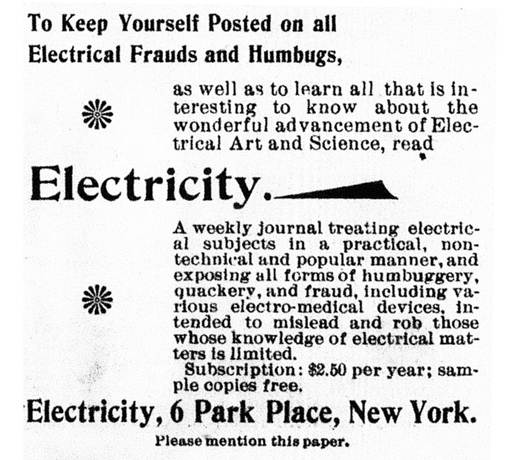
Figure 4.1: Advertisement in Gleanings in Bee Culture 23 (May 15, 1895): 419.
The regular sections about economic deceit in rural America had a strongly democratic flavor, as they depended on the active participation of readers. Subscribers sent in hundreds of letters describing encounters with fraud, expecting them to be printed as warnings to the broader farm population. J. E. Moore sent along a typical missive to the American Bee Journal in March 1878, cautioning readers about “The Crystal Honey Fraud” and its promoter, a Mr. Chidester of New York City, who was offering sales agencies a fake method to make candy out of honey.31 Farmers also bombarded these publications with queries about unsolicited business propositions, unfamiliar marketing tactics, and novel products, seeking authoritative assessments of whether a company or advertised machine was aboveboard. Editors sometimes pursued their own research to furnish readers with answers, especially if the inquiry involved a firm that had advertised in their journals. On other occasions, they convened informational clearinghouses, publishing letters of inquiry in the expectation that far-flung readers would chime in with helpful responses. These journalbased communities were nineteenth-century versions of tightly moderated internet bulletin boards, in which editors selected both initial postings to the community and then the contributors to subsequent threads of sometimes contentious discussion resulting from crowd-sourced investigation.
Persistent efforts to warn Americans about the swindles in their midst reflected an editorial assumption that fraud monitoring paid dividends by helping to convince readers that they received value for subscription dollars. As the Genesee Farmer noted during its 1855 coverage of prevailing frauds in the distribution of guano fertilizers (made from seabird droppings harvested from Chilean and Peruvian island rookeries), “the agricultural press is never more usefully employed than in watching the interests of farmers and guarding them against the frauds of dishonest speculators. Let the farmers see that their trusted friends are sustained.” When circumstances allowed, as they often did, editors crowed about their triumphs in clearing the marketplace of swindlers and shams.32
As the Genesee Farmer plea also suggests, however, the ethos of fraud prevention embraced a more communitarian sensibility. Among agricultural journals that made fraud coverage a specialty, the Departments of Humbug manifested a language of “friendship.” A. I. Root, the longtime editor of Gleanings in Bee Culture, tagged his section on “HUMBUGS AND SWINDLES Pertaining to Bee Culture” with a reminder that “we respectfully solicit the aid of our friends in conducting this department, and would consider it a favor to have them send us all circulars that have a deceptive appearance. The greatest care will be at all times maintained to prevent injustice being done to any one.” Beekeepers who desired information about a company, salesman, product, or business opportunity accordingly addressed their queries not to “Editor,” or even A. I. Root, but rather to “Friend Root.” Root responded in kind, addressing his published replies to “Friend P” or “Friend B.” This practice personalized the answers that he furnished to F. A. Parsons of Oconoe, Washington, or to D. D. Brewer of Springfield, Arkansas, both of whom wrote Root in 1886 to inquire about the supposedly patented “Golden Bee-Hive.” (Root was happy to oblige, explaining that “the patent right man is trying to come the old trick over you.”) Such a familiar mode of address simultaneously connected Parsons and Brewer to the hundreds of other farmers who read his Gleanings. Together, this band of beekeepers kept one another abreast of a continental market, leaning on the intercession of a trusted editorial intermediary to facilitate a collective means of protection against the wiles of patent right agents and other dodgy operators.33
In the case of many trade journals, such as Iron Age and The Railroad Gazette, the inclination of editors to set themselves up as inveterate enemies of imposition and fraud went hand in hand with professionalization. Eager to secure the social and economic status of experts, the era's spokesmen for chemists, pharmacists, and engineers portrayed their lines of work as having an ethic of truthfulness resulting from rigorous technical education and the social obligation to expose falsehood and quackery. This responsibility included not only vetting the legitimacy of new ventures and spreading the word about dicey business practices such as deceptive accounting tricks, but also informing readers about migratory charlatans who posed as experts, or novel scams cooked up by employees to bilk their employers. Assiduous reporting on such matters put readers “on their guard against further swindling.”34
Throughout the postbellum decades, the Engineering and Mining Journal furnished especially detailed articulations of the premises that undergirded expert surveillance of the marketplace. The journal's editors, Richard Rothwell and Rossiter Raymond, proclaimed independence from all conflicts of interest, all “entangling alliances” with mining speculations or stockbrokers. In issue after issue, they professed commitment to the values of professional expertise in the assessment of existing and proposed mines and mining corporations, and the obligations that all geologists and mining engineers had to the broader public, even when employed by mining promoters. They further pledged that their publication was the inveterate “enemy of all fraudulent mining ventures,” and that it would “give such disinterested information as may put investors on their guard against the bogus or overvalued enterprises that are already seeking to beguile the confiding of their money.” To those ends, Rothwell and Raymond emulated the community-building techniques of the agricultural papers, cultivating a far-flung network among subscribers, who were primarily mining professionals and investors. The editors solicited cautions about suspicious mining promotions and queries about the legitimacy of new and often isolated mining ventures, while also requesting readers to respond on the basis of their professional competence and local knowledge.35
All this surveillance, the editors insisted, had the ultimate goals of stabilizing the flow of capital into the American mining industry and so sustaining entrepreneurial opportunities in that sector. By exposing swindlers who sought to unload stocks in phony mines and companies that hawked bogus mining processes, the journal promised not simply “to render them harmless,” and so to save investors from embarrassing losses; Rothwell and Raymond further hoped to buttress public confidence in the mining sector, since “every dishonest enterprise is a standing warning against the investment of capital” by Americans and Europeans alike. Systematic exposure of swindling mining promotions, then, promised to counteract the all-t oo-common equation of mining investments with “wildcats” and “a form of gambling in which the ‘outsider' stood but little chance of winning.”36 Such regulatory impulses mirrored earlier justifications for the methods adopted in American credit reporting, where networks of watchful reporters sent in assessments about local firms and business owners. By identifying the scoundrels who sought credit, the Mercantile Agency's Lewis Tappan had hoped in the 1840s, his network of informants would “check knavery, and purify the mercantile air,” making it easier for honest enterprises to attract the oxygen of credit.37 For Tappan, like the trade journal editors, modern markets rested on public trust, which in turn rested on a base of social norms and regulatory structures (in this case, outside the bounds of the state).
For the trade journals, antifraud stances represented a targeted expression of commercial oversight that reached only a single economic sector. Several agricultural weeklies claimed a broader jurisdiction, recognizing that farm families confronted scams directed at them as producers, consumers, and investors; but these papers tended not to cover the kind of retailing and investing swindles that predominated in America's burgeoning cities. Metropolitan newspapers took on those frauds. Like Orange Judd's American Agriculturist, urban dailies such as the Boston Herald, Philadelphia Public Ledger, and New York Times, and national weeklies such as the National Police Gazette, covered all kinds of commercial deception. Small-scale depredations by local auctioneers and grocers received attention alongside swindles perpetrated through mail-order marketing and the fraudulent machinations of corporate insiders. In reflecting the larger purposes of such reporting, newspaper editors claimed the mantle of commercial guardians and popular educators, on behalf of not just one particular slice of the American population—farmers, or pharmacists, or mining investors—but of the nation's most important marketplaces, of their cities' populaces as a whole. The Times evinced great pride in its “warnings” and “cautions,” characterizing itself in the mid-1870s as a champion of “the commercial honor of the community,” with the “right to bring a great fraud to light in whatever way we can.” The National Police Gazette’s editor similarly thumped his chest as a guardian of truthful commercial communication, proudly recalling in 1880 that since its inception several decades earlier, the publication had had a policy of attacking “all classes and kinds of frauds..., strip [ping them] of their veneering and expos [ing them] to the contempt which they merited.”38
These endeavors shaped popular understandings of the role of the press as monitors of economic candor. By the 1870s, letters from alleged victims of fraud poured into urban newspaper offices. One such missive from “Policy Holder” arrived on the desk of the editor of the New York Times in May 1873, noting that a competing paper had just begun to report on “high-handed corporate mismanagement in life-insurance corporations.” Observing that “the Times has already rendered lasting benefit in fraud exposures,” “Policy Holder” implored the paper to direct its investigative powers toward this question, especially as most “insurance journals” published only “purchased puffs and flattering notices.” Governmental officials became so accustomed to the press alerting the public to prevailing scams that they sometimes sent their own “cards” to newspapers to issue a fraud warning. By this point, urban residents and officials had developed settled expectations that newspapers served as sentinels of trade and finance, sounding the alarm about all manner of fraud and imposition.39
Taking on the role of guardianship against commercial duplicity earned nineteenth-century writers and publications more than a little enmity. In the antebellum decades, reports of circulating counterfeits or fraudulent financial reports triggered vigorous complaints from bank officers, who denied the existence of the former and the veracity of the latter.40 When a newspaper exposed sharp practices or outright swindles involving the management of publicly traded corporations, the incident might elicit whispering campaigns that its editor had been bought off by a syndicate looking to execute a bear raid on the company's stock.41 In some instances, aggrieved corporations either threatened or instigated libel suits against trade journals that had raised serious questions about the truthfulness of financial reporting.42
The lurking possibility of libel actions led most editors to take care before publishing correspondence that alleged some kind of fraud. Orange Judd's American Agriculturist stressed in 1872 that it ignored all anonymous accusations, refused to publicize charges against “names and business enterprises” without “sufficient evidence,” and, in the case of any “error” caused by the “deception” of a malicious correspondent who wished to “vent his spleen,” would “make [a] prompt correction or retraction.”43 But the occasional controversy and lawsuit did not forestall the emergence of a vigorous public conversation about the swindles and beguilement swirling about American marts of trade. Indeed, Judd boasted that despite frequent attempts at intimidation through libel suits, his weekly had exposed over fifteen hundred swindles in its first thirty-one years, or nearly one every week. In one sense, attacks on fraud exposes deepened nineteenth-century antifraud discourse, because they encouraged some editors around the turn of the next century to open their journals to critics who wished to challenge a given accusation. By giving “both sides of a question a fair hearing,” the press would furnish Americans with the most compelling arguments about how to distinguish legitimate businesses and business practices from unwarranted puffery or contemptible chicanery.44
The Paradoxes of Gatekeeping
Orange Judd and his fellow nineteenth-century editors and economic writers took on roles as guardians of American commercial speech. Through specific warnings and more general instruction, these self-appointed gatekeepers extended the number of metaphorical placards paraded before the domiciles and advertisements of dodgy enterprises, imploring strangers to BEWARE of some particular PETER FUNK, or simply of general PETER FUNKISM. Their collective efforts had tangible impacts. When publications built up a strong community of readers committed to a shared project of market surveillance, they hemmed in duplicitous marketers. By calling out operators and shining a light on emerging schemes and scams, they deprived swindlers of the oxygen of trust and plausibility, and so speeded up the process by which a given swindle burned out. Through the media of newspapers, magazines, and coordinated correspondence, these informal communities greatly expanded the geographic reach of watchfulness. They multiplied the pairs of eyes—the Eshelbys and Rooneys—that might not only spot commercial or financial knavery, but also bring it to the attention of a larger, and in some cases continental, neighborhood. Such actions enabled Americans to recalibrate their judgments about the individuals and firms with whom they might do business, improving reputational checks on duplicity.
And yet, the dissemination of so much commentary also furnished new opportunities for fraud. The capacity to use publicity and mechanisms of informal public education to contain the threats posed by economic deception depended on the good faith of journalistic gatekeepers. But could one truly trust the Orange Judds and Rossiter Raymonds of the age's commercial public sphere? As soon as figures developed reputations as trustworthy brokers, the American marketplace faced new dangers of corruption and novel possibilities for corrosive mimicry. The same set of threats emerged with other institutional strategies to combat economic misrepresentation, such as the development of internal accounting and efforts to screen employees for fidelity. Every new form of institutional monitoring to combat business fraud could itself become a vehicle for imposture.45 Indeed, the informal culture of surveillance and public exposure served as a feedback loop to those contemplating economic deception, a low-cost channel of intelligence about prevailing schemes and public awareness of them. All the writing about swindles and measures to prevent fraud thus furnished not only a basic curriculum in deceptive tactics, but also signals to swindlers about when to change modes of operation, as well as blueprints for how to exploit the trust created by new methods of inhibiting duplicity.
Direct evidence for this kind of dialectic is sparse. But descriptions of scams in the press, like more comprehensive book-length overviews of deceit on Wall Street or in the retailing trades, were just as available to the rogue and the hard-pressed entrepreneur as they were to the excessively credulous investor, farmer, or store owner. As a result, coverage of swindles and more comprehensive inventories of deceptive strategies might furnish anyone contemplating the adoption of these practices with a quick course of instruction as to how they might proceed. A midcentury explanation in Hunt’s Merchants’ Magazine about the most common techniques by which grocers doctored their commodities could turn consumers into more savvy judges of vinegar and sugar, or tutor retailers in the finer points of padding profit margins. When agricultural papers published the detailed recipe used by a shady fertilizer company to adulterate guano in 1855, one can certainly wonder whether its impact was limited to placing farmers more effectively on their guard, or whether it also helped to launch new schemes to “palm off on the credulous farmers of our broad domain a comparatively worthless article, at a high price, and under a false name”46
Cognizant of the often-contradictory impulses toward credulity and suspicion bred by an economy prone to boom psychology and characterized by widespread deception, some nineteenth-century scam artists embraced the trust-manufacturing strategy of deflection. These dodgy proprietors directed public attention to competing frauds as the route to push their own. In the late 1880s, the Pulvermacher Company of New York pursued an elaborate version of this strategy, distributing free copies of Health and Strength Regained, a “complete Encyclopedia of information for suffering humanity.” This compendium promised to “expose... the frauds practiced by quacks and medical imposters,” including “sham curative articles,” and to furnish simple tests for detecting increasingly fashionable but “spurious... electric belts,” all the while pointing readers to how they might achieve “permanent health.” That key to such an outcome for the afflicted lay in their finding out “how to treat their own cases at home by electricity,” using “the Pioneer and only reliable Electric Belt” which Pulvermacher would be pleased to send along at half-price. Here was just the sort of elaborate scheme that the purveyors of Electricity would soon promise to uncover.47
The use of exposes as a means of pitching a swindle was especially common within the burgeoning field of patent medicines and health nostrums. But in many other sectors of the economy, a still more complicated dance ensued between people who sought to make economic deception more difficult, and so restore the foundations of impersonal commercial trust, and those who kept a keen eye on novel opportunities for transforming such trust into dangerous credulity. In sectors such as antebellum currency distribution, postbellum mining promotion, and late nineteenth-century financial services, complex systems for detecting and preventing fraud produced ever more elaborate masquerades.
The codependent evolution of counterfeiting techniques and anticounterfeiting schemes began as soon as Americans embraced chartered banks and paper currency in the early nineteenth century. A proliferation of banks generated a blizzard of befuddling banknotes of various denominations, sizes, colors, and degrees of reliability. When the presence of so much “rag” paper led to near-obsessive coverage of known fraudulent bills in newspapers, banking journals, and, by the 1830s, counterfeit detectors, counterfeiting rings rapidly adapted to the new environment, finding ways to manipulate the confidence bred by authoritative catalogues of bad notes. The manufacturers and distributors of bogus currency learned to time their distribution of notes so that they came just after the publication of a local or regional catalogue. Some put out a small batch of a counterfeit with an obvious defect in order to stimulate warnings about a given issue, and then, once those cautions had become widespread, flooded the market with an altered version of the fakes. Bribing the editors of counterfeit detectors to look the other way seems to have occurred with some frequency, at least in light of allegations made by competing publications. Most brazenly, some counterfeiters published their own bogus counterfeit detectors, which both masked particular counterfeits and, in combination with all of the controversies over the honesty of more established organs, sowed public skepticism about the utility of all available detectors.48
Dodgy financing of postbellum mining corporations, particularly in the Rocky Mountains and the Far West, gave rise to a similar process of heightened fraud surveillance followed by adjusted modes of swindling. As Western mining took off in the aftermath of the Civil War, the sector gained notoriety for misrepresentations and outright swindles. The most duplicitous practices included the promotion of phony mining stocks and insider schemes to manipulate the stock prices of genuine mining companies, which often involved the spreading of false information about their output. But the truly sophisticated approaches emerged only over several decades.
During the 1860s, promoters of fraudulent Western mining companies followed a relatively simple recipe. They issued prospectuses that envisioned fabulously rich veins of ore, enticed prominent figures to become company directors through the granting of stock allocations, and exhibited fake sample ores at mining bureaus in San Francisco or large Eastern cities.49 These tactics soon attracted criticism from both technical and nontechnical publications. (The American Mining Index produced a telling spoof of fraudulent promotions in a satire on the “Hunkidora Silver Mining Company,” which was headed by Treasurer Gideon Graball and President Jeremiah Blowhard, whose directors included Major General D. Bility and Adjutant General P. Q. Lation, and which obtained legal advice from the firm of Sneak, Quibble, and Steele.) A stream of news stories about the machinations of mining companies, in combination with widespread losses by outside investors, bred deep-s eated skepticism. Americans began to joke that a mine was “a hole in the ground owned by a liar” or “a hole in the ground sold by a lying promoter to a stupid investor.” Such perceptions, in part the result of journalistic exposes, slashed the supply of capital for all mining ventures.50
Over the course of the 1870s and 1880s, genuine mining promoters adopted several strategies to buttress public confidence. In addition to touting the assessments of independent geologists and mining engineers, they delayed public offerings until ventures began significant mining operations, placed a premium on early payment of dividends to demonstrate earning capacity, and circulated financial reports. In turn, shadier mine promoters crafted novel forms of deceit. Alerted by the mining press to these attempts to display trustworthiness, the swindling community crafted more sophisticated schemes of theatrical emulation. They distributed glowing analyses from sham experts, or “salted” mines with ore samples in order to fool legitimate mining engineers about a location’s prospects. They initiated at least some actual mining operations in an unexplored spot, or revived production at an abandoned mine on the basis of a supposedly newfangled mining process, and then paid early dividends out of capital. They further made it worth the while of local newspapers, and in some cases, national mining journals, to print positive commentaries on their speculations, marking their undertakings as aboveboard and stoking expectations of gain. Finally, in the aftermath of endemic bankruptcies among Western mining companies, promoters bought up the resulting wreckage on the cheap.51
The Engineering and Mining Journal tracked all of these developments, which led the publication to refine its rules of thumb for mining investors. In the late 1870s, amid a renewed interest in mining stocks that sustained the refloating of Eastern mining stock exchanges, the journal consistently reminded its subscribers that “rock or specimen assays... are worthless,” and fancy promises in prospectuses, glowing newspaper columns, and the endorsements of prominent directors little better; that no mine should receive serious attention unless a reputable legal authority vouched for its holding uncontested legal title to its claims; that investors should consider only producing mines with incontrovertible profits; and, most importantly, that no investment should proceed in the absence of “consultation with professional mining engineers.” This latter recommendation required further elaboration, as the turn to such precautions had encouraged the proliferation of “quacks and impostors” posing as reputable engineers. As a result, capitalists had to screen their mining advisors carefully—and of course, the best way to do so was to scrutinize the Engineering and Mining Journal.52
Within the wider financial services industry, the emergence of more complex schemes of misrepresentation also took place over several decades. Initial gambits involved paying newspaper and magazine editors to run stories that placed promotions in a favorable light. Every so often, a big-city newspaper would delight in demonstrating the compromised ethics of a rival, touting the latter's corruption in its coverage of an investment scheme. Thus in 1857, the New York Times sought to prick the New York Herald’s pretensions as an authority on public virtue, running several stories on its rival's longstanding attempts to goose investment in the fraudulent Parker Vein Coal Company of Maryland, which had failed spectacularly three years before.53 As early as the 1860s, some editors had advocated that publications forswear the corrupt placement of promoters' financial news stories or related editorial squibs, a stance that attracted growing support among national publications desirous of social respectability. In the case of the New York Sunday Mercury, the uncovering of journalistic corruption and corporate deceit underpinned the paper's efforts to build a loyal readership. Unlike its “moribund” competitors, who hawked access for “one dollar a line” and sold “editorials, at five dollars a column,” the editor of the Mercury proclaimed that his paper maintained an unswerving independence. Rather than emulating the many “servile tools” of corporate interests, the Mercury pledged a “war upon wickedness and fraud in high places,” alongside a “repudiation of bribery in any form, whether as an advertisement or a purchased puff.”54
By the late 1880s and 1890s, the depth of misrepresentation in the financial markets had helped to spawn several business models predicated on closing the informational gulf that separated insiders from the investing public. These new firms ranged from financial newspapers such as the Wall Street Daily News (founded 1879) and the Wall Street Journal (founded 1889) to investment analysts and bond raters such as Standard & Poor's and Moody's. The financial press cast beady eyes on the legitimacy of new stock issues and the propriety of managerial decision-making at leading corporations. These publications sought, as one reader of the Wall Street Daily News noted in its first year of operation, to give investors “some idea of the movements in the market, and other information that will guard the public against imposition.”55 The emergence of such intermediaries inspired deceptive embellishments, turning the perpetrators of stock frauds toward schemes of deflection. During the early twentieth century, promoters of bogus stocks distributed newsletters, tip sheets, and weeklies that purported to warn readers about scams afoot in the securities markets, all to cover their own misrepresentations.56
In casting aspersions on the press's role in hyping products and investments, the era's critics did not allege that editors and journalists were rotten to the core. The occasional acceptance of compensation in exchange for the publication of planted news stories or editorial endorsements did not mean a complete absence of journalistic integrity. Nor did many newspaper editors possess the capacity to check the veracity of the accounts and stories that crossed their desks. As the Engineering and Mining Journal observed in May 1877 with respect to the evaluation of mining corporations, few publications had sufficient “facilities for separating the wheat from the tares,” for “pass[ing] correct judgment on the thousands of opinions expressed on the subject of mining.”57 Yet whether public misrepresentations emanated from corrupt self-interest or a mixture of credulousness, optimism, and ignorance, they greatly complicated economic decision-making. The profusion of published puffery and countervailing exposes could be dizzying, leaving Americans unsure of what to believe or whom to trust.
Nineteenth-century frauds gave rise to private monitoring of business communications, which in turn begat new forms of deception, new corruptions of trust, and, eventually, new surveillance mechanisms and certifications of trustworthiness. With the emergence of every new community guardian came yet another set of possible theatrical roles and backdrops, yet more concerns about potential impostures. This cycle, so indicative of the “ingenuity” that went into the “preparation and execution of frauds,” did not emerge so early nor with such sophistication in every economic sector.58 To some extent, this cycle had a self-limiting quality. Ever more elaborate swindles depended on ever greater investments; one could not produce compelling counterfeit banknotes, fake mining ventures, or several months' worth of a financial newspaper without access to meaningful startup capital. Once the requirements of effective misrepresentation became more daunting, swindlers faced barriers to entry. Nonetheless, the pattern occurred with enough frequency to sustain healthy demand for intelligence about economic deceit throughout the century, and beyond.
Fraud Sentinels and the Case for Caveat Emptqr
Nineteenth-century editors and writers who sought to combat economic chicanery faced an additional dilemma: the continued credulity of consumers, business owners, and investors. Despite the upsurge in public scrutiny of commercial deception, the American marketplace remained full of swindling. Many leading antifraud beacons marveled at the resilience of duplicity around them. “Notwithstanding the hundreds of warnings of the Press,” one writer pointed out in 1872, swindlers seemed to have little trouble maintaining a steady business. Even if broadly disseminated alarms broke “up a few firms for the time being,” accomplished con artists moved on to territory that had not yet encountered sustained press coverage of their brand of artifice. Alternatively, they cooked up some new scheme, often a variation on some venerable scam, launched it under new names, and continued on their merry way. Despite all the cautions, another commentator fretted a few years later, Americans demonstrated an “amazing gullibility... to enter into mechanical and financial schemes of enormous promise and certain failure”59
Contemporaneous explanations for the American public's enduring susceptibility to fraudulent pitchmen turned in part to psychological themes. Post- bellum commentators homed in on the depth of ambition for wealth in the United States. Some writers argued that, aware of the enormous fortunes created by periodic booms, and attracted to schemes that offered democratic access to riches, Americans' “greed for sudden gain blinded them to the possibility of disappointment, and prompt[ed] them to the most reckless waste of their hard won savings.”60 Here lay a large obstacle before the self-appointed commercial mandarins who sought to watch over the marketplace and alert their readers whenever some roguish plot was afoot. The vision implicit in most antifraud discourse was of dispassionate assessment of risk and reward, of careful evaluation of available information and competing arguments, of sensible reliance on disinterested experts, of individuals who would learn from mistakes and cultivate healthy suspicion of promises that seemed too good to be true. This approach presumed a reflective public sphere, driven by rational assessment and sober calculation.61
But even before the advent of psychology-driven sales campaigns in the early twentieth century, American marketing was suffused with emotional ap- peals—most-obviously to fantasies of easily attained luxury and promises of regained health, but also, in some cases, to the desire to recoup past losses through a new roll of the dice. As early as the 1860s, promoters of fraudulent insurance had learned the effectiveness of the roll-up: that they could lure many holders of stocks or policies in insolvent corporations to buy into new enterprises that had purchased the assets of the failed concerns.62 Through trial and error, veterans of marketing swindles and more legitimate business enterprises learned how to appeal to the cognitive vulnerabilities catalogued in recent decades by behavioral economists. The pervasiveness of what often seemed like transparently foolish economic behavior raised a central problem for postbellum fraud sentinels—what to do if their warnings were not enough to stem the tide of deceit, especially beyond the ranks of those vigilant correspondents who made up some editors' far-flung, informal antifraud police force.
For the most part, America's social elites and middle-class opinion-makers responded to the stubborn reality of endemic duplicity by rededicating themselves to the values of economic self-reliance. Many incidents of deception recalled by memoirists or covered in the press had entertainment value because of the admiration that so many Americans had for a well-executed scam, or because of the humor and schadenfreude elicited by a sucker's misfortune. If the promoters of a fake California diamond mine managed to fool several legitimate geologists and mining professionals by salting the area with diamonds, who then convinced prominent capitalists to jump in with both feet, many journalists felt bound to give the swindlers their due—their duplicity being “a well-laid, skillfully executed, ingeniously arranged and managed affair.” In discussing the problem of falsely packed cotton, a postbellum Georgia newspaper might, rather than scold its readers or sermonize about the threat to Southern commercial reputation, advise that “farmers who wish to cheat buyers” rely on rocks and iron rather than “wet cotton,” because the former was less easily detected, and the latter had less pernicious impact on the remainder of the bale. When insiders revealed the nature of financial-market manipulation, they might describe themselves as a “vigilance committee of bubble prickers.” But their accounts exuded appreciation for the audacity and artfulness exhibited by veteran speculators and pool operators, who often came from modest circumstances, resolutely maintained the secrecy of their maneuvers, and found clever ways to bend public sentiment to their pur- poses.63 Within limits, the minders of economic probity could pay their respects to a good dodge and a successful dodger. The dodgers demonstrated not just coolness, calculation, and self-control, but also a passion for selfadvancement, a canny ability to negotiate the social demands of an industrializing culture, and an adaptability to momentary reversals of fortune.64
With even greater regularity, nineteenth-century writers evinced little or no sympathy for the victims of fraud. The staple jokes about the dismal prospects of outsiders who dabbled in mining investments carried such connotations; so too did the expressions of near-disbelief about the naivete that Americans displayed in so many other contexts. Scientific American marveled at credulous inventors who ought to be “shingled for stupidity” for making no effort to assess the reputations of swindling patent agents who had solicited their business. Orange Judd, who so assiduously compiled reports of fraudulent doings in the American Agriculturist, expressed occasional astonishment at the folly of rural consumers, whose chasing after impossibly cheap deals merited contempt rather than pity. Postbellum observers of the financial markets wondered at the ability of “the outside public [to] forget how they have been bamboozled by these bogus companies,” suggested that “the public loves to be humbugged,” and argued that “it is not advisable to keep a fool and his money together.” Meanwhile, reports on health-related swindles chronicled how “our susceptible young men” so were easily “duped by the specious advertisements in country newspapers into the belief that for some fancied secret ailment they will find a remedy.”65
As far as most Gilded Age commentators were concerned, if creditors or investors or consumers plunged into some transaction without the most basic effort to investigate its legitimacy, they had little justification for pointing fingers anywhere but at their own breasts. The prevalence of fly-by-night storekeepers in the Northeast, who persuaded wholesalers to deliver large orders on credit and then skipped town, prompted one editorial reflection that captured the sentiment nicely: in this sort of situation, “all we can say is that [the credulous merchants] deserve to suffer for it.” Similar premises guided the most common prescriptions for how American society should cope with “rampant quackery”—more suspicion, greater prudence, more investigation, and closer attention to the burgeoning sources of economic surveillance such as credit reporters, reputable stockbrokers, and the fraud-fighting press.66 Here, the sensibilities of American commentators echoed the inclinations of the nineteenthcentury British establishment. However much London opinion-makers railed against duplicitous managers in the aftermath of some colossal corporate bankruptcy, they heaped equal scorn on the middle-class and elite stockholders whose inattention and fanciful projections had “brought their losses upon themselves.”67
Edward Youmans, the editor of Popular Science Monthly, encapsulated this Anglo-American view in an 1874 commentary on the “celebrated Tichburne case” in England. This legal controversy involved a fraudulent claim to an inheritance, which, despite abundant evidence of imposture, led to seven years' worth of court cases and popular controversy. Youmans used this instance of widespread public folly to reflect on the reach of “deception and fraud” in his own nation. He produced a litany of “false pretenses” much like the one proffered by Barnum twenty years earlier, taking note of every type of retailer and artisan—“the falsified foods of the grocer” and “the swindling textures of the dry-goods man,” the flimflam of “unscrupulous shoemakers” and “dishonest hatters,” the “builders of fraudulent houses” and “sham furniture,” the gas man who “sell[s] us one thing and furnishes another.” Even more directly than Barnum, Youmans observed that “overreaching, and circumventing, and the attainment of ends by false pretenses” had taken on the character of accepted, even admirable conduct, “organized in our blood.” Such “‘smartness’ and ‘sharpness’ have acquired new meanings and are openly commended, and nothing is more common than the remark that a little humbug is indispensable in all successful management.”68
Appreciation for clever imposition and impatience with those who should have known better fed into debates about the nature of economic deception, and about who should have authority to distinguish sharp practices from unacceptable and illegal deceit. Nowhere can one see this influence more clearly than with regard to the question of how Americans should apply social norms about duplicity to novel forms of business enterprise, such as the urban spectacles championed by P. T. Barnum or the modes of stock, bond, and commodities investments emerging on New York’s and Chicago’s financial exchanges. As we have seen, Barnum and the emerging financial elite both took the trouble to highlight prevailing swindles and impositions as a means of differentiating such reprehensible practices from their own endeavors, which, because of their supposed benefits to society, deserved respectable status. But to unabashed critics of Barnumesque entertainment or Wall Street financiering, such attempts at legitimation differed little from the techniques of deflection embraced by the era’s especially savvy swindlers.
For Christian moralists who classed Barnum as the false prophet of Mammon and stock operations as inveterate gambling, Humbugs of the World had the same character as the “CAUTION!” that the sophisticated marketer of bogus patent medicines issued about his equally spurious competition. Each reflected commercial sleight of hand, a conjurer’s trick of distraction that built trust on a false foundation of apparent concern for the commercial commonweal. Some reviewers of Barnum’s 1865 volume made such arguments explicit. According to the Boston Advertiser, the showman was a “Mephistopheles” who “glories in the tricks and deceits by which he has grown wealthy,” one of the “wolves” who “must don sheep’s clothing before they can enter the fold at all.” A reviewer for one literary journal used more urban metaphors, likening Barnum to a “thief” who, “when pursued by a crowd will sometimes shout ‘Stop Thief!’ and, thus deceiving his pursuers, escape.”69
Such disputes demonstrated the historically contingent nature of what constituted fraud and who qualified as an authoritative interpreter of commercial culture, especially in domains of economic life characterized by a great deal of entrepreneurial innovation. Was the self-promoting puffer for novel goods, services, and/or business practices a public benefactor or a devilish shapechanger? When did a permissible “white lie” or mere humbug shade over into a confidence-sapping imposition? Nineteenth-century Americans frequently disagreed about where to draw the cultural, linguistic, and legal answers to such questions, and even which public voices possessed the integrity to consider them. As a result, the burgeoning market for public commentary about economic deceit reflected more than just attempts to supply intelligence about the details of acts that essentially everyone agreed to be swindles, and the business operations of individuals universally viewed as swindlers. This part of the American public sphere was additionally characterized by ongoing arguments about how to define swindling itself, and who had the standing to join in that discussion.
In Barnum's case, adroit management of public relations—which extended to writing his autobiographies and Humbugs of the World—allowed him to neutralize the most vehement charges of deceit. Who better to expose the deceivers, he stressed, than one so well versed in good-natured deception, and whose bankruptcy resulted from his own inability to spot a swindle? Who better to school the public in the talents of keeping eyes peeled and ears pricked? A key element of the era's public discourse on fraud, moreover, was humor, often directed at the folly of those Americans who found themselves bested by misrepresentation. Barnum knew how to deflate his cultural, and legal, antagonists through a good joke.
During the immediate fallout of his insolvency, after facing day after day of public questioning from the lawyer of an especially piqued creditor who suspected Barnum of deceitfully secreting assets from his creditors, the showman received a query about his current business. “My occupation at present,” he replied, was “tending bar.” This surprising bit of information, after a shocked pause, prompted the further inquiry, “How long have you been occupied in this business?” to which Barnum deadpanned, “Ever since the lawyers have been pulling me up to the bars of the different courts.” This exchange received coverage in newspapers from New England to Missouri, indicating the extent to which newspaper editors, and presumably many of their readers, appreciated the one-liner. Barnum's clever moment of comedy helped to shift public scrutiny away from his successful efforts to transfer a chunk of his assets into his wife's name.70 Such deftness allowed him to solidify his standing within American society. Along with the increasing receptiveness of his fellow citizens to an urban culture predicated on consumption of goods, services, and the “experience” of commodified entertainment, it allowed Barnum to squeeze his ventures into the social mainstream and sustain his position as a cultural arbiter of swindling. That triumph, in turn, narrowed the grounds on which consumers of entertainment might allege a cheat.
In some contexts, though, exposes of fraud suggested a greater degree of empathy for individuals who found themselves duped. Here, one sees a clear parallel to the bifurcated dispositions of judges and juries in fraud cases. Rural Americans who fell for midcentury scams sometimes received expressions of “sympathy rather than censure” because of their “uncultured intellect,” and because “farmers as a class are more easily deceived than others, because being less crafty themselves, they are not suspicious or on the look out for fraud”; so too did women who were taken in by one “Dr. Skinem” or another, because, as one writer argued, the sex was “proverbially credulous.” Analysts of the financial markets also voiced enduring concerns about corporate secrecy, which facilitated market manipulations by insiders privy to information about an enterprise's performance and prospects. This tendency was especially pronounced if the losers, by some questionable financial failure, turned out to be members of the urban working class, as in the case of savings banks. In all these areas, at least some members of the nation's informal economic vigilance committee counseled the wisdom of heightened governmental regulation, either out of paternalistic concern for supposedly less-savvy groups or because entrenched asymmetries of financial information presented more sophisticated investors with loaded dice.71 Indeed, by the 1870s, heightened concern about insufficient access to financial information led British newspapers and politicians to advocate sterner criminal penalties for corporate fraud, as well as greater investment in public enforcement of criminal fraud statutes.72
When such calls for stiffer governmental oversight of truthfulness in commerce or finance had the strong backing of some cohesive and influential economic interest, or of newly organized professional societies eager to flex their social and political clout, they could result in extensions of governmental responsibility. As we will see shortly, concerns over structural barriers to the detection of fraud drove the successful postbellum movements for state regulation of grain storage in Illinois, the accounting practices of mining corporations in California, and the quality of agricultural fertilizers in states throughout the country, as well the federal prohibition of fraudulent schemes dependent on the United States mails. But arguments for reliance on the state to combat commercial and financial deception commonly faced significant opposition from the country's self-appointed band of informal fraud police, out of concern that governmental efforts to certify economic activities as legitimate would only create powerful new openings for swindling. The fear, especially with regard to areas such as banking and insurance, which already faced regulatory regimes by the 1870s, was that monitoring by the state resulted in decreased public vigilance, and that swindlers would point to regulatory oversight as a guarantee of corporate solvency.73 Distrust of reliance on the state to combat fraud was further amplified by recognition that swindlers so frequently avoided prevailing legal sanctions.
Antagonism to regulatory mechanisms of fraud reflected both worldview and self-interest. Connected to elite economic and social networks and to the politics of Liberal Republicanism, many editors and writers put even more effort into exposing governmental corruption than they did into tracing the duplicitous schemes of shady businesses.74 These reporters of the economic scene tended to harbor skepticism about the ability of government officials to stick to appointed tasks or carry them out well, a tendency that spilled over into the postbellum assault on compulsory government inspection of commodities. Lack of confidence in the institutions of government was often accompanied by awareness that the press benefited from its status as a central source of guidance for Americans who wanted to arm themselves against the artifices of grocers, quacks, and stock peddlers. For many informal guardians of the economy’s public sphere, any decision to champion the creation of government regulatory institutions carried a risk—that those private guardians might no longer play such a central role in protecting Americans from the unpleasant experience of becoming some sharper’s mark.
These concerns appear to have governed how editor Edward Youmans answered the question of how Americans should cope with “all this multifarious imposture” around them. A devotee of the British conservative Herbert Spencer, Youmans had no faith in governmental efforts to handle the problem of ever-present “calculating knaves.” To this social Darwinist, democratic modes of governance were also characterized by the “rankest fraud,” in the guise of “demagogism” and electoral machinations. Any reliance on the regulatory power of the state was accordingly doomed to failure. Instead, the only solution to the problem of commercial deceit lay in the realm of public education. “There is but one thing,” he asserted, “that can protect people against the thousand-fold insidious and plausible impostures to which they are continually and everywhere exposed, and that is a resolute mood of skepticism, and an intelligent habit of sifting evidence that shall become a daily and constant practice.” For this popularizer of scientific method and discovery, the only way to inoculate ordinary people from the rampant fraud around them was to educate them properly in the careful routines of “observation, inference, [and] judgment”—a task to which his humble journal had, of course, devoted itself.
****
Any analysis of responses to economic deceit in the nineteenth-century United States runs the risk of overstating the incidence and salience of business fraud. The willingness of millions of Americans to trust one another through a burgeoning web of impersonal networks and far-flung business organizations did not always, or even usually, result in some barefaced swindle. Innumerable economic decisions were guided by deserved reputations or repeat transactions that built up reserves of confidence. The success of almost all frauds in America's industrializing economy depended not only on the optimism floated by long-term economic growth, but also on perpetrators' ability to emulate legitimate, successful, and trustworthy enterprises, to strike persuasive commercial poses. As a London mining magazine observed in 1872, fraudulent corporations were “cuckoos of the share market,” interlopers whose success depended on the existence of “sound companies]” to imitate.75 The same basic dynamic occurred with most frauds. If at any juncture deceit became too commonplace, its effectiveness would almost necessarily diminish amid ever more wary economic decision-makers.76
One must similarly remain alert to the capacity of many savvy consumers to navigate a marketing environment suffused with misdirection and surface falsehoods. Many of the Americans who responded to wildly inaccurate patent medicine marketing no doubt had some idea of what they were getting— chiefly alcohol or some mix of alcohol and opiates. By the same token, a significant proportion of the consumers who purchased knockoff jewelry or fabrics probably understood that they were receiving a discount for imitations, often produced from cheaper materials on the basis of less-skilled workmanship.77 In some corners of the American economy, such as the trading and sale of horses, the premises of caveat emptor had particularly deep cultural roots. Generations of men accepted, even reveled in the gamesmanship associated with horse-trading, so long as its participants were all adult men in possession of their faculties. They viewed the half-truths, evasions, and trickery that characterized the equine marketplace as a venue for displaying manly cleverness and acumen; occasionally getting taken in was part of the game.78
By the same token, the question of whether business transactions represented acts of fraud could prove to be highly ambiguous and contentious. Consider a rural consumer in the late 1860s who responded to a mail-order firm's fanciful circular by placing an order for some trinkets, perhaps linked to a gift lottery, which presented the alluring possibility of winning a gold watch. Such a customer would have paid vastly more than he might have in a city shop. But if he nonetheless was satisfied with the baubles that he purchased for his wife and enjoyed the chance to dream of a fashionable, expensive timepiece, was he a victim of fraud? Many of his contemporaries would have answered no.79
In the decades after the American Civil War, however, public observers of chicanery noted with ever more emphasis that the population of commercial cuckoos seemed to be on the upswing. So, too, did the numbers of credulous Americans tricked into feeding them. The multiplication of schemes and scams led a growing number of elites to view the culture of fakery and false pretense as threatening public faith in a host of newly integrated, complicated national markets. Throughout the nineteenth century and into the twentieth, swindles continued to bedevil employers, investors, and lenders, insurers and policyholders, readers of consumer advertisements, and purchasers of drugs and foodstuffs. But the formal courts and informal modes of settlement only imperfectly tethered those Americans who were tempted to pursue businesses predicated on deceit. Responding to this state of affairs, a self-anointed “vigilance committee of bubble prickers” had provided a substantial, if flawed, means of regulating the truthfulness of economic communication. Those bubble prickers had also showered as much contempt on the duped as on those who did the duping.
Amid waxing faith in the regulatory powers of government during the Progressive era, the techniques of public exposure would strike growing numbers of Americans, including many muckraking journalists and social commentators, as inadequate to the task at hand. Many of those thinkers embraced an aspect of Edward Youmans's thinking—that effective antifraud initiatives would have to rely on scientific expertise—sometimes seeking to embed that expertise in the state, sometimes preferring to depend on nongovernmental organizations. But even as late nineteenth- and early twentieth-century reformers fashioned new institutional answers for the dilemmas posed by misrepresentation in the marketplace, older premises about individualist selfreliance would continue to influence debates over how best to define and cope with fraud.