Day count convention
For supposed ease of calculation or simply because of long-established habit, some countries/markets use a 30-day month and 360-day year, rather than the actual variable days in a month and a 365-day year, or 366 in a leap year.
This can get complicated when the repayment date falls on the 31st of a month, and there are various methods for dealing with this. Other markets use the precise number of days until redemption of the instrument and the real number of days in a year. Great care must always be taken to check which day count convention is being used and to understand terminology, e.g. actual/360, 360/360, actual/actual, actual/365 and so on; it is imperative that an investor/ issuer knows which convention is being used and how it works.Converting from a 365-day basis to a 360-day basis
To compare interest rates calculated with different day count conventions we need to convert all rates to a common basis. This can be done using the following formula:

If you wanted to compare a 5.5% interest quoted on a 365-day year basis with another instrument calculated on the basis of a 360-day year, the calculation would be:

When the rate offered on a 360-day convention is 5.424657%, then the effective annual rate of interest for the year is 5.5%. This difference may seem small, but when trading is done in millions it can be a significant amount. For example, on an investment of £100 million, the difference in interest rates is worth £75,343:
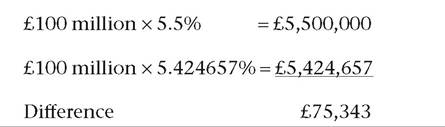
A dealer thinking 5.424657% represented an actual annual rate of interest and investing £100 million at this rate, would end up £75,343 out of pocket.
If the rate quoted is presented for a 360-day year then to compare with other effective annual yield rates we need to adjust upwards. This time the comparison rate is based on 365-days.

Let us assume the 360-day rate is 10%. To compare with other rates on a 365-day basis:
