So far, we have been exploring the input financial analysis elements, which are the market conditions, counterparty characteristics and behavioral assumptions.
In this part of the book, we will go through the output elements of financial analysis namely liquidity, value, income and their risk measurements.
As we discussed in Chapter 5, the centerpiece of the input-output elements is the financial contract.
In this chapter, we will go through the financial analysis elements considered in both market and funding liquidity management, their risk measurement and management and the strategies applied to ensure sufficient liquidity. We will see how liquidity management and risk analysis are based on the full integration of all types of financial risk factors. In addition, we will discuss the role of credit enhancements in liquidity management and the different types of liquidity reports. Then we will analyze value and income, which are driven by the referenced risk factors and valuation principles. We will explore their roles in profit and loss analysis and how they affect the strategies of new production. In addition we will illustrate how to measure and manage value and income risks, and how they are used in the management of economic capital as well as their effects in liquidity risk. We will also see how we can adjust risks by using the risk and profitability measurements. We will then explore the applicability of integrated stress testing and stochastic process emphasizing the key points in applying risk management. Then we will discuss all the different elements that define new production including the parameters of strategies, e.g., going concern, portfolio structure, etc., setting of targeting future volumes and their allocations, as well as the types of new financial contracts and counterparties constructing future portfolios. We will then see that the new production must consider and manage liquidity, value, income and risk and future profits and losses by considering the time evolution and dynamics in markets and counterparty risk factors. We will finally explore the key roles of treasury and funds transfer pricing in managing the evolution of new productions, the profit and losses as well as the exposure to financial risks. Figure 12.1 illustrates all the main elements considered in the above mentioned financial analysis.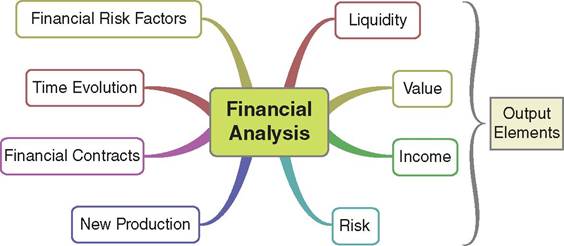
FIGURE 12.1 Main financial analysis elements in regards to liquidity, value, income, risk and new production
12.1
More financial literature on Economics.Studio
More on the topic So far, we have been exploring the input financial analysis elements, which are the market conditions, counterparty characteristics and behavioral assumptions.:
-
Conflictology -
Ecology -
Economy -
Finance -
History -
Law -
Medicine -
Philosophy -
Religious studies -