One FinTech and the Online Lending Landscape—Where Are We Now?
Online lending platforms have become a large part of the thriving FinTech sector, and startups in the space have become a mainstay in the financial press in recent years. Large amounts of venture capital are flowing into the sector.
Many of the current initiatives in financial technology innovation promise great disruption to the status quo in finance. It has become popular to predict the demise of banking as we know it. In fact, the Financial Times even dedicated a series to the subject, aptly titled “Death of Banks.”1 But are recent FinTech innovations really a threat to the existing financial system? And if they are, who says that their solutions will be superior to those that exist today and consumers will be better off?Even though banks are facing assaults on their hegemony on different fronts—payments, foreign exchange, wealth management, lending—we focus on online lending in this book. Let's first define what we mean with this broad term. Roughly speaking, online lending describes the emerging market outside of the established financial sector that is using technology to disrupt the lending market. There exist several business models in the online lending space, and different authors use different terminology to describe similar things. We realize this discussion can become confusing unless we agree on which terms we use for which approach. This is why we will describe several FinTech business models in more detail in Chapter 1, which will set out which terms describe which approaches in the rest of this book when we speak about marketplace lending.
Despite our focus on online lending, we also need an overview of the entire FinTech sector to understand the status quo and potential of the emerging hybrid financial sector. Many of the technologies are overlapping and building on each other. In their current form, most financial technology startups are still operating at small scale compared to the transaction volumes of established banks.
In reality, FinTech startups in their current form are far from a threat. Nevertheless, the sector is attracting large amounts of venture capital, and this trend is set to continue, with global investment in FinTech on track to grow to up to $8 billion by 2018.2 At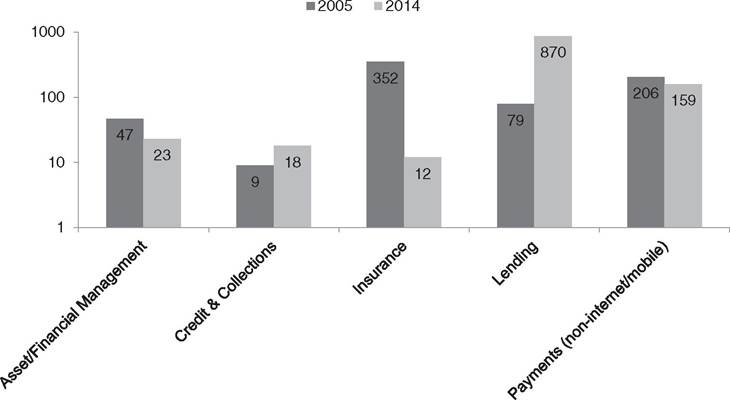
FIGURE P1.1 U.S. venture capital flowing into selected financial companies (US$ millions), excluding corporate venture capital
Data source: CB Insights
the same time, Gartner points out that banking and securities institutions are spending roughly $485 billion on information technology in 2014.3 On a global scale, the United States attracts the lion's share of FinTech investment, about 83 percent of global investment in 2013. Several hubs for activity of financial technology startups have emerged in recent years. Silicon Valley is the biggest FinTech cluster in the world, New York ranks second. London and Hong Kong are evolving as hotspots for startups as well.
Out of the different focus areas of FinTech companies, lending has emerged as a winner in recent years. Especially in the United States, lending companies lead both in terms of the absolute amount of venture capital funding it attracts (Figure P1.1) and the share of total investment in financial companies (Figure P1.2). Figure P1.3 shows venture capital funding over time and the number of investments in lending companies between 2005 and 2014 in the United States. The data consider investments of venture capital firms in financial companies other than FinTech. Nevertheless, the growth trend of capital flows into the lending space is evident. Lending attracted US$ 870 million of venture capital in the United States in 2014, roughly 80 percent of the total investment amount for the year. In comparison, venture capital investors invested less than 10 percent of their funds in lending companies in 2005. Remember that these are equity investments in companies, not capital invested in loans originated by these companies.
Another interesting observation is the relative draw of venture capital from the white-hot payments sector: even though mobile payments and digital wallets seem to occupy a prominent share of media attention, they were attracting less capital in 2014 than in 2005. The multiple of investment in payments over lending has changed from roughly 2.6 in 2005 (payments attracted 2.6 times the capital of lending) to under 0.2 in 2014.The rise of online lending as a leader in the FinTech space is expected: current interest rates are at their lowest since the financial crisis of 2007/8. However, transaction volumes of online lending platforms still pale in comparison with those of the conventional financial
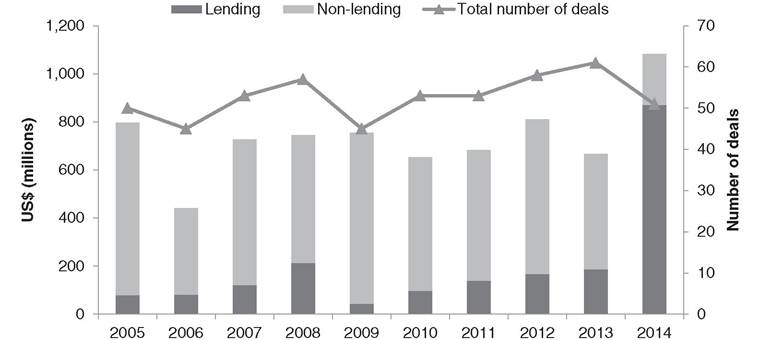
FIGURE P1.2 U.S. venture capital deal volume (US$), number of deals in financial companies, and proportion of investment in lending companies of total investment in financial companies, excluding investment banking and funds
Data source: CB Insights
sector. Nevertheless, author Charles Moldow predicts that by 2025, $1 trillion in loans will be originated on marketplace lending platforms globally.[4] Many technology experts predict that, in the near future, innovations in financial technology will pave the way for a massive paradigm shift that will unseat the existing players in financial markets. This is a possibility. No monopolist has been able to keep the walls up for over a hundred years. In essence, what financial technology startups promise is making transactions cheaper, faster, and more transparent, by replacing the current lending institutions with more effective platforms. They are “trying to eat the banks' lunch,” as Jamie Dimon, chief executive of JPMorgan Chase, put it.[5] But can FinTech companies follow through on their promises?
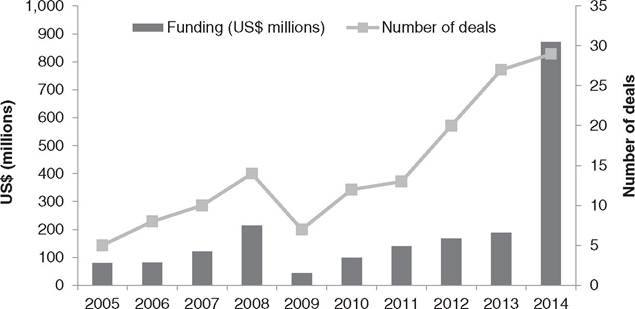
FIGURE P1.3 U.S.
venture capital investment volume and number of deals in lending companiesData source: CB Insights
The logical next step for online lenders and established credit institutions is to find common ground and join forces—at least in some respects. First baby steps are already taking place: banks including Citigroup, Capital One, Bank of Montreal, Barclays and Deutsche Bank are currently exploring ways to finance or securitize loans originated by online lenders.[6] [7] [8] 4 5 [9] This makes it seem as if online lending platforms simply served as sales offices for uncollateralized subprime loans for shadow banks. Of course, there are better ways to explore synergies between online lenders and banks, and all parties in the financial sector have complementary roles. When they work together, great opportunities arise to advance the financial industry toward providing better financial services and a more stable financial system. In the coming chapters, we will address some of the common themes around which innovation in online lending takes place today. We will also examine opportunities and risks. Integrating innovative, customer-centric approaches into banks comes with challenges of its own, and both innovators and banks should understand what they are getting involved in before embarking on the journey. Let's now get an overview of the FinTech sector before we focus on online lending in more detail. NOTES