The pit falls
Some FinTech companies are prone to wrong assumptions about their chances for disruption, including overestimating data science to deal with concentration and adverse selection, overestimating the value of transaction data, overestimating people's willingness to trust technology companies, and overestimating the regulators' willingness to forgive small companies for flouting the rules.14 Figure 1.4 shows how they overlap.
The following paragraphs will briefly explain each of them.1.3.1 Overestimating the ability of data science to deal with concentration and adverse selection
When technology companies segment the market into smaller and smaller fragments, which they service with niche offerings, their customer lists are often rife with concentration risk. When the fortunes of the financial markets change, customers with highly correlated behavior can bring abrupt failure to a company with an excellent track record. To be fair, some banks have been guilty of overestimating data science to deal with concentration risk and adverse selection as well. Why does data science fail to be the cure-all when selecting customers? Hardly because banks are smarter than we give them credit for, but because customer selection is more difficult than we think.
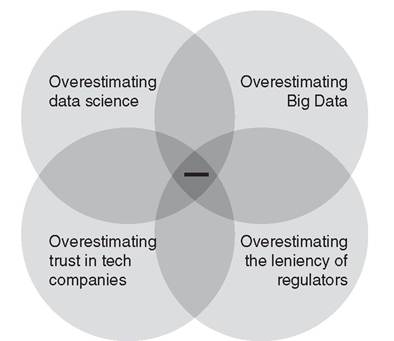
FIGURE 1.4 FinTechpitfalls
1.1.14 Overestimating the value of Big Data in transactions
Data science and Big Data are promising avenues. However, the dollar value of the data that individual users generate on a network is still open to debate. Even though it is interesting to know each and every step that users take on a network, transaction data in itself may be overvalued. Is combining social network analysis with neural net algorithms a billion dollar business idea? Extracting accurate predictions from Big Data still has several hurdles to overcome, and business models that depend on it are unproven.
Those FinTech companies with transactions for the sake of generating data at their core might be in for a rough ride.1.1.15 Overestimating people's willingness to trust a
FinTech company instead of another middleman
Some FinTech companies build platforms that unite a fragmented market and make forex, bond trading and other financial transactions look similar to a stock exchange. In short, such platforms aim at disrupting the “middlemen.” Companies with success in this game often involve a lot more “fin” and a lot less “tech” in their operations. A trading platform needs to convince all parties that transactions between them are safe and that the platform will function in a fair manner. Building trust and good relationships is far more important than cool technology alone. Those companies that manage to build trust make money whether or not they have good technology.
1.1.16 Overestimating the regulators' willingness to pardon
a FinTech company flouting the rules
Financial regulation is strict for a reason: it aims to protect the consumer. The approach of startups to break the law and then send out a press release claiming regulators obstruct their innovative business model has little chance of success in FinTech. In the financial sector, small businesses come with severe diseconomies of scale in terms of regulation. When regulation comes to their doorstep, they will have to follow the same rules as everybody else, regardless of their size.
FinTech is still an immature space, and which business models will prevail is highly uncertain. Nevertheless, the financial industry is likely to profit from outside innovation.
1.2 WHY IS FINANCIAL TECHNOLOGY INNOVATION IMPORTANT?
Most of the services that FinTech startups provide already exist in one form or another. The only problem is that these existing services have been relatively expensive, inefficient, or exclusive. FinTech promises to democratize financial services by making them more efficient, transparent, fair, profitable, and robust.
Consider, for example, payment processing. Shopkeepers have been able to accept cashless payments by credit cards for decades. However, this only makes sense for vendors of a certain size. Those who sell items at the flea market hardly have the scale to absorb the cost involved in processing credit cards. Several mPOS startups have sprung up in recent years that provide credit card readers that plug into a smartphone. Credit card processing is thus available for any merchant or private individual at low cost. The same goes for online financial advisors. A healthy industry of private wealth managers has prospered through the ages, but it existed only for a select group of high-net-worth individuals at considerable cost to the client. Robo-advisors slash this cost to a few basis points, while providing comparable services to almost anybody with a regular savings account or a retirement savings account, such as a 401(k).Common themes in financial technology innovation are streamlining processes, reducing search costs, and minimizing transaction costs, which broadens access to financial services for new customers. FinTech startups thus serve two goals: they increase the market and re-segment it—at the expense of the incumbent players in the established financial sector. It is clear that most of the new services fulfill a need that customers have, mostly because the existing financial sector is not offering it, or is offering it at a price point that prohibits customers from using it. If banks offered a simple way to conduct financial transactions online, why would a payment processor like PayPal amass hundreds of millions of users?
In online lending, the existing gatekeepers are banks and other established lending institutions. How exactly banks operate will be the subject of Part Two of this book. For now, let's simplify and say that banks aggregate deposits from customers and then lend out these deposits to borrowers at a higher interest rate than they pay to those customers who deposited money in the accounts. To minimize the risk of default, they carefully select borrowers according to strict criteria. This often excludes individuals with a low credit score or SMEs with low revenues. Since the financial crisis of 2007/8, banks in the United States have issued on average 15 percent fewer loans to this customer group.15 Online lenders therefore enjoy strong demand from borrowers starved for credit. Demand is hardly the problem for online lending platforms. The main challenge is making a credible case that those who invest in these platforms will receive healthy returns. Online lenders must therefore find the balance of carefully vetting their borrowers and improving on the lending process that established banks would provide. This is by no means a simple endeavor. It took banks hundreds of years to perfect their lending practices, so reinventing the sector at scale in a decade will be a gargantuan task.
1.3