The two types of yield
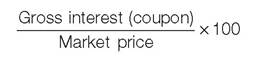
The current yield[28] is the gross (before tax) interest amount divided by the current market price of the bond expressed as a percentage:
Thus, for a holder of Bluebird's bonds in Example 13.3 the current yield is:
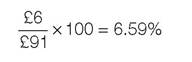
This is a gross yield.
The after-tax yield will be influenced by the investor's tax position.Net interest yield = Gross yield (1 - T)
where T = the tax rate applicable to the bond holder.
At a time when interest rates are higher than 6.59% for that risk class it is obvious that any potential purchaser of Bluebird bonds will be looking for a return other than from the coupon. That additional return comes in the form of a capital gain over three years of £100 - £91 = £9. A rough estimate of this annual gain is (9/91) ÷ 3 = 3.3% per year. When this is added to the current yield we have an approximation to the second type of yield, the yield to maturity (the redemption yield).
The yield to maturity of a bond is the discount rate such that the present value of all the cash inflows from the bond (interest plus principal) is equal to the bond's current market price. The rough estimate of 9.89% (6.59% + 3.3%) has not taken into account the precise timing of the investor's income flows. When this is adjusted for, the yield to maturity is 9.59% - the internal rate of return calculated in Example 13.3.