Trading time drafts
With a time draft the bill is returned to the exporter who can either hold it until maturity or sell it at a discount. Many bills of exchange are traded in an active secondary market.
The purchaser (discounter) in this market pays a lower amount than the sum to be received at maturity from the customer. The difference represents the discounter's interest payment. For example, the customer might have signed the bill promising to pay £300,000 in 90 days. The bill is sold immediately by the exporter to a discount house or bank for £297,000. After 90 days the discounter will realise a profit of £3,000 on a £297,000 asset. Through this arrangement the customer has the goods on 90 days credit terms, and the supplier has made a sale and immediately receives cash from the discount house amounting to 99% of the total due. The discounter, if it can borrow at less than 1% over 90 days, turns a healthy profit. The sequence of events is shown in Figure 11.1.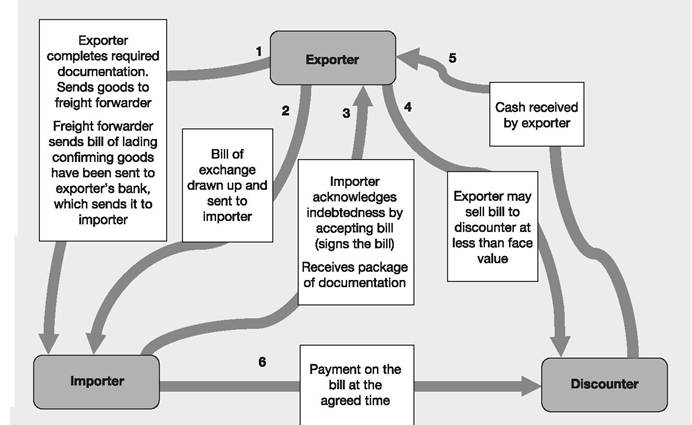
Figure 11.1 Bill of exchange sequence
Despite the simplification of Figure 11.1, many bills of exchange do not remain in the hands of the discounter until maturity but are traded a number of times before then.
Bills of exchange are normally used only for large transactions (> £100,000). The effective interest rate charged by the discounter is usually a competitive 150-400 basis points over interbank lending rates (e.g. Libor). The holder of the bill usually has recourse to both of the commercial companies: if the customer does not pay then the seller will be called upon to make good the debt. This overhanging credit risk for the exporter can sometimes be transferred (to, say, a bank) by buying credit insurance. If the bill is guaranteed by another bank or the importer has a very high credit standing it may not carry recourse rights for the holder to force the exporter to pay.
More on the topic Trading time drafts:
- The Making of the 1993 Constitution
- A Prolegomenon: Imperative of Constitution-Making and Creating a New Constitutional Order
- Nepal's current Constitution, the seventh in the country's history, remains to this day controversial, especially for many marginalised groups in Nepali society, notwithstanding the inclusivity of the body that drafted it and the extensive international support it received.