Commentary
Kazimi’s commentary delves into the minutiae of al-Shaykh al-Baha’i’s text on appraising solitary reports (khabar al-ahad). He does so by refining legal definitions and exhaustively examining which juristic positions are logically consistent, and therefore correct in his view, through complex examples with multiple variables.
Kazimi appeals to various forms of reasoning to make his arguments as well as discredit those he does not agree with, utilising neo-Aristotelian logic and Islamic philosophical conceptualisations that he does not explicitly outline; this approach makes his jurisprudential writing challenging to follow and decipher. Through this process, Kazimi explicitly puts not only al-Shaykh al-Baha’i’s views under the microscope, but also those of the major “classical” jurists al-Shaykh al-Tusi, al-Muhaqqiq al-Hilli, and al-'Allama al-Hilli, as well as later juristic positions and methods that were generally accepted in his time. His main aim is thus to gather all relevant Twelver juristic positions on the matter in order to derive a consistent and rationally sound approach to appraising solitary, non-Twelver transmitters and the question of the acceptance of their reports.[a.1] al-Shaykh al-Baha’i’s section begins with the necessary conditions for a solitary transmitter to have his report accepted by Twelver jurists. After first asserting that the acceptability of the use of solitary reports is already well established, Kazimi proceeds to analyse the five conditions laid down by al-Shaykh al-Baha’i. He combines adulthood (bulugh) and sanity ('aql) under the category of taklif, the capacity to be held accountable, in contrast to the examples he gives of the young boy who is unable to exercise discretion (al-sabiyy ghayr al-mumayyiz) and the completely "insane" person (al-majnun al-mutbiq). However, whereas those examples clearly demonstrate lack of taklif, Kazimi wishes to examine the more complex cases of the transmission of the precocious young boy (al-sabiyy al-mumayyiz) and the insane person who experiences intermittent moments of clarity (al-majnun ghayr al-mutbiq wa-huwa al-dawri), especially since Kazimi acknowledges the difference of juristic opinions regarding accepting their transmitted reports.
Kazimi first breaks down the discussion regarding al-majnun ghayr al-mutbiq on the basis of whether the insane person’s moments of clarity are clouded by his condition, although Kazimi does not explain how such interference would be determined. If the person’s insanity interferes with his moments of clarity, then his transmission during his moments of clarity is rejected. Conversely, if it does not, then his transmission is accepted.As for the precocious boy, Kazimi notes that Twelver jurists and the majority of Sunni scholars (al-'amma) do not accept his transmission. However, Kazimi dismisses the acceptance of a precocious boy’s transmission by some Sunni scholars on the basis of analogy (qiyas) of permitting a young boy to lead prayer (iqttda1). Kazimi considers this argument weak for two reasons: because the permission for a boy to lead prayer is not a basic premise (asl) that everyone agrees on, and because prayer itself is a different category than transmission. Instead, Kazimi argues that acceptance of a precocious boy’s transmission must be seen as comparable to that of a fasiq, which he uses here to refer to an immoral adult. His rationale is that a boy is more prone to lying than a fasiq because a fasiq is at least accountable both in this world and in the afterlife by virtue of being an adult. However, the precocious young boy, knowing he cannot be held accountable because of his age, is not similarly restricted, and thus, Kazimi argues, there is nothing to prevent him from lying in his narration. Thus, if the fasiq is liable to lying in his narration, all the more so the precocious boy, so the rejection of the fasiq’s transmission must mean the rejection of precocious boy’s transmission, which Kazimi asserts as the correct opinion. While this position would clearly apply to the case of a precocious boy who heard a narration and transmitted it
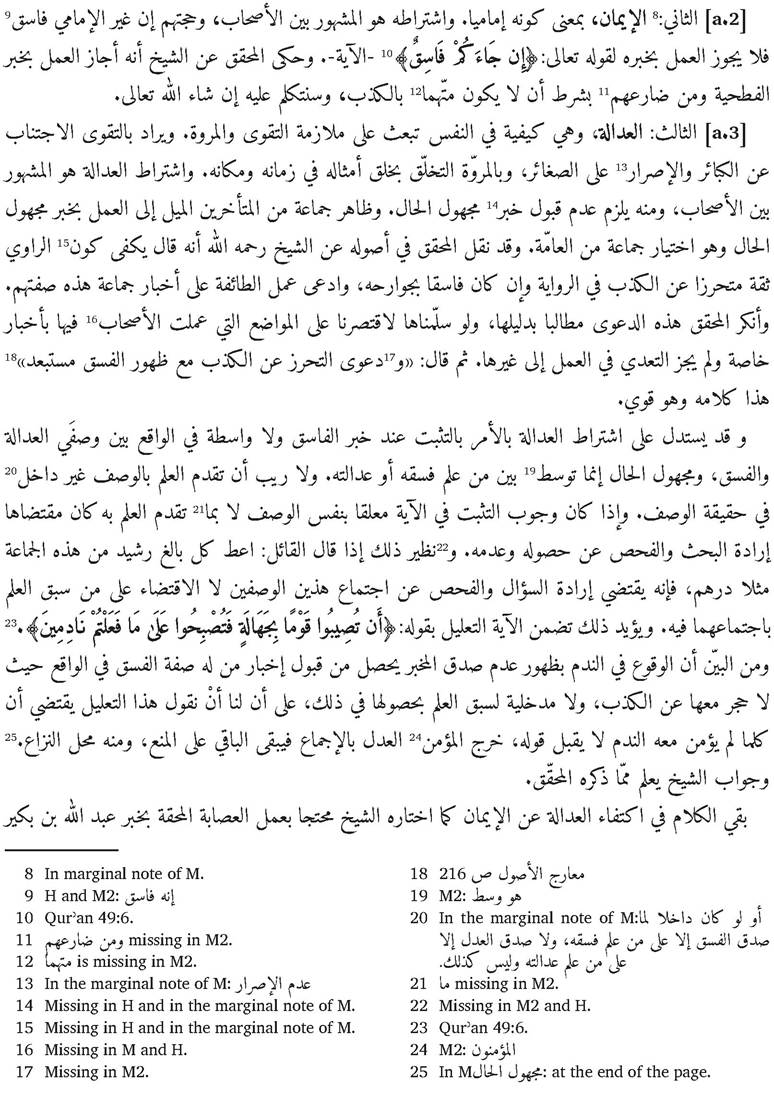
before reaching the age of maturity, Kazimi presents another case that leads to a different conclusion: hearing a narration before reaching maturity and then transmitting it after adulthood.
In this case, such transmission is acceptable, because then the transmitter, upon reaching adulthood, becomes subject to accountability for what he transmits, and his transmissions are thus considered the reports of an upright person (akhbar al-'adl).[a.2] Kazimi then proceeds to discuss al-Shaykh al-Baha’i’s condition that the transmitter must have “belief” (iman) in order for his solitary report to be accepted. Kazimi defines “belief,” in accordance with most Twelver jurists, as meaning the transmitter must be Twelver. He cites the “Reliability Verse”,21 as proof of the necessity of verifying the report of a fasiq, which Kazimi here specifies to mean anyone who is a non-Twelver, that is, is incorrect in his beliefs rather than immoral in his actions. Kazimi mentions that al-Muhaqqiq al-Hilli reported that al-Shaykh alTusi permitted acceptance of the reports of the Fathiyya22 and others like them as long as they had not been accused of lying. Kazimi, who rejects al-Shaykh al-Tusi’s argumentation regarding this point, discusses it in more detail in the following section.
[a.3] The subsequent stipulation that Kazimi expounds on is uprightness ('adala), which he defines as the state in which a person expresses God-fearing and virtue (al-taqwa wa-l-muruwwa). He defines a “God-fearing” person as someone who completely avoids major sins (al-kabahr) and does not repeatedly engage in minor sins (al-sagha’ir). He defines “virtue” as adhering to the standards of morality among the transmitter’s peers and the people of his region. Kazimi asserts that the condition of uprightness is standard among the Twelver jurists, which would entail the exclusion of reports by transmitters whose moral status is unknown. However, he notes that it is clear that some of the later Twelver scholars tend to accept solitary reports that are transmitted by a transmitter of undetermined reliability (majhul al-hal), which, he believes, is also the preference of some Sunni scholars (al-'amma).
By way of example, Kazimi references al-Muhaqqiq al-Hilli in his book on usul (referring to Ma'arij al-usul) to point to al-Shaykh al-Tusi as one of the major Twelver scholars who accept reports by majhul al-hal. 23 According to al-Muhaqqiq al-Hilli, al-Shaykh al-Tusi states that a narrator is accepted as trustworthy if he is not known to lie about narration, even if he is considered an immoral person in other parts of his life; al-Muhaqqiq al- Hilli understands this statement as applying to the issue of majhul al-hal since a transmitter of undetermined reliability could possibly be an immoral person. Whereas al-Shaykh al-Tusi claimed that the Twelver jurists (al-t&ifa) had accepted reports by transmitters in this category, al-Muhaqqiq al-Hilli himself rejected this claim, and thus the acceptance of the reports of a majhul al-hal, on the basis of the weakness of its reasoning; he states that the idea that a transmitter who is known to be immoral would also refrain from lying is unlikely. He further underscores his point by stating that even if this type of transmission were acceptable, it would only be permitted for this specific instance, i.e. only when the majority of Twelver jurists acted on the basis of a specific report; it should thus not be generalised as a principle applying to all reports falling under the same category. Kazimi agrees with al-Muhaqqiq al-Hilli’s position of the unreliability of the immoral person.Kazimi elaborates on al-Shaykh al-Baha'i’s inclusion of the “Reliability Verse” as the basis for uprightness being a condition of a transmitter’s trustworthiness, understanding the second half of the verse to mean one must seek to verify the report or statement of one who is fasiq, lest one cause harm to the community out of ignorance and become regretful due to wrongdoing. Kazimi goes further to assert that there can be no middle ground between immorality and uprightness. A transmitter’s status cannot be both; he must be immoral or upright, and so cannot be upright
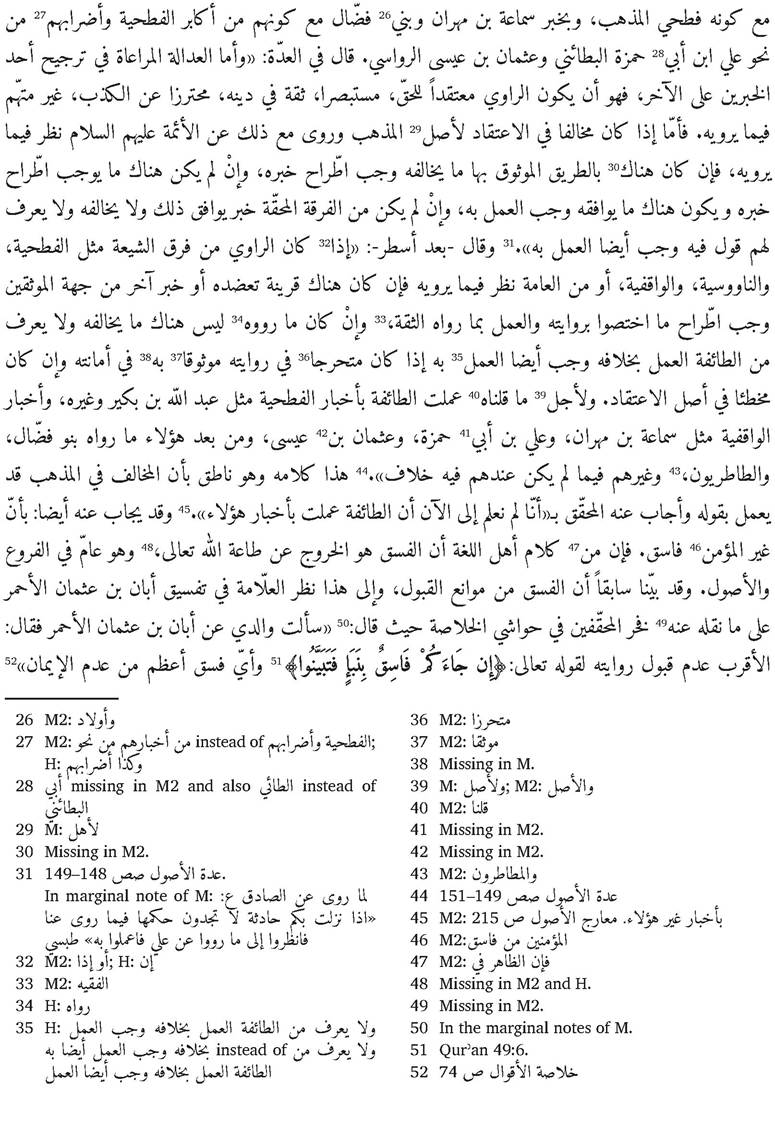
in some aspects and not in others.
It is a matter of knowing or nor knowing one's status. If one does not know a transmitter’s status, the “Reliability Verse” compels him to investigate and examine the transmitter’s characteristics until his status can be determined. Kazimi then gives the example of a command to someone to give a dirham to every upright male in a particularly group who had reached maturity; Kazimi then rhetorically asks, “Wouldn’t the person responsible have to check which males currently met these two conditions in order to properly carry out this command, instead of relying on what he or others knew of them previously?” In this way he demonstrates that the issue at stake is that a person’s status may have changed from child to adult since the last time someone checked their status. Kazimi argues that it is clear from the verse that regret occurs when one accepts a report from a narrator known to be fasiq because fisq does not deter one from lying, and prior knowledge offisq is not the main issue but the likelihood of regret that would occur after accepting the report of a fasiq. According to scholarly consensus, the only type of transmitter who is exempt from this type of examination is the upright transmitter who is also a believer (i.e. Twelver); therefore those who do not fall in this category are not considered upright.For Kazimi, the remaining discussion on this section concerns the issue of stipulation of uprightness for a transmitter without the concomitant stipulation of “correct belief,” a point that al-Shaykh al-Baha’i mentioned as al-Shaykh al-Tusi’s position, with which al-Shaykh al-Baha’i and Kazimi both disagree. al-Shaykh al-Tusi based his claim on the accepted practice of the Twelver jurists (al-'isaba al-muhiqqa) regarding the reports of non-Twelver Shi'is such as the Fathiyya, Nawusiyya,24 Waqifiyya,25 or the Sunnis. That accepted practice meant that if there was additional corroborating information, or another verified report, then the report that overlaps must be preserved and the ones that disagree must be discarded.
Kazimi cites al-Shaykh al-Tusi’s statement in al-'Udda26 that the determining factor in preferring one report over another is that the narrator believes in the “true” faith, adheres to his religious practice, refrains from lying, and is never accused of distorting his narration. Yet he notes al-Shaykh al-Tusi’s exception: if the creed of the transmitter does not conform to that of the adherents of the Twelver school (mukhali- fan li-ahl al-madhhab) but he narrates from the Imams, then his reports must be examined. If his transmission is contradicted by a transmission of a trustworthy chain (i.e of Twelver transmitters), then his report must be discarded. However, if there is nothing in the Twelver corpus that agrees or disagrees with the report, and there is no known precedent among the Twelvers that disagrees with it, then it is compulsory to accept it. Al-Muhaqqiq al-Hilli, Kazimi cites, rejects al-Tusi’s stipulation, arguing that there is no evidence that accepting reports of non-Twelver Shi'is is an accepted or established practice of the Twelver jurists.27Kazimi also notes that lexicographers (ahl al-lugha) define fasiq as “one who is not obedient to God,” which may include disobeying God through acts or “incorrect” beliefs. This implies, Kazimi asserts, that whoever is not a Twelver is a fasiq. Having had previously established in Section [a.1] that fisq necessitates rejection of a report, Kazimi notes that al-'Allama al-Hilli had attributed fisq to Aban b. 'Uthman al-Ahmar, which Kazimi observed from Fakhr al-Muhaqqiqin’s (d. 771/1369-70) comments in the margins of al-Khulasa: that after asking about Aban b. 'Uthman al-Ahmar, his father, al-'Allama al-Hilli, had responded that the most appropriate position was rejection of his narration according to the “Reliability Verse”, commenting, “and what is a greater fisq than being a non-Twelver.”28 However, Kazimi notes that al-Shaykh al-Baha’i rejects this position because the term fasiq cannot be applied to one who misunderstands certain beliefs
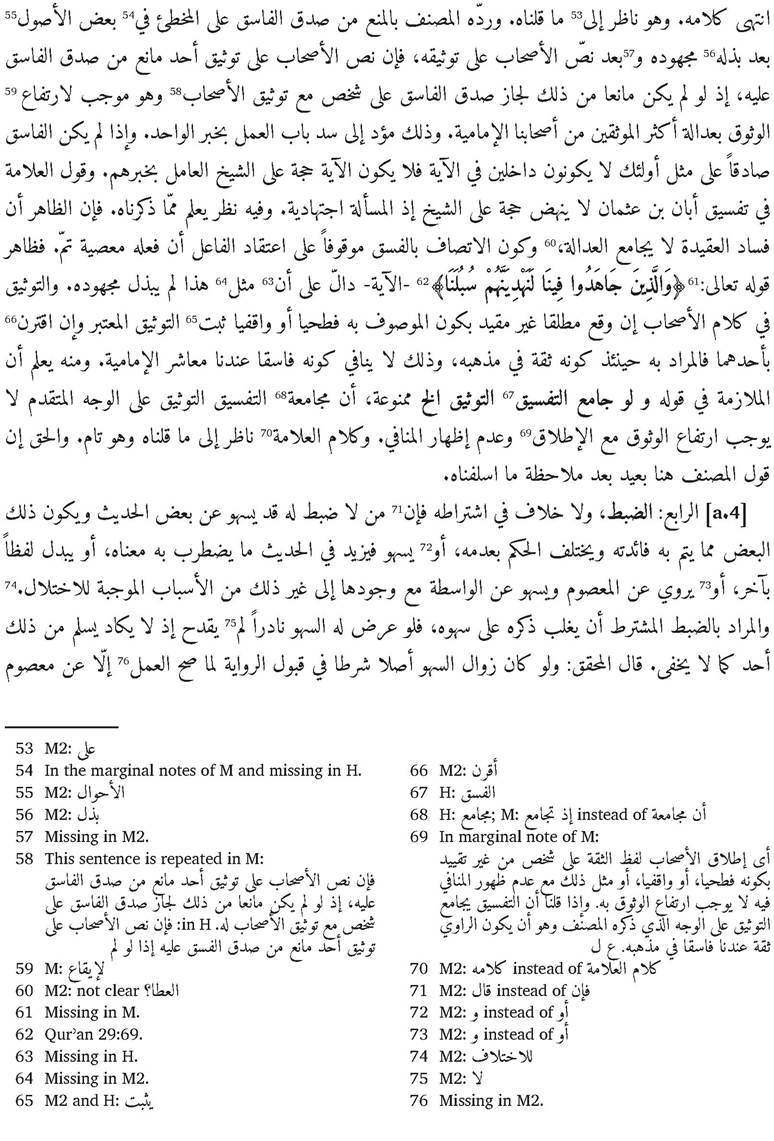
(usul) after having exerted himself to understand them and after having been deemed trustworthy by Twelver scholars.
Kazimi agrees with al-Shaykh al-Baha’i that if the term fasiq can be applied to someone who is already deemed trustworthy by Twelver scholars, that would mean that the reliability of most trustworthy Twelver narrators (min ashabina l-Imamiyya) would be questioned, and so the whole system of appraising solitary reports would collapse. Thus, for al-Shaykh al-Baha’i, a narrator who has been determined to be trustworthy by Twelver scholars cannot be later deemed fasiq. Kazimi then states that if the term “fasiq” does not apply to non-Twelvers, then the “Reliability Verse” would not apply to them and would not be considered a proof against accepting their reports. Also, according to Kazimi, al-'Allama al-Hilli’s consideration of Aban b. 'Uthman as fasiq was based on a personal opinion that does not constitute an argument against al-Shaykh al-Tusi, who accepted non-Twelver reports under certain conditions. In summary, Kazimi and al-Shaykh al-Baha’i consider al-'Allama al-Hilli’s opinion that non-Twelvers are fasiq by default to be unproven. Hence, non-Twelvers who were considered trustworthy by Twelver scholars cannot be declared fasiq.
After thus elucidating the issues with al-Shaykh al-Baha’i’s reasoning that fisq and trustworthiness cannot be attributed to the same person, Kazimi disagrees and provides his own reasoning. Kazimi bases the characterisation of someone as fasiq on one’s belief (Ftiqad) because incorrect belief is a disobedience to God. Kazimi then supports his argument with a section of, wa-l-ladhina jahadu fina la-nahdiyannahum subulana (“.and those who struggle for Us, We will guide them.”).29 Kazimi interprets this part of the verse to indicate that a non-Twelver is considered fasiq because he did not exert sufficient effort to find the “truth”. Therefore, theologically speaking, any non-Twelver is considered fasiq in belief by default. According to this logic, if one were to accept a transmission from a non-Twelver that would indicate that he considered the non-Twelver trustworthy in transmission, leading to the conclusion that fisq and trustworthiness in the same person could exist at the same time in this specific case, as Kazimi asserts. According to Kazimi, if a transmitter is mentioned as trustworthy by Twelver scholars without specifying that he is a Fathi or Waqifi, then this is considered proper verification, because the assumption is that the transmitter in this case is a Twelver. However, if the transmitter is in fact mentioned as a Fathi or Waqifi, then the transmitter is understood to be trustworthy according to his own community, although it does not negate the fact that he is considered a fasiq by the Twelvers. Accordingly, for Kazimi, one can be considered upright and fasiq at the same time in such situations when one is a non-Twelver transmitter known to be of good standing in his own community. Drawing from al-'Allama’s argument, Kazimi argues that al-Shaykh al-Baha’i’s opinion is an implausible one, and that trustworthiness and fisq can in fact coexist in certain cases.
[a.4] The final condition that Kazimi expounds on is accuracy (dabt); he notes that there is no doubt regarding accuracy being a condition, because a transmitter who narrates a report without accuracy could distort its meaning or affect its reliability by omitting a transmitter in its isnad. Kazimi clarifies al-Shaykh al-Baha’i’s definition of accuracy as meaning the “preponderance of remembering over forgetting” as referring to one who rarely forgets or errs, and thus causes no harm, since it is impossible for anyone to have an infallible memory; hence, al-Muhaqqiq has argued that accuracy must be a condition, an argument that Kazimi endorses.30 Additionally, Kazimi considers an argument of al-Shahid al-Thani (d. 965/1558) in his work al-Diraya that uprightness should suffice as a condition because an upright transmitter would not narrate something unless he knew he could do so accurately.31 Kazimi dismisses this reasoning, arguing that
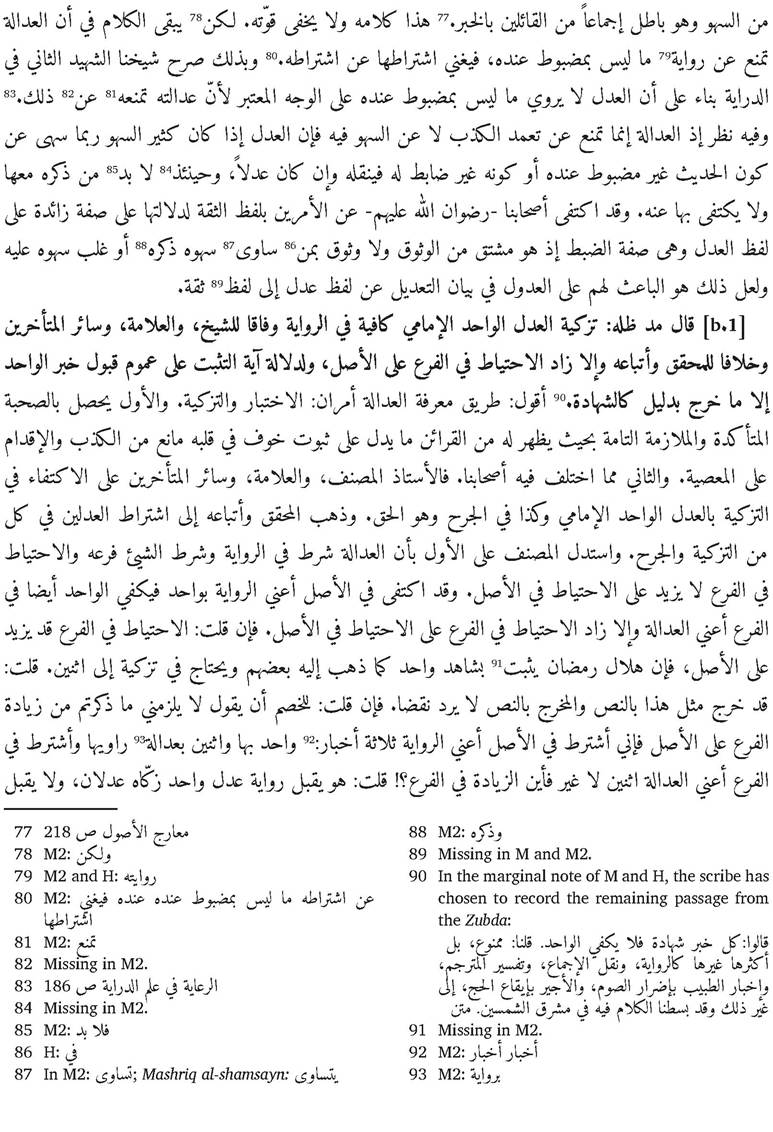
an upright person’s probity would only prevent him from lying about a report, not forgetting its details, so he could still forget parts of a report or even the fact that he is not accurate in his reporting. Kazimi adds that Twelver scholars (ashabuna) have attempted to cover both uprightness and accuracy by the condition of reliability (thiqa), for reliability entails both uprightness and accuracy; one who often forgets cannot be considered reliable, and so must have his reports corroborated. For that reason, they have preferred the word thiqa over 'adl.
[b] Section
This section focuses on two main issues: that requiring to have more than one upright Twelver attest to the reliability of a transmitter is excessive, and that if a transmitter’s reliability has been equally corroborated by a trustworthy person and criticised by another, the criticism of the transmitter’s reliability is given preponderance unless the corroborators are more numerous and scrupulous than the critics.
[b.1] Commenting on al-Shaykh al-Baha’i’s discussion on the sufficiency of a single, upright, Twelver (Imam) in determining a transmitter’s reliability, Kazimi asserts that there are two ways of ascertaining uprightness: the critic’s long-term familiarity with the transmitter (ikhtibar) and testimony or appraisal from others (tazkiya). For Kazimi, long-term familiarity consists of an adequate level of companionship, in which one can witness various factors that indicate fear of God, lack of inclination to lie, and abstention from committing sin. Kazimi notes that al-Shaykh al-Baha’i, al-'Allama al-Hilli, and the later scholars agree that the attestation of one upright Twelver to a transmitter’s uprightness or lack thereof is sufficient to determine the status of the transmitter’s reliability, which Kazimi holds as the correct position. The other position that Kazimi notes was taken up by al-Muhaqqiq al-Hilli and his followers, which stipulated that there must be two upright witnesses to determine whether a transmitter is upright or not. Kazimi further explains the position of al-Shaykh al-Baha’i in contrast to that of al-Muhaqqiq al-Hilli, arguing that the primary concern for the jurist is the integrity of the transmission, whereas uprightness is only a condition for the acceptance of the transmission. So, for Kazimi, since Twelvers accept transmission through a single transmitter, they cannot require more than one person to verify that transmitter’s uprightness, because doing so would mean giving more importance to the condition of being upright rather than the issue of transmission.
In explaining al-Shaykh al-Baha’i’s first argument, Kazimi provides the reasoning behind it through a dialogue with an imagined interlocutor in which he uses logical reasoning to make his case. First, he has his interlocutor argue that there are cases in which precaution in an ancillary issue can exceed the precaution in a primary issue - as in the sighting of the moon of Ramadan - which is accepted with a single witness according to some scholars, whereas tazkiya requires two witnesses. Kazimi states that the stipulation of a single witness sighting the moon does not relate to this issue of tazkiya because sighting the moon by a single person has basis in a specific textual proof (and therefore cannot be generalised). Furthermore, because one cannot accept the transmission of one upright person approved by two upright people while at the same time rejecting the tazkiya of an upright person by two upright people, Kazimi argues that it is a contradiction. Thus, precaution in an ancillary issue - i.e. the tazkiya - cannot exceed the precaution in a primary issue - i.e. the transmission.
In clarifying al-Shaykh al-Baha’i’s second argument, Kazimi then points out that there is a text-proof in the “Reliability Verse”32 for the acceptance of the report of a single, upright transmitter in all aspects including narration, tazkiya, and testimony but that testimony is exempted
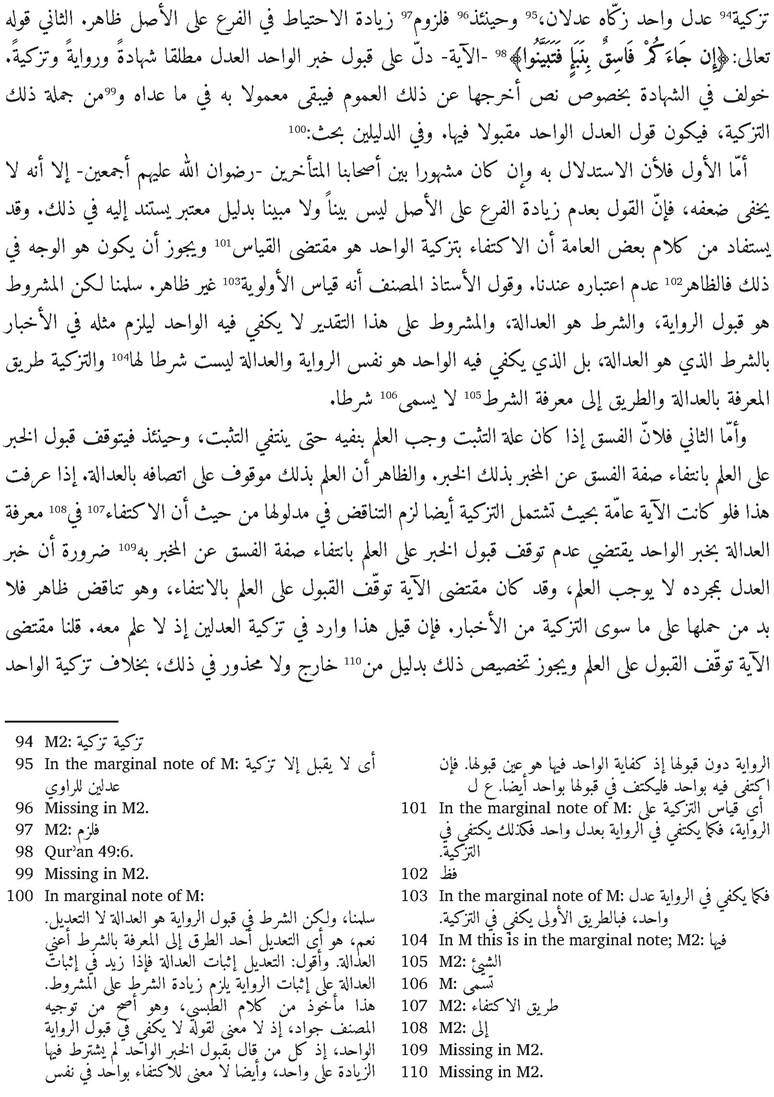
from this rule by another textual proof33 requiring two witnesses. Therefore, anything other than testimony may be accepted through a single upright person.
Kazimi then presents the potential limitations of al-Shaykh al-Baha’i’s two arguments, the first of which he dismisses, and the second of which he partially concedes to. As for the first argument: Kazimi states that the argument of extra precaution in verifying the uprightness of transmitters, although accepted among the later Twelver scholars, is weak, not self-evident, and has no strong evidence to support it. Al-Shaykh al-Baha’i argues that tazkiya by a single upright person is acceptable based on qiyas al-awlawiyya (a fortiori argument), which Kazimi dismisses as invalid. For him, tazkiya is merely the means by which one determines uprightness, and since the method of determining the condition (uprightness) cannot be a condition itself, the analogy thus does not apply.
As for the second argument that anything other than testimony may be accepted through a single upright Twelver, including tazkiya: Kazimi clarifies that the “Reliability Verse,” which he had earlier argued was a proof-text for needing only one person for tazkiya, may in fact be inapplicable to tazkiya. He explains that one would only need to obtain corroboration of a report of an individual who is fasiq; conversely, one does not need to obtain corroboration of a report from a transmitter who is not accused of fisq, which is typically determined through information stating that a transmitter is upright. Thus, for Kazimi, it is obvious that determination of the lack of fisq is conditional on knowledge of the transmitter’s uprightness. Kazimi acknowledges that if the “Reliability Verse” were to apply universally to include tazkiya, then it would create a contradiction, because then the requirement would be to verify that a transmitter is not a fasiq rather than verifying his report. Therefore, the verse must be understood to refer to reports other than tazki- ya. Kazimi says that if his interlocutor were to argue that the tazkiya of two persons does not give “certain” knowledge either, then one must acknowledge that the point of the “Reliability Verse” is to make the acceptance of a report conditional on knowing the transmitter’s lack of fisq. The acceptance of the report in this way, via Qur’anic verse, can thus only be limited by another textual proof. For this reason, Kazimi argues, a single upright witness to a transmitter’s trustworthiness is sufficient because the witness provides probable knowledge (zann) that the transmitter is more trustworthy than not. In this case, it is best to accept the narration of such a transmitter, because, as Kazimi argues, there is more harm in the discarding of a report that is likely to be true than there is in retaining it. However, in the case of the report of a fasiq, probable knowledge is reversed, i.e. the possibility of falsehood is higher than the possibility of truthfulness in the report, which means that there would be greater harm in accepting the report than discarding it. Therefore, God (the “Shari'”) has relieved the community of believers from accepting the report of a fasiq at face value by asking them to verify it.
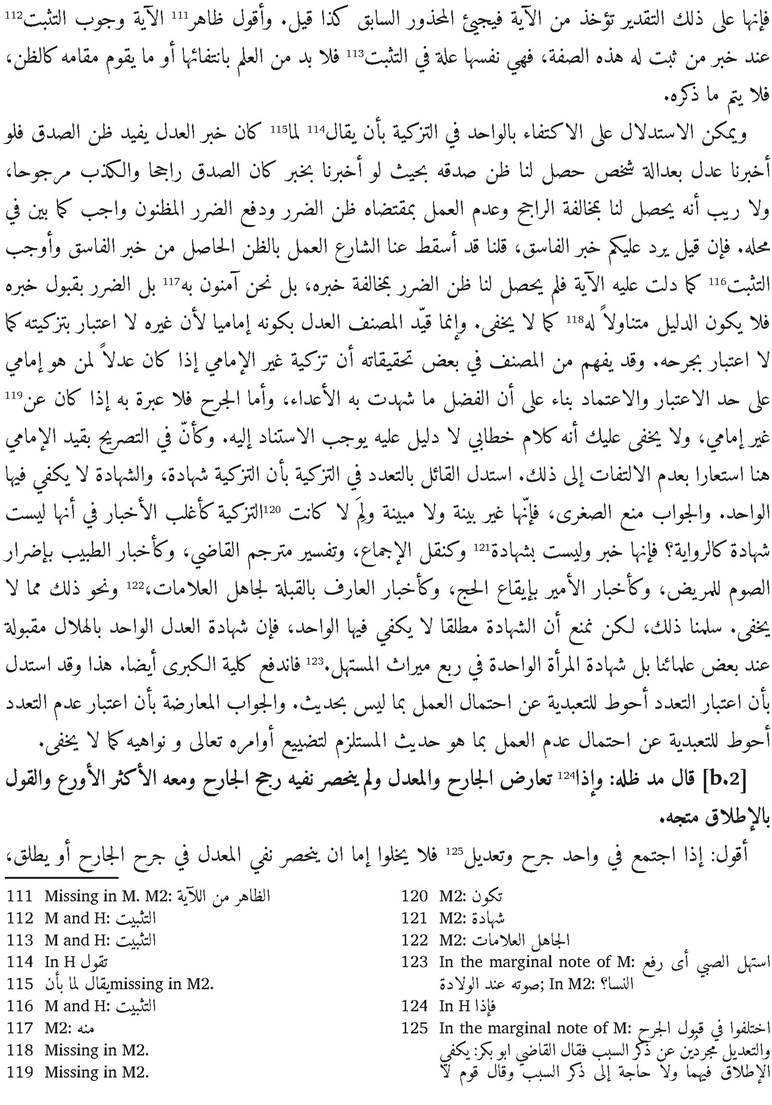
Kazimi points out that al-Shaykh al-Baha’i stated that a witness to the trustworthiness of a transmitter must be an upright Twelver (Imami) in order for his testimony to be accepted by default, and that al-Shaykh al-Baha’i had mentioned elsewhere (fi ba'd tahqiqatihi) that the Twelver jurists did not concern themselves with non-Twelvers attesting to the uprightness of a Twelver transmitter. However, a positive appraisal by one of their opponents would be accepted, with the reasoning that an opponent’s tazkiya would be all the more reliable since it was not self-serving. Kazimi does not find this line of thinking convincing, referring to it as rhetorical discourse (kalam khitabi) rather than proper reasoning.
Kazimi then reiterates that reports do not fall under the same conditions of requiring two upright persons as testimony does, giving the same examples as those of al-Shaykh al-Baha’i, with some modifications, where one witness is accepted as sufficient. Kazimi is careful to note, however, that even though the testimony of a single female adult witness is accepted regarding the live birth of a baby and its effect on the mother’s inheritance (fi rub' al-mustahill), one cannot generalise about testimony based on this specific case. The essential rule is that testimony (shaha- da) is not commensurate with appraisal (tazkiya). One may argue that requesting more than one witness is a better precaution rather than acting upon a report that may not be valid. Kazimi, however, argues that this reasoning is invalid because it may lead to the neglect of God’s commands and prohibitions.
[b.2] Kazimi’s commentary on this section is concerned with what to do when there are two conflicting opinions on whether a transmitter of a solitary report is upright or not. When it is not clear that one opinion has more evidence than the other to support it, Kazimi’s treatment of the issue becomes more complex. Rather than having two equally contradictory appraisals simply revoke each other, Kazimi frames the relationship between criticism and approval as forms of specific and general knowledge. While a mu'addil can only attest to knowing that the transmitter was in a general state of uprightness, he cannot claim to know that the transmitter never committed an act offisq, since it is not humanly possible to have knowledge of all things at all times. A mu'addil’s attestations of trustworthiness is therefore always general knowledge at best. A jarih, however, needs only to point to a specific instance of fisq in order to discredit the transmitter; therefore, his knowledge is specific by definition. Thus, the jarih’s opinion is preferred in instances of stalemate. However, this does not mean that the mu'addil’s opinion is completely disregarded in relation to appraisals of transmitters or even the transmitter in question; rather, it only means that the mu'addil reported what he knew to be true, however limited it may have been. In instances where the mu'addils are found to be higher in number or more scrupulous (akthar aw awra'), then their opinion is preferred. In order to illustrate this concept, Kazimi gives the example of a jarih who stated that he saw a certain transmitter drink wine at the time of the Friday communal prayer, whereas a mu'addil attested that the transmitter was in fact praying during that time. If there is no further evidence to break the stalemate, then preference is given to which one of the two appraisers is more pious, or known to be more accurate in recollection (akthar dabtan), or to whichever of the mu'addils or jarihs were more numerous. However, if there is no deciding factor (murajjih), one must abstain from making a judgment. Kazimi summarises his typology into four categories based on whether the ta'dil or jarh is specific or general.
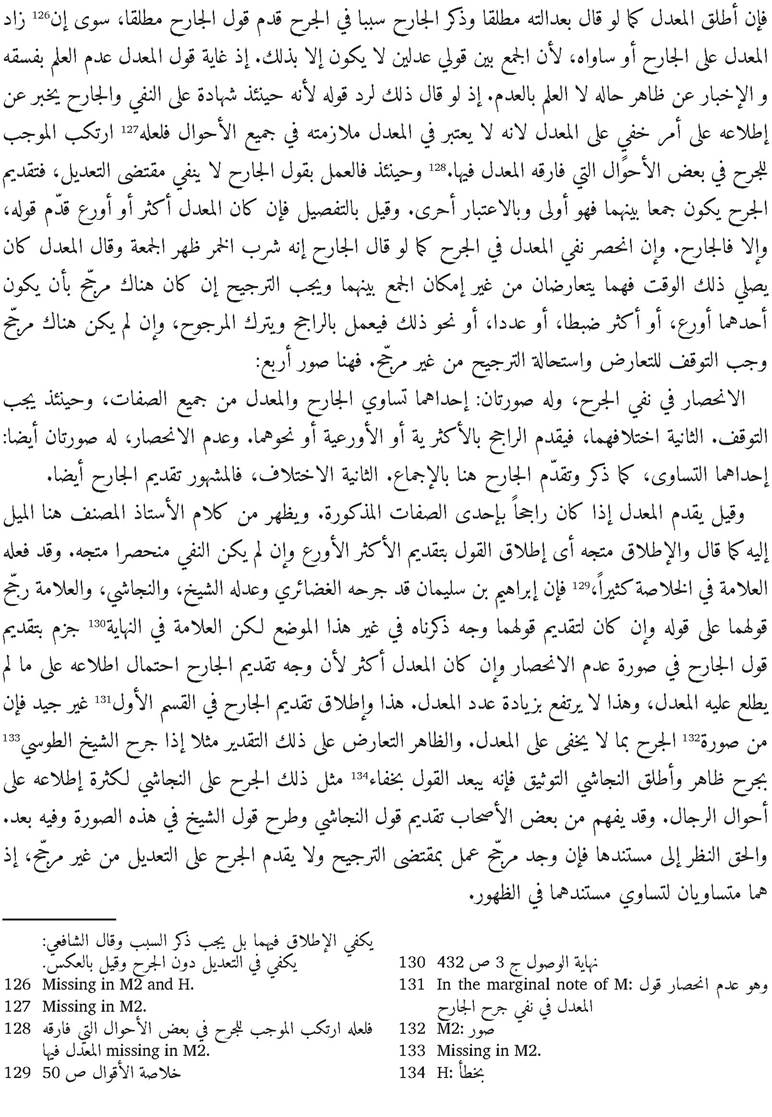
In cases where the jarih makes a specific criticism that the mucaddil rejects in his assessment:
• When the jarihs and mtidddils are equal in terms of uprightness and accuracy, one must abstain from making a judgment regarding the transmitter in question.
• When the jarihs and mtidddils differ in number or scrupulousness, one must abide by the opinion of the group higher in number or more scrupulous.
In cases where both the jarh and the tacdil are general:
• When the jarihs and mucaddils are equal in number and scrupulousness, one must abide by the opinion of the jarihs - this is a rule by scholarly consensus (ijmac).
• When the jarihs and mucaddils differ in number or scrupulousness, the widely-accepted scholarly opinion is to accept the jarih’s assessment. However, others have said that the mucaddils may be preferred if they are higher in number or scrupulousness.
Kazimi notes that al-Shaykh al-Baha’i and al-'Allama al-Hilli applied this reasoning quite often. Citing a case where the transmitter Ibrahim b. Sulayman was considered trustworthy by al- Shaykh al-Tusi and al-Najashi (d. c. 450/1058), whereas their contemporary al-Ghada’iri (d. before 450/1058) discredited him, Kazimi notes that al-'Allama al-Hilli in al-Khulasa34 had preferred the opinion of al-Shaykh al-Tusi and al-Najashi over that of al-Ghada’iri. However, Kazimi notes that in al-Nihaya,35 al-'Allama al-Hilli decisively preferred the opinion of the jarih even if the mtidddils were greater in number, because the nature of knowledge of fisq - its specificity - cannot be affected by the number of mucaddils.
However, Kazimi gives another hypothetical example of a transmitter discredited by al-Shaykh al-Tusi, for instance, due to an abhorrent act that would have been too obvious to have been missed by someone like al-Najashi, with his vast knowledge of transmitters and their backgrounds. In this hypothetical example, al-Najashi happens to approve of the transmitter in question. Kazimi points out that some scholars would prefer al-Najashi’s opinion over al-Tusi, but Kazimi rejects preferring al-Najashi's opinions as a general rule. Instead, Kazimi argues that the correct position is to weigh the evidence or to abstain from judgment until a deciding factor is found, because one must not accept the opinion of a jarih or mucaddil without a sound deciding factor.