Commentary
[a]
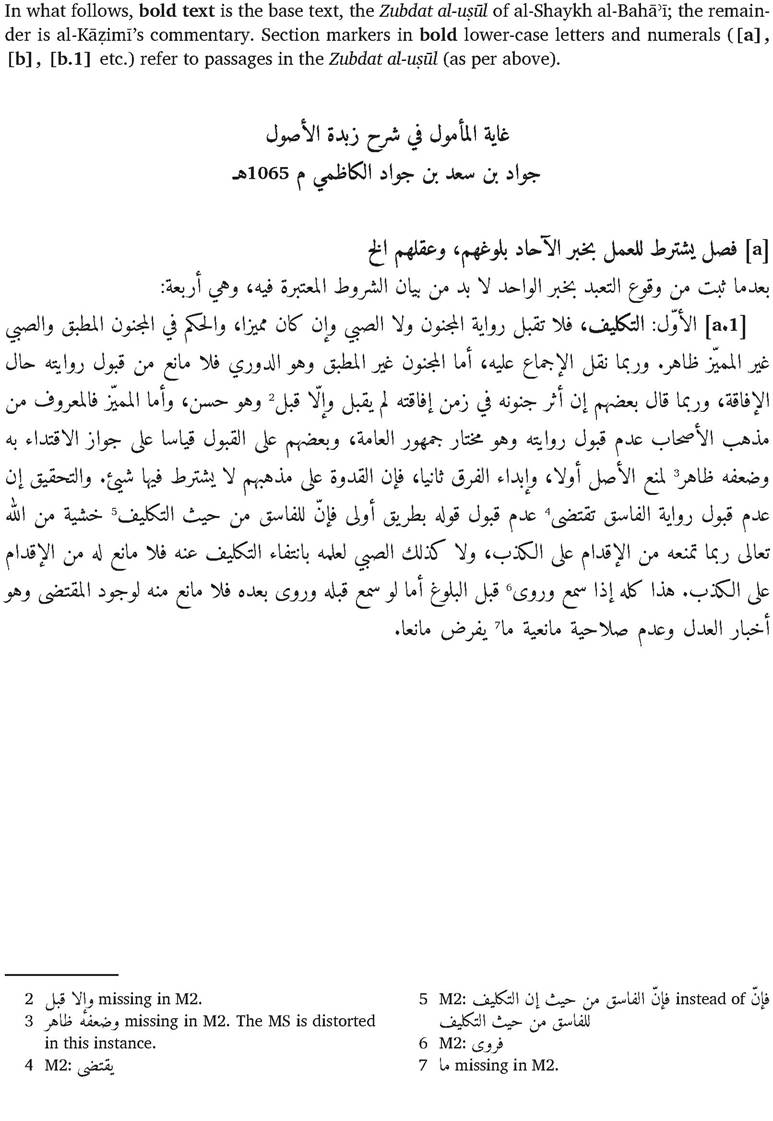
The [following] conditions must be fulfilled [in order for] the reports of solitary transmitters [to be considered binding proof]: [that the transmitter be] adult, sane, upright, accurate, and a believer.
Al-Shaykh [al-Tusi] dispensed with ‘belief’ (iman) as a condition [since for him] ‘uprightness’ ('adala) was sufficient on the basis of the community’s [i.e. Twelver jurists’ precedent of] acceptance of the reports of Ibn Bukayr,15 Sama'a [b. Mihran],16 the Banu Faddal,17 and others like them. However, there is no evidence in the “Reliability Verse”18 supporting [al-Shaykh al- Tusi’s position], because it is not necessarily true that the term fasiq [i.e. non-Twelver] applies to one who errs in certain beliefs (usul) after having exerted himself to understand them and whom the community [of Twelvers] had already deemed trustworthy. If a transmitter could be deemed trustworthy and be discredited at the same time, then confidence in the uprightness of most of the community’s trustworthy transmitters could be in question. As for the discrediting of Aban b. 'Uthman19 by some scholars, despite his trustworthiness being asserted by [most scholars] of the Twelver community: even if that [i.e. the discrediting of Aban b. 'Uthman] is proven, it would not constitute a proof against al-Shaykh [al-Tusi], may he rest in peace. As for ‘accuracy,’ (dabt) it means the preponderance of remembering over forgetting. Some have assumed ‘uprightness’ ('adala) to be sufficient [enough to the extent of dispensing with ‘accuracy’], because ‘uprightness’ should prevent the transmitter from narrating what he did not accurately memorise. This is rejected because uprightness [alone] does not prevent him from transmitting while being unaware that he was inaccurate or that [the report] he transmitted was not accurate in the first place.[b] [b.1]
The testimony of a single, upright Imami (i.e.
Twelver) is sufficient for the transmission [of a solitary transmitter] to be accepted in accordance with [the opinion of] al-Shaykh [al-Tusi], al-'Allama [al-Hilli], and most later scholars, but is in contrast to al-Muhaqqiq [al-Hilli] and his adherents. Otherwise, precaution taken in regard to the ancillary matter (far', i.e. 'adala) would exceed precaution taken in regard to the main matter (asl, i.e. the reliability of the riwaya). Also, the “Reliability Verse” provides a general proof (dalala) for accepting any solitary report [as binding] except testimony, which is exempted by another proof [requiring a minimum of two witnesses]. They (our opponents) say: Every report is testimony, so a solitary transmitter does not suffice. We say: This [statement] is not accepted; most [solitary reports] are not [testimony], such as narration, transmission of scholarly consensus (ijma'), the explanation of a translator, the physician informing [a patient] of the harm of fasting, the person performing the pilgrimage on someone else’s behalf informing them of its fulfillment (al-ajir bi-iqac al-hajj), etc. We have clarified this discussion in Mashriq al-shamsayn.20[b.2]
If appraisals by critics are contradictory [with one group ascertaining the transmitter’s uprightness (mu'addil) and one group discrediting him (jarih)], and the statement of the mu'addil does not specifically address the criticism of the jarih, then preference is given to the [appraisal of the] jarih. [Preference may also be given to whichever of these two groups is] the more numerous and scrupulous. It is reasonable to consider this a general rule.
More legal literature on Laws.Studio
More on the topic Commentary:
- Commentary
- Commentary
- Commentary
- Commentary
- Commentary
- CHAPTER 12 COMMENTARY ON SOME RECENT DEVELOPMENTS (2ND EDITION, 2011 AND 3RD EDITION, 2023, TED BENTON)
- Introduction
- Christ’s Empire
- The Provincial Edict
- COMMENTARIES
- AN ANCIENT ESTIMATE OF THE SPEED OF LIGHT
- Bibliography
- REFERENCES
-
Agricultural law -
Constitutional law -
Fundamentals of Advocacy -
History of state and law -
Muslim (Islamic) law -
Professional ethics of a lawyer -
Roman law -
Theory of state and law -
UK Bar -
US Bar -
-
Conflictology -
Ecology -
Economy -
Finance -
History -
Law -
Medicine -
Philosophy -
Religious studies -