Introduction*
The author of this text, Jawad b. Sa'd b. Jawad al-Baghdadi al-Kazimi (hereon Kazimi), was born in the last decades of the tenth/sixteenth century in the shrine city of al-Kazimiyya north of Baghdad.1 He is popularly known as “al-Fadil al-Jawad” (the virtuous Jawad).
The exact date of his birth remains unknown. Born into a scholarly family, he received early religious training from his father. For further studies, he travelled to the Safavid capital at the time, Isfahan, where he studied under the tutelage of al-Shaykh al-Baha’i (d. 1030/1620 or 1031/1621).2 The biographers introduce Kazimi as one of al-Shaykh al-Baha’i’s most distinguished students.Kazimi was more than a seminarian: he was given administrative responsibilities. He assumed the post of Shaykh al-islam3 of Astarabad (present-day Gorgan) during the reign of Shah 'Abbas I (d. 1038/1629). It appears likely that he was promoted to this prestigious post due to his close ties with al-Shaykh al-Baha’i who himself held the office of Shaykh al-islam of Isfahan and other provinces for much of period between 1580 and his death in 1620-21.4 Kazimi, however, did not stay long in Astarabad; he found himself embroiled in a dispute on account of which he was expelled from the town. This expulsion is believed to have been instigated by a local rival scholar and fellow student of al-Shaykh al-Baha’i, al-Sayyid Amir Muhammad Baqir al-Astarabadi (d. after 1031/1621, popularly known as Mir Muhammad Baqir Taliban). Kazimi reported this incident to Shah 'Abbas I who not only dismissed his plea but also expelled him from the region. The Shah, it is reported, had a close relationship with Taliban.
Kazimi returned to his hometown where he continued teaching and writing. He completed writing a commentary in 1029/1619 in al-Kazimiyya from which we can deduce that he probably left Safavid Iran around 1025/1615.
The Safavid official of Baghdad Bektash Khan Gorji (d. 1049/1639) was impressed by Kazimi’s scholarship and maintained a good relationship with him. Kazimi resided in his hometown for more than two decades. The political turmoil of Baghdad at the time, combined with his close relationship with Bektash Khan, contributed to his decision to return to Safavid Iran just before Sultan Murad IV (r. 1032-49/1623-40) recaptured Baghdad for the Ottomans in 1638. Unlike his first visit when he lived in the northern provinces, this time he chose to live in the south. He resided in Huwayza (also spelled Hawiza or Hoveyzeh; in the Khuzestan province of present-day Iran) for some time and then moved to Tustar (Shushtar - Shoostar in European sources). In 1050/1640 he assumed the post of Shaykh al-islam of Shushtar following the death of Shaykh al-Islam 'Abd al-Latif al-Jami'i (d. 1050/1640-41). There is no further information on how long his tenure as Shaykh al-islam of Shushtar lasted nor do we knowThe introduction of this chapter is written by Kumail Rajani. about his other whereabouts. The precise place of his death also remains unknown. Some biographers record that Kazimi died in Isfahan, whilst others suggest that he died in al-Kazimiyya. Notwithstanding this ambiguity, the sources agree that he was buried in al-Kazimiyya which implies that, if he died in Isfahan, his remains would have been taken there. Similarly, his precise date of death is uncertain; it is estimated, though, that he died in 1065/1655.5
Al-Shaykh al-Baha’i is reportedly Kazimi’s only teacher during his stay in Safavid Iran. Nor are there many prominent figures among his very few students recorded in the biographical dictionaries. Among the students were: al-Sayyid Mir Mahmud b. Fathallah al-Husayni al-Kazimi al-Na- jafi, al-Shaykh Shahin, Muhammad al-Kashani al-'Amili, his nephew 'Ali b. Muhammad al-Hadi b. Sa'dallah and few others.
Kazimi’s major literary output primarily comprised of commentaries.
The twentieth century Twelver bibliophile Shihab al-Din al-Mar'ashi al-Najafi (d. 1990) has credited him with 19 works: 12 sharhs (commentaries), 4 taliqas (glosses), a tawdih (annotation), a monograph and a treatise.6 Most of these commentaries (9 in total) are on the books of his teacher, al-Shaykh al-Baha’i, in diverse disciplines, including Arabic grammar (e.g. his Sharh Risalat al-samadiyya fi l-nahw), astronomy (his Sharh Tashrih al-aflak)7, arithmetic (his Sharh Khulasat al-hisab), geography (his Sharh Risalat fi nisbat tadaris al-ard), riddles and puzzles (his Sharh ba‘d al-mu‘ammayat wa-l-al- ghaz) and occult sciences (his Sharh Kitab surkhab fi ‘ilm al-raml). He composed numerous commentaries on classical works of Twelver law including an incomplete commentary on al-Shahid al-Awwal’s (d. 786/1384) al-Durus (titled Sharh al-Durus al-shar‘iyya fi fiqh al-imamiyya), a commentary on al-'Allama al-Hilli’s (d. 726/1325) Nahj al-mustarshidin (titled Ahwal al-din fi sharh Nahj al-mustrashidin fi usul al-din, completed in 1029/1619 in al-Kazimiyya) and al-'Allama’s Khulasat al-rijal (titled Tacliqa ‘ala Khulasat al-rijal) and a commentary on al-Muhaqqiq al-Karaki’s (d. 940/1534) al-Jafariyya (titled al-Fawa’id al-‘aliyyafi sharh al-Jafariyya; completed on 2 Rabi' II 1032/3 February 1623 in al-Kazimiyya). He also transcribed al-Dhari‘a ila usul al-sharica of al- Sharif al-Murtada (d. 436/1044) on Wednesday 8 Ramadan 1025/21 September 1616 which is arguably the best surviving MS of this usul work. This MS is housed at Majlis-e Shura-ye Islami Library in Tehran (#3794).8 His only monograph and arguably his most important work is an exegesis of the legal verses of the Qur’an titled Masalik al-afham ila ayat al-ahkam (completed on 3 Muharram 1043/10 July 1633).9The text presented in this chapter is yet another commentary on his teacher’s popular usul work, Zubdat al-usul. In his study of al-Mazandarani’s commentary on the Zubda, Gleave (see Chapter 1 of the current volume) outlines the nature and style of postclassical Twelver works of usul, particularly that of the Zubda.
Besides al-Shaykh al-Baha’i’s own marginal notes that he appended after completing his book, Zubda has attracted 28 commentaries (shuruh), 8 glosses (hawashi) and 3 poetic re-presentations (manzumat).10 It is on the request of his teacher and while he was alive, it is reported, that Kazimi wrote his commentary on the Zubda titled Ghayat al- ma’mul fi sharh Zubdat al-usul.11 Based on this account, it is more likely that the Ghayat al-ma’mul should have been composed in Dhu l-Hijja 1027/November-December 1618 and not Rabi' II 1042/October-November 1632.Unlike al-Mazandarani’s commentary (described in Chapter 1), Kazimi’s commentary is not blended (mazji), rather he picks passages from the Zubda and comments upon them phrase by phrase. He elucidates the obscure passages of the base text, elaborates its arguments and compares and contrasts the opinions of his teachers with his predecessors (al-Shaykh al-Tusi d. 460/1067, al-Muhaqqiq al-Hilli d. 676/1277, and al-'Allama al-Hilli d. 726/1325). In the process, he does not shy away from criticising his teacher’s views. On one occasion, for instance, he writes, “it is evident from the evidence presented earlier that the author’s [i.e. al-Shaykh al- Bahà’i’s] opinion is far from being correct” (wa-l haqq inna qawl al-musannif huna ba'id ba'd mulahazat ma aslafnahu). In another instance, Kazimi states, “the opinion of the teacher, the author, that it is a fortiori argument is doubtful” (wa-qawl al-ustadh al-musannif annahu qiyas al-aw- lawiyya ghayr zahir). This critical approach, adopted by Kazimi, has put his commentary on a par with his teacher’s base text (al-sharh ka-l-asl mashhuran).12
The edition of the selected passages and its English commentary presented in this chapter is the result of three teams of researchers: Raha Rafii and Dale Correa produced the first draft from a manuscript housed at Houghton Library of Harvard University (Kitab Ghayat al-ma’mul ft sharh Zubdat al-usül MS #1651, MS Arab 231, 112v-116v - indicated as H); Robert Gleave and I then consulted two other manuscripts from Majlis-e Shüra-ye Islami Library (#14062 [pp.
186-192] and #8081 [fols. 75r-78v] - indicated as M1 and M2 respectively) and collated with H after recording their variants in the footnotes. We found that M1 contains several marginal notes from other commentaries of the Zubda - the most notable was that of another student of al-Shaykh al-Bahà'i, Muhammad b. Mahmüd b. 'Ali al-Tabasi (d. after 1083/1672); Raha Rafii and Belal Abu-Alabbas then composed the English commentary and revised the Arabic draft of the text.The popularity of the Ghayat al-ma’mul can be gauged by the exceptionally large number of manuscripts in which it survives. Dirayati has enumerated upto 130 MSs.13 Sàzmàn-e Asnad wa- Ketàbkhàneh-ye Milli-ye Jumhuri-ye Islami holds eleven of these MSs (#5-2137/3, #5-1549, #5-1622, #5-20714, #5-26089, #5-2626, #5-22890, #5-1548, #5-2196, #5-3600, #5-367). Other MSs are also found in Tehran (Majlis-e Shüra-ye Islami Library), Qum (Ketàbkhàneh-ye Ästaneh-ye Muqaddas-e Hadrat-e Fatimeh-ye Ma'sümeh; Ketabkhaneh-ye Mar'ashi; Ketab- khaneh-ye Markaz-e Ihyà’-ye Mirath-i Islami; Mu’assasa-ye Imam Sadiq etc.), Isfahan (Ketab- khaneh-ye Ketàbkhànehhà-ye Isfahan), Mashhad (Ketabkhaneh-ye Madraseh-ye Nawwab) among few other libraries and private collections.
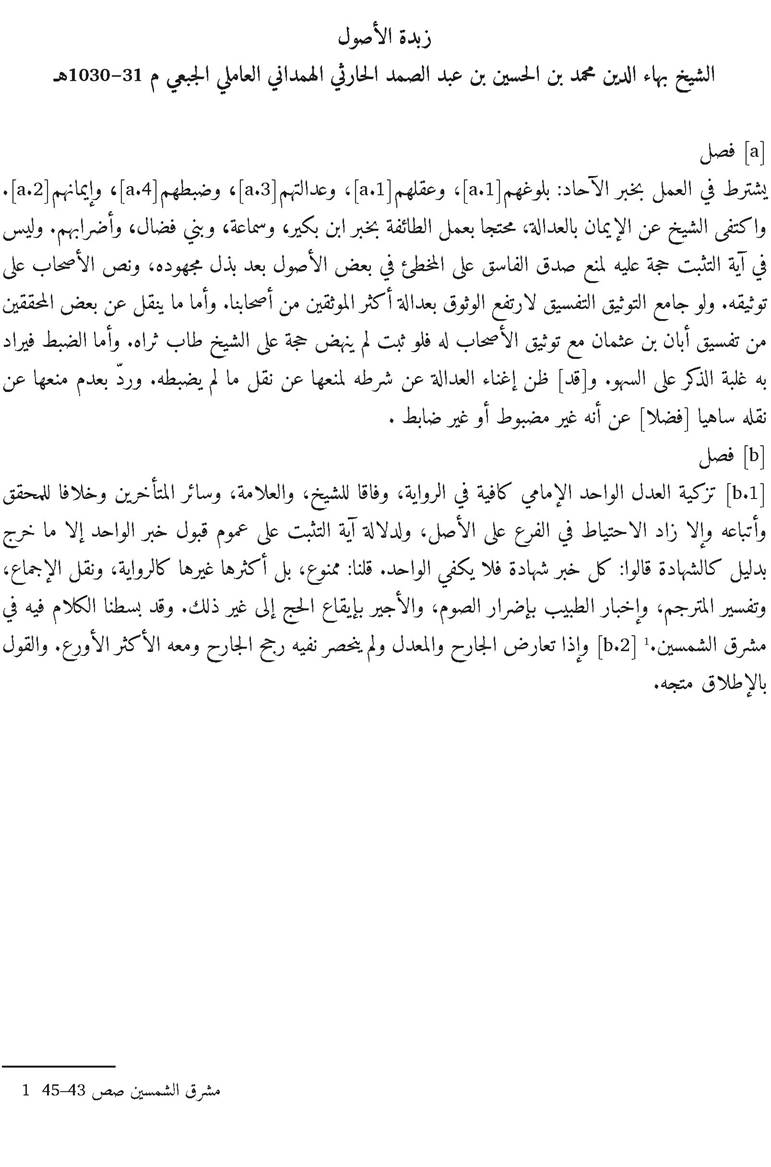
The selected text deals with the topic of solitary reports (al-akhbar al-ahad) and their role as legal sources; this topic is conventionally studied in the chapters of “probativity of solitary reports” (hujjiyyat al-akhbar al-ahad) and “methods of resolving contradictory and conflicting reports” (ta'adul and tarjth). The first section [a] of the edited passages concerns the conditions that are required for the reports of solitary transmitters in order to be considered legally binding proofs. Al-Shaykh al-Baha’i enumerates five such conditions: adulthood (bulugh), sanity ('aql), uprightness ('adl), accuracy (dabt) and belief (tman). Kazimi delves deeper into each of these conditions by rearranging his teacher’s order.
He examines the condition of uprightness ('adl) in greater depth. The question which he attempts to address here is whether Sunnis, or for that matter non-Twelver Shi'is (such as the Fathiyya, the Nawüsiyya, the Waqifiyya) are sufficiently upright for their reports to be considered legally binding for Twelvers. The second section [b] examines the methods of appraising the transmitters and whether the testimony of a single upright Twelver scholar is a sufficient basis on which judgment could be passed on the trustworthiness, or otherwise, of a transmitter? In this section, Kazimi deliberates on the instances in which scholars of 'ilm al-rijal have contradictory opinions vis-à-vis certain transmitters and offers methodological solutions to resolve such contradictions.14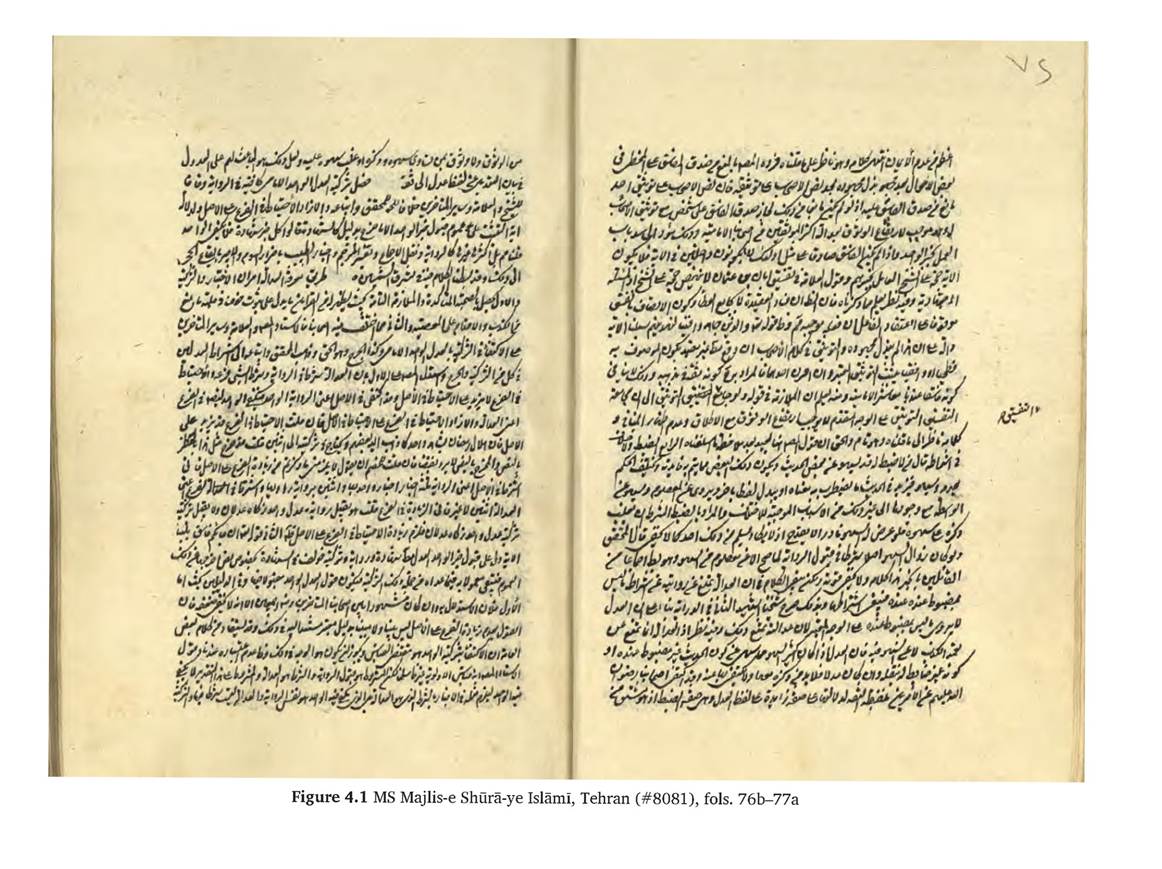
id="Picutre 41" class="lazyload" data-src="/files/uch_group31/uch_pgroup314/uch_uch7345/image/image040.jpg">
More on the topic Introduction*:
- Introduction
- Introduction
- Introduction
- Introduction
- INTRODUCTION
- Introduction
- Contents
- Contents
- AVIAN CHOLERA
- Hare C., Neo D. (eds.). Trade Finance: Technology, Innovation and Documentary Credit. Oxford University Press,2021. — 417 p., 2021