Commentary
Mazandarani commences Kawashif with a brief preface. As it is customary, it begins by offering praises to God and salutations upon the Prophet and the Imams. This is followed by a brief remark concerning the book’s purpose and structure.
He notes that throughout his life, he has been eager to compose such a book to serve as a path to inquiry and reflection for him and others. He adds that due to various factors he has been prevented to undertake this task; these include his own frailties, lack of opportunity, prevalence of tribulations and trials, and the domination of the adherents of oppression and the subjugation of the adherents of knowledge. Nevertheless, realising that waiting for ideal circumstances is bound to be futile and that the passing of years brings more despair than hope for the future, he decided to write the book despite the difficulties involved. Mazandarani informs the readers that in this endeavour he has chosen a middle path between writing a comprehensive or a compressed book. He has arranged the book into 150 sections each containing a veil (i.e. misgiving) and its corresponding removal (i.e. resolution), hence the title of his book: Kawashif al-hujub (‘Removing the Veils’). Mazandarani mentions that considering his book is not arranged like other well-known books of jurisprudence, readers might feel disoriented; hence, he is providing a supplementary list of its contents, facilitating the book’s navigation. The rest of the preface contains the title for each of the 150 sections of the book.Passage One: On Whether or Not Becoming a Legal Expert Depends on Having Faith
One of the topics often discussed in the texts of jurisprudence concerns the requirements a person must fulfil in order to be considered a legal expert (mujtahid). Some of these requirements include fluency in Arabic, familiarity with the legal verses of the Qur’an and their interpretive traditions, and mastery of the hadith literature.
Others pertain to beliefs and personal characteristics, such as religious affiliation (or lack thereof) and personal integrity. Various questions have been raised regarding the second set of requirements. Can, for instance, a Christian or an unbeliever, become an expert in Islamic law even though, according to Muslims, a Christian has but partial knowledge of theological truths and an unbeliever none? In the following section Mazandarani addresses this issue by examining whether the discipline of jurisprudence is dependent on the discipline of theology. The passage begins with a line of arguments, posed to Mazandarani by his hypothetical interlocutor, concerning why being a believer is a condition on being a legal expert.
[1.1] Veil: Mazandarani’s interlocutor remarks that jurisprudence depends on theology. He bases this statement on eight closely linked premises: (1) jurists investigate what one’s legal responsibility is, and (2) knowledge of this depends on knowing the legal responsibility, (3) which depends on knowing the One who sets the legal responsibility, (4) which depends on knowing that the world came into being, (5) which depends on the fact that it needed some creator, (6) that this creator has all the attributes of perfection and is entirely free of negative attributes, (7) sends prophets, supporting them with miracles, and (8) appointing after them the Imams, who are protected from error and falsehood in explicating the law. Mazandarani’s interlocutor concludes that all these matters are known in jurisprudence as a result of the extensive proofs given in theology. According to this position, in order to become an expert in Islamic law, one must know that there is a God; knowledge of God’s existence dependents on knowing God’s attributes, among which is that he is the creator of the world and through his providence sends inerrant prophets and imams to guide humans.
Proofs for each of these propositions regarding God and his attributes are discussed in the discipline of theology. Hence, Mazandarani’s interlocutor concludes, becoming an expert in Islamic law is dependent upon first acquiring theological knowledge.[1.2] Unveiling: Mazandarani finds this argument unpersuasive. He responds that such theological beliefs are a condition on having faith for believers in general - not on being a jurist. Hence, he asserts, a person can become an expert in Islamic law even if he is a non-believer (mukhalif) or an infidel Sufi. An infidel par excellence, Mazandarani continues, could very well be a jurist par excellence, and fully capable of deriving particular rulings from the principles of Islamic law using its legal sources,13 such that it would be incorrect to deny legal expertise of him. In Mazandarani’s view, law is a discipline like any other. To become an expert in any discipline, one needs to master the requirements specific to it. In the case of Islamic law, one of the requirements is to acquire knowledge of Arabic, since the foundational sources of the law were revealed in that language. This knowledge, he remarks, can be obtained regardless of one’s religious beliefs. After making this argument, Mazandarani draws a distinction between whether a non-Muslim can become a legal expert and whether the same person can serve as a source of legal authority for Muslims. In the latter role, the legal expert is also required to be a Muslim of good character. That a jurist be also a believer, he notes, is a condition for seeking legal advice from him, but it is not a condition on his being a legal expert. In Mazandarani’s view, this position is corroborated by what is said about how, in order to be a jurist-consult (mufti), one must have not only legal expertise (ijtihad) but also faith (iman) and integrity (cadala). That, however, would be senseless to say, were faith constitutive of the term’s (i.e. ijtihad) meaning.
Moreover, he takes the fact that jurists are qualified by their sectarian affiliations or juristic orientations, as another piece of evidence for his position, insofar as that qualification is meant to eschew emphasis that would contravene the rule. In Mazandarani’s view, the fact that legal experts identify themselves or other legal experts as “Twelver Shi'i” legal experts, for example, is another indication that the semantics of the word mujtahid does not require any specific religious affiliation.
[1.3] Mazandarani is aware that besides his interlocutor, other prominent scholars have also made faith a requirement for becoming a legal expert. He cites his teacher, Sharif al-'Ulama3, as an adherent of this position.14 He writes that his teacher has, strange to say, insisted that jurisprudence depends on theology. Sharif al-'Ulama3 had reportedly justified this position by arguing that, “Legal expertise is a matter of having developed a capability (malaka) by which one can acquire belief in the divine rulings. It is unreasonable to say that someone who does not believe in God can believe in his rulings. Could you believe that so-and-so is Zayd’s servant while you nonetheless believe that Zayd has no external existence whatsoever? Heavens no! Certainly not”. Mazandarani disagrees with this view and explains his position in the following manner: it is no problem for someone who does not believe in a god to acquire the capability of believing in the rulings of what is, in the minds of others, a god. Mazandarani then entertains a possible counter-argument against his position: it could be objected that a god is something that deserves to be worshipped, and therefore legal expertise would be the capability by which one can acquire belief in the rulings of that which deserves worship. He remarks that according to this view, a jurist must recognise that something deserves worship, and hence, someone who recognises nothing worthy of worship could not be a jurist, since the concept of jurist, so defined, would not apply to him.
Mazandarani responds to this objection by reiterating his earlier remark concerning the semantics of the word ‘legal expert’ (mujtahid). He grants the stipulated emendation, but objects to that being the meaning of legal expertise. Mazandarani’s objection stems from his earlier argument about how it would be improper to deny the term “legal expertise” to anyone who had the relevant capability, even if this person did not believe that there was anything worthy of worship.[1.4] As the exchange so far illustrates, for Mazandarani, Islamic law is a scholarly discipline which can be studied by anyone who has acquired a set of skills essential to it; a person’s religious convictions or moral qualities have no bearing on his mastery of these legal skills. This he thinks, is even expressed in the prima facie sense of the word ‘legal expert’. Mazandarani’s interlocutor, however, remains unconvinced and raises the following objection: “It is necessary to accept the prima facie sense of the term ‘legal expertise’, when there is nothing else to indicate otherwise, because it would be reprehensible for the Wise God to give a term a sense contrary to the obvious one without providing some indicator. Moreover, the ‘Principle of Divine Grace’ (qa'idat al-lutf)15 and the principle that ‘God would not assign a duty greater than people’s capability’ are obtained from the discipline of theology; hence, ‘legal expertise’ (ijtihad) is dependent on the discipline of theology. Hence, it must have the obvious sense, and this is to be relied up- on”.16 As we can see, Mazandarani’s interlocutor disagrees with him regarding the prima facie sense of ‘legal expertise’. Whereas for Mazandarani it indicates only a person who is expert in the law, for his interlocutor the term indicates a legal expert who also believes in God and is committed to certain theological doctrines, and these doctrines have consequences on one’s thinking about the law. The argument, hence, is that imbedded in the prima facie sense of the term ‘legal expert’ is a ‘believing’ legal expert.
Mazandarani is further told that to hold otherwise would undermine the doctrine of God’s grace, according to which God does not act contrary to people’s welfare. In this context, Mazandarani’s interlocutor holds, if the phrase ‘legal expertise’ (ijtihad) had a meaning not expressed in its prima facie sense, it would have been incumbent on God to inform people of its precise meaning; otherwise they would not fully understand its meaning and hence would go astray. This argument assumes that the prima facie sense of ‘legal expertise’ clearly includes in its semantics the expert’s belief in God and that Mazandarani’s argument that it
does not goes against this prima facie sense. Had Mazandarani been correct, it is concluded, it would be incumbent on God to make departure from the prima facie sense of the phrase clear to people; the fact that he has not establishes that Mazandarani’s departure from the prima facie sense of the phrase ‘legal expertise’ is unjustified.
[1.5] To the above argument Mazandarani provides the following response. Were we even to grant the view that the word mujtahid includes in its semantics the meaning of a ‘believing’ legal expert, we would not be committed to holding that one must study what has been written in the discipline of theology and spend one’s entire life trying to understand the proofs and refutations of sophistical misgivings. Instead, the required degree of acquaintance with theology would merely be that needed to acquire correct beliefs about those matters that believers in general have been commanded to acquire - and not in any particular way either; the beliefs can be acquired in any way. Hence, according to Mazandarani, even if one were to concede, for the sake of argument, that legal expertise does require a minimum theological knowledge, it would not necessarily mean that such knowledge must be attained by reading the books of theology. Rather, such knowledge could be gained by a variety of means besides theological inquiry. The critical matter, Mazandarani remarks, is to have correct beliefs and not that the beliefs be specifically acquired through the discipline of theology. In his view, reading books on theology is merely a preliminary to acquiring correct beliefs; if those beliefs have already been acquired, whether from a teacher or parents, there would be no point to command a person to read those books and to undertake a preliminary study yet again.
[1.6] Moreover, Mazandarani continues, were it the case that correct beliefs were commanded to be acquired in a specific way, it would follow that most people - lay persons and countless numbers of philosophers and theologians - would all be negligent in acquiring the commanded beliefs in the specified way, and so they would have to be deemed infidels. He cautions that other false consequences would result as well from which not even pious individuals would be exempt, let alone common believers. This is all to ignore the fact that requiring common believers to acquire their beliefs in this specific way would be to assign them a duty greater than their capability. This last remark is connected with the view expressed in the Qur’an according to which God does not place responsibilities on anyone that would exceed their ability to fulfil them.
[1.7] Mazandarani ends his exposition with a general warning, worded polemically, against spending one’s life in theological pursuits. He states, were we to suppose that one could acquire the commanded beliefs only by reading books of theology, then there would be no escape from agreeing that it is required. However, this is a mere supposition. So beware! Beware spending any time at all on understanding the doctrines theologians have elaborated or on the refutations of misgivings they have adumbrated, let alone spending your whole life on it. If - assuming the impossible - you did not go astray - and few indeed are those theologians who do not - the only thing you would get from theology would be worldly honour. Otherwise, nothing results from it in this world or the next besides regret: those who have incorrect beliefs will, without a doubt, perish in the hereafter, as all Shi'is and many Sunnis have agreed.
Passage Two: On the Prima Facie Sense of the Qur’an
[2.1] Veil: Mazandarani’s interlocutor remarks that the prima facie sense of the Qur’an is non-pro- bative.
[2.2] Unveiling: Mazandarani begins his response by stating, if what is meant by the above assertion is that the Qur’an has no prima facie sense and the entirety of it is ambiguous (mu- tashabih), then the following objections apply. He first comments that this view is so obviously false that holding it could be nothing more than a denial in word, a mere stubborn insistence despite the realisation that it is indeed false. He next argues that were this position correct, how could one make any sense of drawing a distinction between the Qur’an on the one hand and the verbal sunna on the other.17 He asks rhetorically, the same specific words occurring in the Qur’an would be ambiguous, yet when they appeared in the sunna, they would become clear (muhkam)!? In his view, any such distinction would be arbitrary. Furthermore, Mazandarani argues, the Qur’an itself mentions that it contains “clear” verses in addition to “ambiguous” ones.18
[2.3] After providing the above arguments, Mazandarani presents and then refutes another interpretation of his interlocutor’s statement. He writes that if, on the other hand, what is meant by the above statement is that the prima facie sense of the Qur’an is indeed not probative, even though theprima facie sense of other texts (e.g., hadith) may be so, then the following objections apply. His first argument relies on consensus. According to Mazandarani, there is a consensus among scholars that his interlocutor’s position - ‘the prima facie sense of the Qur’an is non-pro- bative’ - is false. He preempts a possible rejoinder to his claim for consensus on this matter: “But our Akhbari scholars deny that their position is false; hence, it is nonsense to claim that there is consensus on a matter on which there are disagreeing views”.19 To this objection Mazandarani replies that consensus, first of all, simply means an agreement that reveals the correct position regarding a given issue,20 and this could occur with only two people party to the agreement, though a hundred others disagree. Moreover, he holds, the fact that Akhbaris disagree is of no consequence, just as it would be of no consequence were they to agree. Furthermore, there are other proofs besides consensus, which, though each on its own yields only conjecture (zann), when taken in aggregate yield certainty (qatfi. Hence, Mazandarani maintains, regardless of whether or not his interlocutor agrees with his take on consensus in general and his views on Akhbaris in particular, his interlocutor’s position is false since there are ten other arguments besides consensus that affirm the probative force of the prima facie sense of the Qur’an. He proceeds to outline each.
[2.4.1] First. The consensus reported from more than one scholar of prior generations: despite his prior dismissive remark concerning some Akhbari scholars’ divergence from his claimed consensus on this topic, Mazandarani finds it difficult to let go of his argument from consensus. He reiterates it again here, this time accompanying it with evidence that, contrary to his interlocutor’s assertion, even prominent Akhbari scholars did not advocate rejecting the prima facie sense of the Qur’an. He points to al-Fadil al-Tuni as an example and writes that although al-Tuni was an Akhbari,21 he wrote the following in his book al-Wafiya: “The Qur’an itself, and the fact that it is obligatory to follow it and act on it, is mutawatir22 and is also a matter of consensus”.23 Mazandarani further remarks that al-Sayyid al-Muhaqqiq al-Kazimi in his commentary on al-Wafiya, has taken the above sentence as a concession by al-Tuni that mutawatir reports and consensus both indicate it is permissible to use the Qur’an to derive law.24 In sum, Mazandarani concludes, it is permissible to use the Qur’an - in its prima facie sense - to derive law, which he believes, no one in their right mind would even consider denying.
[2.4.2] Second. The overwhelming popularity of this opinion: he claims that the position he advocates is prevalent among scholars to such an extent that it is plausible to say that someone who opposes it is a rarity.
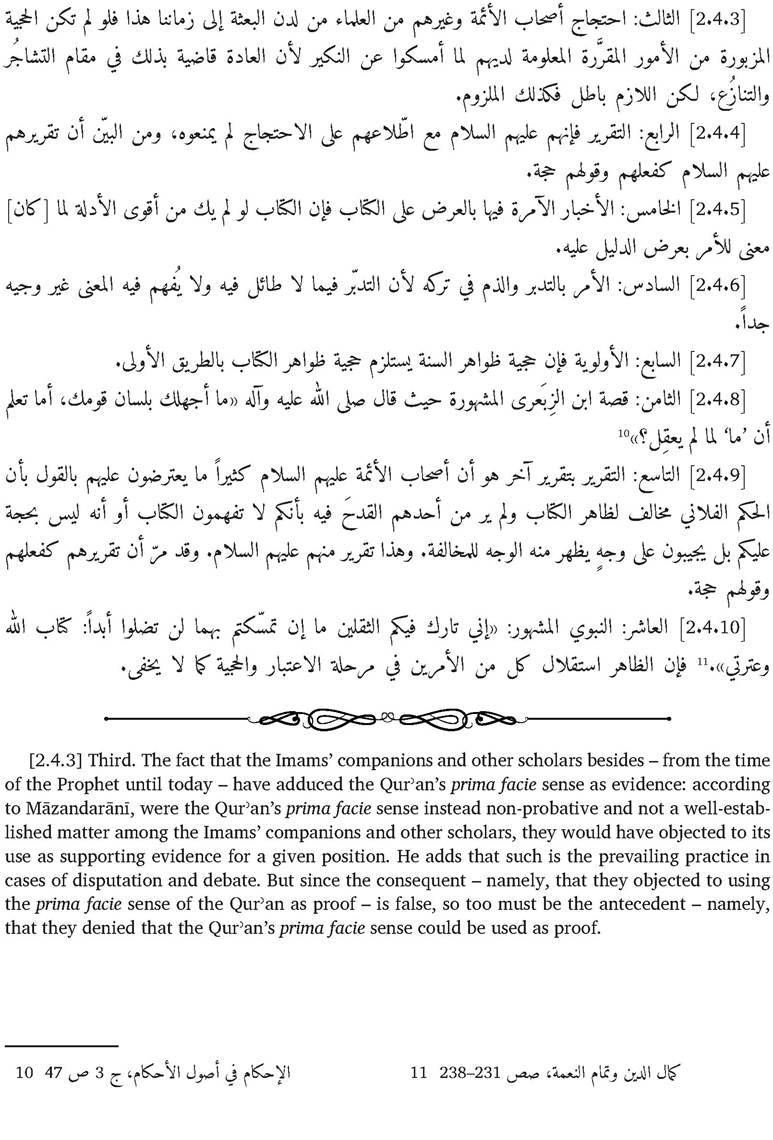
[2.4.3] Fourth. The Imams’ tacit approval: according to Mazandarani, although the Imams were aware that the Qur’an’s prima facie sense was being used as evidence, they did not try to stop it. He adds that it has been well-established that the Imams’ tacit approval is just as probative as their deed or word.
[2.4.4] Fifth. Those hadith (akhbar) commanding that every hadith be compared with the Qur’an:25 he argues that were the prima facie sense of the Qur’an not one of the strongest forms of proof, there would be no meaning to commanding that hadith be measured against it in order to establish their veracity.
[2.4.5] Sixth. The command to contemplate and the censure for failing to do so as found in the Qur’an and hadith:26 he notes that to command someone to contemplate the Qur’an when it is futile, and the meaning cannot be understood, would be preposterous indeed.
[2.4.6] Seventh. An a fortiori argument: granting that the prima facie sense of the sunna is probative, Mazandarani holds, a fortiori so too must be the prima facie sense of the Qur’an.
[2.4.7] Eighth. The story featuring Ibn Ziba'ra:27 Ibn Ziba'ra was a renowned poet belonging to the Prophet’s tribe, the Quraysh. According to some accounts, he was at first a fierce opponent of the Prophet but later became a Muslim. It is reported that in one incident, when Ibn Ziba'ra misunderstood a verse of the Qur’an, the Prophet said to him, “How ignorant you are of your tribe’s language. Don’t you know that...”. In this passage, Mazandarani invokes Ibn Ziba'ra to indicate that mastery of the language has a direct relation to understanding the Qur’an and its prima facie sense; had it been otherwise, the Prophet would not find Ibn Ziba'ra’s failure to understand the Qur’an despite his renowned literary abilities something worth pointing out.
[2.4.8] Ninth. Another tacit approval: Mazandarani points out that the Imams’ companions would often object to their pronouncement on some matter, saying that it contradicts the prima facie sense of the Qur’an, and yet none of the Imams saw it fit to criticise this on the grounds that “you do not understand the Qur’an” or that “the Qur’an is not to be taken by you as proof”. Instead, they would answer the objections in such a way as to explain the apparent contradiction. He concludes, this is a form of tacit approval, and - as already noted - the Imams’ tacit approval is as probative as their deed or word.
[2.4.9] Tenth. The famous hadith of al-thaqalayn: Mazandarani bases his last argument on a well-known hadith attributed to the Prophet: “I leave among you the two weighty things (al-thaqalayn), and if you cling to them, you will never go astray: the book of God and my progeny”.28 According to both Shi'i and Sunni sources, the Prophet addressed these words to the believers during the sermon he delivered on his last pilgrimage to Mecca. Mazandarani uses this hadith to argue that the prima facie sense of the hadith is that each of the two weighty matters, namely the Qur’an and his progeny, is independent of the other in terms of serving as proof. In Mazandarani’s view, had the prima facie sense of the Qur’an lacked probative force, the Prophet would not include it as one of the two means of guidance.
Mazandarani believes that the arguments he has outlined, taken as a whole, establish with certainty that the Qur’an contains clear and ambiguous passages and that the prima facie sense of the clear passages can be understood and, hence, is probative.
More on the topic Commentary:
- Commentary
- Commentary
- Commentary
- Commentary
- Commentary
- CHAPTER 12 COMMENTARY ON SOME RECENT DEVELOPMENTS (2ND EDITION, 2011 AND 3RD EDITION, 2023, TED BENTON)
- Introduction
- Christ’s Empire
- The Provincial Edict
- COMMENTARIES
- AN ANCIENT ESTIMATE OF THE SPEED OF LIGHT
- Bibliography
- REFERENCES
- Involuntary Surrender of Possession
- Voluntary Surrender of Possession (unilaterally or through delivery; movable or immovable property)
- 17 Prohibition on the Possession and Proselyting of Christian Slaves by Jews
- Hume’s critique of the modern philosophy
- Introduction: Thinking about Secularism