Commentary
In writing this commentary, Ahmad b. 'Abdallah provides additional detail to clarify al-Wazir’s intended meaning, especially in those instances in which specific statements could be misinterpreted without additional explanation.
Such a concern would be especially relevant in a teaching context. In so doing, Ahmad b. 'Abdallah also earmarks the major distinguishing points of Zaydi thought on the controversial status of qiyas and its sub-categories vis-à-vis the Twelvers and the Sunni schools of law.[1] Among the Twelvers, theoretically qiyas was considered too uncertain an interpretive tool to be used with authority. Despite their Shi'i affiliation, the Zaydis - who were heavily influenced by Hanafi legal theory - adopted the position of the Sunni legal schools of the validity of qiyas. Hence, we find Ahmad b. 'Abdallah beginning his commentary by praising the significant status of qiyas in legal interpretation and pointing to its ubiquitous usage. He also lists examples of well-known jurists who engaged in prolific discussion on it, including al-Juwayni in his book al- Burhan fi usul al-fiqh, al-Ghazali in his book Shifa1 al-ghalil, and Zaydi Imam al-Mahdi li-Din Allah Ahmad b. Yahya b. al-Murtada (d. 840/1436-37) in his book al-Qistas al-mustaqim.
[3] Jurists across the schools of law debated on the specifics of how exactly to define qiyas as a legal term, often commenting on two divisive issues in their introductory sections. First, did qiyas as defined in usul encompass various forms of legal analogical reasoning and syllogistic reasoning - such as what might be found in formal logic (mantiq) - as most Hanafis believed? Or was qiyas pointing only to one narrowly defined legal procedure that adopted a specific type of analogical reasoning in its application, as many Shafi'is opined? Second, was qiyas referring to a specific type of action pursued by the mujtahid as the Hanafis believed, or was it an empirical truth that existed outside of human activity that the mujtahid was tasked to find, as many Shafi'is claimed? Ahmad b.
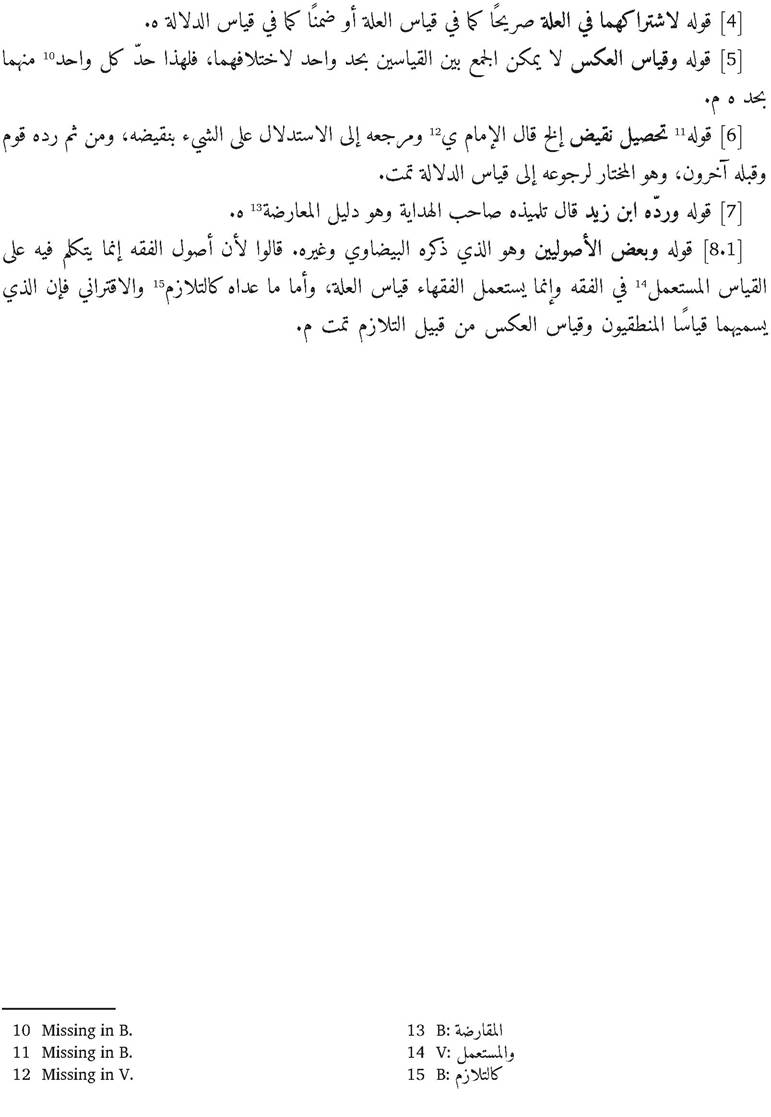
'Abdallah expands on the first issue in later passages [7-8.1], noting al-Wa- zir’s preference for the former. As for the second issue, in discussing the linguistic definition of qiyas, he notes that “comparison is a more accurate definition than measurement, because comparison encapsulates the actual function that qiyas, undertakes as a legal interpretive tool, unlike what is implied by measurement.” In noting the preference for comparison over the oft-used term among the Shafi'is of measurement, Ahmad b. 'Abdallah is demonstrating al-Wazir’s preference for the former approach of the Hanafis to define qiyas as an action within the realm of human activity.[2] Ahmad b. 'Abdallah then moves on to the topic that was of prime importance to al-Wazir in this chapter: the defense of co-absence (qiyas al-‘aks) as a valid sub-category of qiyas both intrinsically and separate from co-presence (qiyas al-tard). Jurists disagreed on whether co-absence (qiyas al-‘aks) and co-presence (qiyas al-tard) could be deemed valid forms of qiyas. Co-presence (qiyas al-tard) referred to the idea that when a specific judgment was operative in a case, another feature co-existed in a correlative fashion in that case as well. That co-existing feature was the occasioning factor for that judgment. Co-absence (qiyas al-‘aks) implied that the opposite was also true: when a specific judgment was not operative, then its corresponding feature was also not present in the case. An example would be the cases of wine and vinegar made from wine. Wine is forbidden while vinegar made from wine is permitted. Since the feature of intoxication was present in wine but disappeared with its conversion into vinegar, one could deduce that the occasioning factor for the prohibition of wine was in fact its intoxicating quality. Some jurists considered this line of reasoning to be air-tight, or at the very least probabilistic. Those who deemed it invalid argued that multiple features could correlate with the presence of a given
judgment without having the causal force of being the occasioning factor for that judgment.
In the case above, wine was both intoxicating and had a distinctive smell. Both features changed with its conversion to vinegar, so how could one deduce with absolute certainty which of the two was the occasioning factor? In such a case, these jurists argued that without weightier evidence, co-presence (qiyas al-tard) alone was insufficient to single out one feature as the occasioning factor. Co-absence (qiyas al-‘aks) in their view was even weaker a premise since this process entailed the void or absence of a specific feature. In such a case, the question of what feature was missing was an exercise of conjecture.In legitimising the existence of both sub-categories, Ahmad b. 'Abdallah comments on the terminological usage of co-presence (qiyas al-tard), noting that jurists holding alternate perspectives such as Ibn Zayd and the scholastic theologians (mutakallimun) used the same term. He clarifies that in their use of qiyas al-tard, “they do not intend the other category, al-tard al-mahjur, the explicitly articulated qiyas, a type of analogical reasoning that is mentioned as one of eleven definitions [of qiyas] in jurists’ commentaries.” [2.2] One might imagine that demonstrating the common usage of this term as al-Wazir defines it only serves to solidify his argument that co-pres- ence (qiyas al-tard) is in fact a separate type of qiyas.
[4] Moving on to the definition of qiyas al-tard, he clarifies what al-Wazir meant by “both cases sharing the same occasioning factor,” noting that “this would apply whether the occasioning factor were apparent and known, like the case of qiyas with an explicitly mentioned textual occasioning factor (qiyas al-cilla)23, or if it were tacit, like the case of qiyas with an inferred occasioning factor (qiyas al-dalala)2'';’” The fact that co-presence (qiyas al-tard) retains attributes very similar to other well-recognised categories of qiyas, he opines, lends credence to its validity.
[5-6] Moving on to co-absence (qiyas al-‘aks), he explains al-Wazir’s partitioning it from co-presence (qiyas al-tard), asserting that “combining the two types of qiyas into one definition is not possible due to their clear categorical differences, hence each of the two categories is best defined in isolation of the other.” Ahmad b.
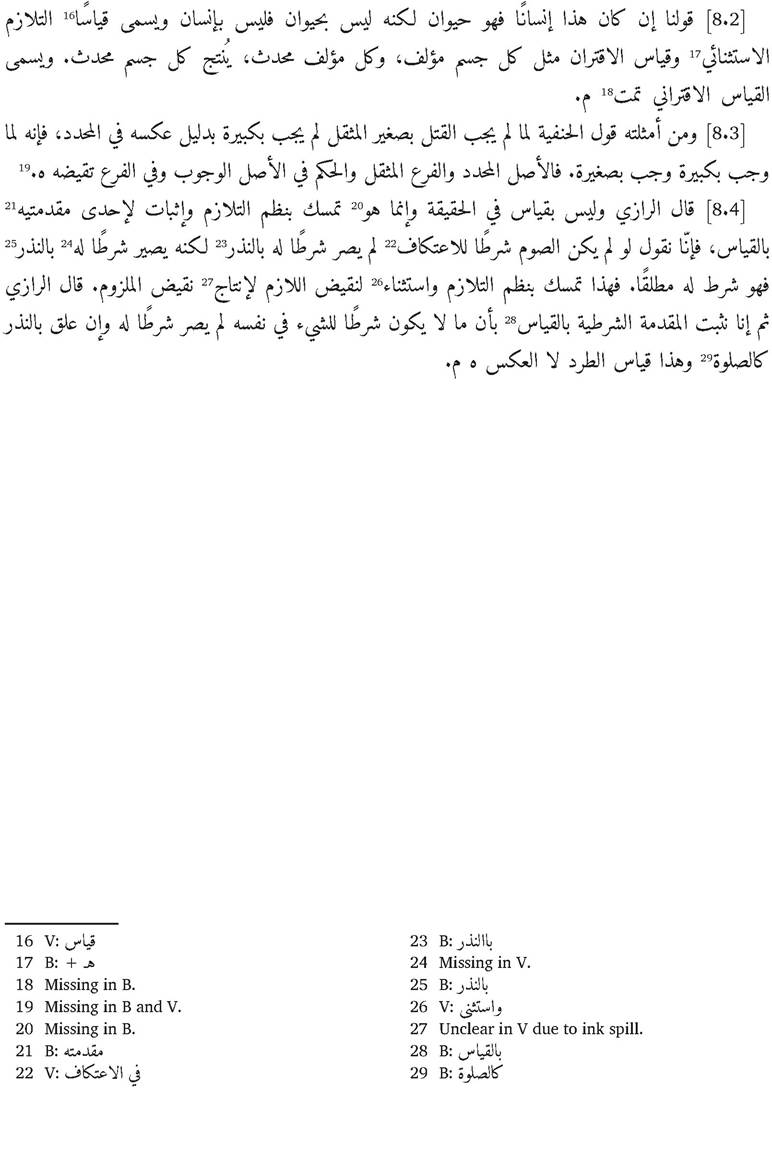
'Abdallah understands al-Wazir’s definition of the rule to be “the application of the converse of a rule of a case to another case.” Leaning on previously articulated arguments, he asserts that since this procedure entails the inference of a judgment by knowledge of its opposite, this necessarily falls within the purview of a type of analogical deduction and hence should appropriately be considered qiyas. Acknowledging juridical disagreement on its status, he asserts that he chooses “to agree with those who accept it [as a valid category], given its traceability (and hence similarity) to qiyas al-dalala.”[7-8.1] On what basis then, did jurists like Ibn Zayd adopt an opposing view? In responding to this, Ahmad b. 'Abdallah reverts back to answering the question of whether qiyas encompassed various forms of legal and non-legal reasoning (in lieu of functioning as one narrowly defined legal procedure). Borrowing from the Shafi'i Nasir al-Din 'Abdallah b. 'Umar al-Baydawi (d. between 699 and 705/1299 and 1306), he explains that those who took the opposing view argued that “usul al-fiqh only speaks of qiyas as it is operationalised in fiqh and employed by jurists in a legal context.” Hence, they deemed qiyas al-Ha to largely be the one legitimate form of qiyas. As for other non-legal types of qiyas - such as the conditional hypothetical syllogism (qiyas al-tala- zum) and conjunctive syllogism (al-qiyas al-iqtirdni) - while logicians deemed these to be types of qiyas and jurists like al-Wazir concurred, Ibn Zayd would not recognise them as such within the realm of jurisprudence.25
[8.1] Ahmad b. 'Abdallah explains that “they consider co-absence (qiyas al-‘aks) to have the likeness of the conditional hypothetical syllogism (qiyas al-talazum).” Hence in this case, Ahmad
b. 'Abdallah is pointing out the fundamental disagreement between al-Wazir and Ibn Zayd on the scope of what qiyas constituted.
The former, he claims, permitted importing ideas from formal logic and accepting them at face value as such. The latter did not consider the act of borrowing ideas from non-legal genres to be valid within the realm of qiyas. This is despite the fact that those who concurred with Ibn Zayd used many of the same interpretive tools either by assigning them an alternate category, or by asserting their textual (in lieu of speculative) roots. Therefore, in the view of Ibn Zayd, the likeness of co-absence (qiyas al-‘aks) to that of the conditional hypothetical syllogism (qiyas al-talazum) - a type of reasoning derived from formal logic - necessarily implied that it is outside of the realm of law. Since he deems syllogistic reasoning to be excluded from the formal definition of qiyas, this implies that co-absence (qiyas al-‘aks) is therefore not a valid form of legal analogy.[8.2] For all of the argumentation on the validity of using formal logic (mantiq) in the realm of law, how did jurists integrate non-legal reasoning into the procedure of legal analogy? To further explain qiyas in the realm of formal logic (mantiq), he offers examples of the conditional hypothetical syllogism (qiyas al-talazum) and conjunctive syllogism (al-qiyas al-iqtirani) as found in classical manuals of that genre; he then shows [8.3] how this is applied in the law, noting an instance of conjunctive syllogism (al-qiyas al-iqtirdni) in the view of the Hanafis that when execution is not mandated for murder committed with a small rock, then it is not mandated for murder committed with a large rock, by way of the evidence of its converse. The converse in this case was that execution could only be mandated for instances in which an iron weapon capable of cutting or piercing was used, on the basis that only with the use of such a weapon could an intent to kill be established. He continues, focusing on how such syllogistic logic would work, noting that “[the same syllogistic relationship would exist if the opposite were true, namely that], if execution were mandated in cases in which a large rock were used as the murder weapon, then it would also be mandated in the case of the small rock, with the primary case (asl) being that of the iron weapon, the derived case (far0) being that of the rock, the judgment (hukm) for the asl being the obligation to execute, and the judgment (hukm) for the farc being blood money (and hence the converse of the obligation to execute).”
[8.4] Ahmad b.
'Abdallah then moves on to the oft-cited query used to demonstrate the application of co-presence and co-absence (qiyas al-tard wa-l-‘aks), namely the problem of whether fasting and prayer are individually obligatory for Ftikaf to be valid. Jurists puzzled over two major issues on the rulings related to Ftikqf. First, were the necessary conditions of the vowed Ftikqf the same as those of the superogatory Ftikaf? Second, was the performance of prayer, fasting, or both, obligatory for one’s Ftikdf to be valid? Citing the Shafi'i jurist and philosophising Ash'ari scholar Fakhr al-Din al-Razi (d. 607/1210), he explains that the analogical reasoning applied in this case on the part of those Zaydis who concur with al-Wazir’s approach is not the specific legal procedure denoted by the Shafi'is, but rather the application of conditional and syllogistic reasoning borne from formal logic (mantiq). The case of fasting and vowed Ftikdf, he notes, “adheres to the line of reasoning known as conditional and exceptive syllogism by way, in this case, of the application of the converse of the necessary condition producing the converse of the sufficient condition.” He continues his discussion of Razi’s explanation, who states that “we have hence established the conditional premise by way of qiyas that whatever is not a prerequisite for (the validity of) Ftikdf independently in and of itself cannot thereafter then become a prerequisite for it (later or in a new circumstance); this is true even if the proposed prerequisite is associated with the case of the vowed Ftikdf, such as the case of prayer, which is an instance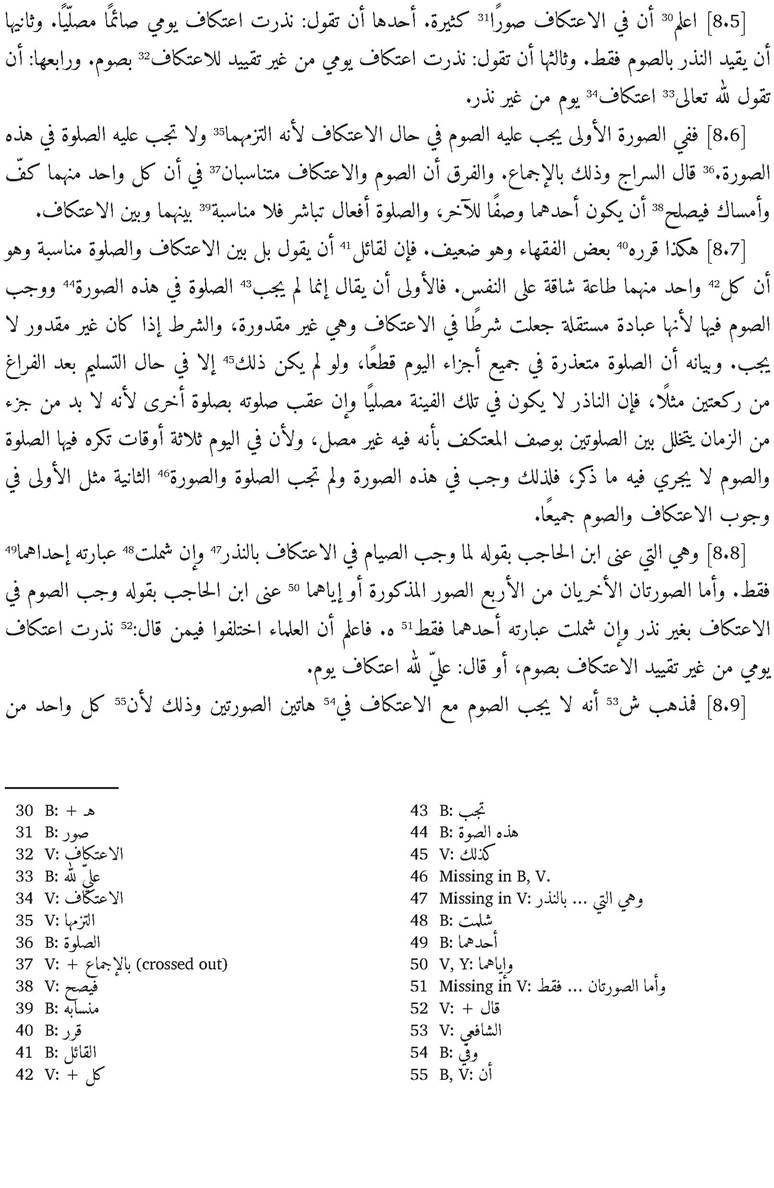
of co-presence (qiyas al-tard) and not co-absence (qiyas al-caks)."
[8.5] He expands further, outlining four hypothetical cases borrowed from Razi’s discussion for further investigation. The first case is that one vowed to perform i'tikaf for a day along with praying and fasting; the second, that one vowed to perform i'tikaf while fasting only; the third, that one vowed to perform i'tikaf but without the restriction of fasting; and the fourth, that one chose to perform a superogatory i'tikaf for a day, without a vow.
[8.6] Ahmad b. 'Abdallah then mentions the implications of each scenario as articulated by al-Razi, appending his own analysis. In the first case, fasting would be obligatory because it is deemed a necessary condition for the validity of the vowed i'tikaf, however prayer would not be obligatory even if explicitly articulated in a vow. He notes that according to the Shafi'i jurist and logician Siraj al-Din al-Urmawi (d. 693/1294), this view is backed by consensus (ijma'). The distinction between fasting and prayer as applied to the vowed i'tikaf is that fasting necessarily co-exists with i'tikaf such that if one breaks one’s fast during the time of day that it should normally be kept, one has also broken one’s i'tikaf. The vowed i'tikaf could be conceptualised as the occasioning factor ('illa) for fasting in this case. Both fasting and i'tikaf necessarily co-exist such that one of the two can be mentioned as an implied description of the other. Prayer, on the other hand, is an act initiated by its own separate and independent procedure, hence as a “state” (hal) it cannot retain equivalency with i'tikaf.
[8.7] Ahmad b. 'Abdallah finds this line of reasoning to be weak. In his view, one could just as much argue for an equivalency between prayer and i'tikaf through an alternate avenue, namely that both share the feature of being directed devotional obedience and hence have a parallel relationship as well. He suggests an alternate line of reasoning as more convincing instead, namely the application of the idea that a condition or prerequisite that is not humanly feasible cannot thereby be mandated as an obligatory act. In this case, there are time periods during the day in which prayer is prohibited or disliked such that the day is divided into portions in which prayer is permitted and portions in which it is not. Due to this, prayer is not a state within which one can persist in uninterrupted continuity alongside the state of i'tikaf. Rather, there are moments in which one must be in a state of i'tikaf but not be in a state of prayer, or else one risks engaging in sin. Fasting, on the other hand, is a continuous act during a part of the day which does not suffer disruption; hence it can be made obligatory as a condition that is humanly feasible, while prayer cannot be made as such.
[8.8] As for the second hypothetical, this adopts the same judgment (hukm) as the first hypothetical in the obligation to fast. He cites the Maliki jurist Ibn al-Hajib (d. 646/1249), noting that fasting was obligatory in the case of the vowed i'tikaf whether or not one specifically articulated a vow to fast along with a vow to perform i'tikaf. Hence, for the Malikis, the second and third hypotheticals yielded the same result of the requirement to fast. As for the fourth hypothetical, he notes that Ibn al-Hajib indicates that fasting is nonetheless still obligatory even in cases of the superogatory i'tikaf as well.
[8.9] ) The Shafi'is, on the other hand, did distinguish between the second and third cases. Contrary to the Hanafis and Zaydis, they deemed fasting to be an independent act of worship, separate from i'tikaf. Hence, if fasting were excluded from the vow, as in the third case, then it was not required in order to complete the vowed i'tikaf. Fasting was likewise not required in instances of the superogatory i'tikaf, as in the instance of the fourth case.
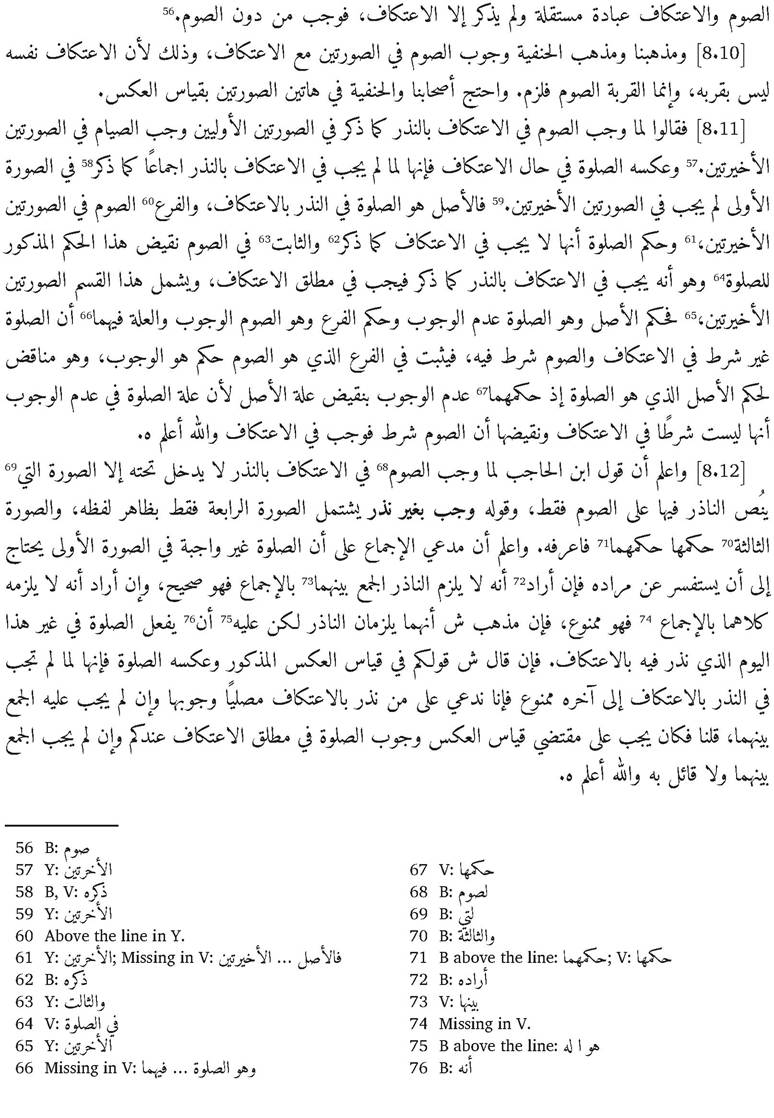
[8.10] Ahmad b. 'Abdallah finally turns to the Zaydi and Hanafi positions. He notes that in their view, fasting was in fact obligatory in the third and fourth cases alongside i'tikdf, because i'tikaf in itself did not yield the result of attempting to achieve closeness to God; rather it was the act of fasting that fulfilled this, hence, it was a necessary condition for i'tikaf in all cases, even if one excluded fasting from one’s vow as in the third case, or performed superogatory i'tikdf as in the fourth case.
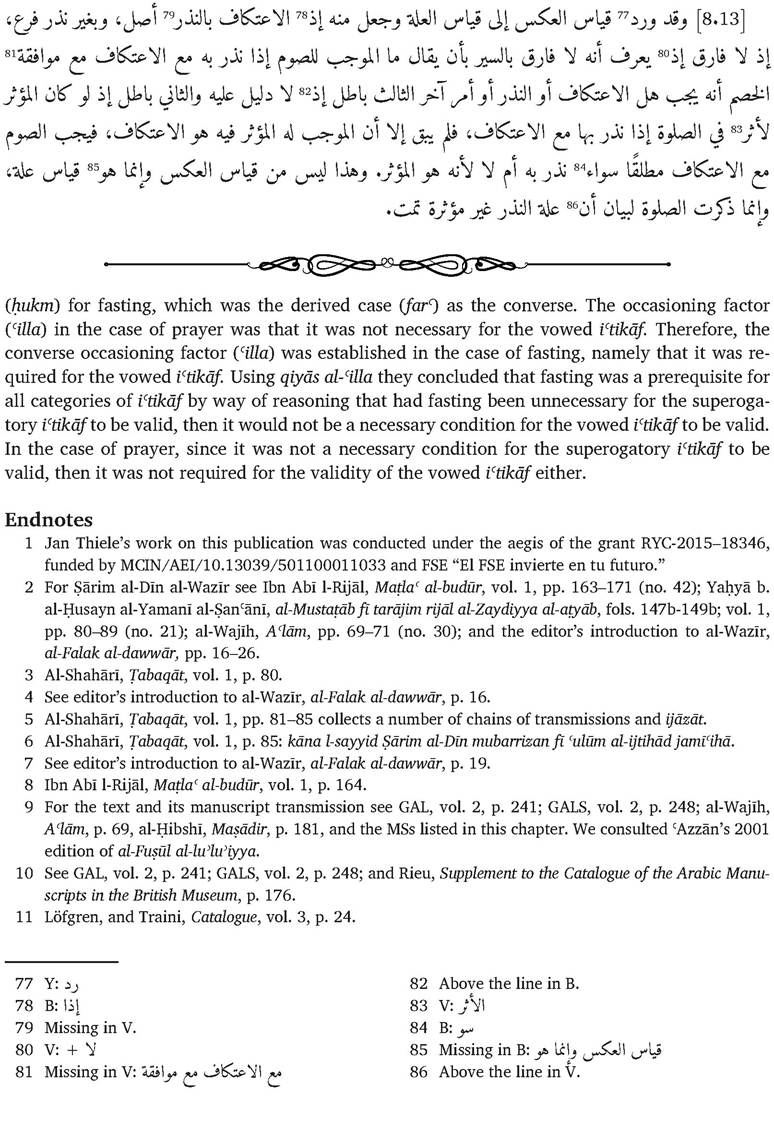
[8.11] His channel of reasoning to support his view was the application of co-absence (qiyas al-'aks). In this view, he notes that when fasting is obligatory for the vowed i'tikdf as in the first and second cases, then it is also obligatory in the third and fourth cases. The converse case is prayer, because when prayer was not obligatory to fulfill the vowed i'tikdf by consensus (ijmd') as in the first case, then it was also not made obligatory in the last two cases. Hence, in this scenario the principal case (asl) is the case of the vowed i'tikdf and prayer, and the derived case (far') is the case of fasting in the third and fourth cases. The judgement (hukm) for prayer would be that it is not obligatory for the vowed i'tikdf, and therefore the judgment (hukm) for fasting would be the converse, namely that it would be obligatory in the case of the vowed i'tikdf. The occasioning factors (Hal) in both were that prayer is not a condition for the vowed i'tikdf, and that fasting is a condition for it. In the Hanafi view, an element not accounted for by co-absence (qiyas al-'aks) was the added implication that because fasting was obligatory in the vowed i'tikdf, it was then obligatory in an absolute sense in all cases, including the fourth hypothetical case of the superogatory i'tikdf.
[8.12-8.13] The Shafi'is, Ahmad b. 'Abdallah notes, were critical of the Hanafis on two points. First, they took issue with the idea that the Hanafis could consider prayer not obligatory in any category of i'tikaf. Second, the Hanafis were allowing for a logical fallacy. Co-absence (qiyas al- 'aks) accounted for obligating fasting in the case of the vowed i'tikdf, however it did not account for the additional Hanafi view that fasting was obligatory in all cases including superogatory i'tikdf. To the first point, Ahmad b. 'Abdallah responds that there is no doubt that prayer was an obligatory act to perform more generally. However, the performance of prayer was obligatory outside of i'tikaf as well. Hence, for the Hanafis the obligation of prayer did not correlate with being in a state of i'tikdf since the obligation existed outside of i'tikdf and since there were periods of time during i'tikaf in which prayer was prohibited. As for the second point, Ahmad b. 'Abdallah concurs that co-absence (qiyas al-'aks) does not account for the obligation to fast in all cases. But, he argues, the Hanafis never intended for co-absence (qiyas al-'aks) to account for both. Rather, the procedure of qiyas al-'illa was used to demonstrate that if fasting were required for the vowed i'tikaf, then this could also be extended to superogatory cases.
In plain language, al-Wazir argues for the validity of qiyas as an interpretive tool, in contradistinction to the classic Twelver position. As Ahmad b. 'Abdallah demonstrates, he also opines with those Zaydis who applied reasoning in congruence with the Hanafis allowing for the application of syllogistic reasoning as a valid form of qiyas. Hence, co-presence (qiyas al-tard) and co-absence (qiyas al-'aks) receive formal entries as valid categories in his text. In the earmarked case described above, the Hanafis and Zaydis used the widely accepted procedure of qiyas al-'illa - which the Shafi'is and Malikis would have theoretically found acceptable - to connect the two cases of fasting in the vowed and superogatory i'tikaf. However, in addition to this they also used syllogistic reasoning to connect the two cases of prayer and fasting through the application of co-absence (qiyas al-'aks). The Hanafis took prayer to be the principal case (asl), with its judgment (hukm) being that it is not a prerequisite for i'tikaf. They wanted to situate the judgment
12 For Ahmad b. 'Abdallah’s biography and works see Ibn Abi l-Rijal, Matlac al-budur, vol. 1, pp. 329-345 (no. 141); al-Shahari, Tabaqat, vol. 1, pp. 153-158 (no. 58); al-Wajih, Adam, pp. 129-130 (no. 101). Lofgren and Traini state that Ahmad b. 'Abdallah was Sarim al-Din al-Wazir’s grand-nephew rather than his great-grandson, but this is not supported by the name given in the biographical literature.
13 The manuscripts digitised by the Zayd b. 'Ali Cultural Foundation are freely accessible online via https://elibrary.mara.gov.om/mktbtt-muosstt-aliemam-zed-bn-ale-althqafett/mktbtt-muosstt-alie- mam-zed-bn-ale-althqafett/ (accessed 26 August 2020).
14 For the manuscript see Ahlwardt, Kurzes Verzeichniss, p. 31; Ahlwardt, Verzeichniss, vol. 4, pp. 327-328, no. 4942; a digital copy (ZMT 00848) can be accessed via https://digital.staatsbibliothek-berlin.de/werkansicht?PPN = PPN733271049&PHYSID = - PHYS_0237&DMDID = DMDLOG_0001.
15 See no. 26 in the list of manuscripts of al-Fusul al-ludu’iyya.
16 Ahlwardt, Verzeichniss, vol. 4, p. 328.
17 The end of the text reads as follows:
18 Missing in the online digital collection at https://elibrary.mara.gov.om/mktbtt-muosstt-aliemam-zed-bn-ale-althqafett/mktbtt-muosstt-alie- mam-zed-bn-ale-althqafett/.
19 Missing in the online digital collection at https://elibrary.mara.gov.om/mktbtt-muosstt-aliemam-zed-bn-ale-althqafett/mktbtt-muosstt-alie- mam-zed-bn-ale-althqafett/.
20 Qiyas al-tard by itself or in combination with qiyas al-’aks is sometimes also translated as “concomitance.”
21 Some authors use the term reductio ad absurdum, however this would be incorrect as such arguments correspond more closely to a fortiori arguments, not qiyas al-’aks. We have found “co-presence” and “co-absence” to be the most accurate in this case, the terms used by Weiss. See Weiss, The Search for God’s Law, pp. 623-624.
22 Ttikaf refers to the recommended practice of retreating and isolating oneself in a mosque for the purpose of voluntary worship. Ttikaf can be performed on any day or night of the year and is considered a superogatory (nafl) act. However, if one has made a vow (nadhr) to perform i’tikaf, then the act becomes obligatory (wajib) to complete. The vow (nadhr) could either be: 1) a vow made to God by way of articulating a specific intent to perform i’tikaf or 2) a vow based on the fulfillment of a condition as in “if a specific event occurs, I will perform i’tikaf for ten days.” The legal schools differed on the details of these categories and what acts of ritual worship were deemed necessary conditions for the validity of each category of i’tikaf.
23 Qiyas al-’illa is also sometimes referred to as qiyas mansus al-dlla - analogical reasoning with explicitly mentioned occasioning factor; or al-qiyas al-jdli - analogical reasoning with an explicit occasioning factor. The concept refers to analogical reasoning whereby the judgment (hukm) as recorded by evidentiary texts directly articulates the occasioning factor (ilia) of the case as well, leaving no doubt as to God’s intention and hence no need for jurists to deduce what the occasioning factor Cilla) might be. This type of qiyas was largely deemed to the be the most reliable of the various types.
24 Qiyas al-dalala, generally speaking, refers to instances in which the analogical relationship had to be inferred or deduced by jurists and was not explicitly textually referenced, as in the case of qiyas al-’illa. There are sub-categories of qiyas al-dalala based on the type of inferential reasoning that is being deployed; This line of reasoning was also sometimes referred to as qiyas al-shabah.
25 In many instances jurists who did not subsume syllogistic reasoning under qiyas instead subsumed it under a fifth category - outside of qiyas, ijma’ and the two textual sources - the category of istidlal.
More on the topic Commentary:
- Commentary
- Commentary
- Commentary
- Commentary
- Commentary
- CHAPTER 12 COMMENTARY ON SOME RECENT DEVELOPMENTS (2ND EDITION, 2011 AND 3RD EDITION, 2023, TED BENTON)
- Introduction
- Christ’s Empire
- The Provincial Edict
- COMMENTARIES
- AN ANCIENT ESTIMATE OF THE SPEED OF LIGHT
- Bibliography
- REFERENCES
- Involuntary Surrender of Possession
- Voluntary Surrender of Possession (unilaterally or through delivery; movable or immovable property)
- 17 Prohibition on the Possession and Proselyting of Christian Slaves by Jews
- Hume’s critique of the modern philosophy
- Introduction: Thinking about Secularism
- Tamim Ansary