The Chapter on Analogy (Qiyas)
Linguistically, analogy (qiyas) is defined as comparison (between two things) and measurement (of two things). As for terminological definitions, we have (two specific types of analogy):
1) Co-presence20 (qiyas al-tard) is the attachment of a judgment (hukm) governing a principal case (asl) to a derived case (far) due to the jurist’s deduction that both cases share the same occasioning factor (Illa) with respect to the judgment (hukm) in question.
The mukhattPa (those who believe that only one juridical opinion could be correct in corresponding with God’s ruling on a given issue and that all other opinions were erroneous) do not require the inclusion of the last clause, “due to the jurist’s deduction.” This is in contrast to the musaw- wiba (those who believe that the opinion of every mujtahid is correct, with God’s ruling corresponding to each mujtahid’s position). This is because in their view the analogical reasoning (qiyas) of the mujtahid is valid (so long as he has applied his reasoning to the best of his ability), even if he later realises his ruling was erroneous and hence retracts it.2) Co-absence21 (qiyas al-'aks) is a type of reasoning whereby the converse of the judgment (hukm) of a principal case (asl) is applied to the derived case (far4), due to both cases having differing or opposing occasioning factors ('ilal). An example mentioned by Zaydi and Hanafi jurists is the case of fasting (sawm) during the vowed i'tikaf (al-i'tikaf bi-l-nadhr).22 Ritual prayer (salah) is not deemed a necessary condition for the validity of I'tikaf more generally because it has not been stipulated as such for the vowed i'tikaf. Extending this principal case (asl) of ritual prayer to the derived case (far') of fasting, the same occasioning factor ('illa) is not present. It has been determined that fasting is a necessary condition for the validity of the vowed i'tikaf.
Applying the converse of the principal case (asl), this implies that since fasting is a necessary condition for the vowed i'tikaf, it must also be that fasting is a necessary condition for i'tikaf more generally. This is the view of the majority [in our school], and it is also the view we choose; however Ibn Zayd and some of the Usulis refute this.3) If we were to combine both into one definition, we would say: the application of the same ruling or its converse, of the principal case, to the derived case, due to their sharing the same or having different occasioning factors.
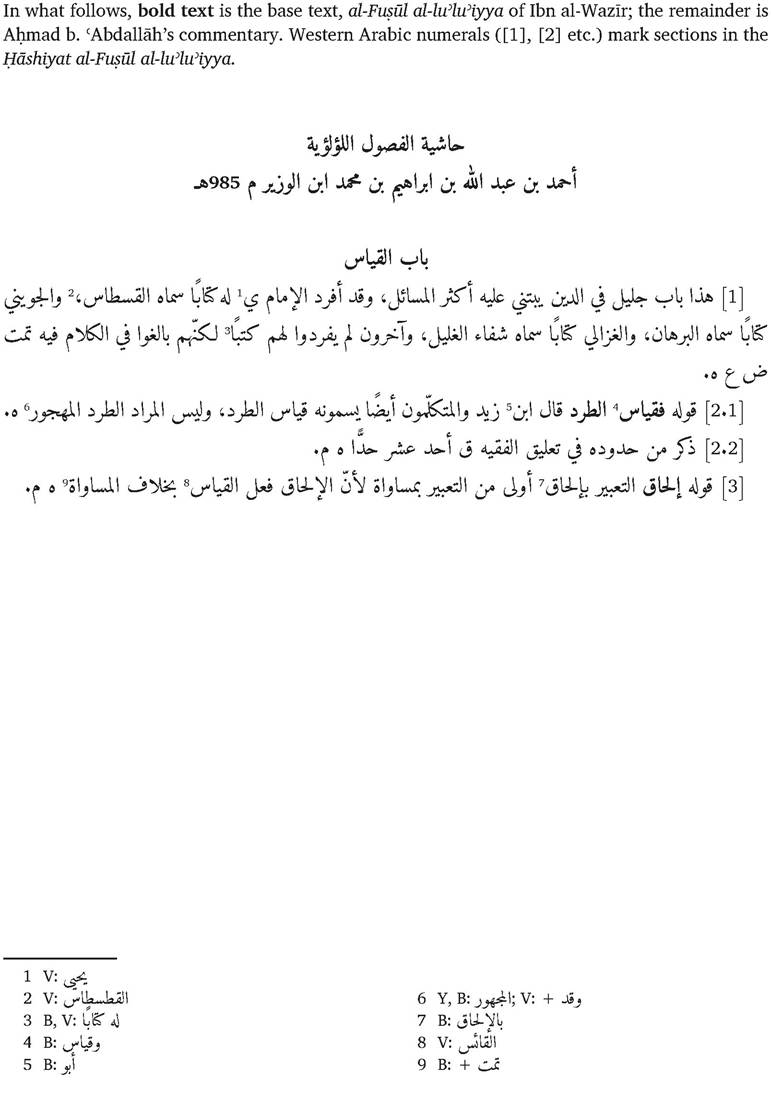
In this short passage al-Wazir makes his views apparent on three issues. First, similar to the Sunni jurists he cites - and contrary to the Twelvers - he considers qiyas to be a valid juridical tool of interpretation. Second, the disagreement between the mukhattba - namely the Twelvers - and musawwiba - namely the Zaydis and majority of Hanafis, Malikis, and Shafi'is - on whether the judgment of every mujtahid is correct, versus the existence of only one empirically correct judgment in alignment with God’s Will, is a significant fissure in usul debates that will affect subsequent conversations. Third, co-presence (qiyas al-tard) and co-absence (qiyas al-'aks) are both valid forms of analogical reasoning (qiyas). While they can be combined into one singular idea, they are sufficiently distinctive such that they are best treated as different sub-types of analogical reasoning (qiyas). The recognition of co-absence (qiyas al-'aks) was an enormously controversial issue among jurists, yielding extensive debate between those who favoured and opposed its validity. Hence, as we will see, Ahmad b. 'Abdallah cites the two prominent Shafi'i jurists Abu Hamid al-Ghazali (d. 505/1111) and Abu l-Ma'ali al-Juwayni (d. 478/1085) in support of al-Wa- zir’s general position on qiyas. However, on the more specific matter of co-absence (qiyas al-'aks), al-Juwayni does not consider it be a valid form of analogical reasoning while al-Ghazali does.
More on the topic The Chapter on Analogy (Qiyas):
- Chapter 6 The Chapter on Analogy (Qiyas) from the Hashiyat al-Fusul al-lulu’iyya of Ahmad b. cAbdalläh Ibn al-Wazir (d. 985/1577)
- Legal Analogy and God's Wisdom
- Legal Analogy and the Ratio Legis
- The Function of Legal Analogy and the Ratio Legis
- II NON-ANALOGICAL ARGUMENTS IN SUNNI JURIDICAL QIYAS*
- Legal Analogy and the Function of the Ratio Legis
- 2 The Function of Legal Analogy
- The above study started with the assumption that God's laws are good and, thus, extending them in analogy to situations not directly addressed in Scripture also extends their ethical content.
- A. D. Nock illustrated the problematic nature of the source materials documenting the cult of Mithras by means of the following analogy (Nock 1964: 58)
- Opwis Felicitas. Ethics and Analogy (Qiyās) in 5th/11th-Century Islamic Legal Theory. Brill,2025. — ix, 201 p., 2025
- Chapter 2 Refraining from Seeking Clarification: A Chapter from al-Wafl fl sharh al-Wafiya of al-Acraji (d. 1227/1812)
- Chapter 8 Why Early Muslims Divided into Sects? A Chapter from the Mukhtasar al-usul of cAli b. Muhammad b. al-Walid (d. 612/1215)1