Commentary
[1] The section begins with A'raji highlighting the issue: If someone posed a question to the Prophet by “relating a scenario” (hikayat al-hal), and the Prophet refrained from “seeking clarification” (al-istifsal) about the scenario, then should the Prophet’s reply be understood as a universal statement despite the possibility (ma‘a qiyam al-ihtimal) that the question pertained to something particular? Al-Shafi'i (d.
204/820), al-Sharif al-Murtada (d. 436/1044), al-Ghazali (d. 505/1111), and others were all of the opinion that it should always be considered a universal statement.2[2] Then A'raji clarifies the meaning of “relating a scenario” (hikayat al-hal) and “seeking clarification” (al-istifsal). The former refers to what the person tells the Prophet about a particular incident. For example, he might say, “So-and-so broke his fast during Ramadan,” by which he means to inquire about a particular instance of breaking the fast (i.e. eating, sex, vomiting, etc.) even though he did not specify which one. In this case, although he posed the question in a general way, there is a strong possibility that it pertains to something in particular (e.g. eating). As for “seeking clarification,” it means seeking to differentiate between what the person is actually asking about (e.g. eating) and other possible instances (e.g. sex or vomiting). For example, the Prophet might ask, “How did so-and-so break his fast?”
[3] The addition of the phrase “despite the possibility” (ma‘a qiyam al-ihtimal) is meant to exclude cases where the question is explicitly about something in particular. For example, if someone says, “I had sex in Ramadan,” and the Prophet replies, “Offer expiation,” then we cannot assume that someone who broke the fast by, for example, eating or vomiting should also offer expiation. Because the question was specific, the answer cannot be generalised.
Similarly, if someone is selling unripe fruit and you say, “Avoid this,” or “Your sale of this is invalid,” then your statement applies to this case in particular; it does not include other cases involving risk (gharar). By contrast, if the seller were to ask about sales involving risk (bay‘ al-gharar) and you said they are invalid without inquiring any further, then, even if the seller was asking about a particular item (e.g. dates), your answer would encompass every sale involving risk because (1) you refrained from seeking clarification and (2) there is a possibility that the seller was asking a general question.[4] Furthermore, it makes no difference whether the question is hypothetical (e.g. What should someone who broke his fast do?) or not (e.g. So-and-so broke his fast). In fact, in the former case, there is no question about its meaning because it can only be understood in a universal sense. Moreover, it makes no difference whether there is a question - in which case refraining from seeking clarification would take the form it took in the examples above - or not. In the latter case, an example of not drawing a distinction is the Prophet’s saying “Keep four [wives] and leave the rest” to a man who had ten wives at the time he became Muslim.3 In this example, the Prophet did not draw a distinction between a scenario in which the man married all ten at once or one after another such that, if he had married all ten at once, he could choose which ones to keep, and if he had married them one after another, then he would have to keep the first four, as Abu Hanifa (d. 150/767) claimed.
[5] A'raji then explains why the rubric only mentions cases where a question is posed about an incident that occurred. This is because every incident is particular and therefore a question about the incident must also be particular. Obviously, if a question is about something in particular, then to refrain from seeking further clarification is an even stronger indication that the answer is universal - at least this is what is said.
Scholars have focused on cases in which a question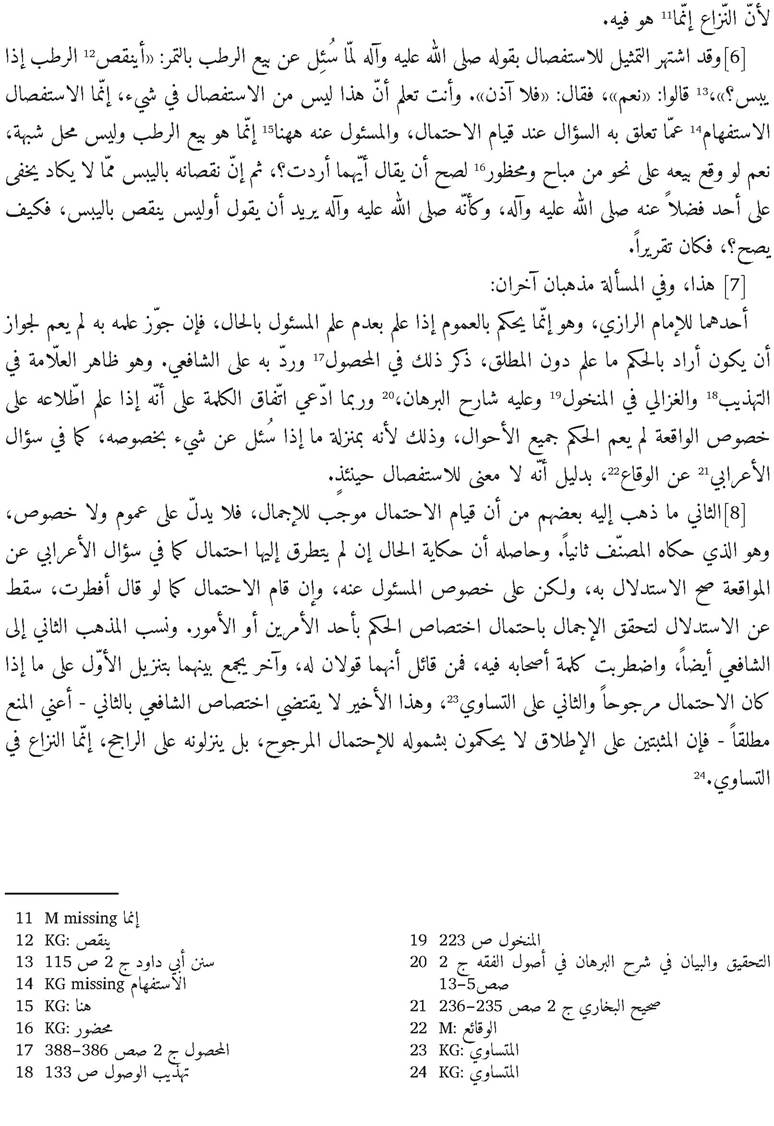
is posed about an incident that occurred (as opposed to hypothetical scenarios) because such incidents have been the bone of contention.
[6] It is common to illustrate “seeking clarification” by citing the example of the Prophet who, when he was asked about the sale of fresh dates for dry dates, said, “Does the value of fresh dates decrease once they are dried?” When they said yes, the Prophet said, “Then I do not grant permission.”4 This example, however, is unrelated to “seeking clarification” because “seeking clarification” means inquiring further about the issue being asked when there is a possibility of variety of interpretations. In the case of the sale of fresh dates, there is no doubt. If, however, the sale used to take place in a way that was either permissible or non-permissible, then it would be correct to ask which of the two was meant. But the fact that the value of fresh dates decreases once they are dried is something everyone knows let alone the Prophet. It is as though the Prophet wished to say, “Will they not decrease in value if they are dried? So how could it be valid?” This is an example of the Prophet’s tacit consent (taqrir), not “seeking clarification.”
[7] In addition to the opinion attributed to al-Shafi'i (and al-Sharif al-Murtada and al-Ghazali) above, there are two other opinions about this issue. First, Fakhr al-Din al-Razi (d. 606/1209) held that it should be understood as a universal statement if we know that the person being asked was unaware of the specific incident. By contrast, if he might have known, then his answer cannot be generalised. This view, which is expressed in al-Mahsul,5 contradicts the view of al-Shafi'i, who believed that it should always be understood as a universal statement. It also seems to be the view of al-'Allama al-Hilli in Tahdhib al-wusul,6 al-Ghazali in al-Mankhul,7 and Sharih al- burhan.8 Perhaps, we can say that what everyone (ostensibly) agrees upon is the idea that if we know that the Prophet knew about the specific incident, then his answer cannot be generalised.
That is because, in this case, it is as though he is being asked about something in particular - such as the Bedouin’s question about sex;9 therefore, it does not make any sense to inquire further.[8] The second opinion is that the possibility that the question pertained to something in particular means the answer is ambiguous and it cannot be understood either as a universal or a particular statement. This is the view that al-Tuni mentioned second [b.3]. It means that if there is no possibility that the question was general - such as in the case of the Bedouin’s question about sex - then the answer can be adduced as evidence, but only in cases involving the same incident (e.g. sex). If the question might have been general, such as when someone says, “I broke my fast,” then the answer cannot be adduced as evidence because it is ambiguous - the answer might only apply to one way of breaking the fast (e.g. eating). This view has also been attributed to al-Shafi'i, but there is disagreement among the Shafi'is themselves as to how to understand it. Some say that al-Shafi'i held both this view and the view that the answer should be considered a universal statement. Others try to reconcile both statements by arguing that if the possibility that the question was general is stronger, then the answer should be considered universal; however, if the possibility that the question was general is equal to the possibility that it was particular, then the answer cannot be adduced as evidence because it is ambiguous. The latter view is not unique to al-Shafi'i: those who take the view that the answer should always be considered universal do not include cases where there is a strong possibility that the question pertained to something in particular. The bone of contention is cases where the possibility that the question was general is equal to the possibility that it was particular.
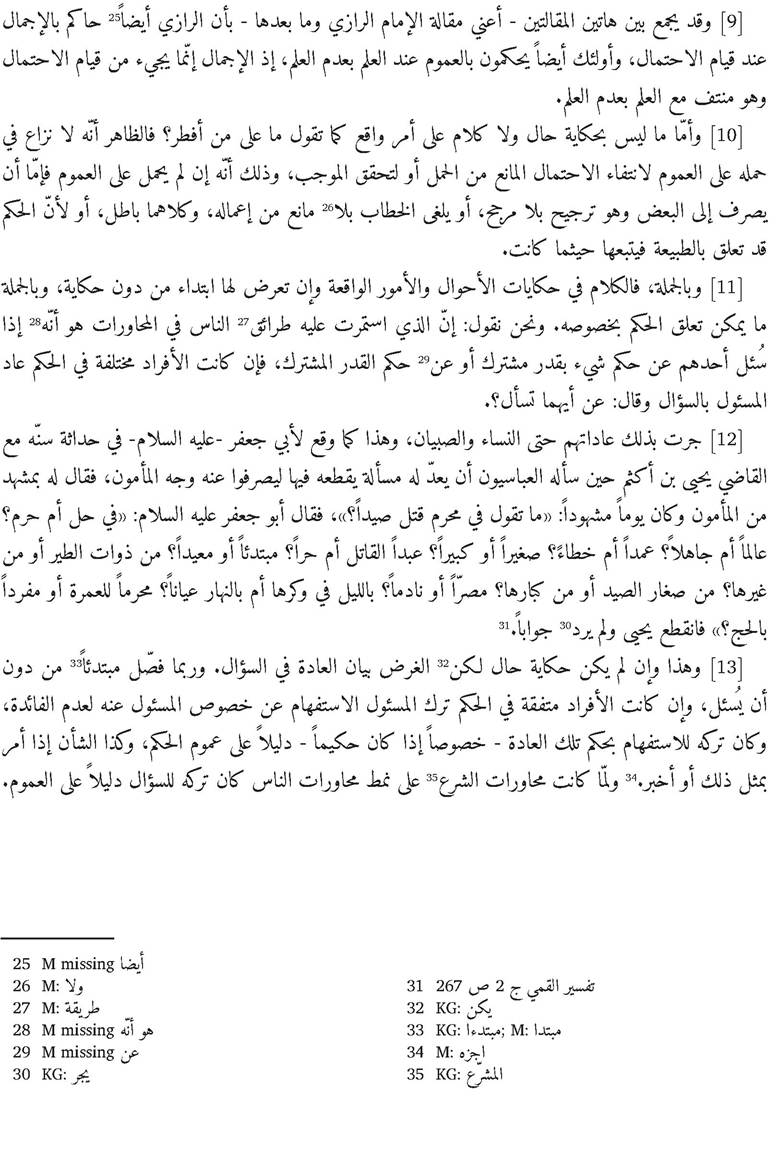
[9] We may be able to reconcile al-Razi’s opinion with the second opinion attributed to al- Shafi'i by saying that, in cases where there is a possibility that the question pertained to something in particular, al-Razi would agree that the answer is ambiguous; in cases where we know that the Prophet had no knowledge of the specific incident, then the proponents of the second opinion attributed to al-Shafi'i would agree that the answer should be considered a universal statement.
It is the possibility that the question pertained to something in particular that gives rise to the ambiguity of the answer, but there is no such possibility in cases where we know the Prophet had no knowledge of the specific incident.[10] As for cases in which no scenario is related, or hypothetical cases, such as when one says, “What should one who broke his fast do?” there does not appear to be any disagreement: the answer should be understood as a universal statement either because there is nothing to prevent us from considering it universal or because the question is phrased in a way that necessitates understanding the answer as universal. If it were not considered universal, then we would have to say that the answer pertains to some instances and not others - which entails giving preference to one of two possibilities without a reason (tarjih bi-la murajjih) - or we would have to say that the speech (khitab) is nullified for no reason - both of which are invalid - or we might say that the answer centres around the generality of any case and therefore follows it in its explanation.
[11] So, in sum, the debate only concerns cases where a scenario is related (hikayat al-ahwal) and an incident has actually occurred (al-umur al-waqicah) even if the Prophet addresses it without having been told the scenario. In these cases, the question is: to which particular things can the answer pertain? In general, the way people talk is that when someone is asked about an issue like breaking one’s fast, and there are several ways to break one’s fast (i.e. eating, sex, etc.), then, if the legal consequences of breaking one’s fast differ based on how it is broken, the person being questioned will ask the petitioner which one he is inquiring about.
[12] This is how people converse customarily and this is precisely what happened to Imam Muhammad al-Jawad (d. 220/835) in his youth when the 'Abbasids asked the judge Ibn Aktham (d. 242/857) to contrive questions the Imam would not be able to answer so that he would fall out of favour with the caliph al-Ma’mun (r.
198-218/813-833). In the presence of al-Ma’mun, Ibn Aktham asked the Imam, “What do you say about a person in the state of ihram who kills an animal?” The Imam replied, “Was that within the sacred precinct (haram) or outside it (hill)? Did he know what he was doing is wrong or not? Did he do it intentionally or accidentally? Was he an adult or a child? Was he a slave or a freeman? Was this his first offence or not? Did he kill an animal that flies or something else? Was the animal small or large? Was he repentant or not? Did he kill it at night when the animal was in its home or during the day? Had he entered into the state of ihram for the hajj or the 'umrah?” Ibn Aktham was speechless.10[13] Although it is not an example of “relating a scenario,” it is mentioned to illustrate how people normally pose questions. The one asking might even offer details without being asked. But if the rule is the same in every instance, then the one being asked does not inquire into details because there is no reason to do so. Based on this custom, when someone (particularly a wise person) is asked a question, and he answers it without inquiring any further, this constitutes evidence of the universality of his answer, whether it is in the form of an imperative or declarative statement. When the Sharia converses in a way that is analogous to the way ordinary people converse, then its answers should be considered universal, particularly those that are issued without making any further inquiry.
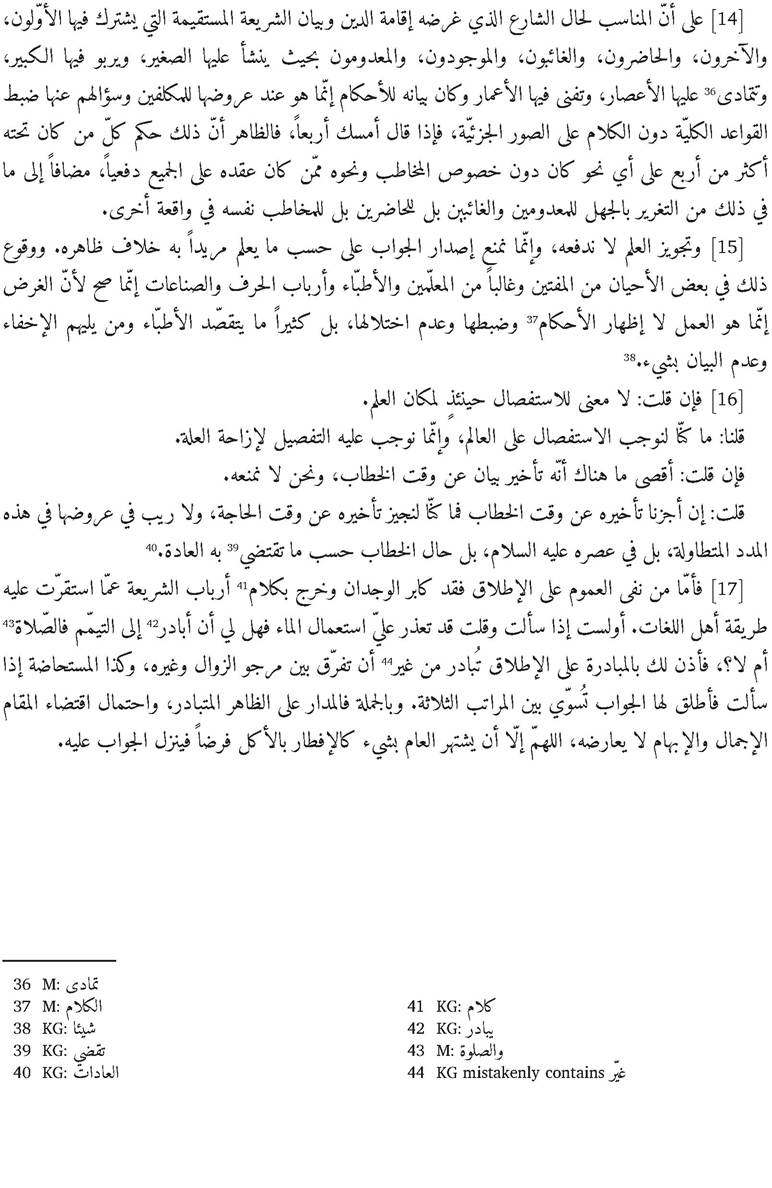
[14] Because the purpose of legislation is to establish religion and elucidate the law, which encompasses everyone, and because the Lawgiver only elucidates rules when relevant situations arise and people ask questions about them, the Lawgiver lays down universal rules; he does not speak in particularities. So if he says, “Keep four wives,” then prima facie, this rule applies to anyone who has more than four wives, irrespective of how he married them; it is not specific to the one being addressed. Speaking otherwise would doom those who are not present, future generations, and even those who are present to ignorance. In fact, even the one being addressed would be doomed to ignorance when facing another similar incident.
[15] A'raji does not deny the possibility that the Prophet knew the specific incident; rather, what he denies is the possibility that the Prophet would give an answer based on his knowledge of the specific incident, but intend something other than the apparent meaning of what he said. Yes, sometimes muftis, teachers, doctors, etc. speak based on their knowledge of the details of a given question, but that is only because they are concerned with action, not the promulgation of laws.
[16] In response to the claim that it does not make sense for someone who knows the specific incident to seek clarification, A'raji notes that he does not believe reason dictates that someone who knows the specific incident must seek clarification; rather, he believes reason dictates that his answer should differentiate between similar cases in order to disclose the underlying reason (i.e. the ratio legis). In that case, however, one could argue, all it means is that the respondent has postponed explaining the underlying reason, which is perfectly acceptable. In response to this objection, A'raji states that even if we were to concede this point, we would not consider such a delay possible if there is a need, either at the time or within the lifetime of the respondent (i.e. the Prophet).
[17] As for those who believe the Prophet’s reply can never be understood as a universal statement, they are stubbornly renouncing their own conscience (al-wijdan) and going beyond the conventions established by linguists (which they themselves follow) by reading into the statements of the lawgivers/jurists. For example, if you say, “I am unable to use water. Can I do tay- ammum right away and perform the ritual prayer?” and you are given permission to do tayam- mum right away (without any qualifications), then you will do just that without differentiating between instances where you have a reasonable expectation of being able to use water soon and other instances. Similarly, if a woman who asked about menstruation were given a general answer, she would not differentiate between the three stages of menstruation. So, in sum, the central factor is the prima facie meaning that occurs to one’s mind immediately (al-zahir al-mu- tabadir). The risk that the answer will become vague and ambiguous (with respect to the particular instance that is being addressed) does not contradict the established general rule, except in cases where the general category (e.g. breaking the fast) is associated with a specific example (e.g. eating). In this case, the answer would only apply to eating.
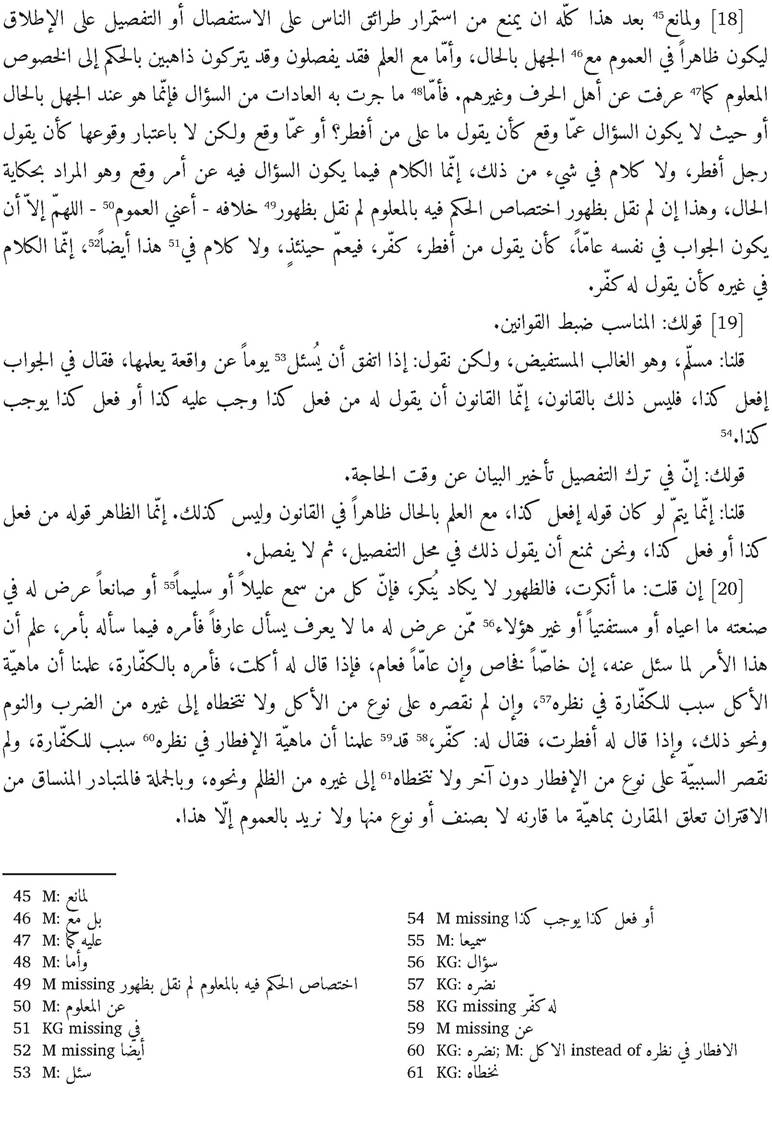
[18] One who believes that the Prophet’s reply can never be understood as a universal statement is essentially asking us to ignore the common practice of seeking clarification or differentiating between similar cases - this is common practice in cases where the respondent does not know the specific incident. In cases where the respondent knows the specific incident, he may or may not provide additional details, believing himself to be providing a specific answer based on his knowledge of the case. This is how, for example, mechanics normally answer questions. As for the general practice of seeking clarification, that is when one does not know the specific incident, the question is hypothetical (e.g. What should one who broke his fast do?), or the question is about something that occurred, but not with regard to its occurrence (e.g. A man broke his fast). None of these examples are relevant; the discussion is about instances where the question is about something that actually happened and it is posed as such - that is what is meant by “relating a scenario” (hikayat al-hal). In this regard, A'raji’s view is that we cannot say that prima facie the answer only applies to what happened nor can we say it is universal unless the answer is itself universal (e.g. One who broke his fast must offer expiation). Such exceptions are, however, irrelevant; in the previous example, to be relevant, the answer would have to be “Offer expiation.”
[19] In response to the claim that the nature of legislation is to establish universal laws (dabt al-qawanin), A'raji says that is true most of the time; however, if, one day, the Prophet were asked about an incident that he knew about, and he replied, “Do so-and-so,” that is not a law (fa-laysa dhalika bi-l-qanun). It would only be a law if he replied, “Whoever does so-and-so must do so-and-so” or “Doing so-and-so necessitates so-and-so.” In response to the notion that, by refraining from differentiating between similar cases, the Prophet is delaying the provision of an explanation beyond the time when it is needed - because this is unacceptable, the Prophet cannot have refrained from differentiating between similar cases and his answer should therefore be understood as a universal statement - A'raji says this would only be correct if we assume that when the Prophet says “Do so-and-so” while knowing the specific incident, it is law. That, however, is not the case. It only becomes law when the Prophet says “Whoever does so-and-so” or “Doing so-and-so,”. According to A'raji, the Prophet cannot say this without differentiating between similar cases if there are any.
[20] Then A'raji poses a lengthy rhetorical objection: someone might say: No one can deny the prima facie meaning. Anyone who hears someone pose a question to a knowledgeable person, and hears him reply with instructions, understands that these instructions pertain to whatever the question was about - if it was about something in particular, then the answer is specific to that thing, and if it was about something general, then the answer is also general. For example, if someone says, “I ate” and the respondent tells him to offer expiation, we know that the quiddity (mahiya) “eating” is grounds for expiation (sabab lil-kaffara) in his view, although we do not restrict what he said to a particular type of food nor do we extend it to other grounds for expiation (e.g. hitting, sleeping, etc.). Similarly, if someone says, “I broke my fast” and the respondent tells him to offer expiation, we know that the quiddity “breaking the fast” is grounds for expiation in his view, although we do not restrict these grounds to a particular way of breaking the fast (e.g. eating) nor do we extend it to other cases like oppression. In sum, based on the association of an answer with a question, what occurs to the mind immediately is the relationship between the answer and the quiddity in the question, not a particular type of that quiddity. When we say the answer should be understood as a universal statement, we mean it applies to the quiddity in question.
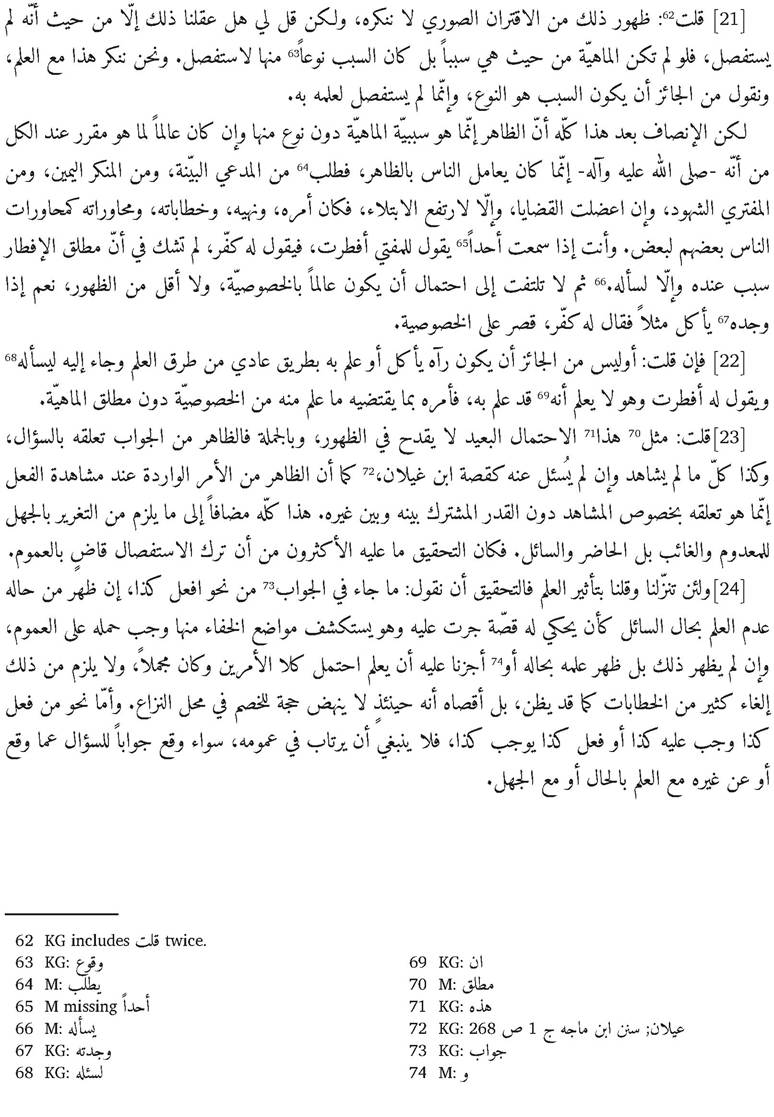
[21] A'raji accepts this, but argues that we only know it because the respondent refrained from seeking clarification. If a particular type of quiddity and not the quiddity itself were the reason (sabab), then he would have sought clarification. If, however, the respondent knows the specific incident and therefore does not seek clarification, then the grounds for the rule could be a particular type of the quiddity. Nevertheless, prima facie, the quiddity is the grounds, not a particular type of quiddity. This is the case despite the fact that everyone agrees the Prophet interacted with people based on what was apparent. For example, he asked plaintiffs for evidence, he asked defendants to take an oath, and he asked accusers (muftari) to produce witnesses - he spoke to people the way people speak to each other. If you heard someone tell a mufti “I broke my fast” and the mufti say “Offer expiation,” you would think he believes that breaking one’s fast, no matter how, is grounds for expiation. If the mufti did not believe that, he would have asked the man how he broke his fast. You would not consider the possibility that the mufti knew the specific incident. At the very least, this is what is apparent. Yes, if the mufti had seen the man eating, then you would restrict his answer to that one way of breaking the fast.
[22] Then A'raji considers the following scenario: Suppose the mufti saw the man eat or discovered (through ordinary means) that he had broken his fast by eating. Suppose further that the man came to the mufti and said “I broke my fast” without realising that the mufti already knew, and the mufti told him to offer expiation. The man would think that anyone who breaks their fast (irrespective of how) must offer expiation, not just someone who breaks their fast by eating.
[23] In response, A'raji says that such an unlikely scenario does not lessen the reasonability of acting upon what is apparent. We can still say that, prima facie, the answer pertains to the question. That is true for any incident that was not witnessed, even if there was no actual question (like in the story of Ibn Ghaylan).11 Similarly, when the incident is witnessed, prima facie, all we can say is that the answer pertains to exactly what was seen, nothing more. Moreover, if that were not the case, then future generations and those who are not present, even those who are present and the petitioner himself would be doomed to ignorance. So the majority opinion is the most accurate one: refraining from seeking clarification does in fact entail a universal statement.
[24] For the sake of argument, A'raji argues, if we were to concede that the question of whether the respondent knows the specific incident is crucial, then the most accurate opinion would be that, when his answer is in the form “Do so-and-so,” if it appears that he does not know the specific incident - such as if the petitioner relates a story and the respondent asks questions about unclear details - then his answer must be understood as a universal statement. If, however, he does appear to know the specific incident (or we grant that he knows), then his answer is ambiguous: it could be universal or particular. Contrary to what some might think, this does not entail the nullification of most legal addresses (khitabat); rather, at most, it means such answers cannot be cited as evidence in this discussion. As for instances where his answer is in the form “Whoever does so-and-so, must do so-and-so” or “Doing so-and-so necessitates so-and-so,” there is no doubt that such answers should be understood as universal statements, irrespective of whether they are answers to a question about something that happened and whether the respondent knows about it or not.
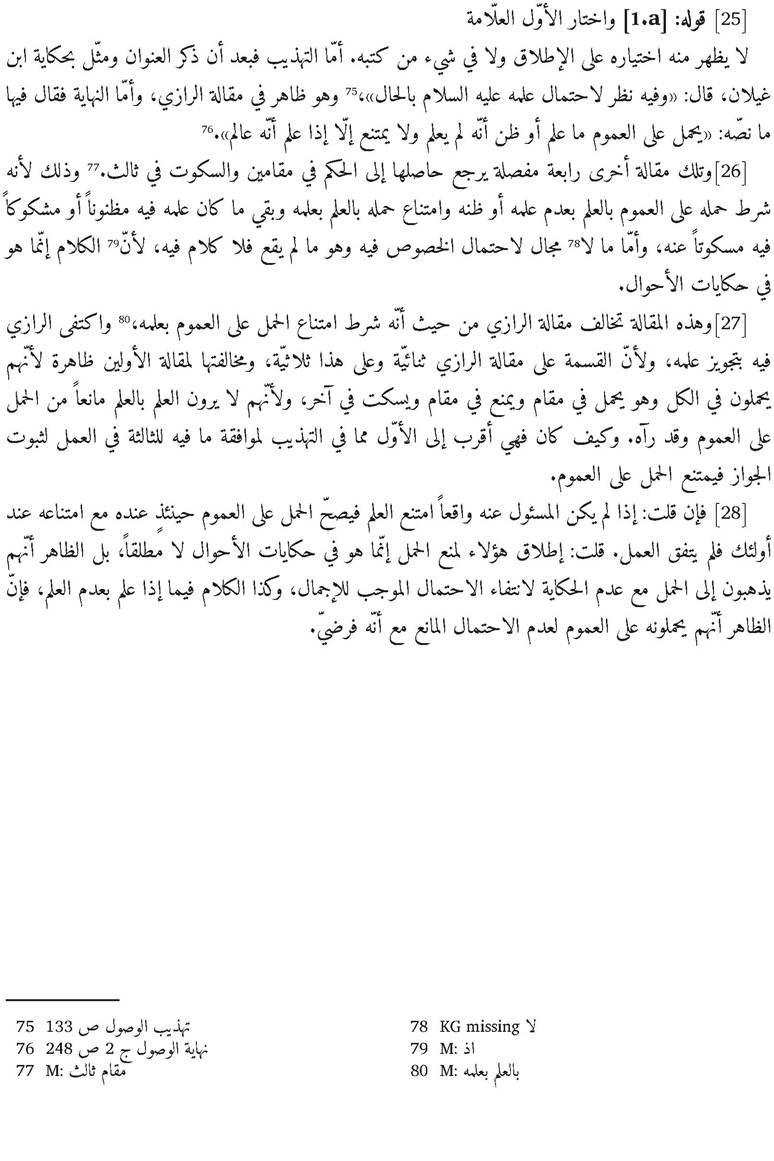
[25] The next sentence that A'raji comments on is “al-'Allama chose the first opinion [a.1].”12 According to A'raji, it is not evident that al-'Allama chose the first opinion unequivocally ('ala l-itlaq). In fact, this does not appear in any of his writings. For example, in al-Tahdhib, after mentioning the issue and citing the story of Ibn Ghaylan as an example, he says, “It is debatable (wa- fihi nazar) due to the fact that the Prophet (peace be upon him) may have known the specific incident,”13 which is also the view of al-Razi. In al-Nihaya, he states, “It should be considered universal as long as it is known or there is no reasonable doubt that the Prophet did not know the specific incident. It is only impossible to consider it universal if it is known that the Prophet knew the specific incident.”14
[26] The view expressed in al-Nihaya is a fourth position on the question. The first three opinions are: (1) it should always be considered a universal statement; (2) whether it should be considered a universal statement depends on if the respondent knew the specific incident: (2a) if he did not know, then it should be considered universal; (2b) if he may have known, then it cannot be considered universal; and (3) the possibility that the question pertained to something in particular means the answer is ambiguous and it cannot be understood either as a universal or a particular statement. The view expressed in al-Nihaya (4) can be summarised as follows: in a scenario like (2a), it should be considered universal; in a scenario like (2b), it cannot be considered universal; and in a scenario like (3), it cannot be considered universal or particular. Thus al-'Allama made knowing that the respondent did not know (or even suppose) a condition for considering his answer universal, and made knowing that he knew a condition for excluding the possibility that his answer was universal; in a scenario where we cannot reasonably suppose that he knew, the answer lapses (maskùtan canhu). Al-'Allama says nothing about cases where there is no possibility of the answer being understood as particular (viz. hypothetical questions) because the discussion only pertains to cases where an actual scenario is related.
[27] In fact, (4) is different from (2) because in (4) what makes it impossible for us to consider the answer universal is the respondent’s knowledge of the specific incident, whereas in (2) the mere possibility that the respondent knew the specific incident makes it impossible for us to consider his answer universal. Furthermore, (2) implies a two-fold typology, whereas (4) implies a three-fold typology. Additionally, in contrast to (2), (4) clearly conflicts with (1) since, according to (1), the answer should always be considered a universal statement, whereas, according to (4), it should be considered universal in one scenario, it should not be considered universal in another scenario, and it lapses in a third scenario. Finally, those who hold (1) do not believe that knowing that the respondent knew the specific incident prevents us from considering his answer universal. In any case, the view is expressed in al-Nihaya (4) is closer to (1) than the view expressed in al-Tahdhib due to the fact that the latter accords with (3) with respect to action because the existence of the possibility that the question pertained to something in particular prevents us from considering it universal.
[28] Then A'raji raises the following rhetorical objection: If the question is hypothetical, then it is impossible for the respondent to know the specific incident. In this case, based on what he said in al-Tahdhib, al-'Allama would say the answer should be considered universal whereas they (i.e. the proponents of the (3)) would say it cannot be considered universal, so they do not agree vis-à-vis action. In response, A'raji says they only say it cannot be considered universal in cases where a scenario is related, not unequivocally. In fact, they even seem to believe that it can be considered universal in cases where no scenario is related because, in such cases, there is no possibility that the question pertains to something in particular and this possibility is what gives
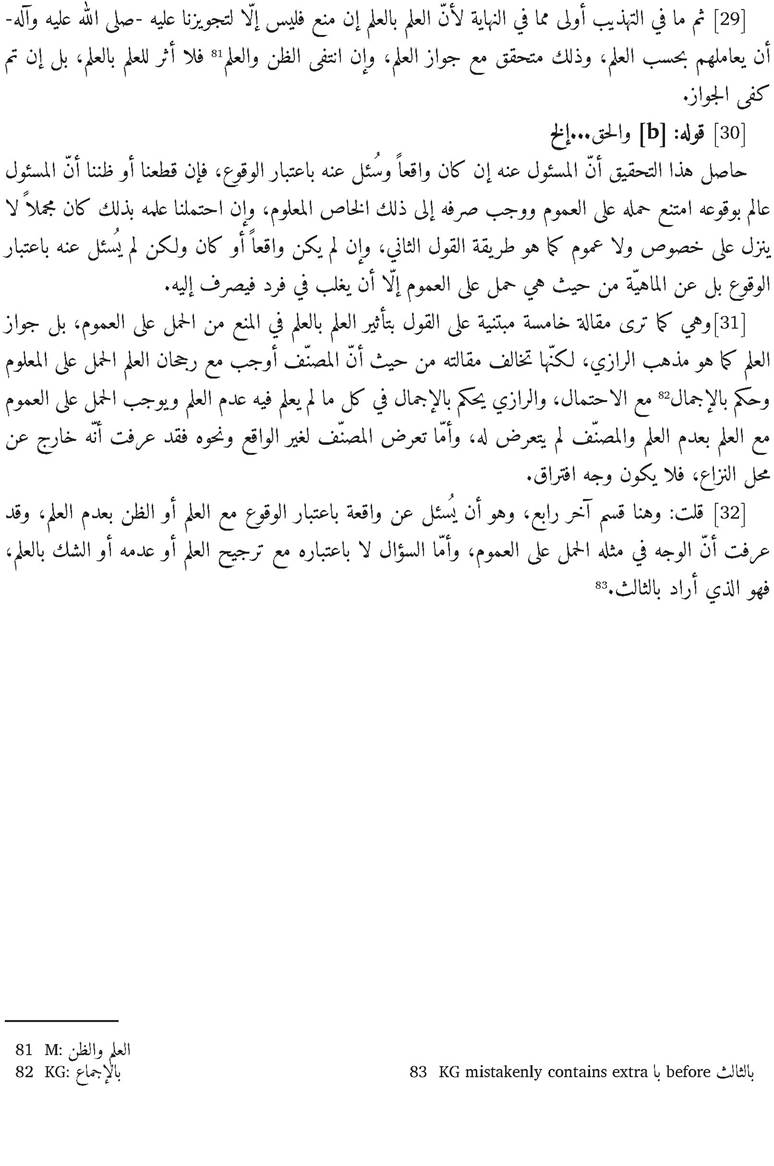
rise to ambiguity in the first place. Similarly, in cases where it is known that the respondent does not know the specific incident, they also appear to believe that his answer should be considered universal because, in such cases, there is no reason not to consider it universal.
[29] So, according to A'raji, the opinion al-'Allama expressed in al-Tahdhib is better than the opinion he expressed in al-Nihaya. That is because, if we disallow knowing that the Prophet knew the specific incident, that is only because we suppose that he interacted with people on the basis of knowledge, which is the case if we suppose he knew the specific incident. If, however, we do not know and cannot suppose (beyond a reasonable doubt), then knowing that the Prophet knew the specific incident has no bearing (and if we do not suppose that the Prophet knows the specific incident, then it makes no sense to talk about our knowledge of the Prophet’s knowledge). Rather, even if we do not know, the possibility that the Prophet knew the specific incident is sufficient.
[30] Finally, A'raji considers al-Tuni’s view.15 A'raji says, if the question pertains to something that actually happened and it is posed as such (i.e. with regard to its occurrence), then, if we know or reasonably suppose that the respondent knows about the incident in question, we cannot consider his answer universal - it must be understood as pertaining specifically to what happened. If, however, we only think the respondent could have known, then his answer is ambiguous - it cannot be considered particular or universal (which is the second opinion mentioned above). If the question pertains to something that actually happened but it is not posed as such (i.e. it is about the quiddity itself) or if the question is hypothetical, then the answer should be considered universal unless one example of the quiddity (e.g. breaking one’s fast by eating as opposed to having sex) is very common, in which case the answer should be understood as pertaining specifically to that example.
[31] This is a fifth opinion and it is based on the notion that knowing that the respondent knew about the incident in question prevents us from considering his answer universal. Even the possibility that we know that the respondent knew the incident in question prevents us from considering his answer universal, as al-Razi said. However, (5) conflicts with al-Razi’s view because, according to al-Tuni, the answer must be considered universal if it is more likely that we know that the respondent knew about the incident in question. If it is only possible that we know that the respondent knew, then, according to al-Tuni, his answer is ambiguous. By contrast, al- Razi held that the respondent’s answer is ambiguous as long as we do not know that the respondent did not know about the incident in question, and that the respondent’s answer must be considered universal if we know that he did not know about the incident in question. Al-Tuni did not consider this case. As for al-Tuni’s discussion of hypothetical cases and the like, it is beyond the scope of the issue so it does not reflect a relevant disagreement.
[32] According to A'raji, there is a fourth scenario: suppose the question is about something that actually happened and it is posed as such and we know (or reasonably suppose) that the respondent does not know about the incident in question. In such cases, the respondent’s answer should be considered universal. What if, however, the question is not posed as such (i.e. with regard to the occurrence of the incident), and either it is more likely that we know the respondent knew what happened, it is more likely that we do not know that he knew what happened, or we doubt that he knew what happened? This is what al-Tuni means by the third scenario [b.5].
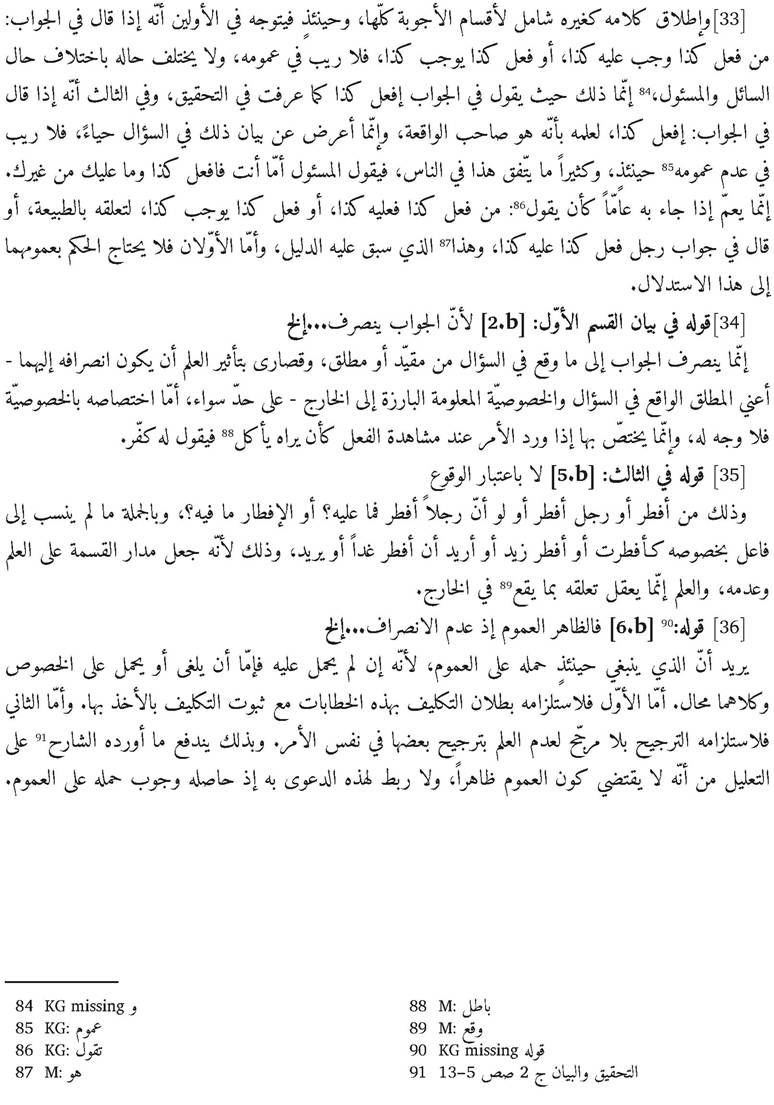
[33] Like others, what al-Tuni said applies to all types of answers. So, in al-Tuni’s first two scenarios [b.1 and b.3], if the answer takes the form “Whoever does so-and-so, must do so-and- so” or “Doing so-and-so, necessitates doing so-and-so,” then there is no doubt that it should be considered universal, irrespective of what we know about the petitioner and the respondent. Details about the petitioner and the respondent are only relevant if the answer takes the form “Do so-and-so.” In al-Tuni’s third scenario [b.5], if the respondent were to say “Do so-and-so” on account of his knowledge that the petitioner is the one who was involved in the incident, but the petitioner was too embarrassed to say so clearly when he posed the question, then there is no doubt that the answer cannot be considered universal. In fact, this happens a lot so the respondent will say “As for you, do so-and-so and do not worry about anyone else.” This can only be considered universal if the answer is phrased as a universal statement like “Whoever does so-and- so must do so-and-so” or “Doing so-and-so necessitates so-and-so” or “A man who does so-and-so must do so-and-so.” This argument, which was mentioned earlier, is unnecessary to establish the universality of the answer in the first two scenarios [b.1 and b.3].
[34] Then A'raji turns his attention to al-Tuni’s explanation of the first scenario [b.2].16 He says the answer only pertains to the incident in question (whether the incident itself was qualified or unqualified). At most, the fact that the respondent knew what happened means his answer pertains to both what is unqualified in the incident in question (e.g. breaking the fast) and what is particular (e.g. breaking the fast by eating) equally. There is no basis to claim that it only pertains to the latter. It is only in cases where the respondent makes an imperative statement after seeing what happened - e.g. he says “Offer expiation” after seeing a man break his fast by eating - that his statement can be said to apply to what is particular (and nothing else).
[35] Regarding al-Tuni’s third scenario [b.5]17 (i.e. when a question is not posed with regard to the occurrence of the incident), A'raji gives four examples: “One who broke his fast,” “A man broke his fast,” “If a man broke his fast, what must he do?” and “What is the punishment for breaking the fast?” In sum, this scenario involves actions that are not attributed to a particular agent (e.g. “I broke my fast” or “Zayd broke his fast”). This distinction is due to al-Tuni’s typology that is based on the respondent’s knowledge or lack thereof, and one can only know (or not know) something that has actually taken place.
[36] Commenting on al-Tuni’s explanation of why, prima facie, the answer should be understood as a universal statement,18 A'raji says, if it is not understood as a universal statement, then either it is null or it should be considered particular, both of which are impossible. It cannot be null because that would entail the invalidity of any obligation (butlan al-taklif) before these addresses despite the fact that the obligation to act upon them has been unanimously accepted. And it cannot be considered particular because that would entail prioritising something for no reason (al-tarjih bi-la murajjih). Thus al-Abyari’s explanation is shown to be incorrect: it does in fact have to be considered universal.19 It has no connection to this claim since the gist of this claim is that it is necessary to understand it as a universal statement.
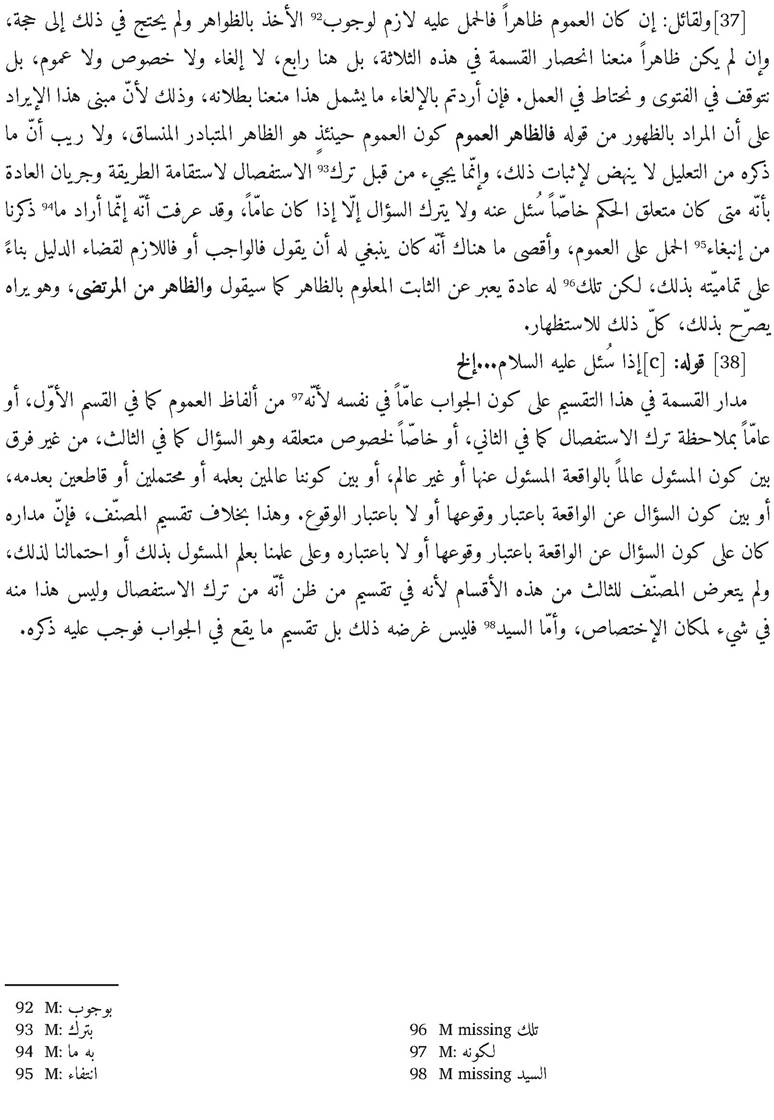
[37] One might argue that, if the answer is prima facie universal, then we must consider it universal due to the necessity of acting upon the prima facie meaning - this does not require any further evidence. If, however, the answer is not prima facie universal, then we cannot restrict the typology to these three cases; there is a fourth case: the answer is not null, particular, or universal; rather, we should withhold judgement and exercise caution (natawaqqaf fi l-fatwa wa-nahtat fi l-'amal). In response, A'raji argues that if what is meant by null is this fourth option, then it is not invalid. That is because this objection is based on the notion that the meaning of “prima facie” in al-Tuni’s claim that “prima facie the answer should be understood as a universal statement” is that the universal sense of the answer is what is apparent and what occurs to one’s mind immediately. There is no doubt that the reason al-Tuni gave for this view does not substantiate it. Rather, it is like refraining from seeking clarification due to the common practice of making an inquiry when the answer pertains to something in particular. One does not refrain from inquiry unless the answer is universal. Al-Tuni was only talking about the fact that it must be considered universal (inbighà1 al-haml 'ala l-'umùm). At most, he should have said “what is necessary (al-wa- jib)” or “what is required (al-lazim),” but this is simply al-Tuni’s style: he uses the term “prima facie (al-zahir)” for what is well-known. For example, when he sees al-Murtada state something explicitly, he will refer to it as “al-Murtada’s well-known (al-zahir) view.”
[38] Regarding al-Murtada’s remark “If he (peace be upon him) is asked...” [c]20 A'raji states that this typology revolves around the answer being (a) universal in and of itself because its wording is universal (e.g. anyone who breaks the fast must offer expiation); (b) universal on account of the respondent refraining from seeking clarification (e.g. if the Prophet were asked about someone who broke the fast and he did not seek clarification about how the fast was broken, rather he said, “He must offer expiation”); or (c) particular due to the question being particular. The question of whether the respondent knew about the specific incident, whether we know (or suspect) that the respondent knew (or we are certain that he did not know) about the specific incident, and whether the question was asked vis-à-vis the incident are entirely irrelevant in al-Murtada’s typology. By contrast, al-Tuni’s typology revolves around whether the question was about the incident vis-à-vis its occurrence or not, and whether we know (or suspect) that the respondent knew that. Al-Tuni did not consider (c) because it is unrelated to “refraining from seeking clarification” since the question itself is particular. Al-Murtada, on the other hand, mentioned (c) because his typology was based on the nature of the answer.
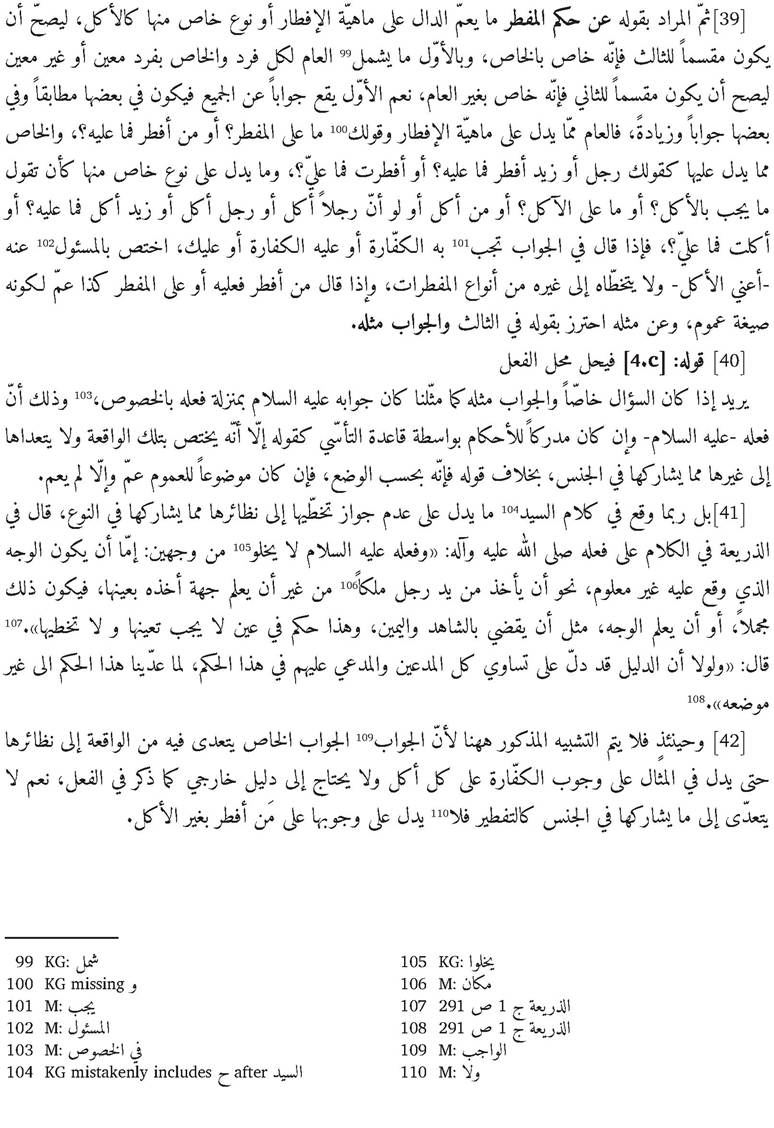
[39] According to A'raji, what al-Murtada meant by, “if he is asked about someone who broke his fast ('an hukm al-muftir),” [c]21 is broader than the quiddity “breaking the fast” or a particular way of breaking the fast (e.g. eating). This way, it is a “meta-category” (maqsam) encompassing the third sub-category too, which is exclusively specific (khass bi-l-khass). By the first, al-Murtada meant what includes the universal for each individual, what is particular to every specific individual, and what is not specific. This way, it can be a maqsam for the second, which is non-universal specific (khass bi-ghayr al-'amm). Yes, the first is an answer for all, so it is, in some, corresponding, and in others an answer and an addition. So the universal is what points to the quiddity “breaking the fast” and the question “What should one who breaks the fast do” or “What should one who broke his fast do?” The particular is what points to it, like “A man” or “Zayd broke his fast so what should he do?” or “I broke my fast so what should I do?” And what points to a particular type of it, like saying “What does eating necessitate?” or “What is the consequence of eating?” or “One who ate” or “If a man ate” or “A man ate” or “Zayd ate so what should he do?” or “I ate so what should I do?” If the respondent answers “It necessitates offering expiation” or “It requires expiation” or “You must offer expiation,” then the answer is particular to the question (e.g. eating); it does not extend to other ways of breaking the fast. If, however, the respondent says, “Whoever breaks his fast must...” or “One who breaks his fast must,” then the answer is universal because of the way the answer was worded. This is what al-Murtada meant when he said, with respect to the [c], “The answer is like the question (i.e. the answer is particular because the question was particular).”22
[40] As for al-Murtada’s claim that “It should be treated the way we treat Prophet’s action (fa-yahillu mahall al-fi'l),”23 according to A'raji, he means, if the question is particular, so is the answer. In the examples above, the Prophet’s answer is analogous to a specific action of his. Based on “the principle of emulation” (qa'idat al-ta'assi), both the action and the speech of the Prophet are a valid basis for law; however, because his action is particular to a specific incident, it cannot be extended to other similar incidents involving the same genus (jins). By contrast, his speech conforms to the ordinary rules of language (wad'): if he uses an expression that was coined for a universal idea, then it is universal, and if not, then not.
[41] Al-Murtada himself may have understood that the answer cannot be extended to cases involving the same type (naw'). In his discussion of the Prophet’s action in al-Dhari'a, al-Murtada says the reason for his action is either known - such as if he took an object from someone without us knowing why - or unknown - such as if he were to issue a judgement on the basis of eyewitness testimony and oaths. In the former case, his action remains ambiguous; in the latter case, it is a judgement in a specific case that cannot be pinpointed and then extended (la yajib ta'ayyunu- ha wa-la takhattiha).24 Moreover, al-Murtada argues, if not for the fact that we know the law of evidence applies to every plaintiff and defendant, we would not extend the Prophet’s aforementioned judgement (on the basis of eyewitness testimony and oaths) to other similar instances.25
[42] So the example that al-Murtada cites to illustrate the issue is not a good example because, in our case, the specific answer implies an extension from the particular incident to similar cases such that it entails the obligation to offer expiation for every kind of food without the need for external evidence, as is the case with actions. It does not, however, extend to everything belonging to the same genus (i.e. taftir): it does not indicate that someone who breaks their fast by doing something other than eating must also offer expiation.
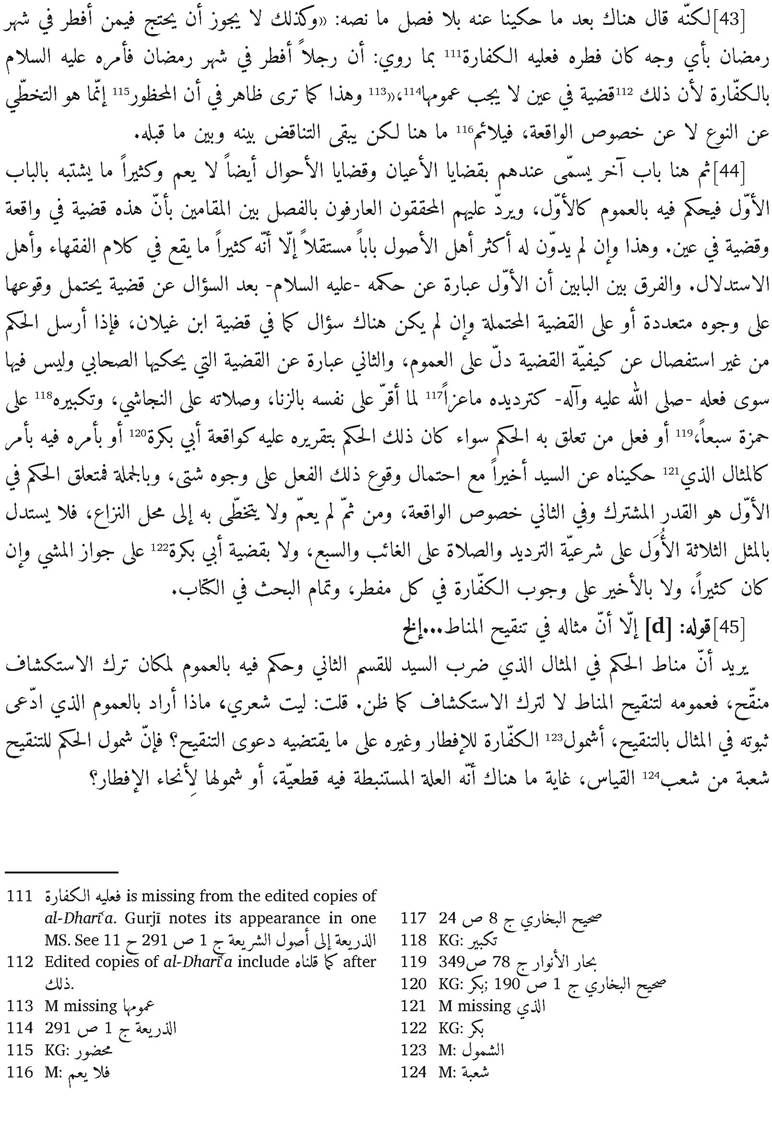
[43] As A'raji notes, immediately thereafter in al-Dhari'a, al-Murtada says one cannot adduce the narration according to which the Prophet ordered a man who had broken his fast in Ramadan to offer expiation, to argue that, however someone breaks the fast, they must offer expiation - that is a specific case that cannot be generalised (qadiyyatun fi 'ayn la yajib 'umumuha).26 Prima facie what this means is that it is impermissible to extrapolate to another type (naw'), but not to another incident. It agrees with that is here, but it contradicts what he said earlier.
[44] There is another issue here known as qadaya l-a'yan and qadaya l-ahwal - these cannot be considered universal either. However, because this issue is often confused with the first issue (i.e. relating a scenario - hikayat al-hal), it is considered universalizable. But astute scholars who understand the difference between the two issues say that this issue involves a specific incident and object (qadiyya fi waqi'a and qadiyya fi 'ayn) that cannot be considered universal. Most Usulis have not composed an independent chapter about this issue, but jurists refer to it frequently in their writings. The difference between the two issues can be summarised as follows: in the first, the Prophet gives an answer after a question has been posed about an issue that could have occurred in one of several ways, or the Prophet addresses such an issue without a question having been posed at all (such as in the case of Ibn Ghaylan). In this case, if he issues a judgement without first seeking clarification about how the incident occurred, his judgement should be considered universal. The second issue involves a Companion relating something that the Prophet did - such as when he discouraged Ma'iz b. Malik al-Aslami from confessing to illicit sex or when, during the funeral of his uncle Hamza, he said “allahu akbar” seven times instead of five - or a Companion relating something that the person being judged did, whether the judgement takes the form of tacit approval (taqrir) - such as in the case of Abu Bakra al-Thaqafi - or an imperative statement - such as in al-Murtada’s example of the Prophet commanding a man who had broken his fast to offer expiation despite the fact that the man could have broken his fast in several different ways.27 In sum, in the first issue, the judgement pertains to the “common denominator” (al-qadar al-mushtarak, e.g. breaking the fast irrespective of how), whereas, in the second issue, it only pertains the specific incident - it cannot be universal and therefore it is unrelated to the bone of contention. In other words, the case of Ma'iz cannot be adduced as evidence of a legal obligation to discourage people from confessing to illicit sex, and the case of Hamza cannot be adduced as evidence of the correct way to perform the funeral prayer.
[45] In the last section of his commentary,28 A'raji explains al-Tuni’s objection to al-Murtada’s example of (b) in the aforementioned typology (i.e. if the Prophet were asked about someone who broke the fast and he did not seek clarification about how the fast was broken, rather he said, “He must offer expiation”). According to al-Tuni, “He must offer expiation” should be considered universal, but not because the Prophet refrained from seeking clarification; rather, it is on account of tanqih al-manat (honing down the basis for any particular law) that we know the statement is universal. A'raji does not seem to have been convinced by al-Tuni’s explanation and in turn seeks further clarification by asking: Does he mean that (a) the obligation to offer expiation encompasses both the act of breaking the fast and other (unrelated) actions, which is what tanqih al-manat entails?29 Or does he mean that (b) the obligation to offer expiation encompasses various ways of breaking the fast?
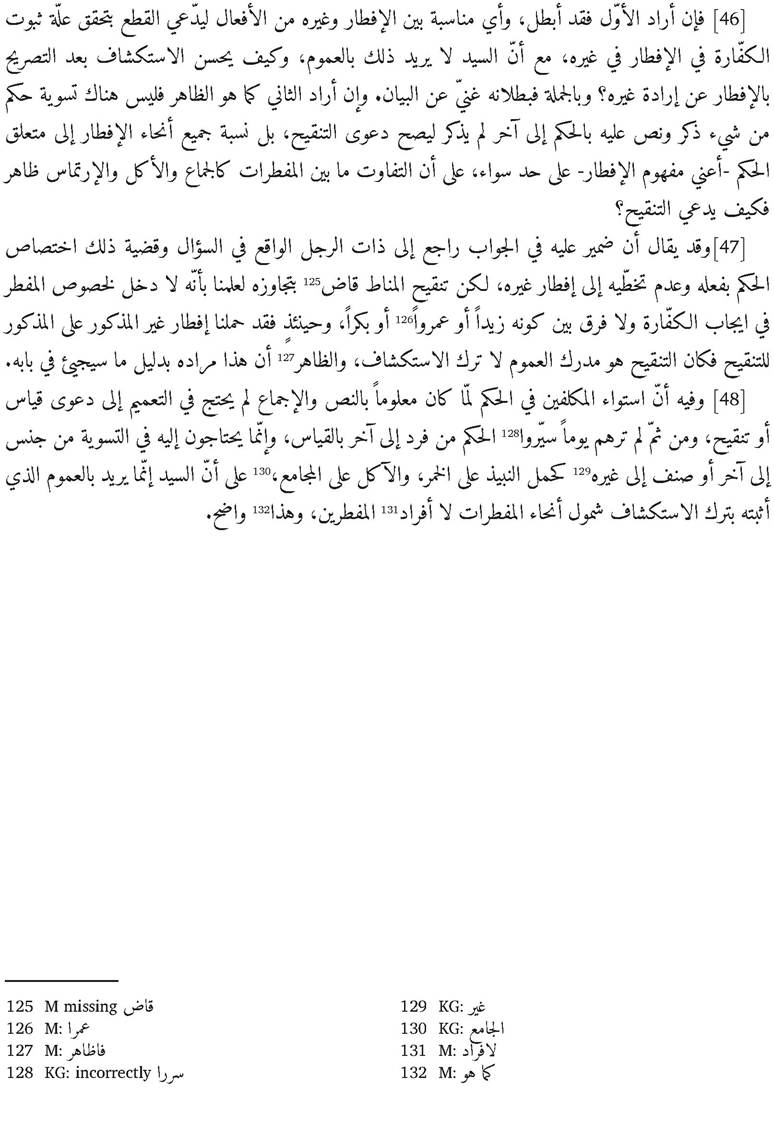
[46] According to A'raji, if al-Tuni meant (a), then this is clearly invalid due to the lack of any similarity (munasaba) between breaking the fast and other acts - tanqih al-manat requires the existence of such similarity. Not to mention the fact that this is not what al-Murtada meant when he said (b) should be considered universal: if the petitioner asked about breaking the fast explicitly, then it would not make any sense for the Prophet to seek clarification about an unrelated act (e.g. hitting). If, however, al-Tuni meant (b) - which is more likely - then it still has nothing to do with tanqih al-manat since all the different ways of breaking the fast are known and there is no difference among them vis-à-vis the subject of the rule (muta‘llaq al-hukm) (i.e. the concept of breaking the fast) - they are equal in that respect despite the obvious difference between, for example, eating and sex.
[47] Then A'raji considers the following argument: What if the third-person singular masculine pronoun in the expression “Hayhi l-kaffara” refers to the individual himself (i.e. expiation is incumbent upon him)? In this case, it would pertain to his action in particular and no other instance of breaking the fast. Nevertheless, based on the fact that the specificity of any individual (e.g. Zayd, 'Amr, Bakr, etc.) has no bearing on the obligation to offer expiation, we could extend the rule to other individuals on the basis of tanqih al-manat. Thus, we could treat the breaking of the fast of someone who is not mentioned just like the breaking of the fast of someone who is mentioned, but the validity of the extrapolation would be rooted in tanqih al-manàt, not refraining from seeking clarification. This appears to be what al-Tuni actually meant.
[48] In response, A'raji argues that explicit texts and consensus affirm that the specificity of any individual (e.g. Zayd, 'Amr, Bakr, etc.) has no bearing on the obligation to offer expiation, so one does not need to resort to qiyas or tanqih to establish the universality of the statement. Moreover, no one uses qiyas to extend a rule from one individual to another (e.g. from Zayd to Bakr); qiyas is used to extend a rule from one genus (jins) to another (e.g. from grape wine to date wine or from eating to sex). This, A'raji concludes, is in addition to the fact that, when al-Mur- tada inferred universality from refraining from seeking clarification in (b), he clearly meant to encompass the different ways of breaking the fast - he was not equating each individual.
More on the topic Commentary:
- Commentary
- Commentary
- Commentary
- Commentary
- Commentary
- CHAPTER 12 COMMENTARY ON SOME RECENT DEVELOPMENTS (2ND EDITION, 2011 AND 3RD EDITION, 2023, TED BENTON)
- Introduction
- Christ’s Empire
- The Provincial Edict
- COMMENTARIES
- AN ANCIENT ESTIMATE OF THE SPEED OF LIGHT
- Bibliography
- REFERENCES