Introduction
Muhsin b. al-Hasan b. Murtada al-A'raji (hereon A'raji), known as al-Muhaqqiq al-Kazimi, belonged to a prominent family of Iraqi sayyids that traced its lineage back to 'Ubaydallah al-A'raj (“the lame”, d.
2nd/8th century), a grandson of 'Ali b. al-Husayn Zayn al-'Abidin (d. 95/713). He was born in the 1130s/1710s in Baghdad, where he studied Arabic and worked as a merchant. After reaching the age of 30 (or 40), he moved to Najaf to pursue a religious education. He remained in Najaf until the appearance of the Bubonic plague in 1186/1772, when he (and many other scholars of Najaf) left and then returned after the plague subsided. He subsequently moved to the shrine city of al-Kazimiyya north of Baghdad, where he lived and taught until his death in his 90s in 1227/1812. He was buried in a cemetery adjacent to the tombs of the Imams Musa al-Kazim (d. 183/799) and Muhammad al-Jawad (d. 220/835). His biographers portray him as exceptionally humble, devout, and ascetic. Like many of his scholarly peers, elaborate stories abound regarding his lifestyle and the events surrounding his life, many of which are based on dreams. In one dream, the ailing A'raji is visited by the seventh Imam Musa al-Kazim, who miraculously expels the illness out of his body. In another dream, A'raji is in his humble home surrounded by luminaries of the Twelver tradition, highlighting his prominence. Together they walk out of his home and proceed toward the shrine of the Imams and onto the outskirts of the city with the intention of confronting Ahmad b. Zayn al-Din al-Ahsa’i (d. 1241/1826), the founder of the Shaykhi school. A'raji’s immediate family - including his wife al-'Alawiyya Hadiyya bt. 'Ali b. al-Murtada, their daughter and four sons Kazim, Hasan, Muhammad, and 'Ali - is also said to have been extraordinarily pious, and his sons were scholars in their own right.A'raji lived through a tumultuous time. Safavid rule came to an end in Iran in 1135/1722 and the Ottomans’ grip over Iraq was loosening in the 12th/18th century. Aside from these political changes, A'raji lived through some of the most intense episodes of the Akhbari-Usuli conflict in the shrine cities of Najaf and Karbala. As an outstanding disciple of both Muhammad Baqir al-Bi- hbahani (d. 1206/1791-2) (whom he refers to as al-ustadh) and Muhammad Mahdi Bahr al- 'Ulum (d. 1212/1797) (whom he refers to as al-ustadh al-sharif), A'raji is counted among the preeminent representatives of the Usuli revival of the late 12th and early 13th/18th centuries. His students include over two dozen well-known Usuli scholars. His literary output indicates that he participated in the intellectual attacks on the Akhbaris. He composed a refutation of the legal principles of the most important representative of the Akhbari school, Yusuf al-Bahrani (d. 1186/1772), entitled al-Radd ‘ala muqaddimat al-Hada’iq. He was a prolific author, producing several treatises, commentaries, and glosses in the fields of kalam, fiqh, rijal, and usul al-fiqh. He was also a talented poet. Most of his contributions, however, lie in the field of usul al-fiqh. It is said that, on his deathbed, he lamented his excessive focus on usul al-fiqh at the expense of other disciplines. Among his major works in this field are al-Mu'tasim, al-Mahsul ft 'ilm usul al-fiqh (which has been published), a marginal gloss on al-Fadil al-Tuni’s (d. 1071/1660) al-Wafiya, and, finally, his famous commentary on al-Wafiya, from which our excerpt is taken.
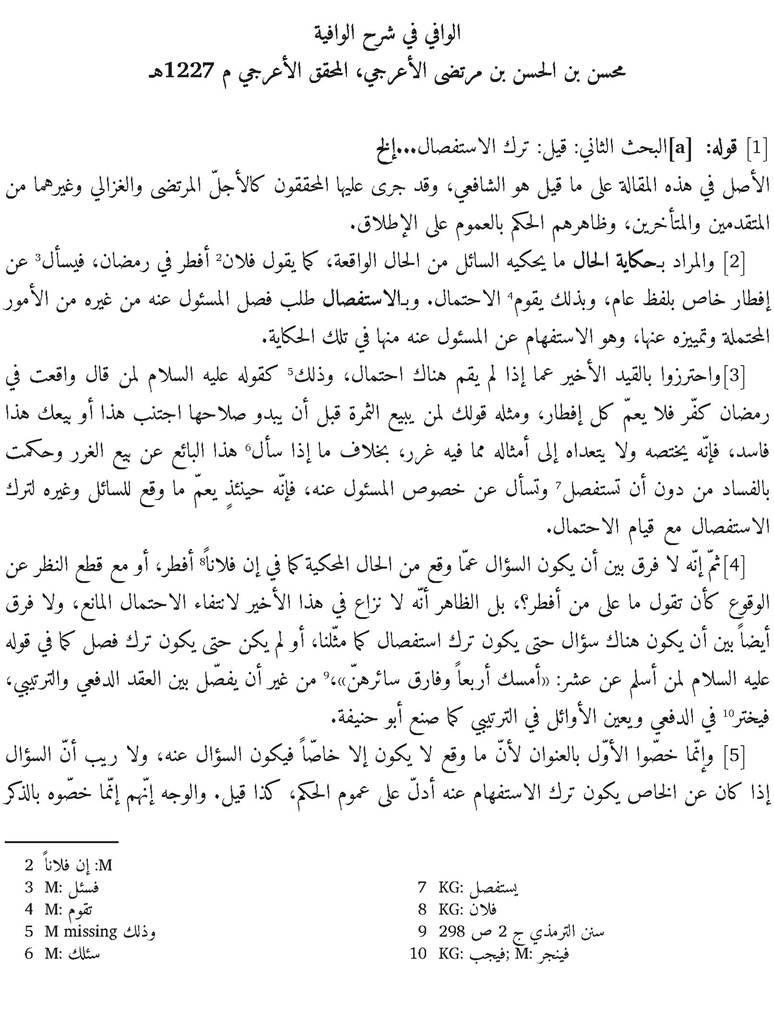
The full title of this work, as mentioned in the introduction, is al-Waft ft sharh al-Wafiya. As noted, it is a commentary on al-Fadil al-Tuni’s al-Wafiya ft usul al-fiqh, which is the earliest Usuli response to Muhammad Amin al-Astarabadi’s (d. 1036/1627) Akhbari theses. Completed in 1059/1649, it appears to be al-Tuni’s only extant work. A'raji began this commentary in the “year of the plague” in 1186/1772 and completed it a decade later in 1196/1782.
Two manuscripts were used for this edition. The first (referred to here as “KG”) belongs to the Kashif al-Ghita3 collection in Najaf (#644, pp. 148-152). It was copied by Muhammad 'Ali b. Muhammad Baqir al-Isfahani in 1207/1793. It appears to be one of the earliest copies produced during A'raji’s lifetime. Several other copies of this work are held in this and other collections. The second manuscript (referred to here as “M”) is from the Majlis Library in Tehran (#7718, pp. 278-286), which was copied in 1263/1847 by Muhammad Baqir b. Ibrahim al-Najafabadi. The differences between the two manuscripts are minimal and have been noted in the footnotes of the Arabic text.
The excerpt under discussion is from the second chapter (bab) of al-Tuni’s al-Wafiya, which is about the universal and particular (al-'amm wa-l-khass). After defining the universal and adducing terms that indicate a universal meaning in the first discussion (bahth) of this chapter, the author proceeds to the second investigation, which focuses on the following scenario: The Proph- et/Imam is asked a legal question and, without requesting further clarification or details, he replies. In this case, does the fact that the Prophet/Imam did not seek further clarification or detail (tark al-istifsal) mean that his statement should be considered universal? In other words, does the report give rise to a universal legal directive? As we shall see, A'raji presents a detailed discussion of several possibilities, drawing on the opinions of his Shi'i and non-Shi'i Usuli predecessors, before providing his own detailed answer.1 We have included the Arabic and English translation of al-Tuni’s entire discussion of the issue in al-Wafiya, which precedes the text from A'raji’s commentary.
A'raji divides his commentary of the discussion into nine sections, each beginning with “his statement” (qawluhu) and containing the first few words of the phrase.
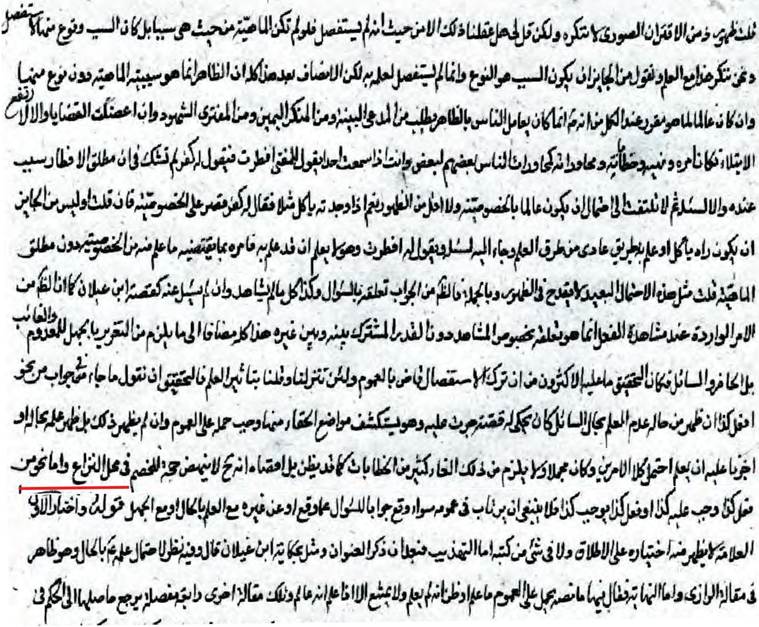
Figure 2.1 MS Kashif al-Ghita’, Najaf (#644), p.
150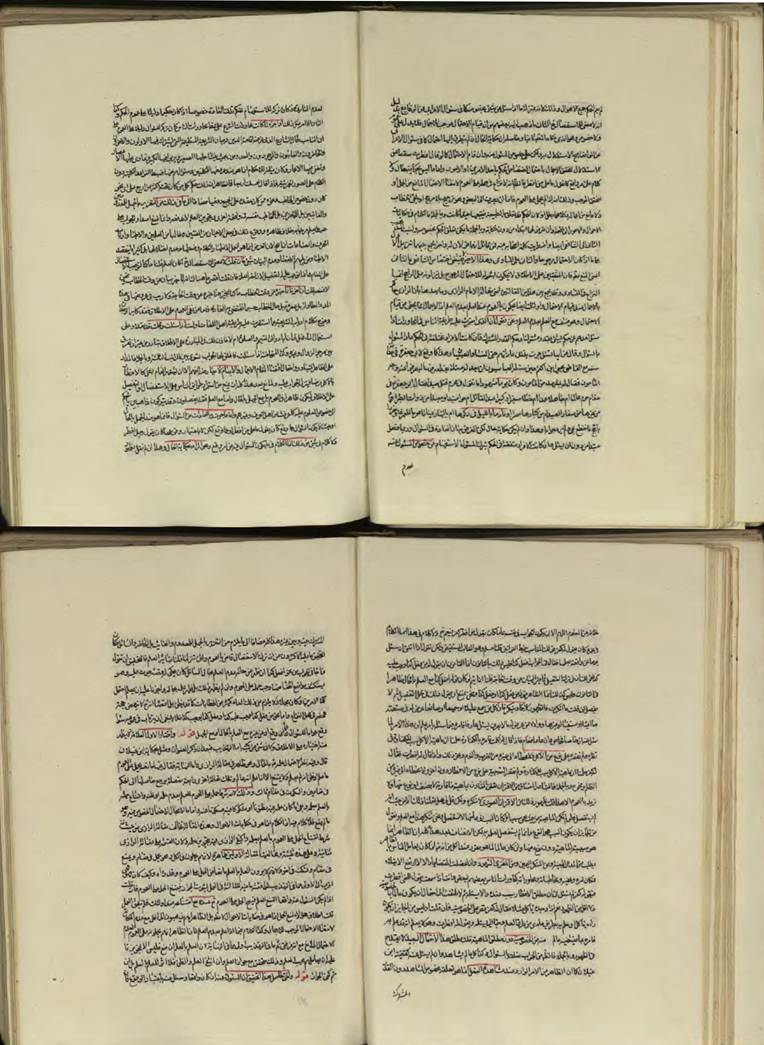
Figure 2.2 MS Majlis-e Shura-ye Islami, Tehran (#7718), pp. 275-278
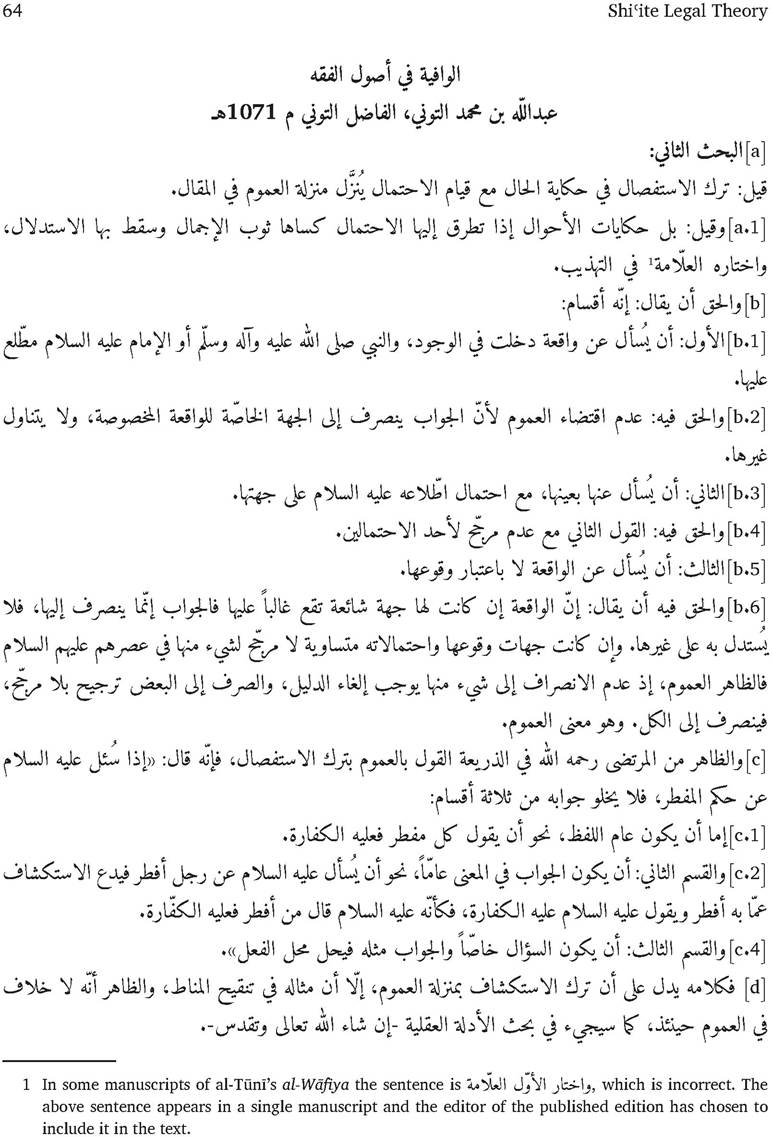
[a] The Second Discussion:
It is said that “refraining from seeking further clarification about the situation [related by the petitioner], despite the possibility [that it may concern a particular case], occupies the position of the universal in speech.”
[a.1] [On the other hand,] it is said that when a situation is presented and there exists the possibility [that it may concern a particular case], it is rendered ambiguous and thus cannot be employed for inference. This view was adopted by al-'Allama in al-Tahdhib.
[b] In fact, it must be said that several possible scenarios exist:
[b.1] First: One asks about an incident that has actually occurred and the Prophet (peace and blessings be upon him and his family) or the Imam (peace be upon him) is aware of the [specificities of the] case.
[b.2] In this scenario, the answer does not entail universality. This is because the answer applies only to the particular case in question and excludes other cases.
[b.3] Second: One asks about an incident that has actually occurred and the Prophet (peace be upon him) might be aware of the specificities of the case.
[b.4] Here, the answer is rendered ambiguous and thus unemployable for inference if the possibility that the Prophet knows and the possibility that he does not know are equal.
[b.5] Third: One asks about an incident, however, not with reference to its occurrence.
[b.6] In this scenario, it depends. If the incident commonly occurs in a particular way, the answer only applies to that particular way and cannot be used for anything else. If all the ways in which the incident could have occurred are equally likely, and none of them was preponderant during the lifetime of the Prophet/Imams (peace be upon them), then prima facie the answer should be considered universal.
This is because not applying to any of the ways in which the incident could have taken place renders the evidence null and applying to some and not others entails giving preference without a reason. Therefore, it applies to all the ways in which the incident could have taken place, which is what “universal” means.[c] Prima facie, in al-DharPa, al-Murtada (may God have mercy on him) takes the position that refraining from seeking clarification entails universality.
Al-Murtada said: “If the Prophet/Imam (peace be upon him) is asked about the ruling of one who broke his fast, his answer must fall under one of three possibilities:
[c.1] [First]: Either the wording of the answer is universal, such as if he were to say: ‘Offering expiation is incumbent upon anyone who breaks the fast’; or
[c.2] Second: the meaning of the answer is universal, such as if he (peace be upon him) were to be asked about a man who broke his fast and he did not ask how the man broke his fast, and said: ‘Offering expiation is incumbent upon him.’ It is as if he (peace be upon him) were to have said: ‘One who breaks his fast must offer expiation’; or
[c.4] Third: the question is particular and the answer is also particular, in which case the answer is treated as though it were the Prophet’s/Imam’s action.”
[d] Thus, what al-Murtada said indicates that refraining from seeking clarification entails universality. However, the example he gives is actually an example of tanqih al-manat (honing in on the real basis for any particular law), in which case there is no disagreement over the answer being universal, as we will see in the discussion on rational proofs, God - the Exalted and the Holy - willing.
In what follows, bold text is the base text, al-Wafiya of al-Fadil al-Tuni; the remainder is al-A'ra- ji’s commentary. Section markers in bold lower-case letters and numbers ([a], [a.1] etc.) refer to passages in al-Wafiya (as per above); Western Arabic numerals ([1], [2] etc.) mark sections in al-Wafi.
More on the topic Introduction:
- 1 Introduction
- Introduction
- Introduction
- 19 Introduction
- Introduction
- Introduction
- INTRODUCTION
- Introduction
- Introduction
- Introduction
- Introduction
- Introduction: Hegel, Marx and the Dialectic