Commentary
Mazandarani, commenting on the Zubdat al-usul of one of his teachers, al-Shaykh al-Baha’i, produces a majzi, or integrated commentary - a sort of compound work of the base text and commentary.
However, it is, perhaps, worthy viewing the base text in isolation to illustrate the referential nature of the style adopted by al-Shaykh al-Baha’i. It is clear from the translation below, and the text cited in full opposite, the text is composed in order to encourage elucidation and commentary.Here is an attempted translation of the base text from the Zubdat al-usul, staying as close to the Arabic as possible, but with some unavoidable insertions in order for the English to make sense.
Chapter
[a] The rulings of the Prophet do not originate in his personal juristic reasoning based [on the following proofs]:
[a.1] there is our [i.e. Twelver Shi'i scholars] consensus (tjmd');
[a.2] [there is also] God’s statement “he does not speak from his own whim; it is nothing but revelation revealed”.5 [Even if] the revelation to him [mentioned in this means] he should perform juristic reasoning, then this does not mean that whatever he says on account of this [juristic reasoning] can be classed as revelation; just as our juristic reasoning [is not revelation, just because] it is based on God’s statement, “So consider”;6
[a.3] it is supported by the fact that he knew he was immune from making a mistake, so his rulings are certain and not based on personal juristic reasoning.
[b] This conclusion can be applied to the rest of the Sinless Ones (may God’s peace be upon them [a reference to the 12 Imams]) as well.
[c Arguments and rebuttals]
[c.1] The “Forgiveness Verse” is simply politeness - like the saying “God have mercy on you”. [c.2] It [i.e. the “Forgiveness Verse”] and the “Consultation Verse” apply to non-religious matters.
If this were not the case, then [in the case of the “Consultation Verse”] the Prophet would be a follower of [the people with whom he consults]. Also [with respect to the “Forgiveness Verse”] we deny that the [Prophet’s] permission [to some to remain] was a legal ruling.[c.3] It is possible that there was choice at first in bringing along your sacrifice [to the pilgrimage], but then it was revealed that the “pleasure pilgrimage” was commendable.
[c.4] In the same way, it is possible that revelation came straight away in relation to the case of the reeds - and [spontaneous revelation] is not more unlikely than spontaneous personal juristic reasoning, and it is probably the case that al-'Abbas heard the exception [from the Prophet] at some earlier point.
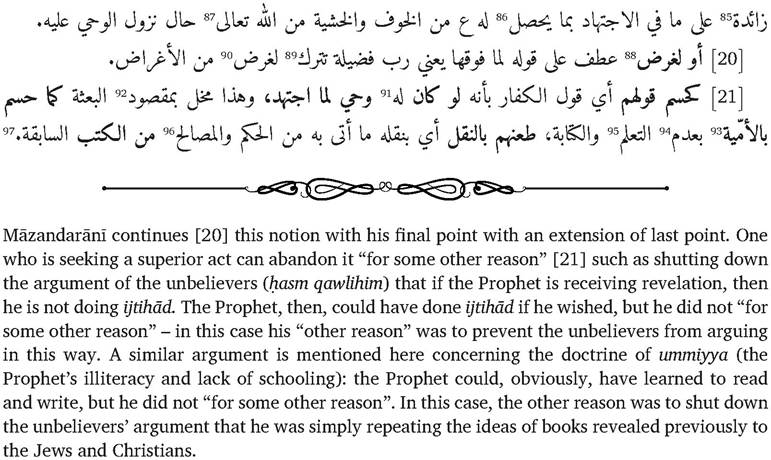
[c.5] [Finally] sometimes, a meritorious act can be abandoned for something which is superior; or for some reason or other, such as to shut down the argument [of the unbelievers] that “if it was revelation, then he cannot be doing personal juristic reasoning”. For instance, God shut down their insult that [the Prophet] was simply transmitting from books by pointing out that he was, in fact, illiterate.
Bold text is the base text, the Zubdat al-usul of al-Shaykh al-Baha’i; the remainder is Mazandarani’s commentary. Section markers in bold lower-case letters and numbers ([a], [a.1] etc.) refer to passages in the Zubdat al-usul (as per above); Western Arabic numerals ([1], [2] etc.) mark sections is the Sharh Zubdat al-usul.
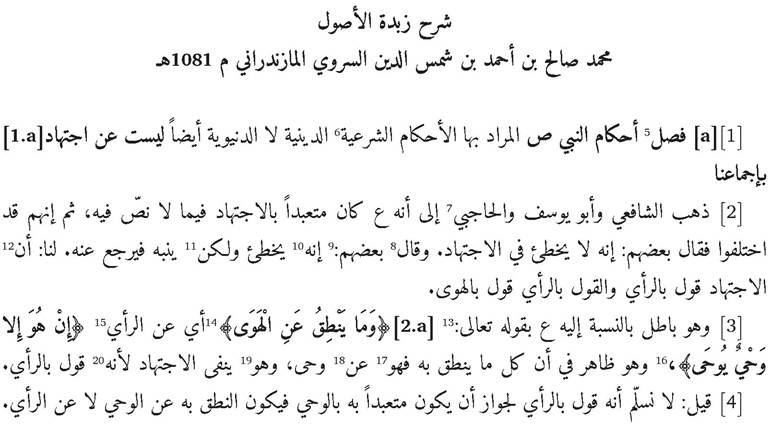
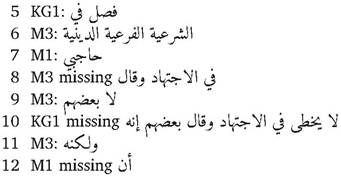
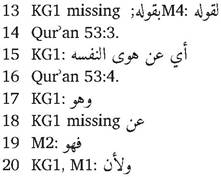
The referential style is clear from the above translation - however, al-Shaykh al-Baha’i has a clear approach to his exposition of the issue of whether the Prophet performed ijtihdd and whether the rulings he pronounced can be treated as fallible (given the common understanding of ijtihad).
His view is that the Prophet’s rulings were not from ijtihad [a], there are numerous pieces of evidence for this [a.1-a.3], that this conclusion applies to the Imams as well [b] and the contrary evidence (put forward by those who believe the Prophet’s ruling are based on ijtihdd) can be dissected and rejected one by one [c.1-c.5].Mazandarani’s task in his commentary is to make al-Shaykh al-Baha’i’s passage fully comprehensible by, in part, giving additional contextual information and by explaining the keyword references (“the Forgiveness Verse”, “The Consultation Verse” etc.). More precisely, though, the commentarial process acts to tie down the intended meaning of the original author, and this is clear from the very outset with the words “[1] The Prophet’s rulings - the intended meaning of which (al-murdd bihd) is religious legal rulings, and does not include worldly rulings - are not from ijtihdd by our consensus (ijmd')”. This is a potentially controversial point: is the intended meaning of al-Shaykh al-Baha’i’s phrase “the Prophet’s rulings” necessarily religious legal rulings (al-ahkdm al-shar'iyya al-diniyya) and not practical worldly rulings (al-ahkdm al-dunyawiyya)? It is not obvious from the text itself, though it does appear to be the standard Twelver position. Mazandarani is, then, ensuring that an ambiguous (and hence potentially disruptive) phrase in the base text is fully in harmony with Twelver doctrine. That the Prophet’s religious legal rulings do not derive from his ijtihdd is now subject to the consensus (ijmd') of the community - the integrated commentary serves to specify what element is subject to consensus (namely, the non-ij- tihdd origin of the Prophet’s religious legal rulings, but not his worldly practical rulings).
[2] outlines the different opinions on this matter. That the Prophet followed his own ijtihdd when there was no text is the position of al-Shafi'i (i.e. Muhammad b. Idris, d. 204/820, and by implication the school he founded), the early Hanafi authority Abü Yüsuf (d.
181/798, and hence at least some Hanafis) and the Maliki Ibn al-Hajib (d. 646/1249, referred to here as al-Hajibi). This then constitutes the three principal schools with which Twelver legal writers are most concerned - the Hanbali school is accepted as a school, but not viewed as having distinctive opinions such that it deserves constant mention when outlining the difference of opinion (ikhtildf) on an issue. These three then differ amongst themselves with some saying the Prophet does ijtihdd but never erred; others saying he did err, but this was always pointed out to him, and he recanted his earlier position.[3] outlines the Twelver opinion (and, in his presentation, that of Mazandarani also) on the matter. Ijtihdd is, by definition a view based on an opinion; an opinion-based view (al-qawl bi-l- ra’y) is really a whimsical view ('an al-hawd): “such a view would be invalid when applied to [the Prophet] for as God says, “he does not speak from his whim. It is in fact nothing but revelation revealed.”7 Everything the Prophet says is, therefore, revelation, and this is to be contrasted with ijtihdd - the results of ijtihdd are personal opinions.
[4] deals with a potential objection here: not all results of ijtihdds are “personal opinions”. In the case of Prophet, it is argued, he is not simply declaring the results of his own ijtihdd because he believes in the power of his own opinion (al-qawl bi-l-ray). The Qur’anic verse demonstrates that when the Prophet announces his ijtihdd-based view, the result is “revelation revealed”.8 The announcement itself becomes a revelatory statement, whilst at the same time being the result of the Prophet’s personal ijtihdd. Therefore (it is inferred), not all ijtihad-based opinions are whimsical personal opinions.
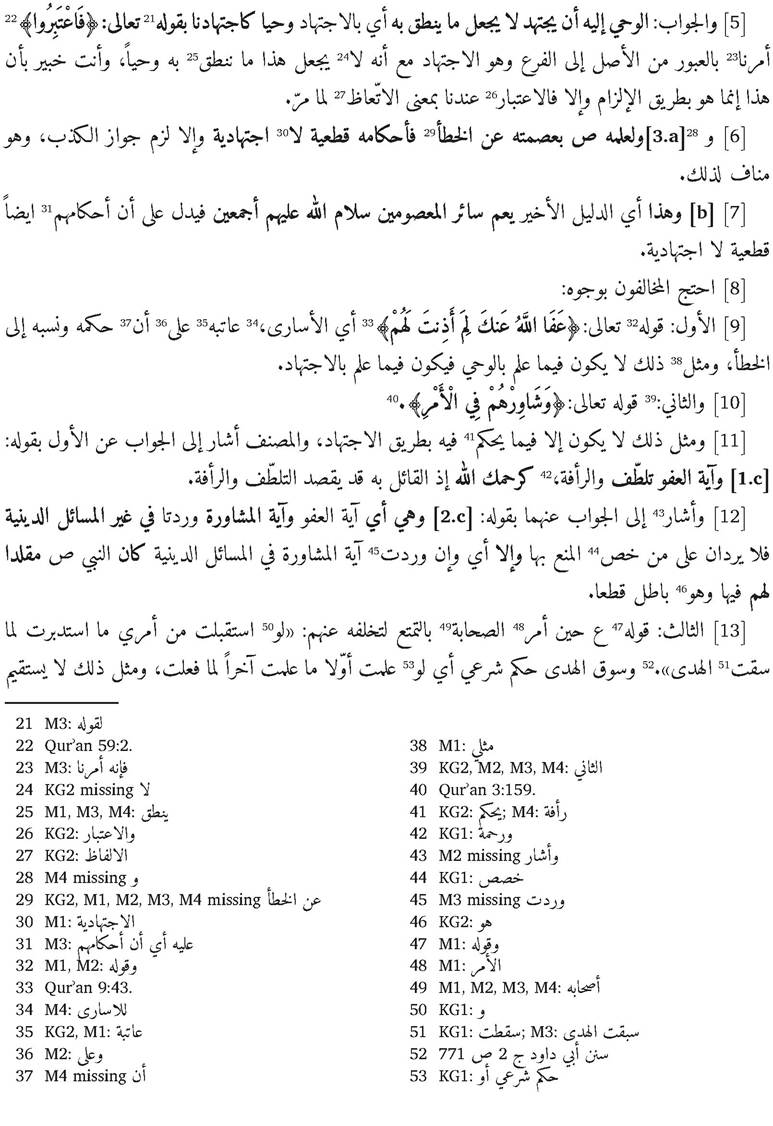
[5] outlines the response to this argument - Mazandarani puts forward an ad absurdum argument: if one argues this way, one could say everyone’s ijtihdd is revelation since the permission to do that is also based on a revelatory command - namely, the statement in the Qur’an “Consider”.9 By this imperative, it could be argued, God orders us (amarand) to practise ijtihdd: that is, to move from one case to another, or from a general principle to a specific application of that principle. However, at no point do the conclusions we enunciate become revelation.
For Mazandarani, even though this argument is in support of his position, he recognises a potential flaw in it: it is dependent on us understanding the imperative “Consider” to be one which requires obligation, and as he has demonstrated, the imperative can have many meanings. In this verse the imperative form means, in his view, that one should view the action being commanded as “advised” (itti'dz).[6] outlines a third argument for the Twelver position: the Prophet knows himself to be immune from error, so his rulings are certain to him, not based on his juristic reasoning (qat'iyya Id ijtihddiyya). The argument here can be rolled out to all the Sinless Ones [7], i.e. the Imams.
Section [8] begins the opposition arguments and their rebuttals. Mazandarani groups the first two pieces of evidence from the opposition [9 and 10], and then gives responses to them both [11 and 12] - I will take the argument and response for each together here. First, [9] they claim that God says, “God forgive you - why did you give them permission?”10 This is referred to as the “Forgiveness Verse” (dyat al-'afw). If God here is forgiving the Prophet for something, then the Prophet must have made an error and not have acted due to revelation. The reply is given a little later in the passage [11] - this, Mazandarani explains, is merely an instance of politeness, like when you say to someone “God have mercy on you”: it does not mean the person is a serious sinner or has even gone astray. The second argument [10] relates to the “Consultation Verse”: “so consult with them on the matter”.11 If the Prophet should consult the people in order to reach a decision, then he cannot be acting on the basis of revelation. Mazandarani’s explanation of al- Shaykh al-Baha’i’s reply to this evidence [12] is that both this verse and the Verse of Forgiveness apply to worldly, not religious, matters (picking up on the point made in [1] above) - “they are not relevant [as a counter argument] for someone who restricts [their application] to [non-reli- gious matters]”.
If they did apply to religious matters, then the Prophet would be following the people (muqallad lahum) in such matters, rather than acting on the basis of revelation - and this is “certainly invalid” (bdtil qat'an).The third argument [13] is rather involved, and concerns an episode when the Prophet was on pilgrimage with the Companions; when he reached Mecca, he found out that not all the Companions had brought the requisite sacrifice (hady) with them for pilgrimage. He therefore told them to change the type of their pilgrimage. They were doing hajj al-qirdn (combined pilgrimage) when the pilgrim does both the minor pilgrimage ('umra) and designated pilgrimage (hajj) in one state of pilgrimage purity (ihrdm). The Prophet said that because they had not brought a sacrifice, they should change this to hajj al-tamattu' (the so-called “pleasure” pilgrimage) - thereby changing the object of their intention mid-pilgrimage. In hajj al-tamattu', the pilgrim completes the 'umra and then leaves ihrdm for a while, and enters a second state of ihrdm in order to complete the hajj. Presumably during the non-ihrdm state, they could locate a sacrificial animal and therefore re-enter ihrdm with the correct prerequisites for hajj. The Prophet said, “If I had known my matter what I know now, then I would not have brought my sacrifice along with me.” (law istaqbaltu min amri md istadbartu la-md suqtu l-hady) - that is, if I had known the pilgrimage type was to change to hajj al-tamattu' I would not have needed to bring my sacrifice.12 The fact he
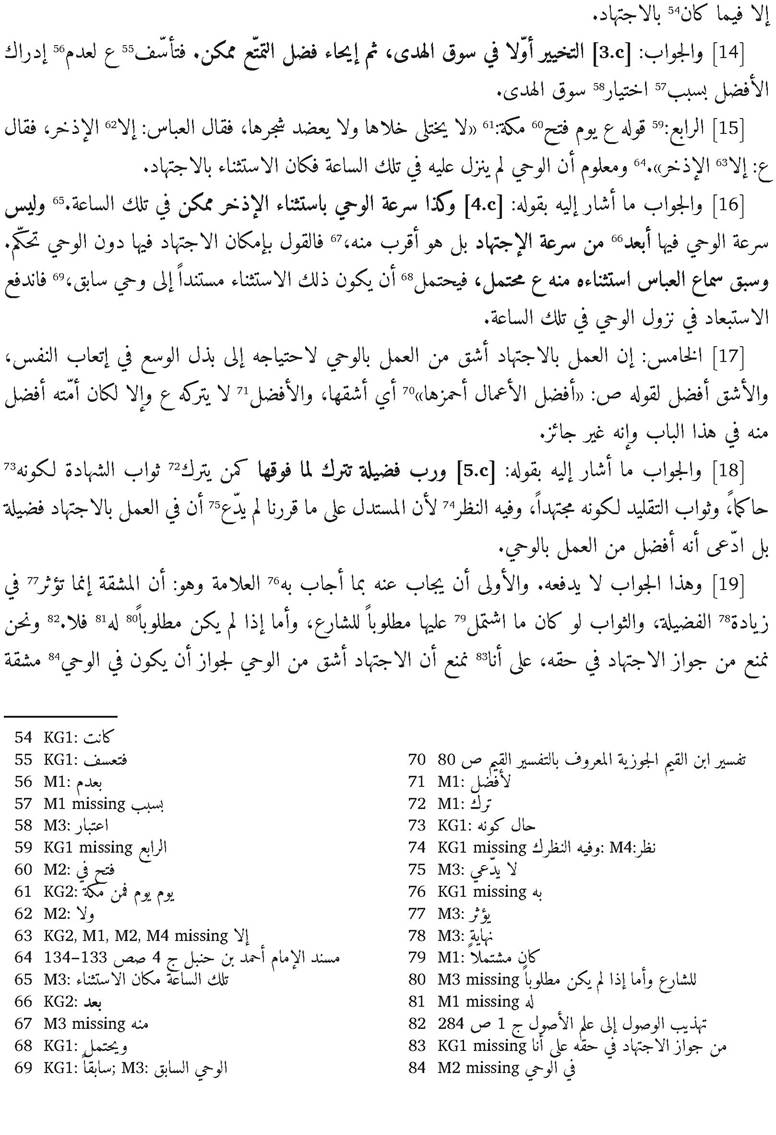
wished he had done differently, the opponents argue, means the first decision - which is a religious and not a worldly matter - cannot have been by revelation and must have been by ijtihdd. The answer [14], explained by Mazandarani, is that there may have been, at first, an option for the pilgrim to bring a sacrifice or to not bring one; then later it was revealed that it was better (afdal) to perform hajj al-tamattu'. The Prophet was expressing regret: he had chosen to bring along his sacrifice when he did not know that it was better to perform hajj al-tamattu'.
The fourth argument [15] is less complex: on the day when the Prophet conquered Mecca he said that you should not uproot Mecca’s grassland, or cut down its trees. Al-'Abbas said, “except for the reeds”, and the Prophet agreed with this.13 By accepting this exception to the general prohibition on cutting down grasses and trees, the opponent argues that: “it is known that revelation did not come to him at that very moment; so the exception [of reeds] must have been from his own ijtihdd,” Mazandarani’s answer [16] is first, that immediate, or alacritous revelation of the exception is possible (sur'at al-wahy bi-l-istithnd1 mumkin), indeed it is more likely than alacritous ijtihdd. The claim that alacritous ijtihdd is possible but alacritous revelation is not is just arbitrary (tahakkum). Second, it is probable that al-'Abbas had heard the exception on a previous occasion (sabq samd' al-'Abbas), so it did come from revelation after all.
The fifth argument [17] is that it is harder to perform ijtihdd than to receive revelation. Ijtihdd means exhausting all possible effort; whilst revelation is simply a passive receiving of information. There is a general rule that the harder something is, the greater its worthiness;14 if the Prophet did not perform ijtihdd then his community (some of whom do perform it) would surpass him, which is, of course, not permitted. Al-Shaykh al-Baha’i’s answer [18] is the condensed phrase “sometimes, a meritorious act can be abandoned for something which is superior”. Mazandarani explains this by examples: the judge forgoes the rewards of witnessing in a case, since the position of judge is more meritorious; similarly, the mujtahid forgoes the rewards of following (taqlid) a mujtahid. Interestingly, though, Mazandarani does not think al-Shaykh al-Ba- ha’i’s answer is an effective rebuttal: “[the opponent] is not claiming simply that there is merit in acting on the basis of ijtihdd; rather he is claiming that it is more meritorious than acting on the basis of revelation, and this response [of al-Shaykh al-Baha’i] does not rebut this.” For Mazandarani, a better way of arguing is following the line of reasoning laid out by al-'Allama al-Hilli [19]: “hardship can only increase merit and reward when it is for something desired by the Lawgiver (matluban lil-shdri').”15 Mazandarani denies that ijtihdd is permitted to hold this position of matluban lil-shdri': by definition ijtihdd is searching for something not explicitly expressed by the Lawgiver (since ijtihdd is necessitated by the lack of an explicit text), and the result of itjihdd may be at variance with the desired result of the Lawgiver. If ijtihdd is not matluban lil-shdri', then hardship cannot increase the merit gained from performing it. This is quite different from receiving revelation, which is, by definition in line with the Lawgiver’s wishes. One is tempted to see an influx of Akhbari ideas here into the argumentation: ijtihdd may be permitted in certain circumstances, but its results are, by necessity, not identical with the Lawgiver’s wishes. Furthermore, receiving revelation brings fear and dread (al-khawj wa-l-khashya) of God. This could actually make receiving revelation harder than doing ijtihdd. Mazandarani here, interestingly, is replacing and supplementing al-Shaykh al-Baha’i’s argumentation as he feels dissatisfied with it.
More on the topic Commentary:
- Commentary
- Commentary
- Commentary
- Commentary
- Commentary
- CHAPTER 12 COMMENTARY ON SOME RECENT DEVELOPMENTS (2ND EDITION, 2011 AND 3RD EDITION, 2023, TED BENTON)
- Introduction
- Christ’s Empire
- The Provincial Edict
- COMMENTARIES
- AN ANCIENT ESTIMATE OF THE SPEED OF LIGHT
- Bibliography
- REFERENCES
- Involuntary Surrender of Possession
- Voluntary Surrender of Possession (unilaterally or through delivery; movable or immovable property)
- 17 Prohibition on the Possession and Proselyting of Christian Slaves by Jews
- Hume’s critique of the modern philosophy
- Introduction: Thinking about Secularism