Introduction
Not much is known of Muhammad Salih al-Mazandarani’s life (hereon Mazandarani). His name suggests that he descended from the Mazandaran region in the north of Iran. His date of birth is unknown; in light of a report that at the time of his death in 1285/1868 he was around eighty- years old, he was likely born at the beginning of the thirteenth century AH, which coincides with the first decades of the Qajar dynasty (1789-1925).1 In addition to receiving seminary training in Isfahan, he studied in Karbala and Najaf with some of the prominent scholars of the time, including Muhammad Sharif al-Mazandarani (d.
1245/1829), Musa Kashif al-Ghita3 (d. 1242/1826) and his brother 'Ali Kashif al-Ghita3 (d. 1253/1837). After reaching the level of juristic expertise (ijtihad) he returned to Isfahan where he had a distinguished career.2Mazandarani has received scant attention in biographical dictionaries and none of his writings are available in print. Besides a few brief treatises on legal topics and a work comprised of his notes (taqriraf) taken from the lectures of his teacher Sharif al-'Ulama3 (d. 1245/1829),3 Mazandarani wrote two books on jurisprudence. The first, titled Usul al-fiqh (‘On Jurisprudence’), was written early in his career; it encompasses only two chapters, one on linguistic postulates and theories of scriptural interpretation (alfaz), and the other on rational proofs (adilla 'aqliyya). The book’s unorganised presentation, a lack of uniform style, and the fact that it was left unfinished has led some to suspect that it was written as a preliminary to his more elaborate work on jurisprudence, Kawashif al-hujub 'an mushkilat al-kutub (‘Removing the Veils from Obscurities of Books’).4 Mazandarani does not mention when he completed this work, although in a biographical work 1247/1832 is reported as a completion date.5
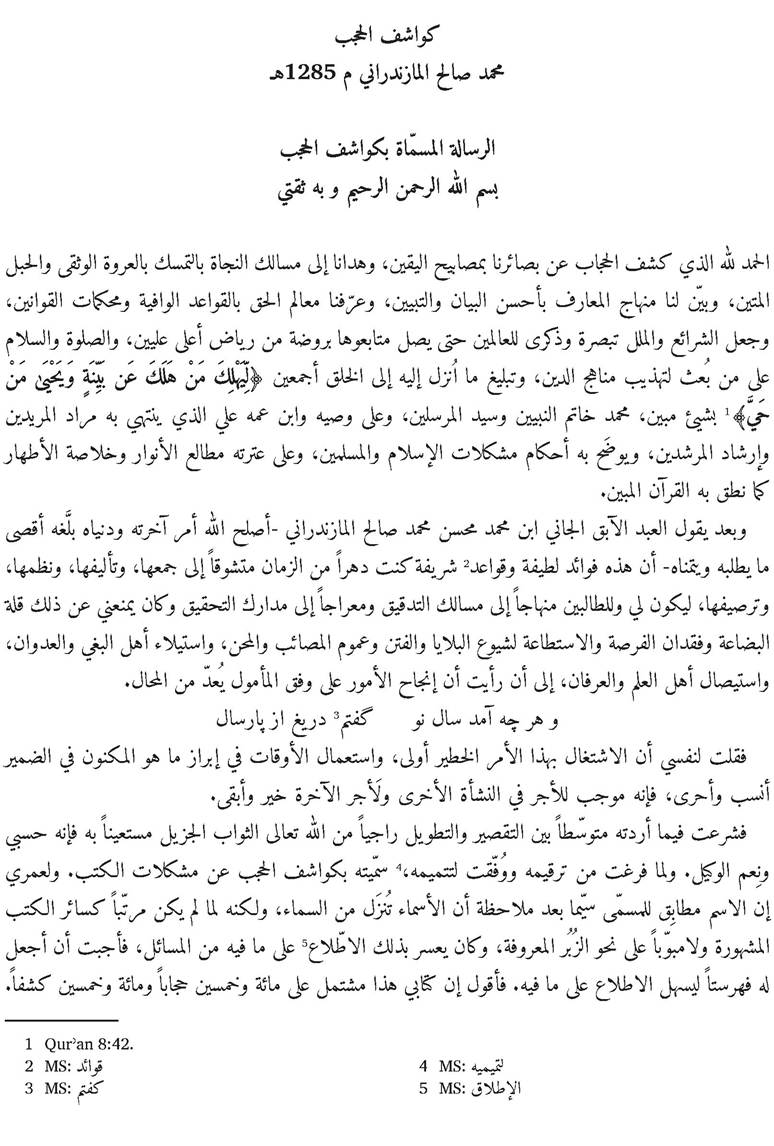
As Mazandarani remarks in the preface, compared to other texts of jurisprudence, Kawashif al-hujub is a book of medium length.
It is organised in 150 sections, each dedicated to a particular topic; the sections vary in length, some only a few lines, others running for pages. Each section consists of a ‘veil’ (hijab) followed by Mazandarani’s corresponding ‘removal’ (kashf) of it. Each veil constitutes a confusion about some matter of jurisprudence, which Mazandarani attempts to remove, thereby unveiling the truth of the matter. Occasionally he characterises the questions as spurious or sophistic arguments. Although Kawashif addresses major topics often discussed in the texts of jurisprudence, the arrangement of the sections does not follow the usual order. For instance, in contrast with the Ma'alim al-din - a widely-read book that Mazandarani was familiar with - Kawashif al-hujub does not begin with a discourse on knowledge followed by chapters dedicated to topics such as linguistic postulates and theories of scriptural interpretation, commands and prohibitions, consensus, prophetic reports, abrogation, legal analogy, and the obligation of non-expert believers to follow the legal opinions of qualified jurists.6 Rather, Mazandarani’s chosen approach in Kawashif al-hujub is to address various topics, often with the aim of refuting the opposing views, and without necessarily seeking to compose a comprehensive and cohesive work of jurisprudence. Indeed, as the book’s title indicates, Mazandarani explicitly seeks to address and remove the veils from the various difficulties he has encountered in other jurisprudential books.Mazandarani’s approach to the issues he discusses in Kawashif al-hujub is representative of the Usuli jurisprudence.7 The Usuli jurisprudential paradigm had faced a serious challenge at the beginning of the seventeenth century. Muhammad Amin al-Astarabadi (d. c. 1033/1623), acknowledged as the founder of the Akhbari movement, had undermined the central juristic principles of his contemporaries.8 This was met with a concerted effort to counter the Akhbari current, which had become increasingly popular.
By the time Mazandarani undertook his training in Isfahan, the Usuli framework, as exemplified by Muhammad Baqir al-Bihbahani (d. 1205/1791), had established itself as the dominant force in Iranian seminaries.9 One of the most contentious disagreements between Usulis and Akhbaris pertained to the probative force of the Qur’an’s prima facie sense. Mazandarani has a section on this topic in his treatise which is included in the present study and is an illustration of his adherence to the Usuli framework.The fact that Kawashif al-hujub still remains in manuscript form and a critical edition is yet to be published indicates its lack of widespread readership or impact.10 Mazandarani may have been overshadowed by his influential contemporaries like Murtada al-Ansari (d. 1281/1864), who is considered one of the most prominent Shi'i jurists in history.11 Despite its unenthusiastic reception thus far, Kawashif al-hujub remains an appealing text. For our part, we have chosen two of its sections. Following Mazandarani’s preface to the book, Section 39 examines whether non-believers can become experts in Islamic law; Section 12 is on the probative force of the prima facie sense (zawahir) of the Qur’an.12 It is hoped that the passages presented here will kindle the interest of a reader to pursue the entire text.
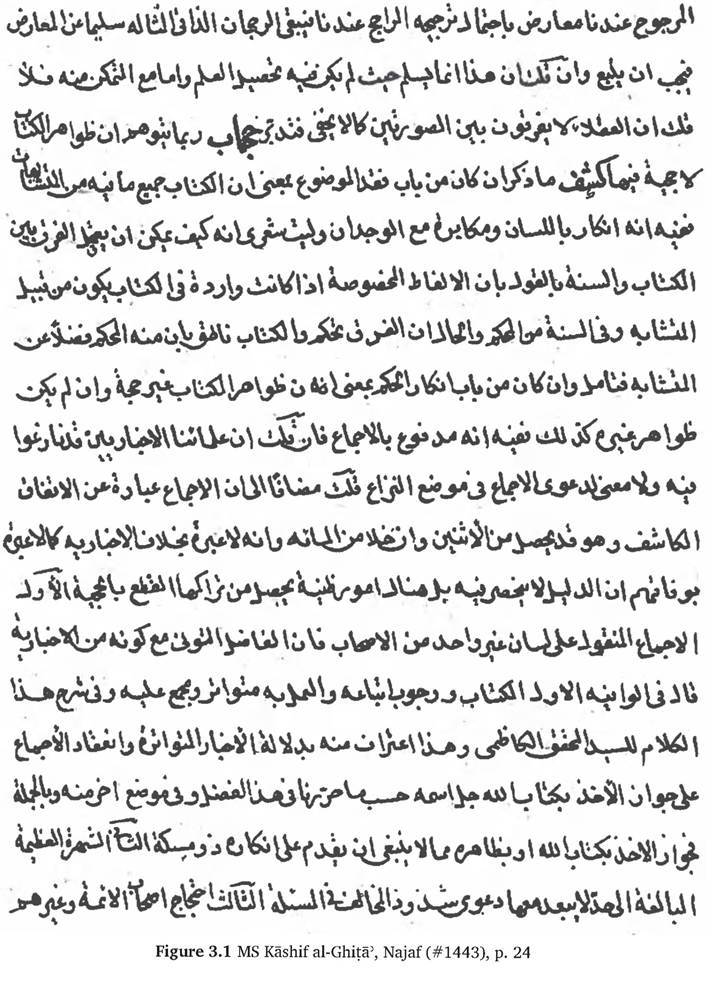
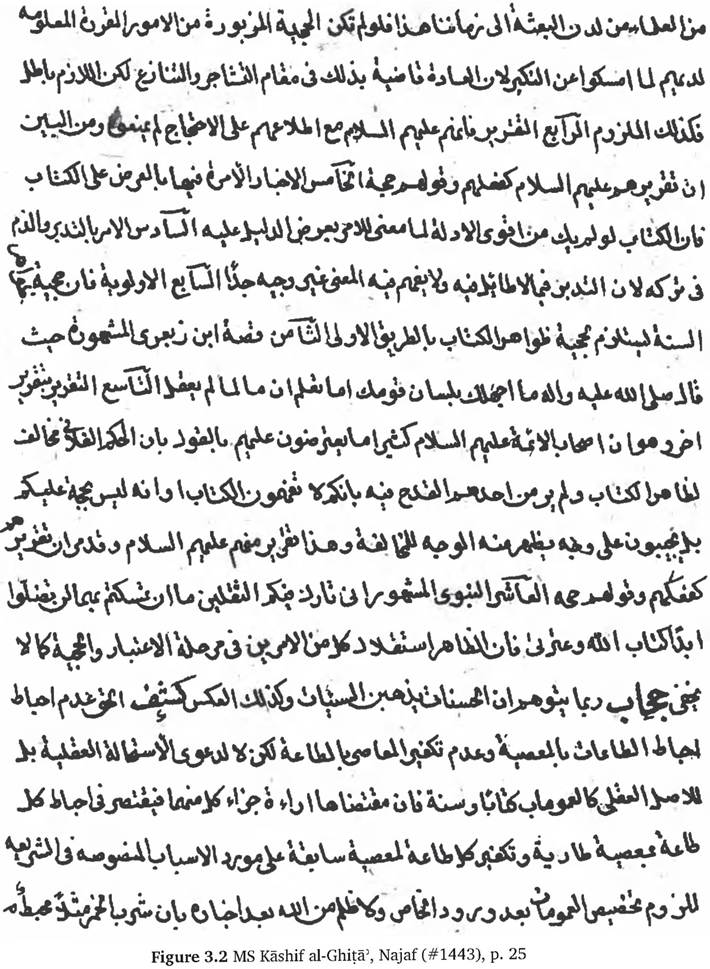
In keeping with the volume’s overarching aim, we have avoided a word-for-word translation of the Arabic text; instead, the following is a close paraphrase, accompanied with commentary whenever necessary. The following edition is based on the MS #1443 of Kashif al-Ghita' Library in Najaf.
More on the topic Introduction:
- 1 Introduction
- Introduction
- Introduction
- 19 Introduction
- Introduction
- Introduction
- INTRODUCTION
- Introduction
- Introduction
- Introduction
- Introduction
- Introduction: Hegel, Marx and the Dialectic