Introduction
Ways of seeing an Arab Girl
This book attempts to explain to as wide a readership as possible what a contract is in Islam; how some qualities of the Islamic contract (‘aqd in Arabic) can be deemed consistent within a great synchronic and diachronic variation of contexts; and why this unity-in-diversity (continuity-in-change) can be coherently linked to the interaction between law and religion in Muslim jurisprudence as part of the intellectual, cultural, and social history of Islam.
The book claims that certain features of the Islamic contract, perhaps the most controversial for Western scholars, but at the same time, the most revealing of its nature, cannot be properly understood unless their rationales are located within the religious background of Muslim juristic discourse. Accordingly, by departing from many valuable works of legal scholarship already available on the subject, it looks at religion and law as co-determining factors in the construction of the ‘aqd both as part of divine revelation (Chapter 2) and as a human enterprise of intellectual/social nature that has developed in the legal tradition (Chapter 3) and in the reality of the Muslim world, within a theory-practice interplay (Chapter 4).
Within this framework, the essential theoretical stance of this volume is that a full understanding of the ‘aqd cannot be achieved without embracing a dialectical relation between the Occident and the Orient in the definition of what-is-law and what-is-religion, with the subsequent need to revisit how the ‘aqd has been constructed in Western literature through comparative methodology, also in the light of media theory (Chapter 1).
More broadly, the book employs the contract as a medium to investigate the Islamic nomos. Thus, the ‘aqd will become, in these pages, a vehicle of legal meaning that is not only particularly useful, as we will see, for shedding light on the interface between the secular and the religious in the normative universe of the Muslim world, but also for disclosing how the nature of the contract, so familiar to legal scholars, has been considered differently in the Western and Islamic legal traditions and how its rules (part of mutable social contexts, where the experience of every individual’s life subsists) have been exercised differently in space and time.
In brief, by devoting its contents to the contract in Islam, the aspiration of this work is to say something valuable about the Muslim world as well as about contract law as a fundamental aspect of human life in any society. Accordingly, it will show how the study of the ‘aqd can contribute as much to a better understanding of law and religion in the East and the West as to the cultural relation between the Orient and the Occident, and ultimately, to its re-orientation.
From archetypes to corpora iuris
Two caveats are needed before starting this study.
First, this book does not argue (even remotely) that a general and uniform idea of contract belongs to Islam as a sort of archetype spanning the whole history of the Muslim world.
Presenting the ‘aqd (lit. ‘tie,’ ‘bond,’ pl. ‘uqud; from the Arabic root ‘-Q-D, ‘to tie, to knit,’ ‘to bind,’ ‘to gather,’ hence, ‘to conclude a contract:’ Wehr, 1979) as a consistent subject of research does not imply here a claim for any trans-historical and trans-geographical univocal identity. In fact, insofar as the multiple rules of the ‘aqd that can be found in Muslim jurisprudence (Chapter 3) have combined elements of doctrine interlinked with changeable factors of social reality, so its practice has always been affected by a variety of local customs and has entered into contact with other legal systems and traditions. In brief, the ‘aqd has never been a uniform entity, since, like any other legal institution, it has never existed in a vacuum. Rather, it has always experienced multiple formulations and contaminations from the time of its origins to the modern period and present times (Chapter 4). A dialectic of non-identity (Chapter 1) will constantly support this approach to the ‘aqd through the pages of this work.
Nevertheless, a key assumption of this book is that a specifically Islamic meaning has always underpinned the multifaceted nature of the ‘aqd: in other terms, the ‘aqd has maintained within its transformative praxis some constant elements (a unity-in-diversity, a continuity-in-change) that can be recognised in the diverse range of human contexts of the Muslim world as related to the religion of Islam.
It has enjoyed a continuity in practice, despite the changeable and plural nature of its theories and practices·, a continuity whose rationales, as this book will try to show, can be coherently linked to the core postulates of Islamic religion (Chapter 2). It is in this sense that the ‘aqd will become, for us, a precious tool of enquiry of the rich and diverse normative universe of Islam; a source of information about how the secular and the religious interact in the Muslim world; a vehicle of legal meaning within a ‘unity of diversities,’ whose rationales have to be studied in a dialectical perspective with Western law and religion, in order to be properly understood.Second, and as a direct corollary of what has just been said, a core argument of this book is that the deepest meaning of the unity-in-diversity of the ‘aqd cannot be fully appreciated unless studied in a comparative approach with the tenets of Western religion (Chapter 2) and law (Chapter 3).
If the plurivocal discordance and disagreement of rules (in Arabic ikhtilaf within the literature offiqh - Islamic classical law in the sense of Muslim jurisprudence - certainly conflicts with the doctrinal archetypes of Western legal tradition, which is grounded on principles of systematic and general normativity within a coherent corpus - a ‘body of law’ - the apparent Western incoherence of these rules will prove to be the major proof of Islamic coherence of the ‘aqd in a methodological framework grounded on its non-identity with the West (Chapter 1). In fact, this absence of a unified corpus for the Islamic contract departs both from the style of civil law (grounded on the droit aca- demique of European conceptual jurisprudence)1 and common law (where cases follow precedents according to the stare decisis principle). Scattered in a myriad of rules presented in a casuistic style, although the ‘aqd constitutes a substantial topic of fiqh al-mu‘amalat,2 it has no ‘legal body’ in the eyes of Western jurisprudence - it has no corpus iuris:2 a body for the ‘aqd cannot be seen when Western standards are applied.
This book will therefore try to demonstrate that, far from being a sign of incoherence, this is, in fact, evidence of the deep-rooted coherence of fiqh. As noted by Norman Calder, a systematic organisation of the contents could not belong to Muslim jurisprudence for the very reason that Muslim scholars never aimed for this. On the contrary, ‘its variation, its complexity, its extravagant exploration of detail, its constant citation of different authorities, its apparent irrelevance, sometimes, to practice, its cunning and witty accommodation, sometimes, to practice: all these things... will alert... readers to the fact that “a valid and sensible corpus of laws” is not quite what... [Muslim] jurists had in mind’ (Calder, 1996, p. 979).
It is from this absence of a valid and sensible corpus of laws that our voyage of discovery can start - together with the consideration that, in modern times, through the colonisation process and the transplant of Western legal culture, the presence of the Occident has somehow been able to ‘re-clothe’ the Islamic contract with a corpus ‘in its own image and likeness’ - to paraphrase the Bible, Genesis 1:26-27. The recognition of this co-existence of absence and presence in the story of the ‘aqd provides precious material for further reflection at the beginning of our journey.
Representations, meaning, and signifying practices: the riddle of the Sphinx
Although, in Muslim jurisprudence, a unified corpus iuris for contract law does not exist, as stated previously, the ‘aqd has been ‘clothed’ according to Western standards in modern times, providing it with some sort of body, even though this may be considered artificial. More precisely, the ‘aqd has been rendered more visible to Western eyes both through the process of codification in Muslim countries (e.g. the celebrated Majalla of the Ottoman Empire, enacted between 1869-1876; or the Egyptian Civil Code, 1949, conceived by the great Egyptian jurist ‘Abd al-Razzaq al-Sanhuri: see Chapter 4) and important doctrinal works, both by Arab (notably Chafik Chehata in his Theorie Generate de l’Obligation en Droit Musulman Hanefite, 1969) and non-Arab authors (for instance: in English, Rayner, 1991; Vogel, 2006; in French, Linant de Bellefonds, 1965; in Italian, Santillana, 1926, 1938).
The most recent volume about Islamic contract law in the English language is by Bantekas, Ercanbrack et al. (2023).But, if these works of legal scholarship have solved the interpretative issues of the ‘aqd by translating them (on the problem of translation, see Chapter 2) into Western jurisprudence, many riddles have remained: metaphorically speaking, if the ‘Sphinx’ has been tamed by ‘clothing’ it in a Western fashion, its wildest and most inner nature has remained mainly unchallenged. As is well-known, in ancient Greece, the Sphinx was a mythical beast with the body of a lion, the head of a woman, and wings of a bird. According to Greek mythology, a Sphinx, which guarded the entrance to the city of Thebes, asked travellers a riddle before allowing them to pass, devouring those who were unable to reply: ‘What walks on four feet in the morning, two in the afternoon and three at night?’ The legend tells that Oedipus solved the riddle with the correct answer: ‘Man - who crawls on all fours as a baby, then walks on two feet when an adult, and later uses a walking stick in old age.’ Certainly, travellers in foreign lands always face challenges - and looking for the meaning of the contract in Islam is precisely the challenge that this book dares to take on. Fortunately for us, this voyage appears less dangerous than Oedipus’ meeting with the Sphinx of Thebes - although not without its own risks.
When starting a journey, a general outline of the itinerary is always needed. Travellers may well already imagine their destination as it has been previously represented to them: Thebes, with its Sphinx, was extremely popular in ancient Greece; mutatis mutandis, today, for instance, the beauty of Rome is linked, in tourists’ minds, to the image of centurions standing close to the Colosseum or that of Tosca flinging herself for love to her death over the edge of Castel Sant’Angelo. What is certain is that neither the centurions nor Tosca depict Rome as-it-is: rather, they represent the city in a way which is attractive for visitors, and the success of their narratives undoubtedly contributes to the appeal of Italy as a popular tourist destination.
However, any representation, as a signifying practice, ‘depends on a difference between what presents and what is presented,’ ‘for... representations... frequently fail to mirror in any direct way the complex world beyond the texts in which they appear’ (Cooper, 2011, p. 5, referring to Eagleton, 1991, p. 213). The inherent distance between what is absent and what is present unveils the intrinsic dialectic that belongs to any representation (from the Latin re-ad-praesentare, literally ‘to present again,’ ‘to make something present,’ or better, ‘to make something which is distant in time or space, and hence absent, present in the here-and-now’). The point is highlighted in a famous article by Roger Chartier.[O]n the one hand, the representation makes visible an absence, that which supposes a clear difference between what represents and what is represented; on the other, the representation is the display of a presence, the public presentation of a thing or a person. In the first sense, the representation is the instrument of a mediated knowledge that makes visible an absent object by substituting it with an “image” capable of reminding (the viewer) of it and of “portraying” it as it is.
(Chartier, 1989, p. 1514; author’s translation)4
Any mediated knowledge selects certain qualities of the referent while marginalising others, frequently by using some ‘codes’ that are shared between the speaker (the person representing the referent) and the addressee (the receiver of the representation). Natural languages are themselves codes that represent reality where words, both written and oral, are a medium for communication, and are, in fact, our mediated knowledge of what-is-real. Fellow citizens use the same language (English, French, Arabic, Finnish...) to communicate, and by doing so, they share a common national and cultural identity. In the same way, images, as representations, implicitly hold messages with a certain meaning. With regard to natural languages, issues of meaning can generally be solved by a process of translation: ‘ciao’ in Italian means ‘hello’ in English. But many aspects of human life necessarily require an effort of comparison to reveal unexpected nuances of meaning behind the translation. ‘Ciao,’ the most common informal greeting in Italian, comes from the Venetian dialect s-ciao, s-ciavo, literally ‘[I am your] slave, servant’ (from the late Latin sclavus), as used by peasants to greet their landowner, and became part of Italian language only in the 20th century. This is a story of meaning that is completely different from the English ‘hello,’ which dates back to the early 16th century as an order to stop, from the French hold: ho ‘whoa’ + ld ‘there.’ Alongside this comparative study, to reach the full understanding of their story or stories, words must also be put in context, since their meaning is immersed in social reality, and so, subject to their presence in-time; nobody today would mistake ‘ciao’ for ‘your slave.’
Just as any word (and any city) has a story, so the ‘aqd as a vehicle of legal meaning of Islamic nomos will be studied in this book according to the ‘stories’ of three overlapping layers that are related respectively to the translation of the revelation of Islam (Chapter 2), the comparison between the Islamic and the Western traditions of contract law (Chapter 3), and the contextualisation of the Islamic contract in the changing social realities of the Muslim world (Chapter 4). In doing so, the study will also directly subscribe to the nature of fiqh in terms of ‘a conceptual replica of social life,... balanced between revelation, tradition and reality, all three of which feed the discussion and exemplify the concepts’ (Calder, 1996, p. 981: see more specifically section 1.4), and in this way, issues of hermeneutics (the theory of language and interpretation) will be linked to fundamental problems of epistemology (the theory of knowledge) in dealing with Muslim fiqh.
With this aim in mind, before entering more details about the methodology underpinning our comparative study of religion and contract law (Chapter 1), some additional considerations are needed regarding the semantic power of representations, whether in the form of natural languages, mythology, and visual images of a city or legal categories (such as the ‘aqd) translated from Islam to the West. Specifically, we cannot avoid at this point a reference to the practice of Orientalism.
Imaginative geographies of Orientalism: The Almeh and the city of the ‘aqd
Representations are tools through which we know; to wit, the medium of our knowledge. As means of communication, they do not respond to parameters of absolute truth but to criteria of mutual understanding; a collective signifying practice is ‘real’ on the grounds of its shared representation within a certain community. Moving back to the example given before, centurions and Tosca are not the ‘truth’ of what-Rome-is; rather, they mirror the collective perception of how-Rome-is-known in the world; in brief, they are ‘real’ as representations in terms of collective knowledge.
When speaking of legal archetypes, corpora iuris, and intelligible representations in connection to the plan of exploring unknown places, the previous pages have referred to images taken from ancient Greek mythology (Oedipus and the Sphinx); figures related to Rome (centurions, Tosca); as well as words from the Italian language (‘ciao’). Although these references may appear, at first glance, detached from a study of law and religion, they can be functional to introduce the topic of this book, whose specific project can be metaphorically described as an attempt to understand better the ‘land’ of Islam by exploring the ‘city’ of the ‘aqd and the life of its ‘inhabitants’ - the Muslim believers practising Islamic contract law. The research will show how the normative world of this town has been conceived by Muslim scholars, the experts offiqh (Chapter 3), in accordance with the postulates of Islamic law and religion (Chapter 2), and how the rules of the ‘aqd have changed in the market as a space of social interaction over time, in mutable historical scenarios (Chapter 4). Chapter 1 will outline more in depth the research methodology according to the general objectives outlined at the beginning of this Introduction, both in relation to what a contract is in the Western and Muslim legal traditions (as different signifying practices); how the interaction between law and religion in the West has represented and ‘codified’ the ‘aqd; and why this representation does not fully shed light on certain ‘features of Muslim juristic discourse, those perhaps which are most revealing of its nature and its intentions’ (Calder, 1996, p. 979).
While still at the entrance of our allegorical city, the quest for the corpus of Islamic contract law returns. I have already pointed out that, although this body has been represented by modern elaborations of Western scholarship and codified in the legislation of Muslim countries, a coherent system and a general theory of the ‘aqd is absent in classical fiqh. In the end, it was the Western representation of Islamic law that made visible (present) an absence (see Chartier, in a foregoing quotation). While dealing with this issue, we are fortunate that, at the gate of the town, it is an Arab girl and not a Sphinx who is waiting for us, and both for reasons of courtesy and intellectual curiosity, we can no longer put off a meeting with her (see Figure 0.1).
The Almeh with Pipe (oil on canvas, 1873; also known as Arab Girl in a Doorway; Najd Collection/Mathaf Gallery London) is a painting by the
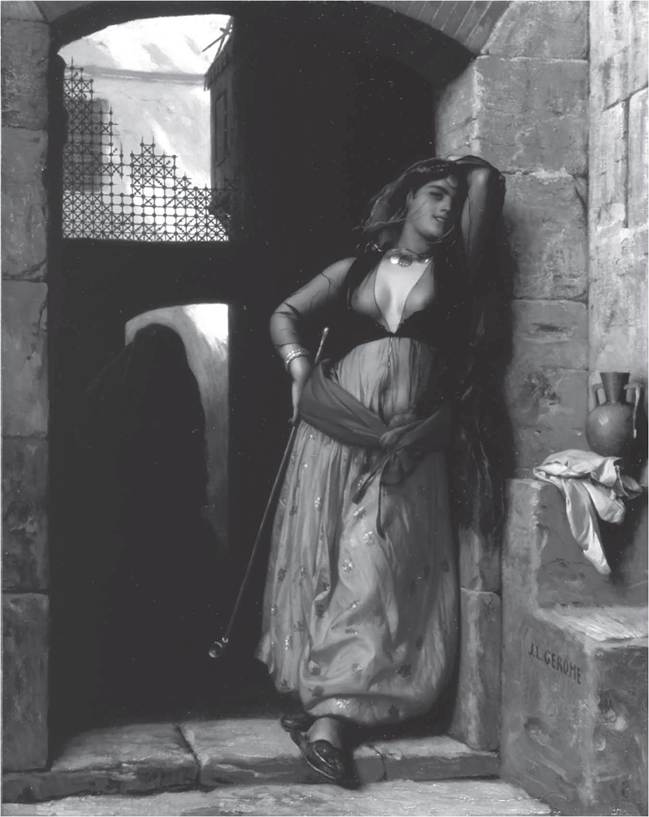
Figure 0.1 The Almeh with Pipe (also known as Arab Girl in a Doorway; oil on canvas by Jean-Leon Gerome, 1873; courtesy by Najd Collection/Mathaf Gallery London)
French artist Jean-Leon Gerome (1824-1904),5 completed after his visit to Cairo.6 In the foreground of the picture, a young woman poses seductively looking at the visitor; in the darker background, another figure (we can reasonably assume an older woman) stands, wrapped in a heavy cloak - seemingly moving towards us. We do not know anything about the girl’s personal life, but the image suggests that she is waiting for some company, and some malicious eyes could charge her with soliciting from the street.7 In fact, her physical beauty is shadowed by a sense of moral decay which is materially carved in the broken, patterned grille over the doorway. All the visual elements of The Almeh's representation8 bear witness to the triumph of Neoclassicism, of which Gerome was a great master. By blending the French art academique with the romanticised appeal of a cultural re-elaboration of the Muslim world, Gerome’s paintings were extremely popular during his lifetime. The ‘improper body’ of The Almeh, with her lascivious figure, greatly appealed to the eyes of his Western public in the 19th century. However, in his representation, Gerome did not falsify reality; rather, the depiction of The Almeh as a concubine, in the figure of a sensual belly-dancer, easily matched the Orientalist imaginary of the Europeans of his time. Western travellers often misapplied the term alme9 to young females of an inferior class who performed erotic dances that were, in fact, prohibited by the Egyptian government, while, on the contrary, as Edward William Lane carefully reports in his famous Account of the Manners and Customs of the Modern Egyptians,10 ‘awalim (pl. of almeh) were often female professional singers of high social status. The name almeh actually means ‘learned woman.’
Beyond this historical reality, the mischievous representation of the Arab Girl was shared between Gerome and his public as if it was the ‘real’ Orient (although ‘fail[ing] to mirror in any direct way the complex world beyond the... [paintings] in which they appear:’ see Cooper, quoted previously in this Introduction). Moving from the past to present times, one can arguably note how a common destiny of decadence and misinterpretation, although in different forms, associates the contemporary representations of centurions and Tosca in Rome, as they appear to the eyes of foreign travellers to Italy, with Gerome’s learned women to the eyes of 19th-century Europeans. Reflecting both an appeal of cultural re-elaboration and appropriation, they select and emphasise (not completely innocently) certain characters of the referent to shape the ultimate meaning of its depiction.
At this point, I would like to explain how I met Gerome’s Arab Girl and why I believe she is so important to the search for Islamic contract law.
Many beautiful things occur by serendipity, and while I was looking for bibliographical sources at the Middle East Centre (MEC) Library of St Antony’s College in Oxford, The Almeh appeared in front of me as the cover illustration of Maxime Rodinson’s Europe and the Mystique of Islam (1988) (English version of the original French La Fascination de l'lslam, 1980). Captivated as I was by her appeal (probably just as Oedipus was intrigued by the riddle of the Sphinx), so my attention was immediately struck by the powerful impact of Gerome’s Orientalism, and how it certainly nourished the European image of Islam in the 19th century. Not by chance, La Fascination de l'Islam deals with Western views of Muslim civilisation and underlies how much ‘[a] knowledge of Islam and the images of Islam... [is] an important key to the understanding of this world’ (Rodinson, 1988, p. xiii). Certainly, the representation of the Orient by means of ‘imaginative geographies’ (according to the concept popularised by Edward Said in his Orientalism, 1978) has been a powerful instrument of knowledge construction and cultural domination by the West. Significantly, the cover of the first edition of Said’s book itself is another painting by Jean-Leon Gerome, The Snake Charmer, ca. 1879. As mentioned previously, representations, as collective signifying practices, are ‘real’ as a space - an ‘imaginative geography,’ created through imagery, texts, and/or discourses. But, to quote Edward Said,
none of this Orient is merely imaginative. The Orient is an integral part of the European material civilization and culture. Orientalism expresses and represents that part culturally and even ideologically as a mode of discourse with supporting institutions, vocabulary, scholarship, imagery, doctrines, even colonial bureaucracies and colonial styles (Said, 1978, p. 2).... Thus the Orient acquired representatives, so to speak, and representations, each one more concrete, more internally congruent with some Western exigency... (ibidem, p. 62). Imaginative geography... legitimates a vocabulary, a universe of representative discourse peculiar to the discussion and understanding of Islam and of the Orient (ibidem, p. 71).
It is in this regard, I believe, that the image of the body of The Almeh, by mediating our understanding of the Orient, can offer a preliminary interpretative key to enter the city of the contract in Islam.
In fact, just as the ‘proper body’ of Lady Justice powerfully represents the Western trust in the moral virtue of its own legal and judicial system (we imagine Iustitia as a dignified, blindfolded woman holding scales and a sword, allegorically personifying equity, order, and the rule of law, and her statue proudly stands in many halls of justice and town squares),11 the ‘improper body’ of Gerome’s Arab Girl can tell us much about our usual (mis?Representation of Islamic law; hence, indirectly, about how Western legal scholars have imagined the space of the contract in Islam. And if all ‘narratives,... texts, images, spectacles, events; cultural artifacts... “tell a story”’ (Bal, 1997, p. 3), the (re-)interpretation of the ‘story’ of the Islamic contract in the West and how it has been translated, compared, decodified, re-codified, and then re-contextualized, can offer valuable insights in the processes through which any culture constructs its own nomos - its normative universe in dialectical terms - i.e. by opposing (and re-affirming) its identity to another.
As each nomos defines the ‘legal reality’ of a certain culture (e.g. Lady Iusti- tia in the West), it also affects the perception, and so too, a possible misperception, of the normative universe of the culture of others. Hence, as Jean-Leon Gerome was extremely successful and influential during his lifetime, so in the circle of Islamic legal studies was Joseph Schacht (1902-1969), whose Introduction to Islamic Law (first edition in English, 1964) has been, for decades, one of the most authoritative references in the field.12 I am not contesting that Schacht’s Introduction is a masterpiece of Western scholarship on Islam; in fact, what I argue is that this masterpiece contains essential elements of cultural (re-)elaboration of Muslim fiqh when it describes ‘[t]he sacred Law of Islam [a]s an all-embracing body of religious duties, the totality of Allah’s commands that regulate the life of every Muslim in all its aspects... [since] it comprises on an equal footing ordinances regarding worship and ritual, as well as political and (in a narrow sense) legal rules’ (as the volume significantly begins at p. 1). A ‘religious body’ that ‘[i]n the vast field of the law of contracts and obligations... had to resign an ever-increasing sphere to practice and custom. The theory of the sacred Law did not fail to influence practice and custom considerably, albeit in varying degrees at different places and times, but it never succeeded in imposing itself on them completely’ (1964, p. 77). Hence, according to Schacht’s representation of the ‘sacred Law of Islam’ (in the form of religious law corpus iuris; on the point, see Chapter 2), ‘[a]t the very time that Islamic law came into existence, its perpetual problem, that of the contrast between theory and practice, was already posed’ (ibidem, p. 209), to the extent that ‘Islamic law... [,] conscious of its character as a religious ideal... [,] believes in a continued decadence since the time of the caliphs of Medina... and it takes the corruption of contemporary conditions for granted’ (ibidem, p. 199; italics added). In brief, the sacred Law of Islam was-not-law in contractual affairs, due to the unbridgeable gap between its religious ideal and the secular real of commercial practice.13
The reader may already have noted the extent to which this decadent scenario of the corrupted body of Islamic contract law shows noteworthy resemblance to Gerome’s Almeh and how much Schacht’s droit academique (see endnote 1 in this chapter) equals Gerome’s art academique - a point that fully confirms the importance of the Arab Girl for our study. Of course, Gerome’s paintings and Schacht’s scholarship were not falsifications of the ‘true’ Muslim world; on the contrary, they were ‘real’ imaginary spaces built by Europeans in thinking the Orient. A cultural construction that, as argued by Said, has functioned to make the Orient subservient to the Occident.14 In the same way that The Almeh was not a respectable learned girl, so Islamic law was-not-law in contractual affairs, and a final sentence was given by Orientalists: the nomos of the Islamic contract was mainly un-present in the social reality of the Muslim world.
Looking at normative worlds; listening to the language of Islam
Along with the issues related to Orientalism, the providential meeting with the Arab Girl at the gate of the city can contribute to our itinerary even in a more radical way, giving The Almeh, I would say, the role of protagonist of this book as an allegory of the Islamic contract as represented by Western scholarship.
We have already noted the commonalities between the hidden ideologies15 of Gerome’s paintings and Schacht’s scholarship and how much (Lady Iusti- tia’s) proper and (The Almeh's) improper bodies mirror the positive Western bias towards the corpus of its own legal tradition and the negative bias towards that of fiqh jurisprudence - with its assumed gap between ideal theory and real practice. In addition, The Almeh may also draw critical attention to some deeper Western assumptions when looking at Islamic law.
In this regard, the reader can agree with me that
seeing comes before words... It is seeing which establishes our place in
the surrounding world.... Yet this seeing which comes before words, and can never be quite covered by them, is not a question of mechanically reacting to stimuli... We only see what we look at. To look is an act of choice.... We never look at just one thing; we are always looking at the relation between things and ourselves. Our vision is continually active, continually moving, continually holding things in a circle around itself, constituting what is present to us as we are.... [A]ll images are man-made.
(Berger, 2008, pp. 7-9; italics added)
Ways ofSeeing was a famous television series by John Berger and Mike Dibb, broadcasted on BBC Two in 1972, and later, adapted into a book of the same title, from which the foregoing extract is taken. The back cover of the volume tells us that ‘when we see, we are not just looking - we are reading the language of images’ (Berger, 2008) - a statement to which I totally subscribe.
But what if jurists’ normative world (i.e. their way of conceiving the law) is constructed not by looking at words which are graphical/visual but by listening to words which are prophetic/phonetic? What if, in radical opposition to the foregoing extract, words come before seeing, so that these words and not human eyes (which hold implicitly a human centrality in the understanding of reality) define the place of men in the surrounding world? Is listening to these words, when visual references are lacking, an act of choice, as it is when we decide to look at something (which implies putting man’s eye at the centre of the scene), or isn’t the attempt to understand their meaning more an act of intellect aimed at constituting what we are as those words present us?
It is by replying to these interrelated questions, I believe, that a new way of listening to (rather than looking at) Islamic law, and subsequently, the ‘aqd as a vehicle of Islamic nomos, can be pursued. This is a new way of listening that may overcome much prejudice towards the Arab Girl and her improper corpus - metaphor of a negative bias towards Islamic contract law by Western jurisprudence - by adhering conceptually to the language of Islam as the revelation of God’s Word. If (God’s) Word comes before (human) seeing in Islam, as I am assuming here, this must necessarily re-define the place of men in the surrounding world (see Berger, previously quoted): it is precisely by re-orienting our perception from looking to listening that our research on the Islamic contact can be re-contextualised in a Muslim universe of sense.
With this specific aim, my suggestion is that our normative language must move from a visual to an acoustic space, by following the differentiation made by Canadian philosopher and media theorist Marshall McLuhan (1911-1980) (see section 1.3.3). This implies, as McLuhan proposes (1989), a radically different way of thinking the man-space relationship, so that the human search for meaning also follows other cognitive ways of understanding.16 Regarding our journey, as we will see, it is by substituting our looking at the corpus of the Islamic contract with the Muslim listening to the plural meanings of the revealed Word in fiqh legal texts that the choice of following Sari‘ah when performing the contract can help discover the unity of its own Islamic meaning. This is an Islamic meaning that will appear connoted by elements of nonidentity in a dialectical relation with Western visual jurisprudence, as well as governed, in its own acoustic coherence, by aspects of differences, divergences, and even contradictions. Chapter 1 will highlight this point in relation to Roy Bhaskar’s philosophy of dialectics (1993; see section 1.3.1) and Shahab Ahmed’s scholarship (2016; section 1.3.2).
As previously announced, to facilitate the reader in the search for the meaning of the ‘aqd, the book will adopt the image of an allegorical city, at whose gate the Arab Girl is standing, waiting for us, and whose inhabitants ‘can be understood... only because the law as a particular manifestation of the divine Word constitutes them by way of word' (Stelzer, 2008, p. 169; italics in the original text). It is a city deprived of strict linearity, as we will discover, lacking in any systematic topography and without codified borders in the form of a ‘body,’ but whose ‘map’ can be reconstructed by following the literature of fiqh tradition (Chapter 3) in echoing the divine revelation (Chapter 2) and by locating its rules in the history of Muslim social reality (Chapter 4). Departing from the narrative through which Western legal scholarship has represented the ‘aqd as a place of its own imaginative geography requires a paradigm shift (Kuhn, 1962) in ‘practising the trade’ of legal comparison. This paradigm shift will be advanced in Chapter 1 by dealing with methodological issues related to the non-identity of law-religion by borrowing, in particular, fundamental aspects of Roy Bhaskar’s philosophy of dialectic.
Our meeting with The Almeh has not revealed the hotspots of the journey yet, nor has it provided solid ground for our enterprise. It has raised, on the contrary, some fundamental questions about the traditional perception, interpretation, and representation (misrepresentation?) of Islamic law as a religious corpus (Schacht’s ‘sacred Law of Islam’) that this book will try to overcome - so as to avoid being devoured by the Sphinx while attempting to solve the riddles regarding the normative world of the ‘aqd.
Moving in-between the normative wor(l)ds of the Occident and the Orient as co-existent in the story, or (better) stories of the ‘aqd, a final remark should be added: by undertaking this journey, we must be conscious that, here and there, in the East as in the West,
law and narrative are inseparably related. Every prescription is insistent in its demand to be located in discourse - to be supplied with history and destiny, beginning and end, explanation and purpose. And every narrative is insistent in its demand for its prescriptive point, its moral. History and literature [as well as art] cannot escape their location in a normative universe, nor can prescription, even when embodied in a legal text, escape its origin and its end in experience, in the narratives that are trajectories plotted upon material reality by our imaginations.
(Cover, 1983, p. 5)
Since we always ‘inhabit a nomos - a normative universe’ (ibidem, p. 4) and our imagination shapes our nomos as much that of the others, by visiting the city of the ‘aqd in this book, it is my purpose to show how the ‘aqd, like the contract in any other society, can be a topic which is bonne a penser (to borrow Levi-Strauss’ famous phrase) to deal with law and religion in a comparative perspective, by navigating in between the spiritual and the material; the sacred and the profane; the religious and the secular.
In this sense, as highlighted at the beginning of this Introduction, not only will the relevance of the ‘aqd as a religious, legal, and social category of Muslim jurisprudence be disclosed along the journey but additional understanding of Western law and religion will also be achieved along the way. Discovering much more about our-selves by listening to the Arab Girl (see Conclusions), will be, I believe, the real surprise which this voyage will bring us all.
Notes
1 I use here the phrase droit academique to describe the civil law tradition as a jurisprudential model that conceives the law as a system of concepts related one to the other, leading inescapably to the formalisation and systematisation of norms. This style found one of its highest expressions in the German Begriffsjurisprudenz of the 19th century. In this regard, European civil law is certainly more dogmatic (and, in this sense, ‘more academic’ in terms of abstraction and theorisation) than English common law, which is grounded on cases and judicial precedents.
2 Fiqh al-mu‘amalM can be translated as ‘the law of worldly dealings’ or, better, ‘jurisprudence of human interactions;’ Hans Wehr describes this field as the rules of ‘human relations, conduct of people among themselves... in contrast to [fiqh al-] ‘ibddtig conduct of men towards God’ (Wehr, 1979).
3 The crucial symbolism of the ‘body’ in Western tradition is well illustrated in the title of the Corpus luris Civilis (lit. ‘Body of Civil Law’), the collection of fundamental legal texts issued by order of the Roman Emperor Justinian from 529 to 534 AD. This ‘ordered body’ still belongs to the style of the droit academique in continental Europe (see endnote 1). In addition, it can be argued that this body of ‘living laws’ brings to mind, in some way, the ‘living flesh’ of Jesus as ‘body’ of Christianity - an aspect of interdependence between law and religion in the West on which Chapter 2 will elaborate.
4
On the one hand the ‘representation’ stands in for the reality that is represented, and so evokes absence; on the other, it makes that reality visible, and thus suggests presence. Moreover, this opposition can easily be reversed: the representation is present in the former case, even if only as a surrogate; in the latter case it ends up recalling, in contrast to itself, the absent reality that it is intended to represent.
(Ginzburg, 2001, p. 63; see also Ginzburg, 1991)
4 Caroline Juler, the compiler of the book dedicated to the Najd Collection ofOrien- talistPaintings, describes Gerome as follows:
he became the most famous in his lifetime. He travelled frequently in the Near East and, though less often, in North Africa, maintaining his zest for long journeys until he was nearly eighty. His view of Arab and Turkish society was as romantic as that of any of his predecessors. The themes he chose often emphasized traditional aspects of life in Muslim countries with which the European public was already familiar, but his pictures appeared more realistic because of his precise, so-called ‘clinical’ technique. In fact, Gerome was a photographer and used his own and other people’s photographs when working on compositions in his studio.
(Juler, 1991, p. 126)
6
Gerome studied the Egyptian dancing girls... on his visit to the Fayoum oasis in 1868. Though the name ‘Almeh’ actually means ‘learned woman’, they earned their living by entertaining soldiers and were banned from southern Egypt in the mid-19th century.... ‘The Almeh’ [with Pipe] (1873) is one of several paintings in which Gerome depicted a woman in... dancing girls’ clothes... The Almehs had already been banished in Cairo when Gerome visited Egypt and though he met a group of them further South in 1868, the models used for these paintings were probably French dancers dressed up for the occasion in his studio. This one leans alluringly against a wall, holding a long wooden ‘shibuk’ against her hip. Behind her a veiled figure can be seen outlined in the dark passageway. But Gerome has concentrated on the loose folds and decoration of the woman’s silk crimson trousers and, the way her skin shows through her thin blouse.
(Juler, 1991, p. 141)
5 In fact, everything about her representation (from her enchanting gaze to the lascivious pose, as she leans against the stone doorway; from her semi-naked belly and breast to the arm cushioning her head, semi-concealed by veils of green and dark chiffons) may lead the visitor to think about her as a prostitute. This lures the imagination of the observer towards the dark passage behind, with the older woman probably being the procuress.
6 Such as: the architecture; the location of the model in a clearly delimited space;
the meticulously painted costume; the naturalistic realism of the voluptuous belly; the ethnographic mannerism of the bracelet, the necklace, the shoes, and the long pipe
7 In fact, the term almeh was primarily used in 19th-century Egypt for courtesans and female entertainers, usually well-educated and of good social standing, trained in dancing, singing, and poetry, who performed behind a screen or from another room at weddings and other respectable festivities.
8 Lane gives full details about
female professional singers... called ‘’Awalim;’ in the singular, ‘’Äl’meh,’ or ‘’Älimeh;’ an appellation... literally signifying ‘a learned female;’.... The ’Awalim are often hired on the occasion of a fete in the hareem of a person of wealth. There is generally a small, elevated apartment, called a ‘tukeyseh,’ or ‘mughanna,’ adjoining the principal saloon of the hareem, from which it is separated only by a screen ofwooden lattice-work; or there is some other convenient place in which the female singers may be concealed from the sight of the master of the house, should he be present with his women. But when there is a party of male guests, they generally sit in the court, or in a lower apartment, to hear the songs of the ’Awalim who, in this case, usually sit at a window of the hareem, concealed by the lattice-work. Some of them are also instrumental performers. I have heard the most celebrated ’Awalim in Cairo, and have been more charmed with their songs than with the best performances of the ’Alateeyeh [male professional musicians], and more so... than any other music that I have ever enjoyed. They are often very highly paid. I have known instances of sums equal to more than fifty guineas [local Egyptian currency] being collected for a single ’Äl’meh from the guests at an entertainment in the house of a merchant, where none of the contributors were persons of much wealth.............................................................................. There are,
among the ’Awalim in Cairo, a few who are not altogether unworthy of the appellation of ‘learned females;’ having some literary accomplishments. There are also many of an inferior class, who sometimes dance in the hareem: hence, travellers have often misapplied the name of ‘alme,’ meaning ‘’al’meh,’ to the common dancing-girls... or they may have done so because these girls themselves occasionally assume this appellation, and generally do so when (as has been often the case) the exercise of their art is prohibited by the government.
(Lane, 1860, pp. 355-356)
9 I would like to acknowledge here my intellectual debt to Dr. Valerie Hayaert for our conversations about law, symbolism, and the allegory of Lady lustitia during my stay as a Fellow at the Käte Hamburger Centre for Advanced Study in the Humanities ‘Law as Culture’ (Bonn, April-September 2018).
10 Schacht’s Introduction discloses, in a compact size, an undoubtedly complex subject, from the chronological development offiqh to the intricacies of Islamic family law, property law, obligations and contracts, criminal law, and judicial procedure.
11 As we will see in Chapter 4, Schacht consequently interpreted the use of hiyal (‘legal devices’) in Muslim medieval trade as evidence of this disconnection between theory and practice; ideal and real; religious and secular (all pairs that will later be discussed as expression of the binary code of Western modernity in Chapter 2). ‘The legal devices represented a modus vivendi between theory and practice: the maximum that custom could concede, and the maximum (that is to say, formal acknowledgement) that the theory had to demand’ (Schacht, 1964, p. 80).
12 On the genesis of Islamic law (in a sense mirroring Western legal theory and practice), important considerations have been recently advanced by Leon Buskens and Baudouin Dupret. They argue that ‘the notion of “Islamic law” is a scholarly and social construct’ (2015, p. 31) and that this category was ‘invented’ by Western legal scholarship during the Western colonial domination: ‘not only in the epistemological innocent sense of “discover,”... [since] we also intend to stress the constructive character of the category “Islamic law”’ (2015, p. 31, note 1). One of the first protagonists of this invention was the Dutch Arabist Christiaan Snouck Hurgronje (1857-1936; ibidem, p. 34). Buskens and Dupret stress how
Snouck Hurgonje’s ‘deontological’ conception of Islamic normativity was spread by his two main pupils, the German (and later British) Arabist Joseph Schacht (1902-1969) and the French sociologist Georges-Henry Bousquet (1900-1978), neither of whom were jurists by training either. However, they both used the term ‘Islamic law’ in the titles of their manuals and essays.
(ibidem, p. 38)
Additional comments on the invention of Islamic law (in relation to the Western conception of law as corpus iuris) will be advanced in this book at section 4.3.1.
13 The notion of ideology relates to categories of true or false cognition; meaning, signification but also illusion; distortion; representation; mystification; (pre-)assump- tion and understanding, just to name some of them. All these concepts characterise ideology also in terms of shared signifying practices (on which this Introduction has focused): please refer to Eagleton on the subject (1991).
14 With regard to the visual space as the predominant symbolic form of Western culture, a list of terms that we commonly use in social research relates in fact to looking at something: ‘paradigm,’ ‘worldview,’ ‘point of view,’ ‘perspective’ (from the medieval Latin ars perspectiva, the ‘science of optics,’ and the verb perspicere, ‘to look through’). All of them witness a primacy of visual metaphors that is distant from Muslim culture, where the normative knowledge (fiqh) comes, in contrast, from listening to God’s Word. These problems will be linked in Chapter 1 and Chapter 2 to what Martin Jay defines as the ‘scopic regimes of modernity’ in European culture (1988). For a fascinating reconstruction of the birth of visual metaphor in Western modernity, from Machiavelli to Descartes and Leibniz (the first philosopher to use the phrase ‘point of view’ from a cognitive approach), see Ginzburg, 2001, pp. 139-156; for a history of seeing and visual technologies, Denham Wade, 2019.
References
Ahmed, S. (2016) What Is Islam? The Importance of Being Islamic. Princeton and Oxford: Princeton University Press.
Bal, M. (1997) Narratology: Introduction to the Theory of Narrative, 2nd ed.; 1st ed. 1985. Toronto, Buffalo and London: University of Toronto Press.
Bantekas, I., Ercanbrack, J. et al. (2023) Islamic Contract Law. Oxford: Oxford University Press.
Berger, J. (2008) Ways ofSeeing. London: Penguin (originally published in 1972, London: BBC, Penguin).
Bhaskar, R. (1993) Dialectic: The Pulse of Freedom. London: Verso.
Buskens, L., and Dupret, B. (2015) The invention of Islamic law: a history of Western studies of Islamic normativity and their spread in the orient. In: Pouillon, F., and Vatin, J.-C. (eds.) After Orientalism: Critical Perspectives on Western Agency and Eastern Re-Appropriations. Leiden and Boston: Brill, pp. 31-47.
Calder, N. (1996) Law. In: Leaman, O., and Nasr, S.H. (eds.) History of Islamic Philosophy. London and New York: Routledge, pp. 979-998.
Chartier, R. (1989) Le monde comme representation. Annales: Economies, Societes, Civilisations. 44(6), pp. 1505-1520.
Chehata, C. (1969) Theorie Generale de l'Obligation en Droit Musulman Hanefite: Les Sujets de l'Obligation. Paris: Editions Sirey.
Cooper, L.H. (2011) Artisans and Narrative Craft in Late Medieval England. Cambridge: Cambridge University Press.
Cover, R.M. (1983) The Supreme Court, 1982 term - Foreword: nomos and narrative. Harvard Law Review. 97(1), pp. 4-68.
Denham Wade, S. (2019) As Far as the Eye Can See: A History of Seeing. Cheltenham: The History Press.
Eagleton, T. (1991) Ideology: An Introduction. London: Verso.
Ginzburg, C. (1991) Representation: le mot, l’idee, la chose. Annales:Economies, Socie- tes, Civilisations. 46(6), pp. 1219-1234.
Ginzburg, C. (2001) Wooden Eyes: Nine Reflections on Distance (trans. by Ryle, M., and Soper, K. (1998) from the Italian original version Occhiacci di Legno: Nove Riflessioni sulla Distanza. Milano: Feltrinelli). New York: Columbia University Press.
Jay, M. (1988) Scopic regimes of modernity. In: Foster, H. (ed.) Vision and Visuality. Dia Art Foundation - Discussions in Contemporary Culture Number 2. Seattle: Bay Press, pp. 3-23.
Juler, C. (1991) Najd Collection of Orientalist Paintings. London: Mathaf Gallery & Manara.
Kuhn, T. (1962) The Structure of Scientific Revolutions. Chicago: Chicago University Press.
Lane, E.W. (1860) An Account of the Manners and Customs of the Modern Egyptians, 1st ed. 1836. London: Charles Knight.
Linant de Bellefonds, Y. (1965) Traite de Droit Musulman Compare, Vol. 1, Theorie Generale de l’Acte Juridique. Paris and La Haye: Mouton & Co.
McLuhan, M. (1989) Visual and acoustic space (from McLuhan, M., and Powers, B.R., The Global Village. New York: Oxford University Press). Reprinted in Cox, C., and Warner, D. (eds.) (2004) Audio Culture: Readings in Modern Music. New York and London: Continuum, pp. 67-72.
Rayner, S.E. (1991) The Theory of Contracts in Islamic Law: A Comparative Analysis with Reference to the Modern Legislation in Kuwait, Bahrain and the United Arab Emirates. Arab and Islamic Laws Series. London, Dordrecht and Boston: Graham & Trotman.
Rodinson, M. (1980) La Fascination de l'Islam (trans. into English by Veinus, R. (1988) Europe and the Mystique of Islam. London: I.B. Tauri). Paris: Francois Maspero.
Said, EW. (1978) Orientalism. London and Henley: Routledge & Kegan Paul.
Santillana, D. (1926) Istituzioni di Diritto Musulmano Malichita con Riguardo Anche al Sistema Sciafiita, Vol. I. Roma: IPO.
Santillana, D. (1938) Istituzioni di Diritto Musulmano Malichita con Riguardo Anche al Sistema Sciafiita, Vol. II. Roma: IPO.
Schacht, J. (1964) An Introduction to Islamic Law. Oxford: Oxford University Press.
Stelzer, S.A.J. (2008) Ethics. In: Winter, T. (ed.) The Cambridge Companion to Classical Islamic Theology. Cambridge: Cambridge University Press, pp. 161-179.
Vogel, F.E. (2006) Contract law in Islam and the Arab Middle East. In: Von Mehren, A. (ed.) International Encyclopedia ofComparative Law, Vol. VII, Contracts in General. Tübingen: Mohr Siebeck; Dordrecht, Boston and Lancaster: Martinus Nijoff, pp. 1-77.
Wehr, H. (1979) A Dictionary of Modern Written Arabic (Arabic-English) (ed. by Cowan, J.M.), 4th ed. Wiesbaden: Harrassowitz.
1
More on the topic Introduction:
- 1 Introduction
- Introduction
- Introduction
- 19 Introduction
- Introduction
- Introduction
- INTRODUCTION
- Introduction
- Introduction
- Introduction
- Introduction