Introduction
The passage edited and summarised below is the chapter on consensus (ijma') from the 11th/17th century Zaydi usül text Qantarat al-wusül ilä 'ilm al-usul by the Yemeni scholar Salah b.
Ahmad b. al-Mahdi al-Mu’ayyadi al-Hasani (hereon Mu’ayyadi). As his name suggests, he was a descendent of the Prophet through his grandson al-Hasan b. 'Ali b. Abi Talib. He was born into a scholarly family in the Yemeni city of San'a’, though his dates of birth and death are uncertain, since the biographical records vary: birth dates between 1010/1601 and 1019/1610 are recorded; death dates between 1044/1634 and (the less likely) 1070/1660.1 Most sources record him as dying at a young age: one early source mentions a death after a “short life” (al-'umr al-qasir) of 29 years (between 1019/1610 and 1048/1638; this may be the most likely dating). His life was certainly eventful. The unpublished al-cAqiq al-Yamani of al-Damadi (d. 1068/1657) gives us, perhaps, the first biography of Mu’ayyadi. He appears as the one of three “leaders of the Sayyids of the family of al-Mu’ayyad”: the first is Muhammad b. 'Abdallah Abü l-'Allama, and the second Salah’s father Ahmad b. al-Mahdi b. 'Izz al-Din; the third is Salah himself. Salah was responsible for leading a troop of Yemeni (i.e. mainly Zaydi) forces against the Ottoman occupiers, capturing the town of Abü 'Arish2 and was involved in the siege and recapture of San'a’ between 1625 to 1629. Al-Damadi writes:The third is [Ahmad b. al-Mahdi b. 'Izz al-Din’s] son al-Sayyid al-'Allama - the Mujtahid of the Time and the Proof of God to the people of the Age - Salah al-Din Salah b. Ahmad b. al-Mahdi b. 'Izz al-Din. He (may God have mercy on him) was a distinguished scholar in all sciences, a jurist, a great horseman, brave, honourable, a visionary leader, an eloquent writer and a poet.
He had elegant handwriting in both Arabic and non-Arabic scripts. He excelled in every branch of knowledge. He studied under the Judge Ahmad b. Yahya Habis and al-Sayyid Dawüd b. al-Hadi; after them with Muhammad 'Izz al-Din the Mufti of San'a’ and other scholars. He received permissions (ijazat) from the scholars of his time such as Ahmad b. 'Allan al-Makki and the like in other branches of scholarship such as hadith, Qur’an- ic exegesis (tafsir) and others. They gave him permissions to transmit what they had written and audited, and what they had received permissions for from their teachers. He was given the general governorship by Imam al-Mu’ayyad bi’llah, and his reputation was thereby enhanced. With al-Sayyid al-Hasan b. Amir al-Mu’minin [i.e. Imam al-Mu’ayyad], he laid siege to the city of San'a’ for 4 years. He patiently waged the jihad until the city surrendered. He attacked the town of Abü 'Arish, taking it from [the Ottoman governor] 'Ali Äghä. [Salah] sent ['Ali Äghä], under guard, to his father. He then assumed the leadership of the territory. After a while, he left the region.3 When his sharpshooters arrived [to support him], he again entered Abü 'Arish and stayed there for 6 months until he had put things in order and then left the region. He conducted multiple raids into Syria, and Huqar4 protecting it from the devils and the hands of the aggressors - may God have mercy on him. He was unique in his age in manners and etiquettes, the most remarkable of his period - may God have mercy on him. He died 3 days or 5 days after his father - may God have mercy on him.5From this description, we have the archetypal Zaydi Yemeni religious leader: a scholar who is also a warrior; involved in the highest echelons of the Zaydi political hierarchy whilst also teaching and writing. Another early source records him as tutoring some of the leading scholars of the next generation. The cause of his early death is not recorded in the biographical literature, but he was buried in the same shrine as his father in the fort of Jabal Razih.
He composed numerous works during his short life. These include a collection of poetry and two works on grammar: a commentary on grammatical examples (shawahid)6 and an abridgement of the commentary by al-'Ayni. In jurisprudence, he is credited with a commentary on the fiqh work al-Hidaya.7 In usul, he composed one of the commentaries on al-Fusul al-lu’lu’iyya of Sarim al-Din Ibrahim al-Wazir (the chapter on qiyas from another commentary of this work is edited by Sarah Islam and Jan Thiele in this volume), and a complete monograph, Qantarat al- wusul ila im al-usul, part of which is edited and summarised below.
The Qantarat al-wusul ila Um al-usul al-warid 'ala qawa'id Al al-Rasul has not, to our knowledge, ever been edited. The only extant manuscript was digitised by the Imam Zaid bin Ali Cultural Foundation, and which the Ministry of Endowments and Religious Affairs of the Sultanate of Oman have made available on their website.8 The provenance of the manuscript is not identified in the online catalogue and other information, though there is an unreadable stamp on fols. 54a and 72b. The cataloguer’s notes explain that this copy is not the original, but is copied from the original by one Muhammad b. 'Abdallah b. Muhammad in 1079/1668 (some 9 years after the latest recorded death date of Mu’ayyadi). The copy itself is at times difficult to read, given that dots and other annotations are used sporadically, and sometimes for the sake of presentation rather than accuracy. The work is a dense summary of the author’s positions on the standard set of usul issues. The work is divided into “chapters” (babs, and each chapter is numbered; there are 10 babs in total); each chapter is divided in the “sections” (fasl), usually dealing with a specific issue (mas’ala).
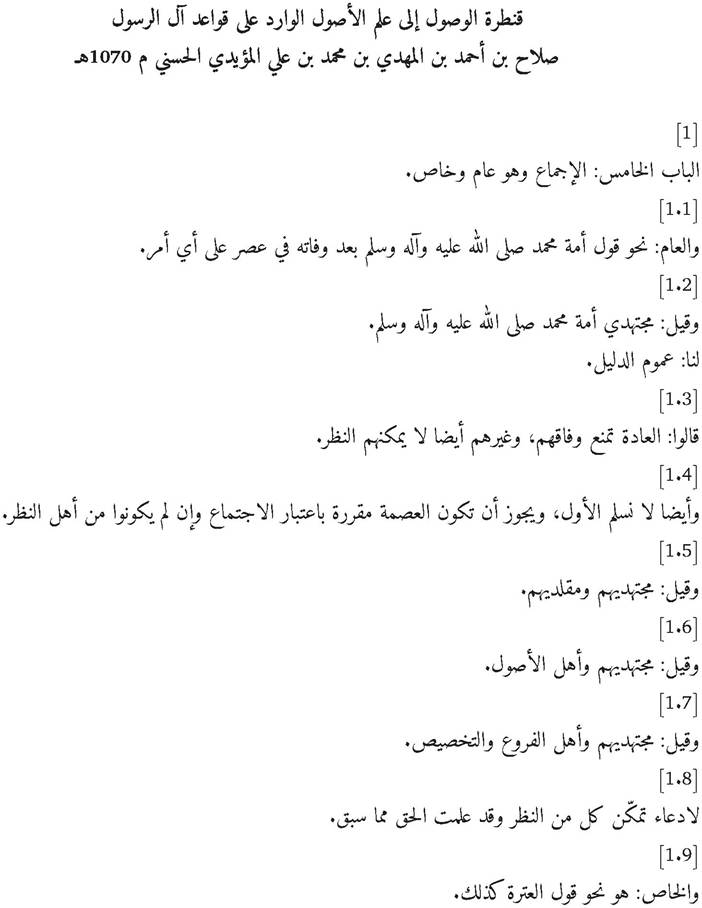
The fifth chapter is on consensus (al-bab al-khamis al-ijma'), and runs from folio 54a to folio 60a. It follows on from the chapter on kitab (the Qur’an and the hermeneutical devices for understanding it: 'amm-khass, muhkam-mutashabih, nasikh-mansukh etc.) and before the chapter on sunna (concerning actions and reports, including the isolated reports).
This order might appear unusual, as the usual order is kitab, sunna, ijma'; however, some classical Zaydi works of usul do place ijma' before sunna (as, for example, in al-Wazir’s al-Fusul al-lu’lu’iyya). The reasoning here is, presumably, that the consensus of the Prophet’s family (ijma' al-'itra) is such an important and powerful legal source for the Zaydis that it gets promoted, and the validity of sunna is somehow reliant on ijmac. As we shall see, this reordering does not prevent Mu’ayyadi citing many reports from the Prophet when arguing his positions on the issue of consensus.Consensus is, for Mu’ayyadi (as for most Zaydi writers), a valid source of law, but when discussed “generally” ('amm), it is restricted to the unanimous agreement of all mujtahids (and perhaps all members of the community, mujtahid or not). More significant for him (and for Zaydis more widely) is the consensus of the Family of the Prophet - by which he means, it becomes clear, the descendants of the Prophet (sayyid, pl. sada) who have reached the level of ijtihad. Since there are numerous Sayyid scholars who have attained this rank, the constituency is large but, it would seem, manageable. There is also much discussion about the consensus of the Companions (since this was a restriction that Zahiri scholars had famously placed on consensus). Mu’ayyadi refutes this restriction, but it does open up a discussion of the ability of the opinion of a Prophetic Companion to act as a proof (hujjiyyat qawl al-sahabi); this in turn leads to a set of arguments which explain why a regular qawl al-sahabi is not a proof, but the opinion of the Companion such as 'Ali b. Abi Talib is a proof. Whilst much of the discussion is quite derivative from Sunni usul discussions, there is a distinctive set of Zaydi concerns demonstrated.
The work as a whole (and this is exemplified in the chapter edited below) is highly abbreviated and referential in style. This goes beyond the usual expectation that a reader knows citations (from Qur’an or from the hadith of the Prophet, for which only the opening words are cited); the reader is also expected to be fully cognisant of parallel discussions in other (particularly Sunni) works of usul al-fiqh.
Phrases (and sometimes whole sentences) are lifted from various usul works, including commentaries on Ibn al-Hajib’s classic text of usul al-fiqh Mukhtasar al-muntaha l-suial/ Mukhtasar al-muntaha al-usuli (including the well-known commentary by 'Adud al-Din al-Iji, d. 756/1355), the Minhaj al-wusul of al-Baydawi (d. 685/1286) and al-Ihkam of Sayf al-Din al-Amidi (d. 631/1233). Phrases are also lifted from Zaydi works, including Sarim al-Din al-Wazir’s al- Fusul al-lu’lu’iyya. The result is a pastiche of usul sources which could not be understood on its own, but which requires a high level of inter-textual familiarity in the canon of usul al-fiqh before the work can be read and understood; we have tried to provide this background information in the commentary. For this reason, the commentary is much longer than the text itself; a straightforward “translation” of the text would be almost entirely incomprehensible given Mu’ayyadi’s referential style.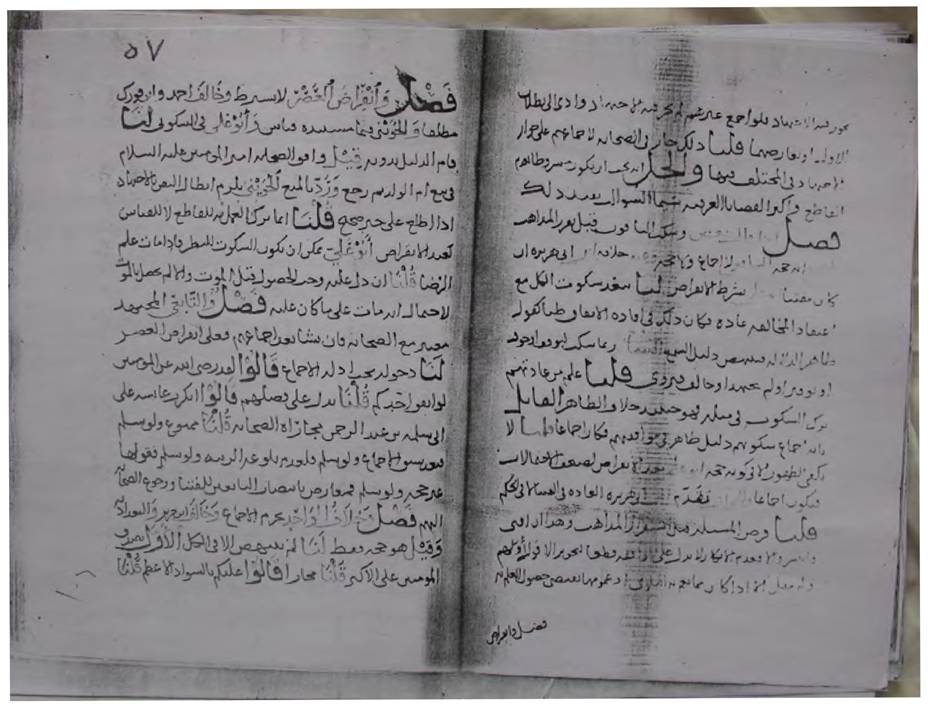
Figure 7.1 MS Imam Zaid Library, San'a’ (#622-03), fols. 56b-57a
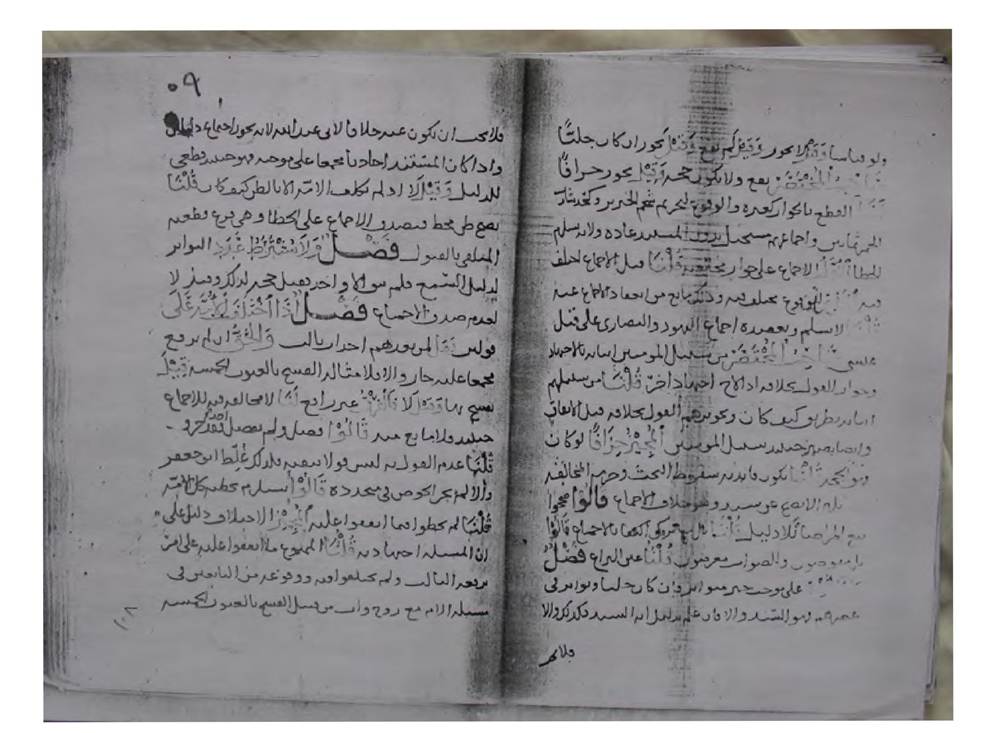
Figure 7.2 MS Imam Zaid Library, Sanca3 (#622-03), fols. 58b-59a