Summary
In the first section [1], Mu’ayyadi introduces the topic, by dividing consensus (ijmd') into two types: general [1.1] and specific [1.9]. The general refers to the agreement of the Muslim community (ummat Muhammad) on a specific ruling at a particular point of time on a particular matter [1.1].
There is some debate concerning whether this “general” consensus refers to the whole community, or the community’s learned scholars (that is, the mujtahids) [1.2]. Mu’ayyadi critiques the restriction of the constituency for ijmd' to the mujtahids; his reasoning here is given in the terse statement “according to us, the indicator is general” (land cumum al-dalil). By “indicator” here, he means that the indicator which establishes that ijmd' can be used as a proof: usually, this is traced to Prophetic statements such as the famous “my community shall never agree upon an error”, which Mu’ayyadi discusses later. By saying the indicator is “general”, he means that in these statements, words such as “community” refer to the whole community unless there is an indication that they have been “specified” to mean something other than this “general” meaning. He clearly does not consider there to be any such “specifying” indicator, so the word “community’ means everyone, and the alternative, restrictive opinion (viz. mujtahids only) is invalid.Other objections are posed [1.3]. First, “custom” (al-'dda, “the usual manner of events”) means the whole community could never, in reality, agree on any single thing - i.e. it is a practical (though not logical) impossibility. Second, not all members of the community have religious knowledge, training and insight (they do not all have nazar - “reflection”). Mu’ayyadi [1.4] does not accept the first point (and he gives reasons in section [2]); on the second point, he states that the inability to err (that is, the community’s 'isma) could be due to their agreement rather than any scholarly qualifications.
That is, it is possible that the coming together (ijtimd') creates the inerrancy (cisma), rather than the fact that the members of the ijmd' constituency are scholars. In this Mu’ayyadi is implicitly arguing that when the community (scholars and laypeople) agree on an issue, a religious truth (almost through a divine fiat) is created: the members’ individual qualities are irrelevant. In the section [1.5] through to [1.7], Mu’ayyadi lists other formulations of the “mujtahid only” argument he has just refuted. Opponents argue for the delimitation of the ijmd' constituency to “mujtahids and lesser scholars (muqallids)”, or “mujtahids and ahl al-usul”,9 or “mujtahids and experts in law and specific legal areas (al-juruc wa-l-takhsis)”. These delimitations are all based on the idea that certain sub-sections of the community are blessed with the requisite scholarly qualities (that is, they can exercise nazar). As he has already pointed out, Mu’ayyadi explains [1.8], the ability of the members of the ijmd' constituency to exercise nazar (tamakkun kull min al-nazar) is not necessarily an element of a valid consensus.Apart from arguments in section [1] concerning the ijmd' constituency, there have been scholars who argue against ijmd' in a more fundamental manner, rejecting its probative force (i.e. its ability to act as a hujja). In section [2], Mu’ayyadi tackles the arguments of those who deny ijmd' any role in legal derivation. The first argument against ijmd' [2.1] is a practical one: that the ijmd' constituency (whether it be the community as a whole or the mujtahids alone) is dispersed (in- tishdr), and the ruling on which they are supposed to agree could not be circulated amongst the group. Mu’ayyadi rejects this: if the ijmd' constituents take their job seriously (li-jaddihim wa-bahthihim), as they surely do, then the circulation should not be impossible. The second an- ti-ijmd' argument [2.2] is a rational one, and is both complex, and expressed in a highly compressed manner.
Ijmd' is (it is argued) agreement on a proposition: what is the epistemological status of this proposition in itself: is it (in itself) certain (qdti') or is it merely an opinion (zanni)?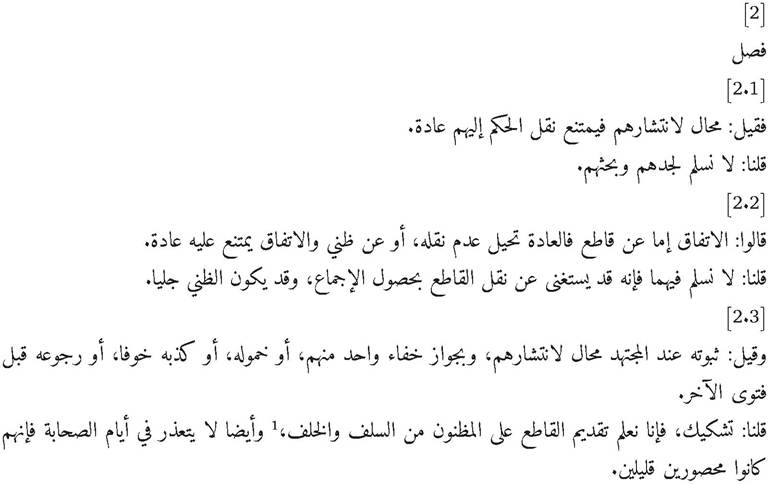
[1] The text is scrubbed in the MS. Another possible reading could be dl»jJI.
Mu’ayyadi gives no example of this, but it could be a mathematical proof. Say the whole community were to come to an ijma' that the maghrib prayer consists of 3 units; since everyone already knows this (i.e. it is qati'), ijma' adds nothing. The consensus is superfluous and therefore, epistemologically speaking, of no use. Mu’ayyadi responds that it is possible for ijma' to be achieved (husul al-ijma') on a proposition which is known with certainty, and therefore be epistemologically useful (and, he adds, labour-saving). Commentators on Ibn al-Hajib’s famous Mukhtasar al-muntaha (on which, see below) envisage the following scenario: a proposition is circulated, but without the demonstration that it is indubitably certain - that is, the proposition is circulated without its proofs (adilla). Such a proposition is, then, certain in itself, but not recognised as such by the community. Say the community then achieves ijma' upon that proposition; if ijma' has probative force, then by doing so, they raise the proposition to the level of “certain” through their agreement. In this instance, something that is certain in itself has become certain through ijma'. The circulation of the proofs now becomes unnecessary, because the proposition has achieved certainty through ijma'.10 Mu’ayyadi (following Ibn al-Hajib) is effectively arguing that ijma' may be achieved on a proposition without anyone knowing that it is already certain (qati'). In such cases, the ijma' saves the community the bother of transmitting the proof-based certainty of the proposition (naql al-qati'). Ijma' in such instances is not useless, but is a shortcut to certainty.
All of this complex argumentation is compressed into the phrases in [2.2]: al-'ada tuhd 'adam naqlhi... qadyustaghna 'an naql al-qati' bi-husul al-ijma', and to understand it, one really needs to already know the discussions in works such as Ibn al-Hajib’s Mukhtasar and its commentaries.There is another possibility: the proposition on which there is ijma' is not certain in itself, but is something less than certain (i.e. opinion-based or zanni). The opponent argues as follows: anything zanni is, customarily, something on which there can be numerous opinions; if this is the case, absolute agreement (ittifaq - i.e. an agreement from which no member of the ijma' constituency could demur) on a zanni proposition is impossible: a zanni proposition is, by definition, one on which there can, logically, be differing opinions. Mu’ayyadi counter-argues: a proposition could be technically zanni (that is, it is logically possible for one to doubt it), but so obvious (jali) that no one doubts it. An ijma' could be achieved on this “zanni jali” proposition; once you have proved the logical possibility of ijma' on a zanni, the opponent’s argument (based on logical impossibility) is defeated. Mu’ayyadi gives no example, of a zanni jali proposition - but a possible example might be taken from the wider usul al-fiqh literature. When God says one should not be rude to one’s parents,11 then, a fortiori, it is obvious (jali) that one should not also hit one’s parents. The conclusion is technically zanni (because the text does not forbid hitting one’s parents), but, it is argued, it is obvious (perhaps even undeniable) that hitting, being worse than swearing, is also forbidden by the Qur’anic verse. In [2.2], all this argumentation is compressed into the phrase: 'anzanniwa-l-ittifaqyamtani' 'alayhi 'adatan... wa-qadyakuna l-zannijaliyan. Once again, a familiarity with the wider usul tradition is crucial to understanding Mu’ayyadi’s argument here.
The opponents’ third argument [2.3] relates to ijma' of the mujtahids.
Such a consensus is, it is argued, impossible because the mujtahids are spread out, or one (or more) of them might be absent for some reason or other, or unknown, or he might be lying (out of fear - from the authorities perhaps), or he might change his mind before everyone has given their opinion (and thereby prevent agreement from happening). We encountered a similar argument in [2.1] in relation to the possibility of whole community agreement. Mu’ayyadi’s response in [2.3] is to highlight instances where this sort of mujtahid-based consensus has occurred.12 We know, for example, that all the early generations of Muslims (al-salaf wa-l-khalaf)13 agreed that a piece of information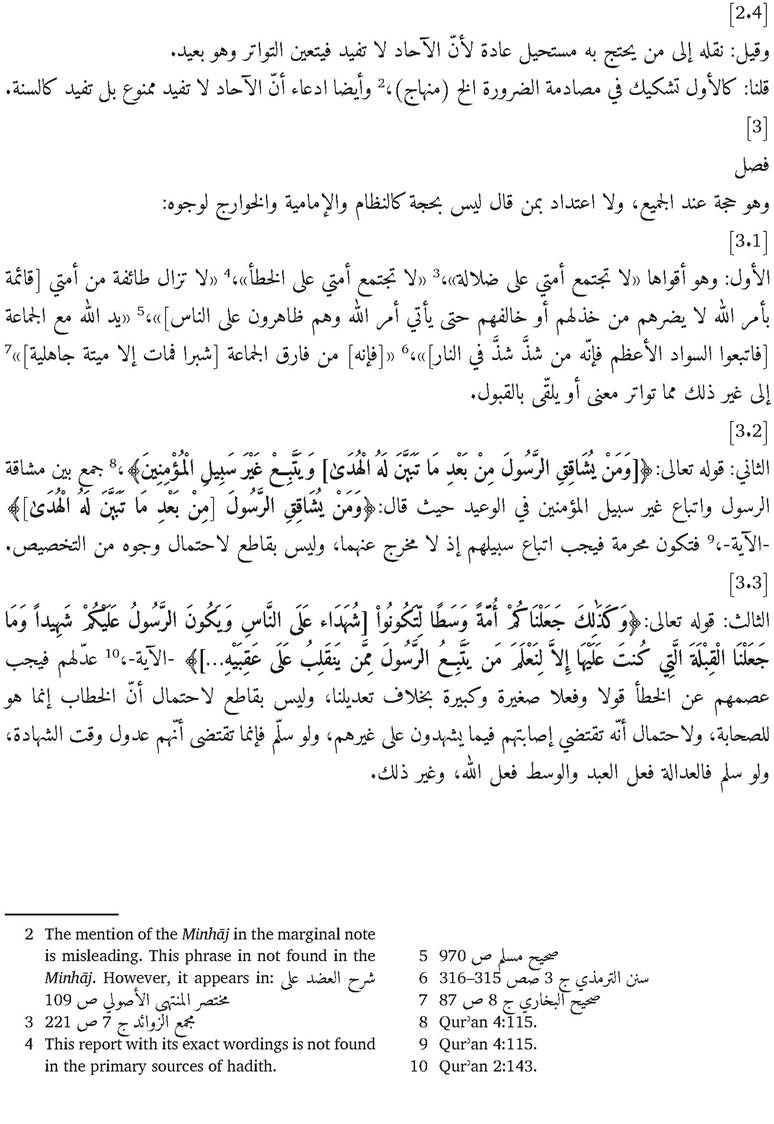
which is certain (gained from a reliable text, for example) will over-rule something based on personal opinion (maznun). Therefore, at least one past ijma' is known to have occurred, and when one instance is proved, the impossibility (muhal) is disproved. Furthermore, immediately after the Prophet’s death, it was perfectly possible to bring the Companions together, as they were of limited number - and in such an instance, the ijma' could be established. The argument around the impossibility of the mujtahids forming a consensus is rebutted, then, by counter examples.14 Finally, the opponents argue that ijma' cannot be transmitted to anyone in a later generation who might want to use it in their argumentation [2.4]. This is because any report of ijma' having occurred is extremely likely to be an isolated report (al-ahad). To be certain the ijma' had occurred, one would need a report which is transmitted through multiple sources (the process known as tawatur), and this is highly unlikely to be available (ba'id). Mu’ayyadi’s reply is first, that the reports of the Companions’ consensus (mentioned in [2.3]) are not isolated but transmitted through multiple chains (mutawatir), and thereby produce immediate necessary knowledge; once again the existence of a single counter example carries the weight of disproving the logical impossibility (mustahd).
Second, the claim that ahad reports are not useful is straightforwardly rejected by Mu’ayyadi. They are useful, and they are used all the time when arguing about the records of the model behaviour of the Prophet (al-sunna). The rebuttal argument is, then, that not only are multiply transmitted reports of tjmd' available, but even when they were not, the remaining isolated reports are still useful in legal argumentation.Section [3] is an exploration of the textual sources for the probative force of ijmac. This section consists of sources which Mu’ayyadi cites in support of ijma' [3.1]. Some of the sources are, for him, unpersuasive [3.2] and [3.3], and he does mention scriptural verses which the opponents of ijma' use to disprove its probative force [3.4]. The argumentation requires detailed unpacking, since the sources are cited in abbreviated form (indicating that the readership were already fully familiar with the verses and need no more than a couple of words to recall them). Mu’ayyadi begins by stating that the vast majority of Muslims accept ijma' as a legal proof and one should pay no attention to those who argue otherwise. Mu’ayyadi lists these opponents to ijmac: the Mu'tazili thinker Ibrahim al-Nazzam (d. 225/840), the Imamiyya and the Khawarij.15 The next three sections [3.1-3.3] examine the sources for ijma', and these are familiar from the wider usul tradition. [3.1] lists the strongest proofs of ijmdc’s probative force in Mu’ayyadi’s view: the reports from the Prophet. These include the famous “my community shall not agree upon an error”16, as well as a variant (e.g. “upon a mistake”)17. Also cited are the reports “there will always be a group within my community which is on the right [path]”,18 “the hand of God with the collective group”19 and “whoever breaks away from the collective group.dies a death outside of Islam - Jahiliyya.”20 There are others, Mu’ayyadi states, but he does not list them, and they are so well-attested that their combined meaning is either indubitable (tawatur ma'nawt), or their level of attestation is such that one must accept them as true and a source of knowledge. Sections [3.2], [3.3] and [3.4] refer to Qur’anic verses, and here Mu’ayyadi is less convinced. [3.2] introduces the verse “Whoever opposes the messenger. and follows a way other than that of the believers. we shall cast him into hell.”21 The crucial phrase here is “a way other than that of the believers” (wa-yattabic ghayr sabil al-mu’minin), which is supposed to mean “a way other than the believer’s ijma'”. Both the person who “opposes the messenger” and the person who refuses to follow the “way of the believers” are promised the same fate of eternal damnation. God, in this verse, makes it obligatory for all to follow the Prophet’s example (i.e. sunna) and the way of the believers (sabil al-mu’minin, i.e. ijma'). However, the verse, for Mu’ayyadi is not a knock-down
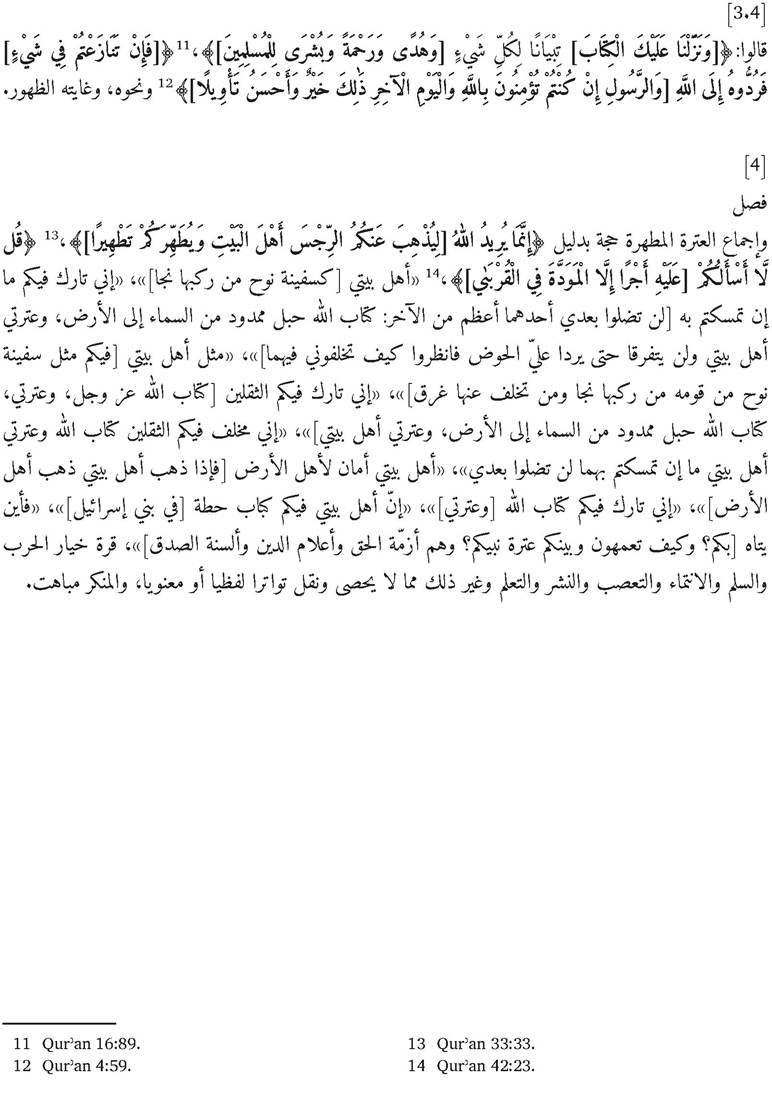
proof. It could be interpreted differently and more specifically, he says (without elaborating further). Also unconvincing for Mu’ayyadi is the much-cited verse: “We have made you a virtuous nation, so that you can be a witness to the people...” [3.3].22 God has said that the Muslims are virtuous, and because he has declared their moral probity; this must mean that when they agree in word or deed, they are immune from error. A divine declaration such as this differs from “our declarations of moral probity” (bikhilaf ta'dHina - for witnesses in a legal case, for example). There are interpretational issues here as well. First, the declaration may have been made specifically to the Companions (al-khitab innama huwa ila l-sahaba) and not to the community as a whole. Second, the verse’s phrase “so you can be a witness” could restrict the declaration of moral probity to the act of giving testimony, and not refer to all things. If this is so, then the Muslims are only “just” and “virtuous” for the purposes of giving testimony - not when they agree outside of this context. Finally, the moral probity of a witness is based on the individual’s actions; in this verse, though, the declaration that the community is “balanced” or “virtuous” (al-wasat) is clearly an act of God.23 Since the verse states that it is God who makes the community virtuous, and not the actions of the community, Mu’ayyadi implies there is an ambiguity in the verse, and ambiguous verses cannot act as definitive proofs (laysa bi-qati) since their interpretation is debated.
Those who argue against ijma' cite the verses “We sent down to you the Book as the clarification of all things”,24 and “if you disagree over anything, then refer it to God and his Prophet”25
[3.4]. There is no mention of ijma' in these verses, they argue; the community is required to refer to God for clarification (i.e. to his word in his Book) and to God and his Prophet in cases of disagreement. “If ijma' was a source of knowledge, then why is it not mentioned here?” the argument would go. For Mu’ayyadi (as for the authors of texts he is shadowing - the Mukhtasar al-muntaha, the Minhaj al-wusul and their commentaries), at the very most, these interpretations are merely the verses’ apparent meaning (ghayatuhu al-zuhur); there may, and most likely will, be additional, deeper meanings, and therefore the verses cannot be considered conclusive an- ti-ijma' proofs.
Section [4] introduces Mu’ayyadi’s thoughts on a central Zaydi doctrine: the probative force of the ijma' of the family of the Prophet. That is, the descendants of the Prophet come to an agreement on an opinion, that produces a proof. Unlike in similar Zaydi texts, Mu’ayyadi does not enter into a discussion around who counts as a member of the Prophet’s family, and whether the ijma' constituency includes all descendants or just those legally qualified (i.e. the mujtahids from the Prophet’s family). The lack of discussion here leads one to the tentative conclusion that he considers the ijma' constituency in the “consensus of the pure family” (ijma' al-citra al-mutah- hara) to be the whole family. The proofs for this position include a series of citations from the Qur’an and the corpus of Prophetic hadith. They are provided, in the same style as in previous sections, in highly abbreviated form (with just the first few words of each citation given); the assumption yet again is that the readers will know these references already, and there is no need to quote the entire verse or hadith. The references include the standard Qur’anic verses “O People of the House, God intends to keep you from defilement and purify you completely”26 and “I do not ask you [the Prophet] for any reward save honour for the kin”.27 “People of the House” and “kin” are understood to refer to the family and descendants of the Prophet. The hadith references include the famous report (cited in four variants): “I leave you two weighty matters (thaqalayn): the Book and my family”, as well as “I leave you the book and my family, if you cling to them, you shall not err”.28 Other reports cited (in two variants) include “My family is like
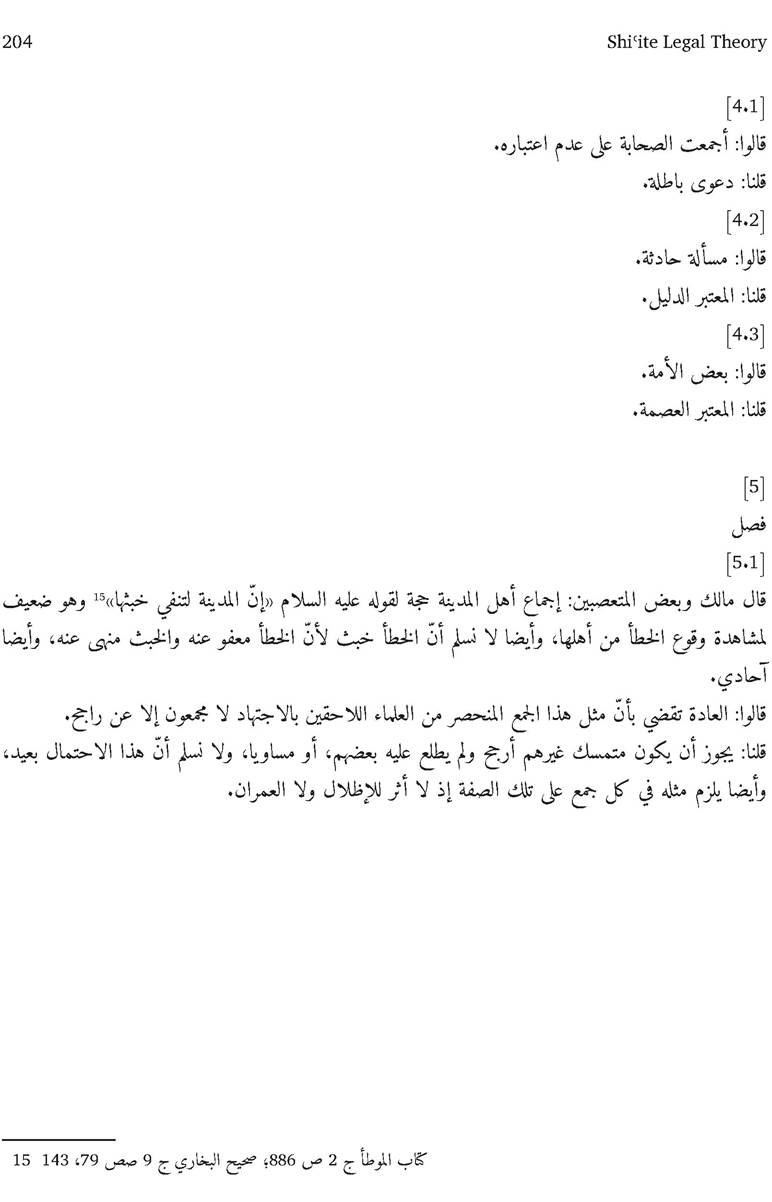
Noah’s ark - whoever sails in it is saved; others are drowned”,29 “My family is, for you, like the Hitta Gate for the People of Israel”,30 “My family provides security for the people of the Earth”.31 The list of citations ends with a quote from the sayings of 'Ali recorded in the Nahj al-baldgha: “Where are you being taken astray and how are you groping while you have among you the descendants of the Prophet? They are the reins of truth, signs of religion and tongues of truthfulness.”32 From these references, Mu’ayyadi concludes that the descendants of the Prophet are the epitome of excellence in all the skills associated with the Zaydi Imam (war, statecraft, lineage, scholarship and many other attributes known through well-attested sources). “The one who denies this is a slanderer” (al-munkir mubdhit), he says in conclusion.
Next there are a series of objections to the doctrine that the ijmd' of the Prophet’s family is a valid legal proof. These are expressed in highly abbreviated form in a “they say. we say.” (qdlu...qulna) format [4.1-4.3]. Each objection is summarily dismissed. If it is claimed that there is a companion-based ijmd' against this doctrine, this is, in Mu’ayyadi’s view, simply a weak claim [4.1]. There is no such evidence of a companion-based ijmd'.33 Opponents may claim that this doctrine is a new issue on which there has been a previous ijmd'; the reply is given that one should focus on the evidence, not on the existence (which, by implication, pre-empts any post-Prophetic ijmdc) [4.2]. There might be a claim that the Prophet’s family make up only part of community - and a partial consensus is not a valid ijmd' [4.3]. The reply is that the focus of the argument is establishing inerrancy - and Mu’ayyadi believes he has already demonstrated (through the citation of evidence) that the Prophet’s family enjoy this special quality of collective inerrancy.
In section [5], Mu’ayyadi deals with various claims for the probative force of the ijmd' of some, but not all of, of the community. He discusses the view of Malik (the ijmd' of the people of Medina is a proof), Abu Khazim (the ijmd' of the four “Rightly Guided” Caliphs is a proof) and an unnamed scholar (the ijmd' of the first two caliphs is a proof). He then discusses whether the opinions of the Companions, as a group and as individuals, can be used as a legal proof - and he concludes it cannot, except for the special case of the opinion of 'Ali b. Abi Talib. True to his Shi'i persuasion, 'Ali’s opinion is considered a proof, on account of a raft of scriptural proofs, which overlap sometimes with the evidence he adduces for the probative force of the ijmd' of the Prophet’s family more generally.
Malik’s opinion that the ijmd' of the people of Medina is a proof is based on a Prophetic saying that “Medina removes its wickedness or sins, like the blacksmith’s furnace”.34 [5.1] Mu’ayyadi responds first, that this is weak - though it is not clear if it is the argument that is weak, or the report. The argument may be weak because it does not accord with reality - people from Medina make mistakes (i.e. they are not sinless).35 Further rebuttal arguments are adduced. First, Malik’s argument relies on “wickedness” (khabath) meaning the same as “mistake” (khatd1); this is unconvincing because the latter is excusable, whilst the former is absolutely prohibited. Second, this report is an isolated report (dhddt), and therefore a limited probative value. A response from Malik and his followers is entertained: customarily, when a limited group of scholars, like the mujtahids of Medina, agree on something it should be on account of an overwhelming indicator, so their ijmd' has probative force on this basis. Mu’ayyadi’s reply is that the same could be said of another group of scholars - or even, that they have a stronger (or equally strong) indicator as the basis for their collective opinion. The scholars in Medina could have no information about this other, stronger, indicator. “We do not accept that this potential scenario is unlikely” (Id nus- allim anna hddhd l-ihtimdl ba'id). Finally, this argument does not discount every group of scholars
having this characteristic (i.e. when they agree on something it must be on account of an overwhelming indicator), and the fact that they resided in the same city (or they shared the same city) where the Prophet lived sometime in the past does not make them special.
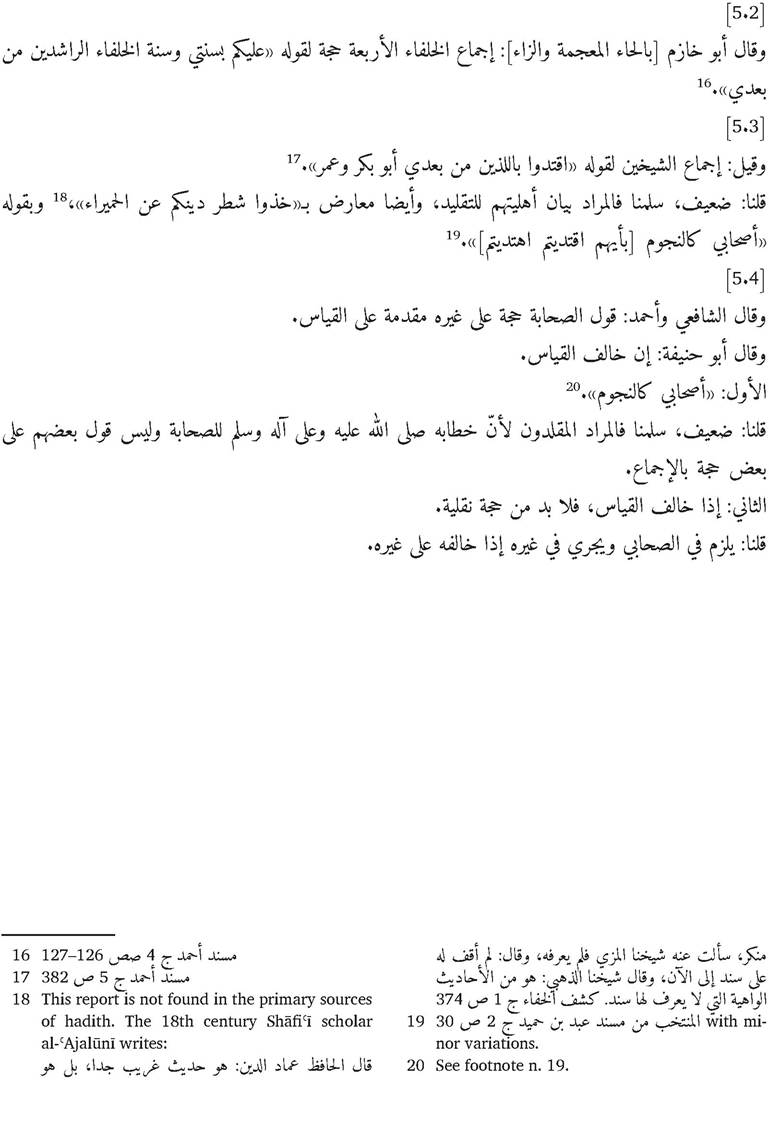
In [5.2] and [5.3], Mu’ayyadi discusses the views that restrict ijma' to a limited number of the Prophet’s Companions, in particular those who are considered the “Rightly-Guided Caliphs” by the Sunnis. In [5.2], the view of 'Abd al-Hamid b. 'Abd al-'Aziz known as Abu Khazim (d. 292/905, the Hanafi judge) is laid out. He argued for the probative force of the ijmd' of the four rightly guided caliphs on the basis of the Prophetic saying, “You must follow my sunna and the sunna of the Rightly-Guided Caliphs after me”.36 There is also an unattributed view (qil) that one should follow the ijmd' of the first two caliphs: Abu Bakr and 'Umar. Both of these views are based on weak reports, Mu’ayyadi argues.37 However, even if we were to accept them they prove nothing more than it is permitted to follow the caliphs (be it two or four - bayan ahliyyatihim lil- taqlid), not that they form some type of ijmac. Even then, the reports contract other well-known reports such as the report “My Companions are stars, follow any of them”,38 and the Prophet’s statement regarding 'A’isha, “take half your religion from the Humayra’ [i.e. 'A’isha].”39 Of course, a Zaydi jurist such as Mu’ayyadi is unlikely to be himself convinced by these reports (one of which he has possibly already indicated is weak), but he is arguing (following the texts he is shadowing) against the opponent on the opponent’s own premises.
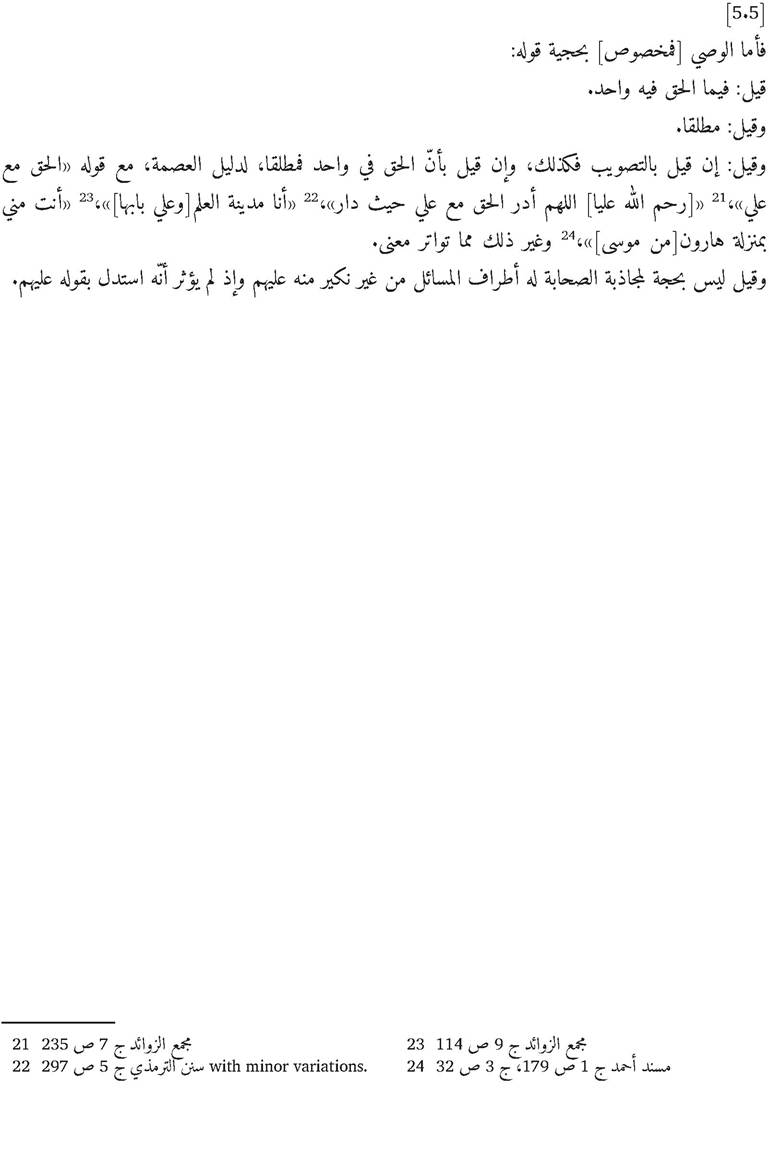
In [5.4], Mu’ayyadi shifts his focus from legal status of the ijmd' of the early generations to the legal status of their individual opinions. Discussions of the probative force of “the opinion of a Companion” (qawl al-sahabi) comes later in many works of usul, and not in the section on ijmac. Mu'ayyadi, in doing this, is following a traditional Zaydi precedent. Some other usul traditions consider the probative force of a Companion’s opinion in the section discussing other legal sources beyond the standard four (such as “juristic preference” - istihsan, and “general benefits” - al- masalih al-mursala).40 Many Zaydis include such a discussion within the chapter on ijmac. This appears to be a consequence of their argument against the doctrines of some Sunni scholars that the ijmd' of the four caliphs, or of the first two caliphs, is a valid legal proof. In order to reject these doctrines, the Zaydis argue that there is no reason to prefer their opinions over those of another Companion. Of course, the response then would be to query why the opinion of 'Ali b. Abi Talib is a proof for the Zaydis. This leads on to a specific justification of 'Ali’s opinion to the exclusion of the other Companions. This is the logic for the presentation of discussion around qawl al-sahabi in the ijmd' section in Zaydi usul works, and Mu’ayyadi conforms to this model:
[5.4] discusses (and rejects) qawl al-sahabi; in [5.5] he discusses (and strongly affirms) the opinion of 'Ali.
In [5.4], the opinions of other schools are entertained. Al-Shafi'i (d. 204/820) and Ahmad (d. 241/855) are credited with the opinion that the qawl al-sahabi is legally binding on subsequent scholars (and the community) and takes precedence over the results of their analogical reasoning (qiyas). The argument here is that the Companion, when he proffers an opinion, could actually be recounting the Prophet’s opinion - which is a primary source of law and takes precedence over qiyas. Elsewhere in the usul tradition, the argument is made that if this qiyas is later found to agree with that qawl al-sahabi, the qiyas-based opinion become a supporting piece of evidence that the qawl al-sahabi is in fact a record of the Prophet’s opinion. In these circumstances, qiyas confirms that the qawl al-sahabi is, in fact, based on a scriptural source (i.e. kitab and sunna). Abu Hanifa is credited with the opposite opinion: the qawl al-sahabi is a proof only if it disagrees with a qiyas-based opinion. This view is based on the presumption that the Companions sometimes
related Prophetic opinions and practice which have been lost - hence, sometimes the opinion has survived as a Companion’s position, but it is in fact a Companion relating a Prophetic ruling. Qiyas-based opinions, on the other hand, are only considered when there is no evidence of a scriptural rule (be it from the Qur’an or the Prophet); the Companions themselves used qiyas in order to reach rulings when there was no scriptural ruling. How might one explain those occasions when a Companion’s opinion diverges from an opinion based on qiyas? For Abu Hanifa, therefore, a qawl al-sahabi based on a lost Prophetic ruling should take precedence over a qiyas when these two disagree. If the qawl al-sahabi is based on qiyas, then his analogical reasoning is equal to that of later scholars, since they are all mujtahids, and there would be no reason to give the Companion’s qiyas precedence to ours. This nuance, Abu Hanifa’s opinion implies, is missing in al-Shafi'i/Ahmad’s view.
Mu’ayyadi explores the evidence for these two opinions and ultimately rejects both. For the opinion of al-Shafi'i and Ahmad, the main proof is the Prophetic saying, “my Companions are like stars...”.41 This was used as proof of the ijma' of the Companions also, and for Mu’ayyadi it is a weak report. However, he says, even if the report was accepted, then the most it could actually demonstrate is that they are worthy of being followed as a group - al-murad al-muqalladun as the text says. The Prophet is addressing the Companions, and it has been agreed (i.e. there is an ijma.) that one Companion’s opinion cannot be given preference over another’s. Therefore, the most this weak report could mean is that, as a group, the Companions can be followed. Abu Hanifa’s supposed opinion is summed up “if [the qawl al-sahabi] opposes qiyas, then there must have been a transmitted proof” (a hujja naqliyya - which has been left unrecorded, and which supports the Companion’s view). Mu’ayyadi’s response is that if this is true for a Companion, then it could also be true of anyone else: the generations following the Companions could be basing their opinions on lost pieces of evidence when their opinions conflict with qiyas. Having access to lost Prophetic opinions is not exclusive to the Companions. Abu Hanifa’s argument does not protect the qawl al-sahabi at all, but instead dilutes its authority, as, logically, the proof must be extended to the opinions of those who lived in the generations after the Prophet but might have access to Prophetic opinions not recorded elsewhere.
If the opinions of the Companions are not, in themselves, counted as proofs, then what of the opinion of 'Ali? In section [5.5] Mu’ayyadi explores this issue. For Shi'i jurists generally - including Zaydi jurists - 'Ali’s position as a legal authority is a defining feature of the tradition. Therefore, for Zaydis, it would seem that one Companion’s opinion (i.e. that of 'Ali) must be counted as a proof. One view is that 'Ali’s opinion is authoritative on issues on which the scriptural texts are unclear and ijtihad is necessary: on such issues there may be differing opinions, but there is only one true opinion (fima al-haqq fihi wahid). This view would seem to restrict 'Ali’s opinion to ijtihadi matters.
Some Zaydis (and Shi'is more broadly), though, may feel this is a condition placed on 'Ali’s opinion having probative force and therefore lean towards a second view: 'Ali’s opinion has probative force unconditionally (mutlaqan, i.e. whether the matter is open to ijtihdd or not).
Mu’ayyadi discusses a third opinion in relation to the ijtihdd of the Companions. Given that the Companions are all considered mujtahids; if one of them gave an opinion which is not based on a scriptural ruling, then it must have come from their personal ijtihad. In ijtihad theory, there is a dispute over whether, when the opinions of the mujtahids diverge, whether the various opinions of mujtahids can all be considered correct (kull mujtahid musib - the position known as taswib), or “the truth is with one of them” (al-haqq fi l-wahid). If one holds to the taswib doctrine,
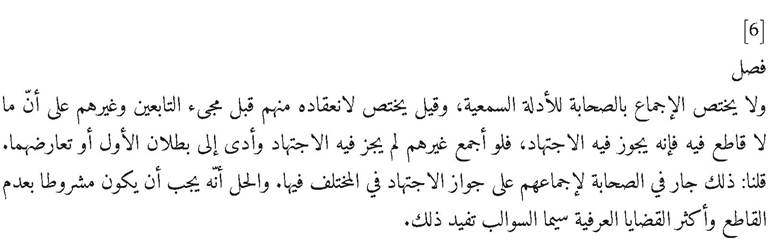
then 'Ali’s opinion cannot have probative force if he was acting as a mujtahid, because for such a person, all mujtahids’ opinions are equally correct. To hold the taswib doctrine and to remain within the Shi'i doctrine of privileging 'Ali’s doctrine, then one must believe that 'Ali’s opinion is not restricted to matters of ijtihdd (i.e. he is not a mujtahid among many mujtahids). His legal authority must be unconditional. If, on the other hand, one does not believe in taswib, and instead considers only one mujtahid’s opinion correct (and in the case of 'Ali and the Companions, the correct opinion is always 'Ali’s) then this also cannot be because of his ijtihdd. Ijtihdd by definition is the personal, and fallible, efforts of the jurist: to say 'Ali’s ijtihdd is always correct is, in effect to say that he is free from error ('isma), and hence he is correct without conditions (mutlaqan). Mu’ayyadi references four Prophetic reports as evidence that 'Ali is free of error (he cites them in abbreviated form giving the first few words of each report expecting the reader to know the rest of the report by heart - al-haqq ma'a Ali'l2...alldhum adir al-haqq ma' 'Ali43...and madinat al-'ilm44...anta minni bi-manzilat Hdruri'5...). All of these are widely transmitted and prove that 'Ali has the quality of being free of error, just like the Prophet himself. Therefore, he cannot be thought of as a mujtahid like the other Companions.
Finally, there is the opinion that 'Ali’s view is not a proof above those of the other opinions (i.e. the view of the non-Shi'is). This is because the other Companions used to discuss legal issues with him, and he did not condemn them for their views, and he did not try and disprove their views. That is, they were all mujtahids who accepted each others’ opinions as valid. 'Ali’s opinion is, then, nothing special under such a perspective.
Section [6] is a discussion around the nature of the issue on which the Companions form a consensus. Mu’ayyadi is, here, employing arguments from the wider (mainly Shafi'i) usul tradition without explicitly referencing them, and hence to understand this passage, an excursus is necessary. Some scholars argue that there can only be a consensus on “scriptural indicators” (al-adilla al-sam'iyya) and can only be valid when the participants are Companions of the Prophet (ijmd' al-sahdbd). The Zahiri school is specifically mentioned in Shafi'i usul texts as holding this view, though Mu’ayyadi introduces their argument simply by the phrase “it is said...” (qil). Those who hold this view (it is claimed) put forward an argument for their position which, they claim, demonstrates the illogicality of the mainstream view (namely that consensus can happen in any generation and can be on any issue for which ijtihdd is permitted). The Companions formed a consensus that ijtihdd is permitted on legal issues for which there is no definitive and certain indicator (md ld qdti' jihi). Say the Successor generation or another group (al-tdbi'in wa-ghayrihim) form a subsequent consensus on a particular legal norm for something the Companions considered an ijtihddi matter. When this later consensus is formed, the issue ceases to be an issue “on which there is no definitive and certain indicator” (ijmd' is, supposedly, such a definitive indicator). Ijtihdd is now not permitted on this legal topic. Now, so the arguments goes, either the second consensus invalidates the first consensus (butldn al-awwal) or the two consensuses contradict each other (ta'drudihimd). That is, the Companions say ijtihdd is permitted on the issue whilst the Successors say it is not permitted. This, it is implied, means that allowing the consensus of subsequent generations to be a proof makes the consensus of earlier generations (particularly that of the highly respected and authoritative Companions) invalid. Therefore (it is implied but not explicitly stated), consensus can only be a valid proof when it occurs on issues which are non-ijtihddi (i.e. “scriptural indicators”, al-adilla al-sam'iyya) and amongst the Companions. Mu’ayyadi’s refutation of this argument in section [6] (i.e. the passage following qulnd) is that this is true of the Companions themselves. They could agree that an issue was ijtihddi and there-
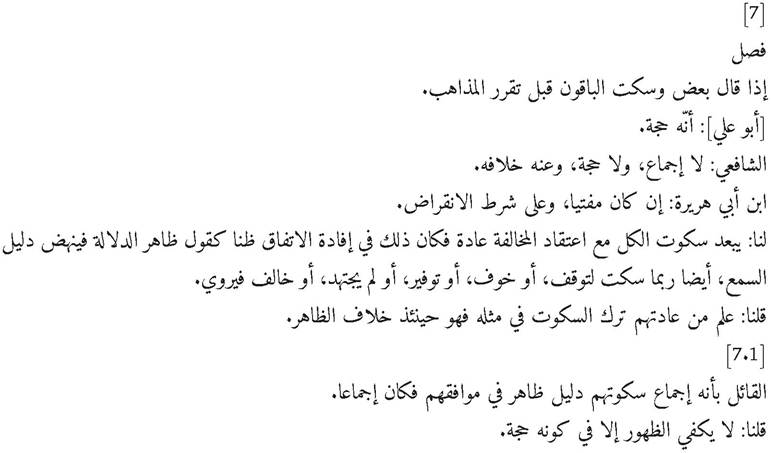
fore subject to different opinions (al-mukhtalaf fiha), and then come to a consensus on a legal norm for that issue. The issue is not between generations, he argues, but is in the nature of having issues which are disputed, and then a subsequent agreement emerging. The solution is to say that one of the conditions of ijmdc’s validity is that there is no definitive or certain indicator for that issue (mashrutan bi-‘adam al-qdtif This reasoning follows most everyday statements as well (al-qaddyd aPwfiyya), particularly negative ones (al-sawdlib): a statement’s validity can be dependent on the maintenance of some aspect of its assertion. The wider usul tradition gives an example46 (which is not given by Mu’ayyadi but is cited in the texts he is echoing): the statement “there is no sign of wakefulness in him” (when applied to someone sleeping) is a negative statement. It does not explicitly indicate that there will never be any “sign of wakefulness in him”; it is true as long as he is sleeping. Similarly, the validity of the negative statement “there is no definitive indicator for this matter” at one point in time does not establish its permanent validity. Its continued validity is dependent on the continued non-appearance of a definitive indicator. The mistake opponents (who in other texts are identified as the Zahiris) are making is thinking that a consensus on a statement (particularly on a negative statement) must be unconditional: consensus on a statement (by the Companions or any other generation of scholars) can - like everyday assertions - be dependent for its validity on the continued existence of a particular state of affairs. Validity need not imply a permanent, unconditional state.
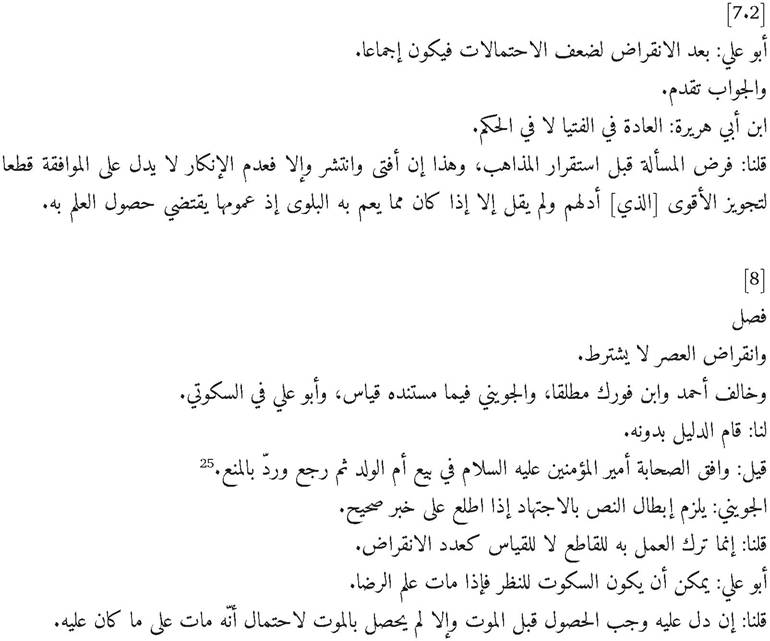
Section [7] deals with the disputed topic of ijmd‘ sukuti (“tacit consensus”) - that is, if a scholar declares a legal norm and the rest of the (scholarly) community is silent and raises no objection, is this, in effect, a consensus? Mu’ayyadi is most concerned with the period before the establishment of the legal schools (so, the period of the Companions and Successors’ generations); once the schools are established, an acceptance of legal variation is built into the system. Three views are entertained:
1) Some (Abu 'Ali al-Jubba’i, d. 303/915) argue that the silent ijmdc is a legal proof (hujja);
2) others (al-Shafi'i) argue that it does not count as an ijmd‘ and it is not a proof (ld ijmd‘ wald hujja - characteristically, the opposite view is also transmitted from Shafi'i - i.e. that it is an ijmd‘ and it is a hujja);
3) Abu 'Ali b. Abi Hurayra (d. 345/956), the early Shafi'i scholar, allowed it to be a legal proof on two conditions: (i) the person making the statement must be acting as a mufti, and (ii) there needs to be a gap in time after the declaration (bi-shart al-inqirdd) and before the ijmd‘ can be confirmed.
The crucial distinction which Mu’ayyadi draws (and which can also be found in the wider usul tradition) is between ijmd‘ sukuti being a form of ijmd‘, and it being a legal proof (hujja). He wishes to argue that tacit consensus is a proof, but it does not establish with certainty that an ijma‘ has occurred. The dispute is, then, around how strong an indicator a tacit consensus might be. There are those who argue that it is so strong that it almost establishes a consensus. The evidence for this is that it is extremely unlikely (yabud) that the pre-madhhab scholars would, as a matter of custom (‘ddatan) disagree with a fellow scholar’s statement but remain silent. However, it could be argued that their silence was due to a number of extraneous factors: the scholar might have not arrived at a specific conclusion (tawaqquf), his fear prompted him to stay silent (khawf), or he simply relied on other scholars (tawfir); he may not have performed his own personal ijtihdd yet, or he may disagree but intends to transmit his opinion separately. But, Mu’ayyadi concurs, they would not keep silent - the apparent conclusion (zdhtr) one can draw from their silence is that they concur with their fellow scholar’s declared legal norm. Whilst some think of this “ap-
25 348 10 ^jspecial status is brushed aside: they simply indicate that they were honourable and worthy (without denouncing Successors’ special status). The counter example that 'A’isha disapproved of Abu Salama’s tussles with Companions51 is refuted by a barrage of counter arguments: his opinion came after ijma‘ had been established; Abu Salama had not yet reached the level of ijtihad; 'A’isha’s opinion is not a proof in any case; and finally, if one were to accept this, it would contradict the fact that the Successors used to give fatwas, and the Companions used to consult them.
Section [10] covers discussions around whether or not consensus has to be absolute. For Mu’ayyadi, if a single person in the ijma‘ constituency disagrees, then ijma‘ cannot occur. Baghdadi scholars and Ibn Jarir (al-Tabari, d. 310/923) disagree. Yet others say that whilst a near- but-not total agreement creates a legal proof (hujja) it is not consensus proper. For Mu’ayyadi, for ijma‘ to be taken into account it must be total. The roots of this stipulation, one suspects, are in the Shi'i insistence that the supposed majority view concerning the first caliphate (i.e. Abu Bakr taken over 'Ali) has no legal validity in itself. He dismisses various arguments in favour of following the majority. The saying that “the term ‘believers’ can be truthfully applied to the majority” is a case of non-literal usage (majaz). Elsewhere in the usul tradition, this is highlighted as a case of overwhelming majority (istighraq), which cannot act as a proof for an element of ijma‘ theory. The saying of the Prophet “you should follow the greatest majority” (‘alaykum bi-l-sawad al-a‘zam)52 is also cited. Mu’ayyadi, again following the Minhaj,53 argues that this hadith actually indicates that total agreement is required. If one thinks that the phrase al-sawad al-a‘zam can mean a simple majority, then this would mean one can ignore the opinions of a third of the community. Clearly, Mu’ayyadi (following the Minhaj)54 thinks this is a weak argument. A further argument (10.2) is that it is unlikely that, when indicators of a legal norm conflict, the preference should go to the most popular opinion. Mu’ayyadi’s answer is that one shouldn’t consider it unlikely that the minority opinion is the truth - truth can be assessed by the individuals who transmit it, not by the number of such individuals.
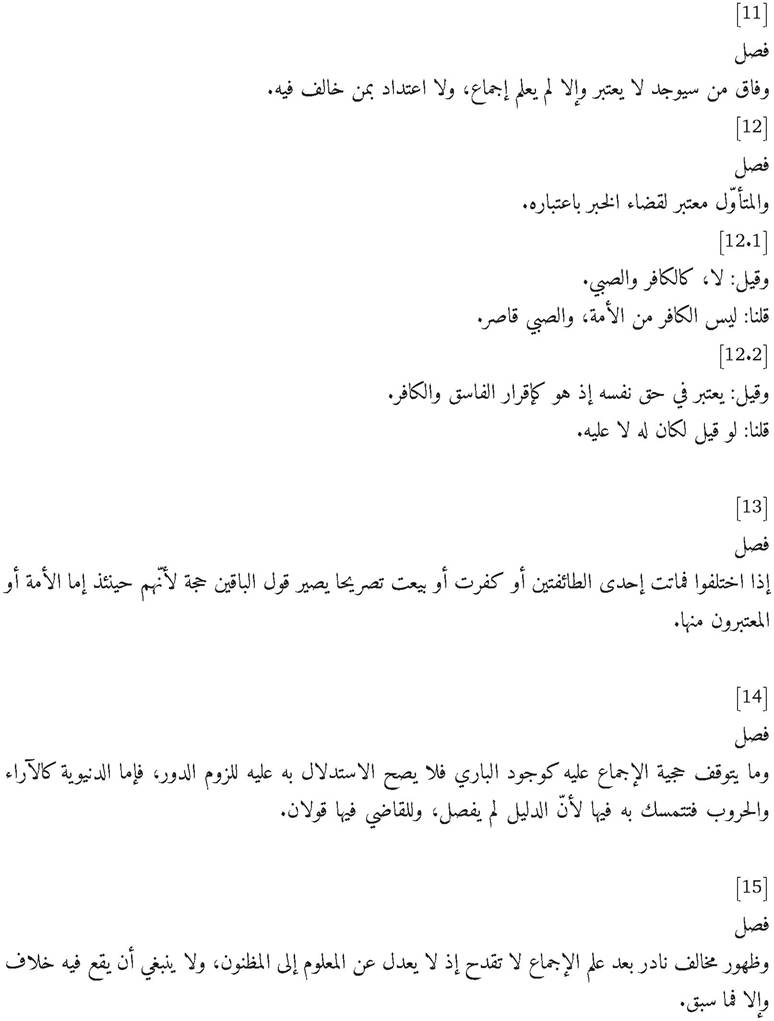
In section [11], Mu’ayyadi makes the simple point that the consensus cannot include those scholars who are yet to be born, for if that were so, consensus could never be reached, and there would be no means of determining who disagrees with a legal norm.
Section [12] discusses whether the individual who has a deviant belief (i.e. a muta’awwil - but not so deviant that he ceases to be a Muslim). Mu’ayyadi considers such individuals to be included in the ijma' constituency, on the basis that if the muta’awwil gives an account of an event, his word would be taken into account; so therefore his opinion in terms of the matters under consideration for consensus should also be taken into account. Opponents might say he should not be included, just as we do not include children and unbelievers in the ijma' constituency. Mu’ayyadi’s reply is that he is neither an unbeliever (and outside the community) nor he is a child (who is not yet legally responsible), so these rules should not apply to him (i.e. the analogy is unsound). The final counter argument involves the concession that, just as the confession of a miscreant or an unbeliever are accepted, so the statement of a deviant regarding his own situation (f haqq nafsihi) can be accepted - but not, it appears, on matters of general importance. Mu’ayyadi’s reply is that such a position would actually support his inclusion, not exclude him - presumably because, on the matter of whether he is a Muslim (and hence to be included in the ijma' constituency), his word (presumably saying that he is a Muslim) should be accepted; and once this is accepted, his view is to be counted in the consensus on other matters as well. Mu’ayyadi’s opinion (i.e. that the muta’awwil should be part of the mujmi'in) reflects, perhaps, his Shi'i perspective - to exclude individuals on the basis of theological variation is likely to mean Shi'i scholars being excluded from the consensus.
Section [13] entertains the hypothetical situation where the community disagrees on an issue splitting into two camps. If the members of one camp all die, or fall into unbelief, or give allegiance to someone who is not a legitimate leader (i.e. outside of the Ahl al-bayt), then the members of the other group become the ijma' constituency on their own, and therefore an ijma' is immediately formed.
For the arguments of consensus to be valid, certain truths must be established - such as the existence of God. One cannot “prove” that God exists by ijma' because that would be lead to circularity (luzum al-dawr). If ijma' relies on the existence of God for its validity, one cannot establish the existence of God via ijma' (section [14]). Trivial worldly matters (al-dunyawiyya), such as battle tactics, are available for ijma', because the proof for ijma' does not exclude them. This appears to be Mu’ayyadi’s opinion, though he is not explicit. He does mention that al-Qadi ('Abd al-Jabbar, d. 415/1025) had two opinions (i.e. that ijma' can be applied to these worldly matters; and that it cannot). Elsewhere in the usul tradition, those who say they are subject to ijma' argue that the texts are general in terms of reference, applying to all items where it is logically possible; those who argue against say that the Prophet himself excluded such things with his saying “you know more about the affairs of your world (than me)”55 - meaning that such matters can change by situation and therefore no certain, invariable rule could be established by ijma'.
Furthermore, an occasional subsequent random opinion, after an ijma' has been established, does not invalidate the previous ijma' (section [15]); it does not make it any less powerful as an indicator (“it does not turn it from something known (al-ma'lum) to something presumed (al- maznun)”), and it does not mean that the past ijma' is suddenly cast into doubt.
If the community agrees that the true opinion is limited to one of two opinions, can it, at some later time, agree that one of those opinion is the true one? The question here is whether the later
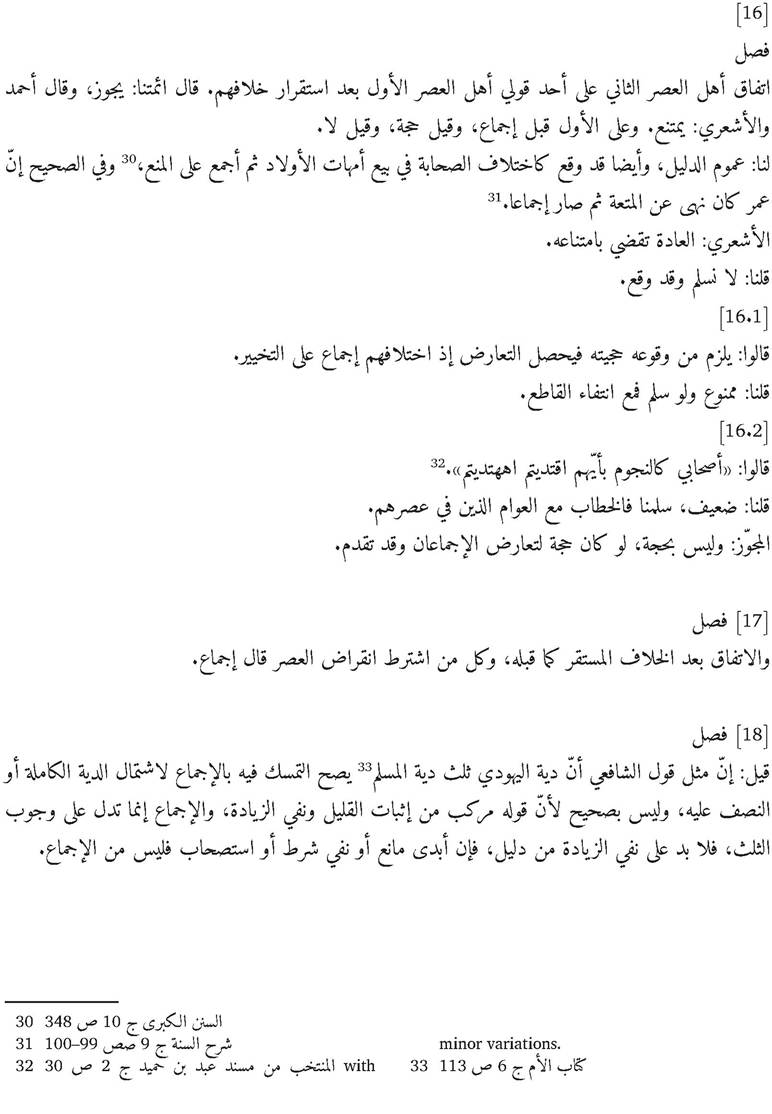
ijmac on one opinion would, in effect, be breaking the earlier ijmac that there were two acceptable opinions (section [16]). Mu’ayyadi and the other Zaydi scholars (a’immatuna) consider this quite possible; others (Ibn Hanbal and al-Ash'ari, d. 324/936) prohibit it. Those who consider it permitted for the later community to agree on one of the opinions, there are those who say it is only a lesser proof (qil hujja), and there are those who do not even consider it a hujja. Mu’ayyadi’s arguments for his own opinion are that the proofs for ijma' do not preclude this - they are general and include it; and he points out that it has, in fact happened in the history of Islam. The Companions differed over the sale of the slave who bears the master’s child; and then they agreed;56 similarly, 'Umar forbade temporary marriage (mut'a)57 whilst others allowed it - but it became an ijma' that it was forbidden. Al-Ash'ari supposedly had the opinion that custom dictates that it is impossible, but Mu’ayyadi refutes this. The objection goes: “if it happened, then it must have probative force”, and if that is the case, then it contradicts the earlier consensus that, on the issue under investigation, choice between the various opinions was permitted (al-takhyir) (section [16.1]). Mu’ayyadi rejects this too - because the earlier ijma' implied that there would be choice as long as there is no definitive proof of one option or the other. When that definitive proof comes (in the form of an ijma' on one of the options), then the matter is settled without contradiction. If the Companions agreed that there could be a choice between two options in a particular question, and there was a later consensus on one of those options, then this later consensus must be more than simply a proof (hujja), Mu’ayyadi argues: it must be a definitive statement (qati'). The reasoning here is that the Companions’ agreement on choice (takhyir) means that each of the two opinions has an indicator which is non-definitive (i.e. the two proofs are merely a hujja). If the later consensus on one of those opinions is also classed as a non-definitive proof (i.e. is also a hujja), then one is facing a conflict between the two ijma's, and this cannot be (section [16.2]); rather, Mu’ayyadi argues, the earlier consensus was for the people at the time of the Companions, and the later consensus is a definitive statement (qati').
If the matter is as a-Mu’ayyadi argues, then anyone who argues that the epoch must pass before an ijma' can be claimed, will also agree that a later agreement on one of two opinions will form an ijma' only when that later epoch has passed. He provides no reasoning for this view, but it would seem uncontroversial (section [17]).
Someone had argued, perhaps as a clever aside, that al-Shafi'i’s opinion that the compensatory payment (diya) for a Jew is one third of that for a Muslim58 was based on ijma' (section [18]). The argument was that the two opinions common before al-Shafi'i (namely that the diya of a Jew is either equivalent to that of a Muslim, or it is half that of a Muslim) had formed an ijma'. The consensus was that holders of both opinions agreed that one third was valid - what they differed over was the amount above one third of a Muslim’s diya which should be set. Hence, al-Shafi'i’s opinion of one third is something they would both agree on, and therefore his opinion is supported by ijma'. The rebuttal of this argument is not too difficult. Al-Shafi'i’s opinion is made up of two elements, Mu’ayyadi states: first there is the opinion that one third is the minimum diya; and second the opinion that the diya is not more than one third (nafy al-ziyada). Whilst there may be ijma' on the first (namely, the fact that one third is contained within a whole and within a half), the second element (the view that it is not more than one third) needs a consensus. Even if there was some form of an indicator to say the diya of a Jew is not more than one third, this would never be based on ijma', but rather on some other type of indicator. Mu’ayyadi concludes, then, that Shafi'i’s opinion is not based on ijma', and to claim that it is, is invalid.
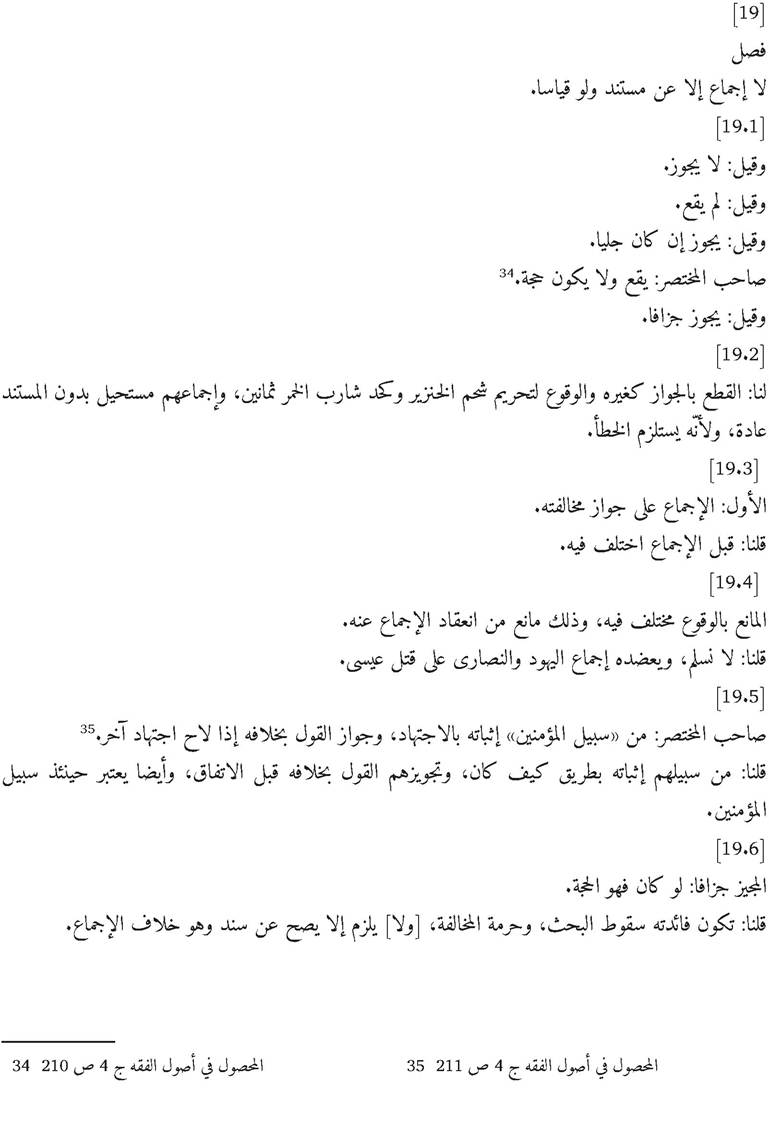
What sort of proposition can there be consensus about? Section [19] is the beginning of Mu’ayyadi’s discussion of this issue. First, he discusses whether the consensus must be upon a proposition supported by a recognised source (mustanad). His own position is that any valid consensus must be based on a source, and even analogical reasoning can be a source (wa-law qi- yasan). There is debate, though, on whether a consensus can be formed on a proposition derived through qiyas (the positions are mentioned one by one in section [19.1]). Some say it is not possible for such a consensus to emerge (presumably since qiyas is by its nature a subjective judgement, and hence one could not form agreement on something so subjective). Some say it has never happened (so it is not an issue). Some say it is possible but only on an analogy which is “obvious” (jali) and indisputable. The “author of the Mukhtasar” (the fourth/tenth century traditionist from Khurasan, Muhammad b. Muhammad b. Ahmad b. Ishaq al-Hakim al-Kabir, d. 378/988) argues agreement can occur, but, for him, consensus on a proposition derived from analogical reasoning does not constitute a proof (hujja).59 Finally there are those who argue that the scholars could agree haphazardly (jizafan) upon something which has no underpinning recognised source. Mu’ayyadi’s position is that not only is it possible for consensus to occur on a proposition agreed through qiyas, it has actually happened. He gives examples of when it has happened (eating pig fat; the punishment for the wine-drinker). In both cases, there is a legally valid basis for the opinion (mustanad) on which there has been agreement, and it is impossible, on the basis of custom, for agreement to happen without this legally valid basis.
Mu’ayyadi then entertains a series of potential objections. Say there is a consensus that it is allowed to contradict an earlier qiyas-based consensus [19.3]. This, Mu’ayyadi argues, would effectively be arguing that the earlier agreement was an error; this constitutes an internal contradiction - since you cannot say that the earlier consensus was an error (and thereby demonstrate that ijma' is fallible) and then prove this by appeal to (fallible) ijma'. Say, there is another objection: the dispute over whether consensus on the basis of an analogical reasoning has ever happened means there is no way an ijma' on analogical reasoning can be treated as a reliable source [19.4]. Here, Mu’ayyadi does not accept the premise: there are instances of it happening in the past. The classic example is that the Jews and the Christians agreed, on an analogical basis, that the Jesus was killed - so it can happen. The reason their agreement can be questioned by a later agreement is because, unlike the ijma' of the Muslims, their ijma' is not immune from error. Another objection is raised by al-Hakim al-Kabir (“Sahib al-Mukhtasar”): The Qur’an stipulates that one should follow “the way of the believers” (sabil al-mu’minin)60 [19.5].61 This is understood to be a useful proof for ijma' (since what the community agrees upon is sabil al-mu’mimn). Now, their first conclusion - based on qiyas - was reached through the personal juristic reasoning (ijti- had) of each member of the ijma' constituency; anything which was discovered through ijtihdd is subject to disagreement on the basis of another ytthad. Therefore, agreement on any qiyas-based conclusion is both an ijma' and it is subject to disagreement. This, for him, disqualifies ijma' on a proposition based on qiyas as a proof. Mu’ayyadi’s response is that sabil al-mu’minin means “whatever way they use to prove a proposition upon which they subsequently form a consensus”. They express disagreement before the agreement occurs, and when there is agreement, the sabil al-mu’minin is taken into account then. The opinion is mentioned that if a consensus happens occasionally or randomly (jizafan), it creates a non-definitive proof (hujja), and not a definitive one [19.6]. Mu’ayyadi responds to this position by arguing that this so-called non-definitive proof will end all debate and make it prohibited for anyone to oppose it - and this can only happen if it is validated by a source; anything else would make it less than a proper consensus. The
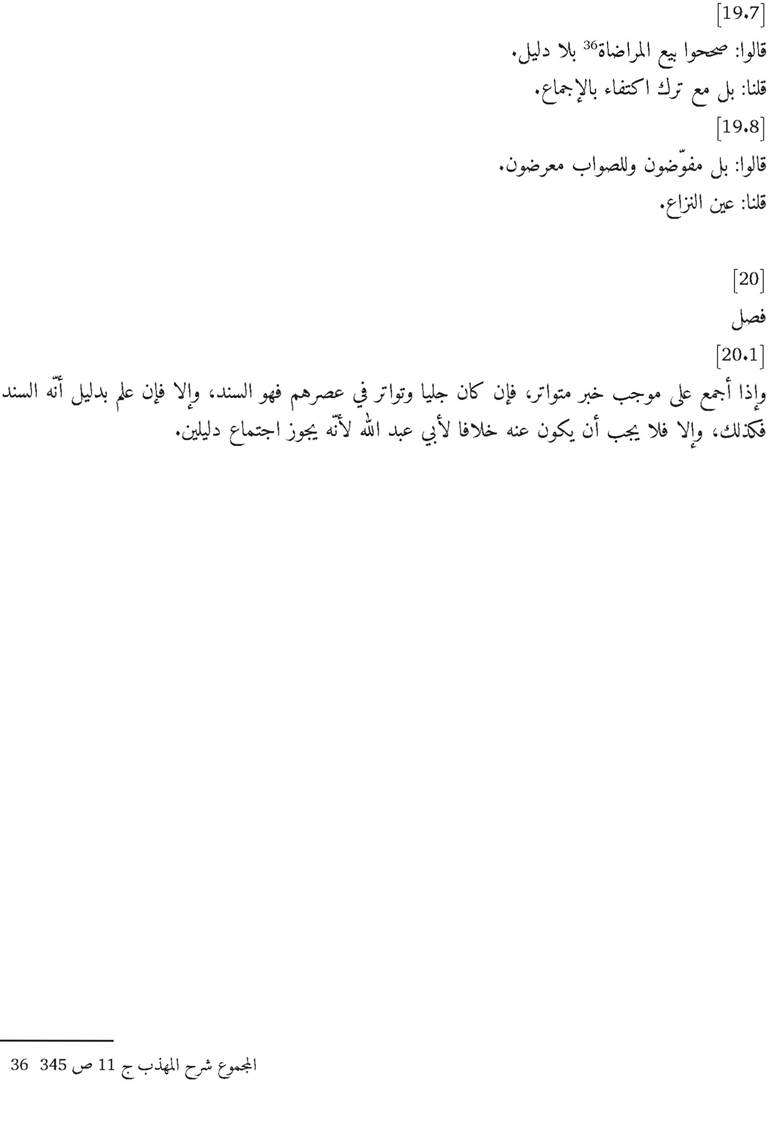
opponents bring an example: it was agreed that any transaction in which both the parties consented was deemed valid (bay' al-murada),62 even though there is no specific indicator that this is permitted [19.7]. That is, this is a consensus with no underpinning recognised source, but it is counted as a consensus nonetheless. Therefore, it is possible to have an ijma' without a recognised source (contra Mu’ayyadi). Mu’ayyadi replies that actually, the ijma' is not sufficient in and of itself in this example (tark iktifa1 bi-l-ijma'); there must be an underpinning recognised source. Elsewhere in the usul tradition, the argument is made that the fact that no recognised source is mentioned (like an indicator, dald) does not mean there is no indicator. It simply means the transmitters have neglected to include the recognised source when transmitting the ijma'. Finally, the opponents argue that there might be a haphazard agreement on something without any reference to a recognised source [19.8]. The members of the ijma' community are delegated (mufawwadun) by God to make their judgements; they could all do that without reference to a recognised source, and come to the same conclusion; and since all mujtahids are correct (according to Zaydi doctrine), and they all are seeking the right opinion (wa-lil-sawab mu'ridun). This, Mu’ayyadi points out, is precisely why any consensus must be based on a recognised source. This is the nub of the dispute ('ayn al-niza'), for unless one stipulates that ijma' must be based on a recognised source or method of deriving rulings, one opens the door to the possibility of unfounded agreements by the scholars.
When the scholars agree upon something but the recognised source of their consensus is unmentioned, this presents a particular problem; one needs to know that they agreed not only upon a legal norm but also that this agreement was not haphazard - i.e. it was upon a recognised source (mustanad). Section [20] deals with such instances. Say the ijma'-constituency agree upon the legal norm set out in a report which has been transmitted by multiple reliable chains of transmission (mutawatir; 20.1). If it is obvious that this is the case, and it reached this high level of transmission (such that it brings certainty as to its contents), then the report itself is the recognised source of the consensus. But, say they agreed upon a legal norm, and that legal norm is contained in the mutawatir report, but the report itself was not the basis for their agreement (it was some other indicator). This could have happened, for example, if the report was not known to be mutawatir when the earlier generation came to their agreement; their agreement was reached on the basis of another (unrecorded) indicator. In these circumstances, can it still be said that it is known that their consensus was based on a legally recognised source? Mu’ayyadi says it can, because it is known that, had they known of this mutawatir report, it would have been the basis of their consensus (illa fa-in 'ulima bi-daldin annahu l-sanad, fa-kadhalika). The fact that their consensus was on some other basis which is not recorded (and hence cannot be articulated), and that a proper legally recognised source is known (separate from their agreement) means that their consensus is confirmed as being on a legally recognised source, even if it is not the one. This opinion is against that of Abu 'Abdallah (al-Basri, d. 369/980, a Hanafi Mu'tazili jurist), who clearly believed that the earlier ijma' must encompass both the legal norm and the legally recognised source for that norm. For Mu’ayyadi, though, there can be two equally strong indicators of a legal norm (ijtima' al-daldayn), and therefore the earlier ijma' could have been on one indicator (which was left unrecorded), and, for later jurists, it could be on another known indicator (in this case, a khabar mutawatir).
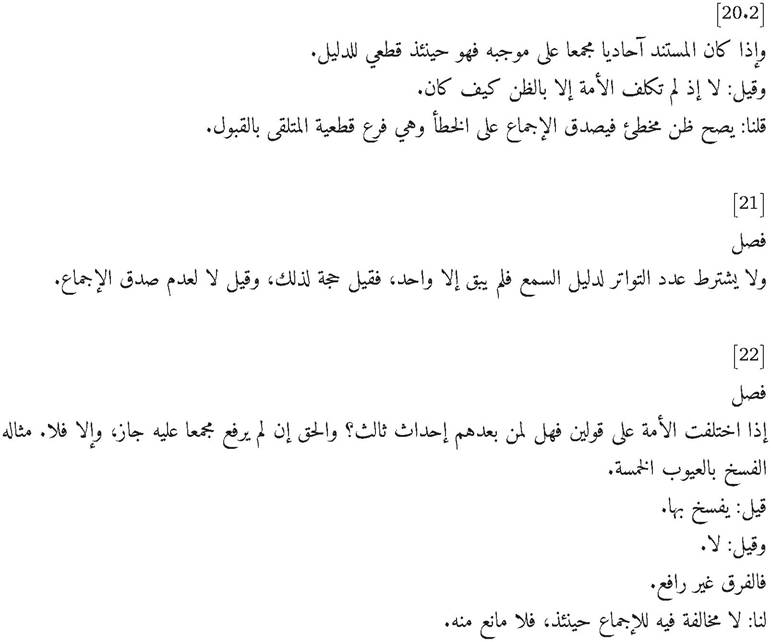
Say the ijmac constituency agreed upon a legal norm, but did not mention a legally recognised basis; it could have been on the basis of qiyas, or the apparent meaning of a Qur’anic text, but it was left unmentioned (20.2). Then, say, a non-mutawatir report is found (i.e. a khabar al-wahid - or, as expressed by Mu’ayyadi, ahadi reports) which confirms this legal norm. Can it still be said that their consensus has a legally recognised source and that that report is no longer zanni but qat'i? For Mu’ayyadi, one can still say this: the fact that there has been consensus on a legal norm, and that same legal norm is expressed in a less-than-certain report means one can be certain that the consensus was on a legally recognised source and the consensus now makes that report certain (fa-huwa hina’idhin qat'i lil-dalil). There are those indicators about which one cannot be certain; but this is not so important, because (they argue) the community can validly follow uncertain indicators (lam tukallaf al-umma illa bi-l-zann kayf kana). Mu’ayyadi sticks to his position though. If one allows the report to remain less-than-certain (zanni) after there has been a consensus on the legal norm contained within it, then one is admitting that the report may be mistaken (yasihh zann mukhti'), and therefore the consensus may be on a mistaken legal norm (fa-yasduq al-ijma' 'ala l-khata’). Ijma' produces a type of certainty which is wholeheartedly accepted - it cannot be one which has any possibility of error.
How many people have to be members of the ijma' constituency? Usually, membership of the constituency is restricted to mujtahids, so the question concerns whether, if the total number of mujtahids in the community falls below a certain number, then an ijma' which binds future generations cannot be formed. Section [21] discusses this issue, and following discussions in al- Baydawi’s Minhaj,63 Mu’ayyadi argues that there is no minimum number. Some have entertained that the minimum number should be the number which confirms a report as “widely-attested” (tawatur); but Mu’ayyadi says there is no stipulation that it should be so (la yushtaratu 'adad al-tawatur); ijma' is a proof based on scripture (dalil al-sam'), so there is no need to turn to other types of (reason-based) proofs. Some say that if there is only one mujtahid, then that person’s opinion, though, is a hujja; other say the opinion of a single mujtahid cannot be classified as consensus ('adam sidq al-ijma).
Section [22] discusses a well-known issue in works of usul: if the community agrees, at one point in time, that there are two possible and acceptable answers to a particular legal problem, does this agreement imply that no one in the future can devise a third answer (or a fourth, or a fifth etc). The issue is known as the permissibility of “the introduction of a third opinion” (ihdath qawl thalith, abbreviated to ihdath thalith in Mu’ayyadi’s text). Mu’ayyadi considers the third opinion permissible providing it does not entirely negate one of the positions which was agreed upon earlier. For example, there are five well-known reasons for the annulment of a marriage after it has been contracted: the so-called “five defects” (al-'ayub al-khamsa). According to one opinion, if a wife discovers that her new husband is insane, or has leprosy, or has elephantiasis, or is impotent, or has been castrated, then the marriage can be annulled. According to another opinion, none of these has the power to annul a marriage. Later, a third opinion emerged, which was that there is a distinction to be made here (al-farq): some of these can annul a marriage and others cannot. This third opinion does not go against (or “nullify”, raf') anything that the earlier two opinions agreed upon: it is a wholly distinct new opinion. If, for example, the earlier generation had stipulated that these two opinions were acceptable and that one could not pick and choose between the defects (an “all or nothing” approach), then the third opinion would be a “breaking” of the earlier consensus. So, Mu’ayyadi’s position is that a third opinion can emerge providing there is nothing in it which contradicts something upon which there has already been
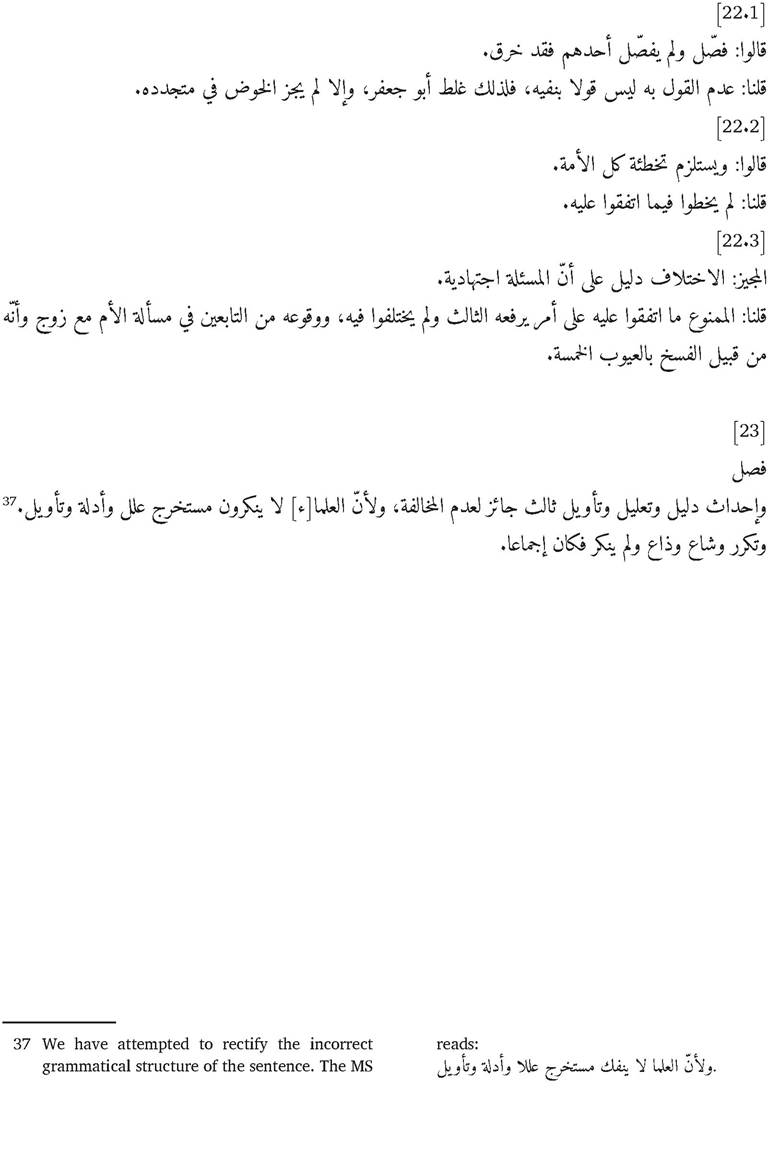
agreed upon. The objectors reply that in this example the third opinion is distinguishing between the various defects, whilst the earlier opinions did not distinguish between them and treated them as a single block; so there is a breaking of an earlier consensus here (fassala, wa-lam yufassil ahaduhum fa-qad kharaqa). The answer (section [22.1] - qulnd) is that that the earlier generation did not explicitly state that one should not distinguish between the defects, and the lack of an explicit statement concerning distinguishing between the defects does not mean that they wished to affirm that they should, in fact, be considered a single block. If we were to assume that silence means affirmation in such circumstances, all debate within the law would be severely curtailed (“it would not be permitted to delve into any new [answer to an existing issue]”, lam yajuz al- khawd fi mutajaddidihi). The second objection is that permitting a third opinion to emerge is, effectively, saying that the community, when it agreed on the two positions previously was in error (takhti’at al-umma) (section [22.2]). Mu’ayyadi’s response is that they were not in error when they agreed on something, but they did not agree, in the example just cited, that the defects had to be treated as single block. Next there is the view from those who permit the emergence of a third opinion, but are not concerned about the new opinion contradicting something agreed upon by the earlier generation [22.3]. The fact that they disagreed is, in this opinion, an indicator that the issue is one open to ijtihdd (individual juristic interpretation - al-ikhtildf dalil 'ald anna l-mas’ala ijtihddiyya). Mu’ayyadi’s response is that the question is not necessarily one of pure ijtihdd - there might be elements they agreed upon, and elements they did not agree upon. Finally, Mu’ayyadi mentions another case where a valid third opinion did emerge. The issue of the mother’s inheritance, when her deceased child has a living spouse. The Companions agreed on two possible positions: either the inheritance is one third of the original sum, or it is one third of what remains after the spouse’s portion has been subtracted. A third opinion emerged in which the third is taken from the original sum in the case of a woman dying with a husband; and the third was taken from the remainder in the case of a man dying with a wife. In the literature this opinion is attributed to the successor Ibn Sirin (i.e. one of the tdbi'in, d. 110/728), and the example is sometimes used to support the view of those who permit unfettered ijtihdd for future opin- ions.64 Mu’ayyadi though simply views this instance as of the same type with the “five defects” example (wa-annahu min qabil al-faskh bi-l-'uyub al-khamsa): a third opinion can emerge providing it does not nullify any element of the question upon which the previous generation had explicitly agreed.
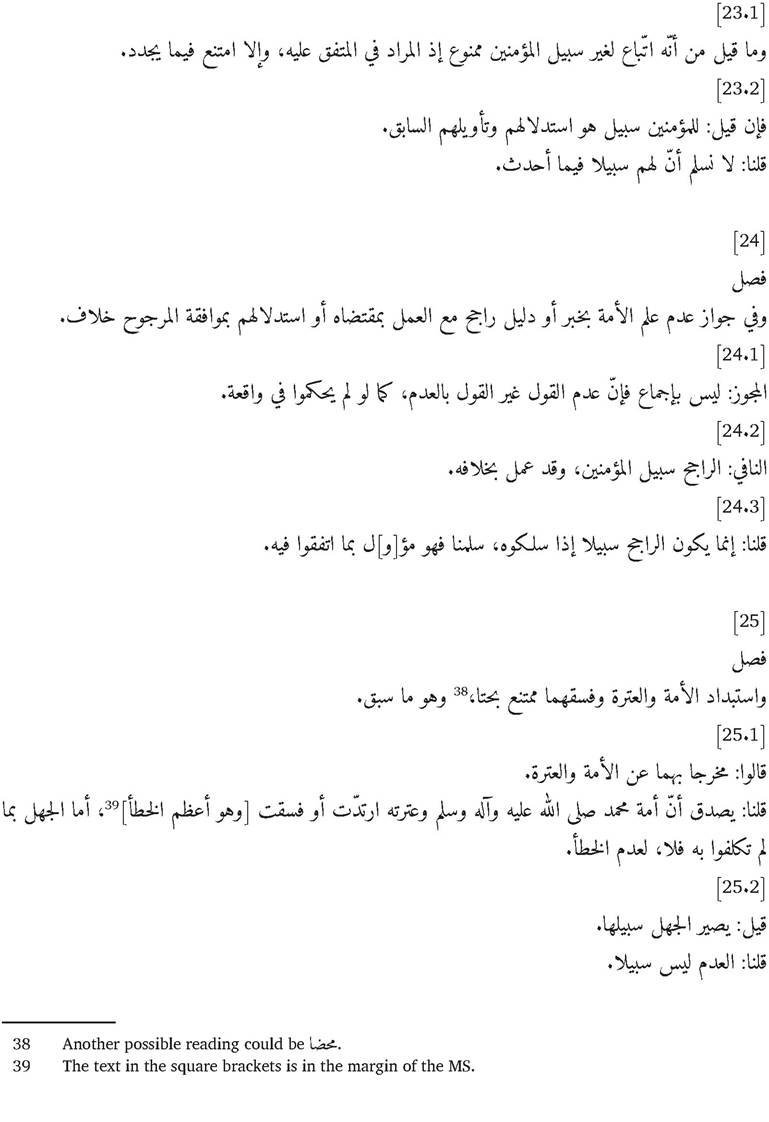
In addition to the debate around whether a third opinion can emerge (which Mu’ayyadi argues it can under certain restrictions), there is also a debate about whether a third piece of legal reasoning can emerge for a position established by consensus [23]. For example, if the ijmd' constituency agrees on a position, and supports that position with two authoritative indicators (or items of evidence), can a subsequent generation bring forth a new piece of evidence for the position? or is the community not only locked into the position, but also locked into the legal reasoning which establishes that position? Mu’ayyadi argues that they are not restricted in this way - the item could be a new indicator (dalil), or a new piece of analogical reasoning (ta'lH) or a new interpretation of a scriptural text (ta’wil). The scholars are continuously involved in deducing new analogies, indications and interpretations. They do this repetitively and their ideas are distributed around the community, and when no one disagrees, then one has a consensus (wa-lam yunkar fa-kdna ijmd'an). The objection to this consists of a reference to the Qur’anic verse, where the audience is warned not to follow “a way other than that of the believers” (wa-yattbic ghayr sabil al-mu’minin).65 We have already seen this verse used in the justification of ijmd', and it is
clear it becomes a pivotal focus in a number of ijmd‘-related arguments. So the argument goes
[23.1], the way of the believers consisted of the ruling and the reasoning for that ruling; coming up with a new piece of legal reasoning is to depart from the way of the believers, as established when the tjmd‘ came about. This argumentation is rejected; ijmd concerns the ruling, and the legal reasoning for that ruling is not included unless explicitly mentioned as such. If future generations were restricted in this way, then there would be a bar on investigating all new evidence (wa-illd imtana'a ftmd yujaddad). Anyone who argues that the “way” (sabil) of the believers in the past generations was their legal reasoning (istidldluhum) is rebuffed by the argument that their “way” cannot be extended to matters which come to light after the ijmdc.
[24] It is possible that the community did not know about a report, or a proof of a greater strength (rdjih) than the one that they had been using; their behaviour was in accordance with this unknown evidence, but their reasoning was on a weaker indicator (marjuh). Mu’ayyadi does accept that there is some dispute (khildf) here. There are those (sing. al-mujawwiz) who say that it is possible for the community to be unaware of an indicator which is stronger than the one they are using - arguing that just because they do not mention the indicator does not mean they had necessarily rejected it [24.1]. On the other hand, those (sing. al-ndfi) [24.2] who dispute that the “way of the believers” is always the strongest and most preferred indicator (rdjih); by adopting a new argument or indicator, the later generation is departing from that “way”. Mu’ayyadi’s position [24.3] is that it is permitted to discover a new indicator for an agreed position; it is only when the past generation has definitively followed a legal argument can we say that it forms part of their “way”. When this is the case, this is a necessary interpretive offshoot of what they have already agreed upon. Here Mu’ayyadi’s view mirrors his position in the “third opinion” (qawl thdlith) argument: it is permitted for this third position (or piece of evidence) to emerge later and it does not break the previous ijmd‘, provided the previous generation did not laydown and agree upon any exclusionary clauses or elements to their ijmdc.
In section [25], Mu’ayyadi returns to the wider issue of whether the community as a whole, or the Prophet’s family (al-ltra) as a whole can act tyrannously or in contravention of the law (istibddd al-umma wa-l-ltra wa-fisquhum). His view is that it is impossible for this to be the case, and he refers the reader back to his earlier discussion. An opponent makes the argument that they have behaved in this way in the past [25.1]. Mu’ayyadi responds that it is possible that they have acted in this way, but it might have been through ignorance, and those who make mistakes out of ignorance are not excluded from either the community or the Prophet’s family. The opponent responds [25.2] that, in that case, ignorance become the recommended course of action of the Prophet’s family or the community as a whole (yasir al-jahl sabilahd) - and that cannot be correct. Al-Muayyadi’s response [25.3] is that when they do not know something, this does not constitute a “way” which they are recommending for general adoption (al-‘adam laysa sabila- hum). Furthermore, it is possible for the ijmd community (the umma or the ‘itra) to split into two groups [25.3], and each group be sometimes correct and sometimes incorrect. The argument is not that the ijmd‘ constituency will always agree, but rather that when it does agree, an inerrancy (‘isma) comes about.
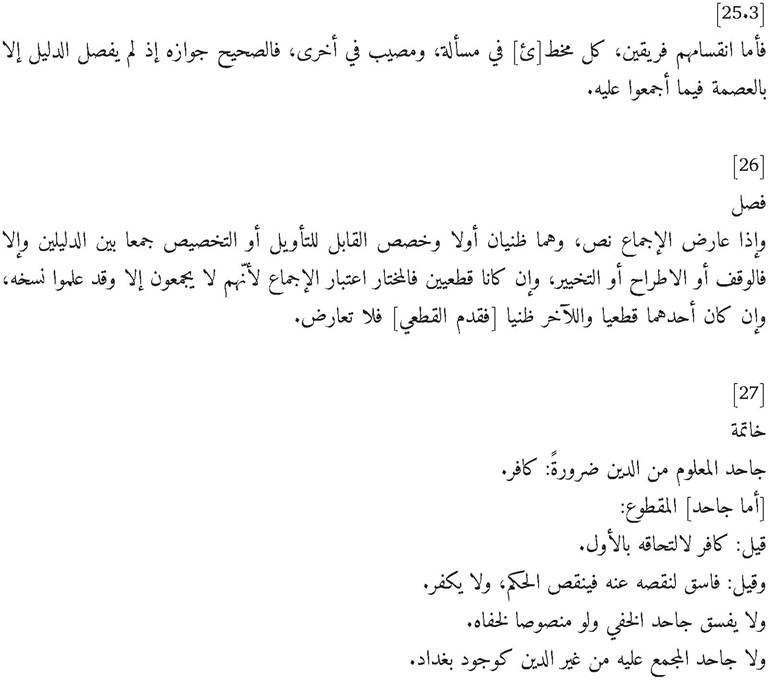
What should one do if the issue on which there is consensus contradicts a text? In section [26], Mu’ayyadi tackles this by classifying the contradictions on the basis of the epistemological status of the consensus and the text. If both are considered less than certain (zanniyan), and one of them is seen as an interpretation or a particularisation of the other (al-qabil lil-ta’wil aw al-takhsis), then they should be combined (jamf However, if this is not possible, then one should suspend judgment (waqf) or reject (al-ittirah) or chose between them (al-takhyir). He does not indicate here how one might select the correct course of action; usually in works of usül that is covered in a special section on “contradiction between indicators” (ta'arud al-adilla). If, on the other hand, both texts are considered epistemologically indubitable (qat'iyayn), then the preferred option is to choose the norm recommended by ijmac. The reason being, quite straightforwardly, that the ijmd' constituency must have had information which is not available to us that the norm in the textual source has been abrogated. If one is certain and the other less than certain, then of course, the certain indicator takes priority, and there is no contradiction here.
In the conclusion (khatima - section [27]), Mu’ayyadi discusses the status of one who refuses to accept the ijmac. If an individual obstinately refuses to accept (jahid) an element of religion that is known “by necessity” (darOratan), then he is an unbeliever (kafir). If he rejects something which is certain (but demonstrated by reason, al-maqtO”), then there are some who say he is also a kafir, but other who say he is just a disobedient miscreant (fasiq). The reason for the second opinion is that refusing to accept something which is established through rational demonstration (even when it securely established) is less blameworthy. Though Mu’ayyadi does not state it, this would be where the one who rejects ijmd' would most likely fall - that is, he or she rejects something which is not obviously, immediately and necessarily true (darOratan, like the oneness of God), but ijma' is established with certainty to be true (maqtüc), even though it requires demonstration. If someone refuses to accept something which is difficult to comprehend, or is obscure or hidden, then he or she cannot even be considered a miscreant. Finally, if the person obstinately refuses to accept something which is not connected to religion but is widely agreed (al-mujmac 'alayhi) to be the case (such as the existence of a city like Baghdad), then he is also not considered a disobedient miscreant. With this, Mu’ayyadi closes his argumentation around the validity of consensus.