Introduction
This book attempts to define the nature and main characteristics of the legal thought of Imam Jafar al-Sadiq, a preeminent religious scholar and jurist of Medina in the first half of the second century of the Muslim calendar (mid-eighth century CE).
During the reign of the Umayyad caliphate, which ruled the Muslim world from 41 to 132 AH (662-750 CE), various trends in legal interpretation and reasoning emerged, mainly in the Hijaz and Iraq. A generation of jurists with circles of devoted students and the subsequent debates and disputes between supporters of rival positions gradually turned these trends into brands and, over a few further decades, into local schools of legal interpretation. Some of these local schools managed to attract followers beyond their lands of origin and spread to other parts of the Muslim world. Each of these schools is usually identified by the name of the prominent jurist in early Islam who started or led the trend that the school represents. The schools made invaluable contributions to the legal thinking of the young Muslim community. A few survived the test of time, formed vast communities of followers, and continued to inform the Muslim legal mind down to our time.
The school that is the focus of the present study emerged in the late Umayyad period. Its eponym was Imam Abu 'Abd Allah Jafar b. Muhammad al-Sadiq, a highly respected jurist of Medina who was also a revered member of the House of the Prophet (ahl al-bayt), as was known to his contemporaries. Ever since his lifetime, the school has been known as the Jafari school, and its adherents are known as the Jafaris.[1] Like all other schools of Islamic law, it developed over time into a well-established school with a specific legal theory and distinctive methods of analysis. The school embodies a living tradition that endured for thirteen centuries and presently has more than two hundred million followers worldwide, and its legacy is preserved in thousands of books conveying the ideas of a long list of original legal thinkers.
In the two areas of legal interpretation and contract in particular, this tradition has expanded to a degree unmatched by any of its counterparts in the Muslim legal tradition.Numerous works in different languages, including a 1984 English monograph by the present author,[2] have appeared in the past half century to introduce this school of Islamic law, its history, legal theory, and contents. All of this literature, however, has focused on later stages of the school in its developed and expanded form. The goal of the present study as an essay in intellectual history is to show how the school began and to sketch the background and past that it represented.
There are other aspects of the character of Imam Jafar al-Sadiq that this study will not touch upon. The most important is his leadership of the Shia Muslim community of his time and its recognition of him, to the present day, as the sixth Imam from the House of the Prophet. This matter is too well known to require deep explanation. The following paragraph provides a brief summary for readers who may require it:
For the first twenty years after the death of the Prophet in the year 11, the community remained united under rulers commonly known as caliphs. A protest by some members of Muslim society against certain administrative policies of the third caliph, 'Uthman b. 'Affan (r. 24-35), got out of hand and ended with his killing, but the hostility between his supporters and opponents continued and culminated in a civil war during the caliphate of 'Ah b. Abi Talib (r. 35-40), which broke the unity of the Muslim community. The civil war subsided after 'All's assassination and the accession to the caliphate of his rival and opponent, Mu'awiya (r. 41-60), who assumed rule over the entire Muslim community and established the Umayyad dynasty, which subsequently governed the lands of Islam for close to a century. However, support for 'All and his descendants and hopes that they would one day come to lead the community again did not die away.
The supporters of the 'Alids' cause[3] were involved in a number of unsuccessful uprisings against the Umayyads. The latter, for their part, chased and prosecuted the supporters of the 'Alids in a ruthless manner, as is well known to students of the history of Islam.[4]As the most learned and esteemed member of the House of the Prophet in his time,5 Jafar al-Sadiq was the focus of both public reverence and governmental jealousy and suspicion for most of his life. His supporters were not limited to proponents of the 'Alids' cause, who were by then known as
followers not to mention the name of 'All in public in order to protect themselves from harm, given the general pro-'Uthman sentiment of the time:
إياكم وذكرعلي وفاطمة فإن الناس ليس يثيء أبغض إلهم من ذكرعلي وفاطمة.
Beware of mentioning 'All and Fatima, for people detest nothing more than mention of 'All and Fatima.
See further Ibn Abi al-Hadid, Sharh Nahj al-balagha, 11:44-45 (quoting the historian Abu al-Hasan 'All b. Muhammad al-Mada'ini [d. 225] in his Kitab al-Ahdath).
See, for instance, the letter that his contemporary caliph, Mansur, wrote to another member of the House with a claim to the caliphate, Muhammad b. 'Abd Allah al-Nafs al-Zakiyya:
وما ودل منكم بعد وفاة رسول هللا أفضل من علي ن ا خسيف. وماكان فيكم بعده مثل ابنه محتد بن علي.
ولامثل ابنه جعفر.
No one born among you after the death of the Messenger of God was more virtuous than 'All b. al-Husayn. After him, no one among you was like his son Muhammad b. 'All, nor like his son Ja'far (Ibn 'Abd Rabbih, al-'Iqd al-farid, 5:82-83; Mubarrad, Kamil, 4:119; Tabari, Ta’rikh 7:569-70).
The letter was written before 145 and thus during the lifetime of Ja'far al-Sadiq, who passed away in 148. See also how the caliph received Ja'far when he was brought to the caliph's presence by his order, as reported by one of the caliph's close associates:
رزام مولى خادل ن عبد هللا القسي قال: وحهني [المنصور[ في حمل جعفربن محتد ين علي ن الحسين ين علي ن أبي طالب فحلنه. فلتنا صرنا علي باب المنصور وقبل: »جعفر ين محتدا» فما هوإلاأن سمع به أمربالأبواب فعتحت، واللنثور فرفعت، وخرج المنصور يستقبله إلى صحن الدار، فعانقه وأخذ نده يمثى معه إلى صدر فراشه وقد جعل يده علي صدره وحنا عله، فاجلسه معه علي فرشه.
[Ruzam, client of Khalid b. 'Abd Allah al-Qasri:] Mansur sent me to bring Ja'far b. Muhammad b. 'All b. al-Husayn b. 'All b. Abi Talib to him, so I did. When we arrived at Mansur's doorstep and [the name of] “Ja'far b. Muhammad” was announced, he [Mansur] upon hearing the name immediately ordered the doors to be opened and the curtains to be raised and came out to the front yard to welcome him, [where he] embraced him, took him by the hand, then led him to the upper part of his sitting place, and had him sit with him on his seat while [Mansur] had his hand upon his chest and inclined towards him (Raqqam al-Basrl, al-'Afw wa'l-itidhar, 2:568-69).
And the caliph's comments when he received news of Ja'far's death:
إن جعفراكان متنن قال هللا فيه: ليثمه أورنتا الكثادب الدين اصطئشئا من عبادئا^ وكان متنن اصطنى هللا وكان من السابقين با لحيات.
Ja'far was among those about whom God said, “Then We allowed the Book to be inherited by those of Our servants whom We chose.” He was among those whom God chose and of “those who took the lead in good deeds” (Ya'qubl, Ta’rikh, 2:383. The quotation is from Qur'an 35:32).
See also the following comments about him:
لكن هللا قد قدم كل فضل ليس لأحد من قومك.
God granted you an excellence that no one among your family shares with you (Kulaynl, Kafi, 1:358-59 quoting 'Abd Allah b.
al-Hasan, father of the abovementioned Muhammad b. 'Abd Allah al-Nafs al-Zakiyya).the Shi'a—shorthand for an earlier name, Shi'at 'Ali—and who held specific theological doctrines and historical views about the past. Others6 also believed that Ja'far had a better claim to the caliphate than his contemporary caliphs did. Even though he never claimed the position for himself, the Shia considered him to be the legitimate ruler of the Muslim community as heir and successor to the Prophet, not only as the bearer of true knowledge of religion but also as the rightful leader of the community. The absolute majority of the Shia thus venerate him as the sixth Imam of their doctrine, following 'All, his two sons Hasan and Husayn, Husayn's son 'Ali Zayn al-'Abidin, and the latter's son Muhammad al-Baqir.
Certain supporters of the House of the Prophet had esoteric inclinations7 and attributed supernatural qualities to Ja'far alSdiq and other Imams, including unlimited knowledge and knowledge of the unseen. He consistently condemned these claims in the strongest possible terms. Such supporters wrote, but ascribed to him, numerous books and reports on the

['Amr b. Abi al-Miqdam:] Whenever I looked at Ja'far b. Muhammad, I knew that he was a descendant of the prophets (Ibn 'Adi, Kamil, 2:556; thence, Mizzi, Tahdhib al-Kamal, 5:78; Dhahabi, Siyar a'lam al-nubala', 6:257).
كان أفضل الناس وأعلمهم بدين هللا.
He was the best of people and the most knowledgeable about God's religion (Ya'qubi, rah, 2:381).
سمعت أبي يقول: جعفر ن محمد ثقة، لا دأل عن مثله
I heard my father say "Ja'far b. Muhammad is reliable. One does not ask about the likes of him” (Ibn Abi Hatim, al-Jarh wal-ta’dil, 2:487).
كان من سادات أهل البيت فقها وعلما وفضل.
He was one of the masters of the House of the Prophet in religious law, knowledge, and excellence (Ibn Hibban, rhiqat, 6:131).
كان سييد بى هاشم ني زمانه.
He was master of the Banu Hashim in his time (Dhahabi, 'Ibar, 1:209).
أحد الأئتة الأعلام، لر صادق كبيرالثأن، سيد بى هاشم.
One of the leading luminaries, pure, virtuous, great in stature, and master of the Banu Hashim (Dhahabi, Mizan al-i’tidal, 1:414, 192).
For later periods, see for instance Dhahabi, Siyar a'lam al-nubala', 13:120 where he says:
جعفرالصادق كبير الثأن، من أئتة العلم، كان أولى بالحلافة من أبي جعفرالمنصور.
Ja'far al-Sadiq, great in stature, one of the leaders in knowledge. He had a greater right to the caliphate than [the caliph of his time] Abu Ja'far al-Mansur.
And Dhahabi, rah al-Islam, 3:833, where he says of Ja'far:
كان يصلح للخلافة لثؤدده وفضله وعلمه وسرفه.
He was qualified for the caliphate because of his sublime status, merits, knowledge, and family honor.
See Modarressi, Crisis and Consolidation, 21-32.
natural sciences, alchemy, geomancy, dream interpretation, and augury, as well as Sufism and other esoteric genres. It is obvious, however, that all of this literature is misattributed. This topic has also attracted a good number of treatments in different languages.
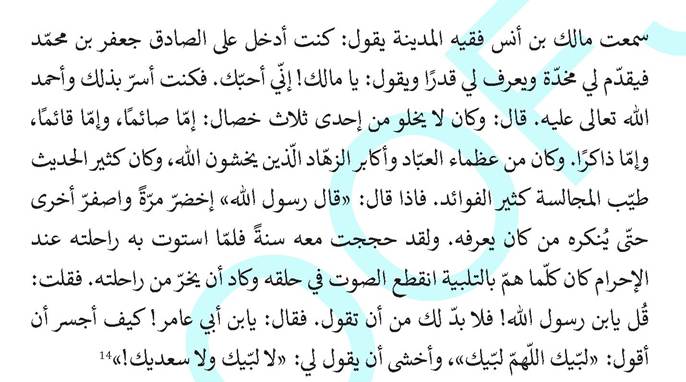
For the mainstream of the Shia, the Imam was and remained the source of correct religious knowledge and the bearer of the legacy of the House of the Prophet. The oldest definition of Shiism, by a prominent scholar of Kufa in the early second century, Aban b. Taghlib (d. 141),8 neatly explains this point: “The Shia are those who follow the opinion of 'Ah when reports from the Prophet are contradictory, and the opinion of Ja'far b. Muhammad [al-Sadiq] when reports from 'Ah are contradictory.”[8] [9] As noted above, Ja'far al-Sadiq was a highly esteemed jurist in his time, and his mastery of Islamic religious law was a matter of unanimous agreement in the Muslim society of his time. This mastery is well-documented in Islamic sources, some of which will be quoted in the first chapter of the present work. The following story, describing an alleged meeting between Abu Hanifa, the eponym of the Hanafi school of Islamic law, and Ja'far al-Sadiq in the presence of the Abbasid caliph Mansur (r. 136-58) as quoted by some early Hanafi sources on the authority of Abu Hanifa's student, Hasan b. Ziyad al-Luui, shows how the Muslim community remembered Ja'far al-Sadiq in its early centuries:[10] سمعت أبا حنيفة وئدئل من أفقه من رأيت؟ قال: ما رأيت أحدا أفقه من جعفر ين محتد. لتا أقدمه المنصور الحيرة بعث إل فقال: يا أبا حنيفة! إن الناس قد فتتوا يجعفر ين محتد فهى ء ل من مسائلك الصعاب. فهيأت ل أرعين مسألة بم أتيت أبا جعفر [المنصور] وجعفر جالش عن يمينه. فلما بصرت بهما دخلي لجعفر من الهيبة ما لم بتدخلي لأبي جعفر. فسلمت وأذن لي فجلست. بم التفلق إلي جعفر فقال: يا أبا عبد هللا! نغرف هذا؟ قال: نعم! هذا أبوحنيفة — بم أنبعها: قد أتانا. بم قال: يا أبا حنيفة! هات من مسائلك شأل أبا عبد هللا. فابتدأت أسأل، فكان يقول في المسأل: أنتم تقولون فيها كذا وكذا، وأهل المدبة يقولون كذا وكذا، ونحن نقول كذا وكذا. فربما تابعنا، وربما تاح أهل المدينة، وربما خالفنا جميئا، حى أنيث على أربعين مسألة، ما أخرم منها مسألة. بم قال أبوحنيفة : أليس قد رويتا أن أعلم الناس أعلمهم باختلاف الناس؟[11] I heard Abu Hanifa [when he was] asked who was the person most knowledgeable in religious law he had ever seen. He replied that he had never seen anyone more knowledgeable in religious law than Jafar b. Muhammad [al-Sadiq]. When Mansur brought him to Hira [near Kufa, the seat of the Abbasid government in its early years], he sent for me and said, “O Abu Hanifa! The people are enchanted by Jafar b. Muhammad, so prepare for him some of your hardest questions.” I prepared [a list of] forty questions and went before Abu Jafar [al-Mansur] while Jafar was sitting on his right. When I saw the two, the awe that I felt for Jafar was well above that which I felt for Abu Jafar [al-Mansur]. I offered my greetings and was given permission to sit down. Then Abu Jafar [al-Mansur] turned to Jafar and said, “O Abu 'Abd Allah! Do you know this man?” Jafar said, “Yes, this is Abu Hanifa,” and added, “He has been to see us before.” Then [Mansur] said, “O Abu Hanifa! Present your questions so that we may ask Abu 'Abd Allah.” So I started asking him questions and he would say in his answer to every question, “You [in the school of Iraq] say such-and-such [about this question], and the people of Medina [that is, the jurists of the school of the Hijaz] say such-and-such, and we [in the tradition of the House of the Prophet] say such-and-such.” His opinions agreed at times with ours, at times with those of the people of Medina,[12] and at times with none, until I finished all forty of my questions. He did not leave a single question unanswered. Commenting on the story, Abu Hanifa then said, “Are we not told that the most knowledgeable of the people is the one who knows best the differences of opinion among the people?”[13] [14] Malik b. Anas, the eponym of the Maliki school of Islamic law, was a student of Ja'far alSdiq and transmitted hadith from him. The following report conveys how Malik remembered his time with Ja'far al-Sadiq: I heard Malik b. Anas, the jurist of Medina, say: I used to visit al-Sadiq Ja'far b. Muhammad. He would offer me a cushion and honor me and say, “O Malik! I like you!” That would make me happy, and I would praise God the Exalted for that. He was always engaged in one of three practices: fasting, prayer, or remembrance of God. He was among the greatest of worshippers and self-deniers who feared God. He was also full of pleasant speech, and his company was plentiful in benefits. When he said, “The Messenger of God said,” he would turn sometimes green, sometimes yellow, such that even those who knew him could not recognize him.[15] One year, I performed hajj with him. When his mount stopped in order for him to enter the state of pilgrim sanctity, every time he would resolve to say the talbiya, his voice would choke up, and he would almost fall off his mount. I said, “Say it, O son of the Messenger of God! You must say it.” He said, “O son of Abu 'Amir![16] How can I dare to say, ‘Here I am, My Lord, here I am,' when I fear that He may say to me, ‘You are not welcome!'” A brief remark about the sources for this study seems merited. As expected, there is an enormous number of quotations from, as well as reports and information about, Ja'far al-Sadiq in the collections of religious reports and compendia of law, as well as in works on biography and literature, by adherents of various doctrinal and sectarian tendencies in the general Islamic tradition.[17] Some of that material is spurious or pure fabrication. In Sunni hadith, attempts can frequently be observed by late Umayyad and early Abbasid transmitters to rebuff rivals by putting statements in the mouths of leaders of the opposing group, which was a well-attested tactic in the sectarian milieu of the early Muslim centuries. In Shi hadith, the hand of various esoteric groups and individuals who pretended to have affection 15 16 17 for and affiliation with the House of the Prophet,18 although many of them may not have even believed in God or Islam,19 can clearly be seen behind many texts that do not match the language and conventions of the Imams.20 Some of that material was nevertheless received favorably among the uneducated or unsophisticated masses.21 There were also hadith fabricators in both camps who boldly improvised lies on behalf of Ja'far al-Sadiq with no specific doctrinal agenda, simply because of the popularity of his name as a leading authority on religious teachings.22 There is, however, a large The esoterics usually had no education or social and family distinction. Their esotericism and exaggeration were only stratagems to acquire distinction in the community and set themselves up as devoted supporters and advocates of the Shi'! cause (see Kashshi, Rijal, 138, 148, and passim). They were ready and happy to create tension, hatred, and animosity between people only to assert themselves as notables in the community. Much of the material that they forged and ascribed to the Imams could have potentially put the life of the Imams and those of their disciples and transmitters in danger, or the community of the supporters and well-wishers of the House of the Prophet in deep shame and disgrace, if the Imams had actually said this or the alleged transmitters reported it at the time. This is a clear indication that such material, with its claimed authority and chains of transmission, was blatant fabrication. See Modarressi, Crisis and Consolidation, 35-36. Such were many ofthe fabrications told about Ja'far al-Sadiq by the esoterics, which could easily be distinguished by their tone and content as neither in line with his widely-transmitted statements nor comparable to his style of speech, personal character, or family and class culture. As attested in numerous examples, the close disciples of the Imam who were familiar with his language would immediately recognize the true from the false as soon as they received a statement ascribed to him (see Chapter 1 below). A very common practice by the esoterics was to edit narratives and paraphrase words, putting the new versions into the mouths of the Imam or his prominent disciples and then into vast circulation in the Shi'! community of the time. With a small edit, a straightforward statement could take on a very different meaning by the time it reached Kufa. Many of the Shi'a of Kufa had recollections of some phonetically similar statements from the Imams (see, for instance, Modarressi, Tradition and Survival, 1:90), a fact that helped the forgers succeed in their edits. Human inclination toward wonders, make-believe, imagination, and exaggeration about their spiritual leaders always led uneducated masses to fall victim to the traps set by the esoterics, to believe in their claims and ascriptions, and to act as a type of free-of-charge mass media to spread each new fabrication. These three categories of lies and liars will be discussed in greater detail in Chapter 1. See also the intelligent observation of a prominent scholar of hadith, Abu Hatim Muhammad b. Idris al-Razi (d. 277), in Ibn Abi Hatim, al-Jarh wa'1-ta'dil, 9:25. It shows that the government and its supporters were happy with, and presumably encouraged, fabrications and misattributions to Ja'far al-Sadiq, as these would taint the image of the Imam and the House of the Prophet in the eyes of the religious masses, and especially of the scholars of hadith, by casting them as “weak transmitters" of false material: 18 19 20 21 22 كتب الفضل ين الريع إلى أبي فقال: لا تحذث عن جعفرين محتد. فقلت لأبي: هذا أبو الخزي ببغداد يحذث عن جعفرين محتد بالأعاجيب ولابغش. قال: يا دى.١ أما من يكذب على جعفريبن محتد فلا بالون به، وأننا من يصدق على جعفر فلا دعجبهم.١ Al-Fadl b. al-Rabi' wrote to my father, saying, “Do not transmit hadiths from Ja'far b. Muhammad.” I said to my father, “Here is Abu al-Bakhtari in Baghdad transmitting fantastical hadiths from Ja'far b. Muhammad but not getting forbidden.” He said, body of material that sounds authentic or can reasonably be assumed to be. As for the provenance of the material, there is naturally much more in Shici sources, especially those of the Ja'far! school. The present study uses all material that corresponds to the language and character of Ja'far al-Sadiq, as known through both historical and biographical accounts, and as such can reasonably be deemed reliable. The same is true with those reports that are supported by internal or external[22] [23] evidence, including the language and style of legal discourse in his time.[24] Sectarian tendencies and doctrinal affiliations play no role in my acceptance or rejection of any individual item, whether a historical or a religious report.[25] There are three further points to note: First, the word "Shi" is used in this work as an adjective in respect for the publisher's preference. This is a break from my thirty-year-long practice of using the word "Shi'ite." Second, unless otherwise specified, all dates in this book are according to the Islamic hijr! calendar, except for publication dates, which refer to the Common Era. Third, the editions used of the sources cited in the work are those specified in the bibliography at the end of the book. The reader will notice that at times I use a different edition, as specified in each citation. This is a reminder of a time during which libraries were closed because of a pandemic, resulting in the author having no access to the specific editions used throughout a work, and requiring him to be content with whatever he could find online. And finally, it is a pleasant duty to thank Michael Cook and Intisar Rabb who read an earlier draft of this work and offered invaluable suggestions for its improvement. My thanks are also due to the anonymous peer reviewers for their very helpful comments and corrections, to Rami Koujah for helping in various ways as my research assistant, and to Hanna Siurua and Stuart Brown for their careful and thorough copy editing of this volume.
More on the topic Introduction:
- 1 Introduction
- Introduction
- Introduction
- 19 Introduction
- Introduction
- Introduction
- INTRODUCTION
- Introduction
- Introduction
- Introduction
- Introduction
- Introduction: Hegel, Marx and the Dialectic
- INTRODUCTION: OVERVIEW OF COMPLICATIONS ASSOCIATED WITH HIV THERAPY