Chorionicity and zygosity
Assessment of chorionicity and zygosity is important for prenatal diagnosis, risk stratification of pregnancy, genetic counselling, and planning interventional procedures, particularly in twin pregnancies discordant for structural, chromosomal, or growth abnormalities.
With the advent of non-invasive prenatal diagnosis, accurate assessment of chorionicity is important in interpretation of the results.There are two types of twin pregnancy—dizygotic and monozygotic.
Dizygotic twins occur when two ova are fertilized and have separate amnions, chorions, and placentas (dichorionic diamniotic). The placentas may fuse if the implantation sites are close together. The majority of twin pregnancies are dizygotic. Monozygotic twins
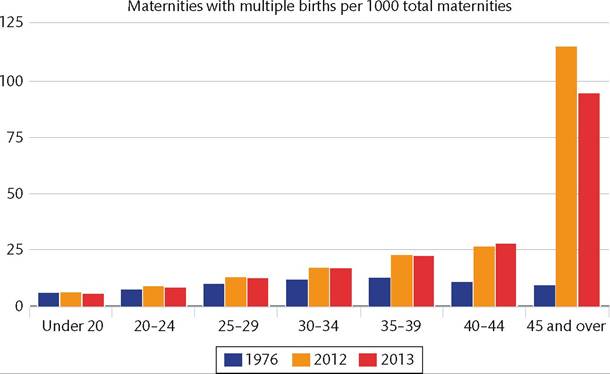
Figure 20.1 Risk in multiple pregnancy over years with advancing maternal age.
Source data from Office for National Statistics.
develop when a single fertilized ovum or zygote divides after conception (Figure 20.2).
Early division of the zygote (within 2 days of fertilization) results in separate chorions and amnions (dichorionic diamniotic twins). This occurs in approximately 30% of monozygotic twins. Later division (3-8 days after fertilization) results in a shared chorion and placentation and occurs in approximately 70% of monozygotic twins (monochorionic diamniotic (MCDA) twins). Division of the zygote
between 9 and 12 days after fertilization) results in a shared chorion, amnion, and placentation and is rare, occurring in only 1% of monozygotic twins (monochorionic monoamniotic (MCMA) twins). If twinning occurs more than 12 days after fertilization, then the monozygotic fertilized ovum only partially divides resulting in conjoined twins. This is extremely rare occurring in 1 in 50,000 to 100,000 twin pregnancies.
Triplet pregnancies may result from various fertilization and division scenarios involving ovum and sperm. Triplets can Ultrasound determination of amnionicity and chorionicity is best achieved in the first trimester by examining the inter-twin membrane at its placental attachment and identifying the lambda (λ) or T sign (14). The earliest gestation for determining chorionicity is 5 weeks and for amnionicity 8 weeks. The lambda sign or the ‘twin peak' sign is seen in dichorionic twin pregnancy. It appears as a triangular tissue projection extending from the base of the inter-twin membrane, giving the characteristic appearance of the Greek letter lambda (λ) (15). It is produced by extension of chorionic villi into the interchorionic space where the two separate placentas and chorionic attachments meet. Studies suggest a sensitivity and a specificity of 97-100% for accurate determination of dichorionicity using the lambda sign. In MCDA pregnancies, the T sign is evident as there is no triangular chorionic projection and the two amnions meet perpendicularly to the shared placenta. This is a reliable sign in identification of monochorionicity with about 98-100% accuracy. In MCMA pregnancies, there is no inter-twin membrane and the placental cord insertions are close together (16). See (Figure 20.3).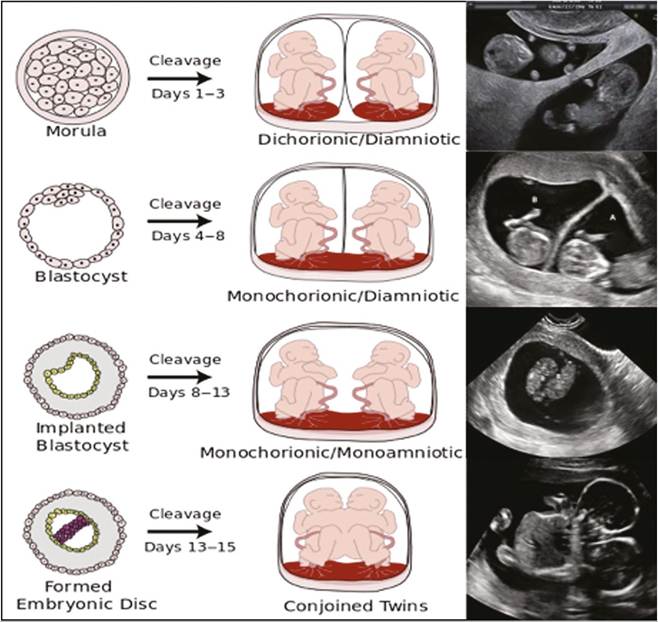
Figure 20.2 Twinning process in monozygotic twin pregnancy.
The reliability of using the inter-twin membrane for assessment of chorionicity decreases as the gestation advances. The lambda sign regresses in about 7% of dichorionic twin pregnancies in the late second trimester. If there is no accurate first-trimester detection of
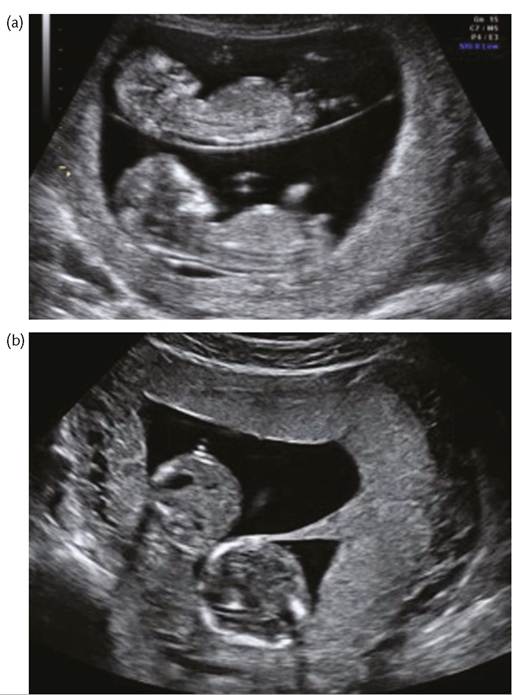
Figure 20.3 (a) T sign in monochorionic twin pregnancy. (b) Lambda or twin peak sign in dichorionic twin pregnancy.
chorionicity, fetal sex determination may be useful in the dizygotic pregnancies. However, one needs to be mindful that a proportion of dichorionic pregnancies (up to one-third) are not discordant for gender. Although measuring inter-twin membrane thickness has been described (the mean measurement is approximately 2.4 mm whereas in monochorionic twins mean thickness is 1.4 mm), it is less reliable, technically more challenging, and affected by inter- and intra-observer variability in the late second and third trimesters (17). Care must be taken in a new diagnosis of monoamniotic twin pregnancy in the second trimester, as this may represent severe TTTS in a MCDA twin pregnancy.
The evaluation of the membranes (amnion and chorion) and placenta(s) after the birth is important in all multiple pregnancies, but it does not always help determine zygosity (dichorionic pla- centa/like-sex twins).