Optimal Antenatal Care in Multiple Pregnancy
Leanne Bricker
Introduction
Women with multiple pregnancy are at higher risk of almost all maternal complications in pregnancy. Maternal mortality is more than double that of singleton gestations and this is often overshadowed by fetal considerations, reflected in the literature with few published studies from the developed world addressing maternal risks.
For fetuses or babies of multiple pregnancies, premature birth is the main cause of adverse outcome, but there are important contributions from fetal growth pathology, fetal abnormality and complications of shared placentation. Cerebral palsy is also increased amongst twins and even more so amongst triplets and higher-order multiples with aetiologies not entirely restricted to prematurity. Given the higher risk of complications, there are a number of additional elements of care, which necessitates more monitoring and increased contact with the healthcare team. Additionally, the increased risk may have a psychosocial and economic impact on women and their families and may heighten anxiety, resulting in a specific need for more information and support in pregnancy. This chapter summarises the additional elements of antenatal care required to identify complications and optimise outcomes in multiple pregnancy, but it does not address how to manage these complications once detected and diagnosed.Existing Guidelines and the Case for Following Them
There are a number of national/international guidelines relating to various aspects of care of multiple pregnancy. The most comprehensive guideline is the United Kingdom's (UK) National Institute for Health and Care Excellence (NICE) guideline.1 In the UK, the stillbirth rate in twins nearly halved between 2014 and 2016 and there was also a reduction in neonatal mortality, and this is thought to be partly due to publication and subsequent uptake of the NICE guideline in 2011.2 This view is further supported by an audit undertaken of 30 maternity units in the UK where reduction in stillbirths, neonatal unit admission and neonatal mortality was directly linked to uptake and implementation of NICE quality standards derived from the NICE guideline.3
Early Pregnancy
The use of obstetric sonography in early pregnancy is widespread and is known to improve gestational dating, thus reducing induction of labour for post-mature pregnancy, and it also ensures early detection of multiple pregnancy.
Accurate dating and amnionicity and chorionicity determination are key to planning and providing optimal antenatal care, including discussion about screening for aneuploidy and other fetal complications (fetal221 abnormality, fetal growth restriction and complications of shared placentation). Furthermore, it allows labelling of each fetus and timely discussion about the risks of higher-order multiple pregnancy and also consideration of multifetal pregnancy reduction in settings where this is possible. If chorionicity and amnionicity cannot be determined, the woman should be referred for specialist evaluation for clarification. If still undetermined, the pregnancy should be treated as monochorionic until proven otherwise.
With regard to labelling fetuses, if the fetus closest to the cervix in early pregnancy is labelled fetus 1 and further numbering is assigned to the other fetuses, it does not accurately determine which will be the leading fetus as pregnancy progresses, or indeed birth order. The presenting twin will change between left and right fetus in 8.5% of cases and the birth order will change from the last scan in 5.9% delivered vaginally versus 20.3% delivered by caesarean section.4 Correct orientation labelling in relation to the mother as maternal left and maternal right in laterally orientated fetuses or upper and lower in vertically orientated fetuses allows consistency with longitudinal biometric assessment, accuracy in interpreting screening results and undertaking invasive diagnostic tests when necessary, and it avoids confusion about birth order, ensuring the parents and paediatric team are aware of the possibility of peri-partum switch (i.e. change in birth order).
Screening for Fetal Complications
Down's syndrome and other aneuploidies (see Table 21.1)
Down’s syndrome and other aneuploidy screening in multiple pregnancy is complex as (1) there is a higher risk of aneuploidy, (2) the detection rate (sensitivity) of screening tests is lower compared with screening in singleton pregnancy, (3) the false positive rate is higher, (4) the likelihood of being offered invasive diagnostic testing and the risk of complications of the testing is higher and (5) if there is an affected fetus, the management is complex because of the risks to the surviving normal fetus or fetuses.
Women need to be fully informed about these issues before the screening test and also afterwards in the event of a positive result.The options include nuchal translucency screening with or without additional elements (maternal age, other maternal factors and serum screening), second-trimester serum screening or cell-free DNA (cfDNA) non-invasive prenatal testing (NIPT). In the first trimester for twin pregnancy combined screening (nuchal translucency (NT), maternal age, other maternal factors, and serum screening - beta-human chorionic gonadotropin and pregnancy-associated plasma protein-A) can be offered. For dichorionic (DC) twin pregnancies, risks should be calculated for each fetus. For monochorionic (MC) twin pregnancies, each fetus has the same risk of Down’s syndrome or other aneuploidy, and the overall risk is the same as in a singleton pregnancy. Therefore, the NT measurement should be averaged and used to calculate a pregnancy-specific risk. For triplets, there are no normograms for serum screening, and therefore NT and maternal age are the only available screening methods.1 If the woman presents too late for first-trimester screening, the NICE guideline recommends offering second-trimester serum screening for twins. For triplet pregnancy there are no second-trimester screening options.1
Non-invasive prenatal testing is commercially available for screening for trisomies 21,18 and 13 with high levels of accuracy and low false positive and false negative rates in singleton pregnancy. A published study including a meta-analysis of seven other studies found that
Table 21.I Down's syndrome screening test options in multiple pregnancy
| Type of Multiple Pregnancy | First Trimester | Second Trimester |
| Dichorionic twins | Combined NT test | Serum screening |
| (Calculate fetus-specific risk) | (Calculate pregnancy-specific risk) | |
| OR | OR | |
| NIPT | NIPT | |
| Monochorionic twins | Combined NT test | Serum screening |
| (Calculate pregnancy-specific | (Calculate pregnancy-specific risk) | |
| risk by using average NT) | OR | |
| OR | NIPT | |
| NIPT | ||
| Triplets or higher-order | NT and maternal age alone | No available test |
| Vanishing twin | Combined NT test | Serum screening |
| OR | OR | |
| NIPT | NIPT | |
| But note not as accurate | But note not as accurate | |
| NT = nuchaltranslucency; NIPT = | non-invasive prenataltesting |
the performance of NIPT for trisomy 21 in twin pregnancy is similar to that for singleton pregnancy and significantly better than first-trimester combined or second-trimester serum biochemical testing.5 However, accuracy for trisomies 18 and 13 remains unclear due to the small numbers of cases.
It is important to note that in multiple pregnancy where chromosomal abnormality is likely to be discordant (particularly if there is dizygosity or polyzygosity), where it is not obvious (i.e. no visible structural features aiding identification of the affected fetus) invasive testing will be required to identify and confirm diagnosis of an affected fetus. If the woman opts for invasive diagnostic testing, this should be performed by a specialist who has the expertise to subsequently perform selective termination of pregnancy if required.6
Structural Abnormalities
Structural abnormalities are more common in twin, triplet and higher-order pregnancies, mainly because of the higher incidence in monozygotic twins (due to cleavage of the conceptus) compared with dizygotic twins. The management is complex when one fetus has an abnormality. Timely diagnosis allows more choice, preparation time, optimal fetal surveillance depending on the anomaly, involvement of the multidisciplinary team (e.g. genetics team, paediatric surgeons) and appropriate birth planning (place, timing and mode), including access to intrauterine therapy where relevant. Ultrasound assessment will take longer and visualisation may be limited by fetal positions, but mid-trimester ultrasound is expected to be as effective in multiple pregnancy as it is in singleton pregnancy with similar detection rates. Therefore, as in singleton pregnancy, routine anomaly screening by ultrasound between 18 and 20+6 weeks of gestation is recommended.
Abnormalities specific to monozygotic twins are usually midline, such as holoprosencephaly and neural tube defects and cardiac abnormalities. For this reason, the value of fetal echocardiography in addition to routine anatomy scan is debated. Not all monozygotic twins are MC twins, however; therefore this would need to be applied to all twins irrespective of chorionicity unless discordant-sex twins are excluded, which can complicate the situation if the couple do not want to know the gender of the babies.
Guidance on this subject advocate that the anomaly scan should include extended heart views but formal fetal echocardiography is not necessary if there is no other risk factor.1,7,8Fetal Growth Pathology
Fetuses of multiple pregnancies are at increased risk of being small for gestational age (SGA) and if there is placental dysfunction, of fetal growth restriction (FGR). Both SGA and FGR fetuses and babies have poorer perinatal outcomes and therefore identifying growth problems is important. The pathophysiology of growth pathology in MC and DC pregnancies differs. In DC twins the pathophysiology is similar to singleton growth problems whereas in MC twins it is often related to unequal sharing of the single placenta and does not always follow the same pattern in evolution and deterioration as singleton pregnancy. Symphysis- fundal height measurement is not effective in identifying growth problems in twin pregnancy and serial ultrasound scans are required to identify both small babies and a significant size difference between the fetuses. The frequency of ultrasound scan assessment depends on the chorionicity.
It is well described that fetal growth in twins is different to that in singletons with reduction in growth velocity in the third trimester, and this is more marked in MC twins.9 There is a current debate amongst experts about whether specific growth charts for twins should be used to monitor fetal growth. Proponents of twin charts argue that use of such charts would (1) result in more accurate diagnosis of twin growth pathology, (2) identify those at risk of increased morbidity and mortality and (3) result in avoiding overdiagnosis of twin growth pathology and therefore unnecessary intervention and preterm delivery. The opposing argument is that (1) the charts have not been validated clinically in prospective research, (2) such charts are not in use for other high-risk obstetric conditions associated with fetal growth pathology (e.g.
diabetes), (3) multiple pregnancy is a high-risk situation and using specific charts may hide that risk and (4) we should not rely on fetal size alone anyway in evaluating fetal growth pathology - that is, fetal well-being evaluation includes evaluating growth velocity and Dopplers.Historically there has been inconsistency in defining growth restriction in multiple pregnancy. Recently a panel of experts using the Delphi process defined selective fetal growth restriction (sFGR) for both MC and DC pregnancy.10 See Table 21.2 for diagnostic criteria. The formula for calculating the estimated fetal weight (EFW) discordance percentage is: EFW larger fetus - EFW smaller fetus / EFW larger fetus x 100 (e.g. 700 g - 540 g / 700 g x 100 = 23%). Growth pathology in DC twin pregnancy is managed very similarly to growth pathology in singleton pregnancy. In MC twin pregnancy, however, it is classified according to the type of abnormality in the umbilical artery Doppler of the smaller fetus and management depends on severity and type.
Table 21.2 Diagnostic criteria for selective growth restriction in twin pregnancy (Delphi method consensus adapted from Khalilet al.10)
| Monochorionic twin pregnancy | Dichorionic twin pregnancy | |
| Solitary | EFW of one twin < 3rd centile | |
| parameter | ||
| Contributory | At least 2 of the following: | At least 2 of the following: |
| parameters | EFW of one twin < 10th centile | EFW of one twin < 10th centile |
| AC of one twin < 10th centile | EFW discordance >/= 25% | |
| EFW discordance >/= 25% | Smaller twin UA PI > 95th centile | |
| Smaller twin UA PI > 95th centile | ||
EFW = estimated fetalweight, AC = abdominal circumference, UA PI = Umbilicalartery pulsatility index
Complications of Shared Placenta
Twin-Twin Transfusion Syndrome (TTTS)
Ten to fifteen per cent of MC pregnancies develop twin-twin transfusion syndrome (TTTS) and in severe cases the outcome is significantly improved if treated with fetoscopic laser ablation. Given that there is available treatment it is essential to screen for TTTS to allow timely access to therapy. It usually presents between 16 and 24 weeks of gestation and therefore earlier screening would need to be very effective to advocate its use. There are several studies evaluating first-trimester parameters for TTTS screening - namely NT and/or crown-rump length (CRL) discordance and/or ductus venosus Doppler blood flow - but they all show low sensitivity and variable specificity, and there is potential to cause unnecessary anxiety. First-trimester screening for this complication is therefore not advised.1,7 The recommendation for screening is scan every two weeks from 16 weeks of gestation until delivery but a step up to weekly scans if there are concerning features such as inter-twin membrane folding or liquor discordance.1,7
Twin Anaemia-Polycythaemia Sequence (TAPS)
Twin anaemia-polycythaemia sequence (TAPs) is an uncommon complication unique to monochorionic placentation whereby there is a severe inter-twin haemoglobin discordance, apparently due to chronic transfer of blood via miniscule placental arterial-venous anastomoses. It can occur at any gestation and is relatively rare - 2-3% of MC twin pregnancies - but in complicated MC pregnancies with sFGR, or after laser treatment for TTTS, it occurs more commonly. It can be detected by measuring middle cerebral artery peak systolic velocity (MCA-PSV) whereby the donor has an MCA-PSV > 1.5 multiple of the median (MoM) (due to fetal anaemia) and the recipient has an MCA PSV for TAPs, but most international guidelines recommend screening only in MC pregnancies complicated by TTTS which has been treated or sFGR.1,7,8 Universal screening may be advised when the best management approach is known.
Other Shared Placenta Complications
See other chapters for details about diagnosis and management of monoamnioticity, twin- reversed arterial perfusion (TRAP) sequence and conjoined twinning.
Screening for Maternal Complications
Hypertensive Disorders of Pregnancy
Women with multiple pregnancy have much higher risk of developing gestational hypertension, pre-eclampsia or eclampsia. Additionally, such disorders are more likely to occur earlier and be more severe. The UK NICE guideline for ‘Hypertension in Pregnancy' recommends that women with one high-risk factor or at least two moderate-risk factors take oral low-dose aspirin (75-150 mg daily) from 12 weeks of gestation until birth.11 Multiple pregnancy is considered a moderate risk factor. As with singleton pregnancy, to detect hypertensive disorders it is recommended that a woman's blood pressure is measured and urine tested for protein at each antenatal contact.
Gestational Diabetes
Gestational diabetes is due to a relative insulin insufficiency secondary to the diabetogenic effect of placental hormones (human placental lactogen, progesterone and cortisol). In multiple pregnancy there is a larger placental mass, which increases the amount of placental hormones and therefore theoretically the risk of developing gestational diabetes. In practice, however, there is conflicting evidence about whether the occurrence of gestational diabetes is increased in multiple pregnancy and whether it is advisable to screen for, and this area warrants further research.
Anaemia
There is a higher incidence of maternal anaemia in multiple pregnancy. This coupled with the higher risk of post-partum haemorrhage and the demands of breastfeeding more than one baby after birth makes it imperative to optimise maternal haemoglobin level antenatally. Routine iron and folic acid supplementation for this purpose is not necessary, but the NICE guideline recommends checking the full blood count at 20-24 weeks and 28 weeks of gestation (cf. singleton pregnancy where it is advised at 28 weeks of gestation only) to identify women who may need iron and folic acid supplementation in time to effectively treat anaemia.1
Other Maternal Complications
In multiple pregnancy there is an increased risk of almost all other complications of pregnancy, such as placenta praevia, obstetric cholestasis and antepartum haemorrhage. Additionally, all minor ailments of pregnancy are worse. The management of these complications and ailments is no different compared with management in singleton pregnancies.
Prediction and Prevention of Preterm Labour
Prediction
To predict spontaneous preterm birth (SPTB) in twin and triplet pregnancy, the diagnostic accuracy of several factors/tests has been studied - ultrasonographic cervical length (CL) measurement, fetal fibronectin test (FFT), home uterine activity monitoring, digital cervical examination, screening for bacterial vaginosis, past obstetric history of preterm birth and composites of these approaches. Both a previous history of SPTB and abnormal CL measurements have been shown to be predictors of preterm birth in multiple pregnancy. The NICE guideline concluded that a CL of < 25 mm at 18-24 weeks of gestation is a good predictor of SPTB in twin pregnancy and a CL measurement of < 25 mm at 14-20 weeks of gestation is a good predictor of spontaneous preterm birth in triplet pregnancy.1
Prevention
Interventions that have been studied to prevent spontaneous preterm labour in twin and triplet pregnancy include bed rest, oral tocolytics, progesterone (intramuscular or vaginal), cervical cerclage and cervical pessary. None of these interventions have been found effective, but much interest remains in progesterone treatment in particular and there is large body of published literature in this regard. It must be noted that in the recent update of the NICE guideline, the expert panel withheld recommendations about whether to use progesterone as they were ‘aware that new evidence would be emerging about the use of vaginal progesterone in subgroups of women with a shot cervix which may change conclusions about its effectiveness'.1 At the time of writing this chapter, the situation is unchanged and therefore the current advice remains that in the absence of an effective intervention routine, screening to predict preterm delivery is not recommended in twin and triplet pregnancy and the use of progesterone (either vaginal or intramuscular) has not been proven effective.
Use of Corticosteroids
Giving timely antenatal corticosteroids reduces neonatal complications in preterm babies, albeit it is thought that they are less effective in multiple pregnancy. Given the substantial risk of preterm delivery in multiple pregnancy, the question arises about whether giving an untargeted course of steroids routinely at a given gestation or whether giving multiple courses at regular intervals may be beneficial. However, a single course remote from delivery dampens its effect and multiple courses compared with a single course do not improve outcomes but are associated with potential harm - that is, lower birthweight and head circumference.12 It is therefore better to avoid untargeted routine single or multiple courses of steroids and to advocate targeted steroids when indicated - that is, when preterm labour or birth is imminent - and therefore to shift the focus towards informing all women with twin and triplet pregnancy of the increased risk of preterm birth and the benefits of targeted steroids and to provide information about symptoms and signs to be aware of so they can present in a timely manner.1 A second question does arise - if a woman is given a targeted course of steroids but preterm labour is arrested and she does not deliver, should a further course be given if she presents at a later preterm gestation with signs or symptoms of threatened preterm labour or if iatrogenic preterm delivery is planned? A recent individual patient data meta-analysis of 11 trials found that repeat prenatal steroids given to women at ongoing risk of preterm birth after an initial course is beneficial for the neonate but to provide clinical benefit with the least effect on fetal growth, the number of repeat treatments and total dose should be limited.13
Planning Delivery
In addition to discussing risks of spontaneous preterm labour and delivery and preparing women for this possibility, many multiple pregnancies will progress uncomplicated, and an important aspect of optimal antenatal care is to ensure an informed discussion occurs about place, timing and mode of delivery. While in triplet and higher-order pregnancies caesarean delivery is advocated, discussions in twin pregnancy should include details of the risks and benefits of vaginal delivery versus caesarean section and pain relief options if vaginal delivery is planned. Discussions should also include who will be present at the delivery (more personnel than in singleton pregnancy) and the potential for the need for specialist neonatal care even if delivery is not preterm.
Other Aspects of Care
Information and Emotional Support
In current times women and their families have access to a wide range of information sources, some of which may be misleading or poor. The high-risk nature of multiple pregnancy and additional care requirements may lead to anxiety and stress for the woman and her family and it is important to ensure women are supported with good information, are guided to reliable sources of further information and can clarify issues of concern. They should be encouraged to think about socio-economic aspects of raising more than one child. This process of information sharing and provision of information can take place via a number of formats.
Nutritional Supplements, Diet and Lifestyle Advice
It has been suggested in multiple pregnancy that as the metabolic needs of the mother are greater than in singleton pregnancy, a high-calorie diet may help with her nutritional state. However, boosting weight gain might not be advantageous. There are no randomised clinical trials to provide guidance. The NICE guideline group reviewed the limited literature and concluded that the few published studies were of very low quality and there was no evidence to give different advice to that given in singleton pregnancy.1 They did, however, recommend that the woman is referred to a dietician if necessary.
How and Where to Deliver Care
Given the extra elements required to deliver optimal antenatal care in multiple pregnancy it seems logical that this should be provided in a dedicated service whether it be in a clinic staffed by a dedicated multidisciplinary team or delivered by a core team in a specialised model. A Cochrane systematic review found only one small randomised controlled trial (RCT) (162 women) of specialised antenatal care in multiple pregnancy and the intervention was extra midwifery support (not specialist obstetric care).14 There was no difference in incidence of postnatal depression (this was the primary outcome), perinatal mortality, stillbirth, neonatal mortality and breastfeeding. The intervention group members were more likely to have caesarean delivery. From other studies, all conducted in the USA, there is some evidence of improved outcomes, but it is conflicting and limited for the following reasons: (1) there is a potential for bias (e.g. women at lower risk may have had better access to this care for financial, educational or other reasons), (2) it is not clear whether it is the actual elements of care (and if so which elements) or the continuity and specialist knowledge of the caregivers that makes the difference and (3) as the evidence comes from one healthcare setting (i.e. the USA) where in particular there is little midwifery input, it may not be reproducible in other settings.15 What does, however, appear to be clear is that continuity and consistency of care by the same experienced and knowledgeable professionals contributes to better outcomes. For this reason, the NICE guideline recommends that ‘clinical care for women with twin and triplet pregnancies should be provided by a nominated multidisciplinary team consisting of a core team of named specialist obstetricians, specialist midwives and ultrasonographers, all of whom have experience and knowledge of managing twin and triplet pregnancies’. This team should have access to refer to an enhanced team including a perinatal mental health professional, a women’s health physiotherapist and infant feeding specialist and a dietician.1
The NICE guideline also specifies a schedule of appointments which includes timing of ultrasound scans according to whether the pregnancy is twins or triplets and based on chorionicity and amnionicity, and it also details recommended timing of delivery.1 The International Society of Ultrasound in Obstetrics and Gynecology (ISUOG) guideline specifies what elements should be measured and evaluated at each scan.7 These schedules provide guidance for the minimal requirements and recognises that if there are comorbidities or complications there may be a need to deviate from the schedule. See Table 21.3.
Indication for Referral to Tertiary-Level Fetal Medicine Services
Easy access to care is important and therefore the principle of care close to home and local expertise is important. But there are complications of multiple pregnancy which require specific expertise. When these complications occur, clinical decisions and choices can be complex and it is crucial to recognise this and refer to specialist fetal medicine services with appropriate expertise. The NICE guideline identified complications which would fit this criterion as follows: a high-risk aneuploidy screening result, monoamnionicity, any triplet pregnancy with a shared placenta, or pregnancies complicated by discordant fetal growth, fetal anomaly, discordant fetal death, TTTS, conjoined fetuses, TRAP or suspected TAPs.1
Key Points
• Twin and triplet pregnancies are high risk for both mother and babies and require additional elements of care to identify and manage complications effectively and to optimise outcomes.
• In managing multiple pregnancy, it is proven that uptake and implementation of evidence-based guidelines improves outcomes.
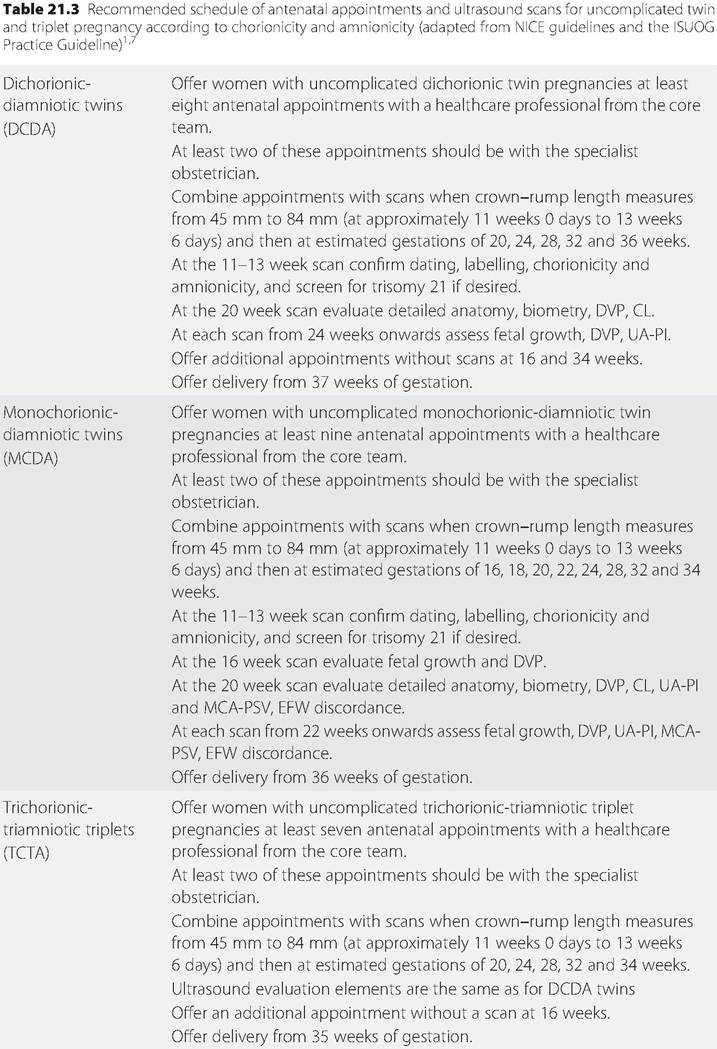
Table 21.3 (cont.)
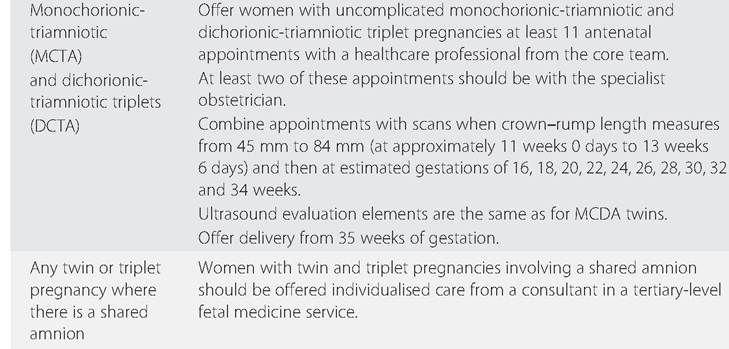
DVP = deepest verticalpocket, CL = cervicallength, UA-PI = umbilicalartery pulsatility index, MCA-PSV = middle cerebral artery peak systolic velocity, EFW = estimated fetalweight. For monoamnionicity refer to Chapter 17.
• Care needs to be delivered by healthcare professionals with specific knowledge and expertise ensuring consistency and continuity, and this may be best delivered in the context of a specialist clinic or service.
• Early pregnancy care should include a scan to accurately date the pregnancy, label fetuses and determine chorionicity and amnionicity.
• An individualised care schedule should be followed based on chorionicity, amnionicity and other risk factors specific to the woman.
• Screening for fetal complications should be offered along with specific information about the complex clinical issues and decisions that may result from such screening.
• Later care should focus on presentation and management of complications such as preterm labour, growth restriction and maternal complications and planning for delivery.
• Complex cases should be referred to specialists in fetal medicine.
• Emotional support and relevant reliable information should be given to mitigate the stress and anxiety associated with these high-risk pregnancies.
• Interventions for which there is no solid evidence base should be avoided.
References
1. National Institute for Health
and Care Excellence (NICE), UK. Twin and Triplet Pregnancy (NG137), 2019. www.nice.org.uk/guidance/ ng137
2. Kilby MD, Gibson JL, Ville Y. Falling perinatal mortality in twins in the UK: organisational success or chance? BJOG 2019;126(3):341-7.
3. NICE Works: Twins and Multiple Births Association Maternity Engagement Project Final Report. https://twinstrust.org/uploads/ assets/afcc44b3-776e-4341-8a16e9bd990 c3425/NICE-works-final-report.pdf
4. Dias T, Ladd S, Mahsud-Dornan S, Bhide A, Papageorghiou AT, Thilaganathan B. Systematic labeling of twin pregnancies on ultrasound. Ultrasound Obstet Gynecol 2011;38:130-3.
5. Gil MM, Galeva S, Jani J et al. Screening for trisomies by cfDNA testing of maternal blood in twin pregnancy: update of the Fetal Medicine Foundation results and meta-analysis. Ultrasound Obstet Gynecol 2019;53(6):734-42.
6. Royal College of Obstetricians and Gynaecologists (RCOG). Green-Top Guideline (no. 8). Amniocentesis and chorionic villus sampling. 2010. www.RCOG.org.uk
7. Royal College of Obstetricians and Gynaecologists (RCOG). Green-Top Guideline (no. 51). Management of monochorionic twin pregnancy. 2016. www.RCOG.org.uk
8. ISUOG practice guideline. Role of ultrasound in twin pregnancy. Ultrasound Obstet Gynecol 2016;47:247-63.
9. Stirrup OT, Khalil A, D'Antonio F, Thilaganathan B, on behalf of the Southwest Thames Obstetric Research Collaborative (STORK). Fetal growth reference ranges in twin pregnancy: analysis of the Southwest Thames Obstetric Research Collaborative (STORK) multiple pregnancy cohort. Ultrasound Obstet Gynecol 2015;45:301-7.
10. Khalil A, Beune I, Hecher K et al. Consensus definition and essential reporting parameters of selective fetal growth restriction in twin pregnancy: a Delphi procedure. Ultrasound Obstet Gynecol 2019 Jan;53 (1):47-54.
11. National Institute for Health and Care Excellence (NICE), UK. Hypertension in pregnancy: diagnosis and management (NG133), 2019. www.nice.org.uk/ guidance/ng133
12. Crowther CA, Harding JE. Repeat doses of prenatal corticosteroids for women at risk of preterm birth for preventing neonatal respiratory disease. Cochrane Database Syst Rev 2007;(3):CD003935.
13. Crowther CA, Middleton PF, Voysey M et al. Effects of repeat prenatal corticosteroids given to women at risk of preterm birth: an individual participant data meta-analysis. PLoS Med. 2019 12; 16 (4):e1002771.
14. Dodd JM, Dowswell T, Crowther CA. Specialised antenatal clinics for women with a multiple pregnancy for improving maternal and infant outcomes. Cochrane Database SystRev 2015;(11). Art. No.: CD005300.. https://doi.org/10.1002/146518 58.CD005300.pub4
15. Bricker L. Optimal antenatal care for twin and triplet pregnancy: the evidence base. Best Pract Res Clin Obstet Gynaecol 2014;28(2):305-17. https://doi.org/10.1016/j.bpobgyn.2013.12.006. Epub 2013 Dec 17. PMID: 244