Practical Management of Vaginal Delivery in Multiple Pregnancy
Julian N. Robinson
The Facts
Mode of Delivery of Twins
The choice of mode of delivery in twin gestations can be a complicated decision. Many mothers strongly desire a vaginal delivery.
However, some may have a belief in the safety of caesarean delivery. Such a conviction can be heightened by advancing age and fertility treatment. The obstetrician may be more comfortable with elective caesarean delivery for twins, and it is certainly convenient for both mother and obstetrician. There may be limitations to a delivery suite's depth of experienced obstetric providers to provide a service for twin vaginal delivery at all times. The most undesired outcome for most twin mothers is a vaginal delivery for the first baby and a caesarean delivery for the second; some lean towards caesarean delivery just to avoid this outcome. The significant increase in caesarean delivery rates for twins over the past 30 years is documented in Chapter 24: this increase has likely led to a loss of clinical skills. The recovery from an abdominal surgery will make the first weeks of mothering much more challenging and may have longer-term sequelae (especially if the mother already has young children). In 2014 a joint consensus statement from the American College of Obstetrics and Gynecology (ACOG) and the Society of Maternal Fetal Medicine (SMFM) emphasised that perinatal outcome is not improved by caesarean section for twin deliveries where the presenting twin is in the cephalic presentation and recommended that women with cephalic-presenting twins should be counselled to attempt vaginal delivery.1 The National Institute for Healthcare Excellence (NICE) published similar guidance on this topic in 2020. ‘There is no reason to recommend one type of delivery over another in a twin pregnancy (irrespective of chronicity) when the presenting fetus is in cephalic presentation after 32 weeks, when there are no additional obstetric complications and no significant discordancy in the size of the twins.'2 Pregnant twin mothers should be counselled about the safety of vaginal birth and obstetric departments should strive to allow women to comfortably make such a choice.Preparation
Informed consent is complicated in twins and time should be taken in this process. The consent should include the possibility of all obstetric interventions that may occur in the course of a twin delivery. Obviously if a provider does not offer interventions such as internal podalic version and breech extraction or cephalic displacement there is no need for such consent. However, if a procedure may occur, consent should be obtained, regardless of the likelihood or intent to use it. The accoucheur may approach the delivery of a low-risk multiparous woman with cephalic/cephalic presentation with the very reasonable expectation of a simple, uncomplicated, vaginal delivery; however, if an unexpected breech extraction ends up being performed, it is optimal to have had appropriate consent.
Labour
Many aspects of obstetric labour and delivery care warrant particular attention in twin pregnancy: consent, analgesia, fetal monitoring, delivery planning and delivery methodology.
Analgesia
The woman should be informed of all of the choices available for analgesia in labour from natural childbirth to epidural. A practical approach is to go through all of the possible scenarios and how they might play out with differing methods of analgesia, integrating the approximate chance of occurrence of intervention so that the woman can make an informed choice. Twin patients at our institution have delivered with natural childbirth, pudendal block and epidural analgesia and patients are counselled in an open and non-directional fashion. However, it is fair to note that the possibility of a breech extraction or operative vaginal delivery appears to weight the choice of analgesia and the vast majority of our patients choose epidural analgesia.
Labour Patterns in Twins
Leftwich et al., using data from the Safe Labor Consortium, compared the labour curves of 891 twin gestations with 100,513 singleton controls and found labour progression was slower in nulliparous twin gestations, with a greater median time for cervical dilatation at every centimetre interval up to 7 centimetres compared with singleton nulliparous pregnancies.3 The provider should keep in mind the potential for a slower labour and integrate this into clinical management before making a diagnosis of failed induction or failure to progress.
Fetal Monitoring
Our recommended practice for fetal monitoring in twin labour is for continuous electronic fetal monitoring with artificial rupture of membranes and placement of a fetal scalp clip on the presenting twin early in labour. The use of a scalp clip reduces the risk of inadvertently monitoring a single baby, or one baby and the mother (‘coincidence’ monitoring). It is reasonable to do external monitoring for both if the patient prefers, as long as clear, continuous, distinct fetal heart tracings are obtained for both babies. Simultaneous or coincidence monitoring may be precipitated by transducer, maternal or fetal movement, and very rarely fetal demise. Techniques to investigate and avoid coincidence include maternal pulse examination, pulse oximetry, three-lead maternal electrocardiogram and ultrasound examination. Software algorithms for coincidence detection include comparisons of the averaged heart rates over time with an alarm if only 2-3 beats per minute (bpm) difference over a period of greater than 30 seconds and detection of synchronised heartbeat patterns for greater than a minute. Another method to avoid coincidence monitoring is the use of a heart rate ‘offset’ or ‘shift’ mode that increases the baseline of the second heart rate by 20 bpm. If using this latter technology, care should be taken not to misinterpret tachy- or bradycardia. In the delivery process electronic fetal monitoring can be substituted with intermittent ultrasound monitoring.
Delivery
Planning
The delivering obstetrician should ideally know from recent ultrasound the presentation, lie, orientation of the limbs and the estimated amniotic fluid volume for both babies. It is possible for these things to change in the course of a delivery, but it makes sense to be aware of them at the time of contemplating the plan for delivery.
Twin deliveries should take place in the largest operating room (OR) available. The rationale for this is purely to have more space.
The number of participants in team care in the academic setting is large. The protocol should ensure a paediatric team present for every twin birth under 37 weeks of gestational age. The timing of the transfer to the OR is at the end of the second stage, just before delivery, but with adequate time for transfer and optimal preparation of the final delivery destination.Well before transfer, the obstetric team should plan the exact personnel roles and logistics for the delivery - down to the location of individuals and equipment. Delivery on a surgical bed is recommended for access, speed and simplification of procedure in the setting of complications.
It is our usual practice to have the surgical technician aware that a twin delivery is occurring; however, we do not necessarily have them present and do not have a caesarean section kit open in the room. It may be that the presence of an open, prepared surgical kit enables a self-fulfilling prophecy. If an epidural is in situ the anaesthetic team is present on transfer of the patient to ensure that analgesia is adequate on arrival in the OR; however, they may elect not to stay in the room for the entirety of the delivery but are always immediately available. Most providers prefer to have an ultrasound machine present for the delivery for confirmation of the presentation of the second twin after delivery of the first, and to help with guidance of a trainee if an internal podalic version and breech extraction is being performed. The presence of bedside intra-partum ultrasound is not essential. However, performance of a recent ultrasound is recommended. These ultrasound images can be transferred to a mental visual model that can be recreated in the delivering physician’s mind if extra- or intrauterine manipulation is needed.
Delivery Methodology
It is important to note that the ‘hands on’ methodology of delivery has experienced an anecdotal rather than evidence-based evolution and there is considerable institutional and geographic variation in practice.
The monologue that follows attempts to provide a comprehensive overview of current practices.There can be a tendency in obstetric practice for an accoucheur to have a preferred method and to use that technique broadly. Twin delivery is a setting where such habitual practice may not be ideal: there are differing twin delivery scenarios and each can change dynamically as the delivery progresses, making adaptation of clinical approach appropriate. To have a single technique for all twin deliveries may be an over-simplistic approach.
Cephalic/Cephalic
There are three common current techniques for the delivery of cephalic/cephalic twins.
Passive Approach
This approach is non-interventional and is particularly appropriate for multiparous mothers. The first twin is delivered in the normal singleton fashion by the primary accoucheur. An assistant can confirm persistent cephalic presentation of the second twin by clinical or ultrasound examination. This assistant may manually attempt the cephalic presentation of the second twin, but this may be impractical due to the length of time from the delivery of the first twin to rupture of the membranes. Cephalic presentation of the second twin can also be confirmed by digital examination from below. Expectant management is then followed while the uterine contractions effect descent of the fetal head until it is engaged in the pelvis. Uterine activity can be encouraged if needed by institution or augmentation of oxytocin infusion. The heart rate of the second twin is monitored externally throughout. Once the head of the second twin is clearly engaged in the pelvis, artificial rupture of the membranes can be carried out (if it has not occurred spontaneously). The second twin is then delivered spontaneously as in a singleton. The advantage of this method is that allowing the head to properly engage in the pelvis before the membranes are ruptured minimises the chance of fetal heart rate abnormality and cord prolapse. The disadvantage is that the process can take an unexpectedly long time.
Active Approach
The active approach is similar to the passive approach, except immediately after the delivery of the first twin the cephalic presentation of the second twin is confirmed and stabilised by an assistant and artificial rupture of the membranes is carried out almost immediately (when the presenting part may still be high). The advantage of this approach is that it decreases the time between delivery of the second twin and delivery of the first and it reveals the nature of the second twin's amniotic fluid early in the process (the presence of meconium may lead to less tolerance of an abnormal fetal heart tracing). The disadvantages of the early rupture of membranes are the risk of cord prolapse if the presenting part is high and the common occurrence of a fetal bradycardia as the fetal head descends relatively quickly through the maternal pelvis. If a bradycardia does occur, the fetal heart rate usually returns to normal in a few minutes and care can proceed as planned. After rupture of the membranes and descent of the head of the second twin, the delivery can then be continued as for a singleton. A lack of recurrence of effective uterine contractions may need augmentation with an infusion of oxytocin.
Cephalic Version
After delivery of the first twin external cephalic version of the second twin combined with internal podalic version and breech extraction is an efficient method of delivery of a cephalic-presenting second twin. The rationale behind this approach is to minimise the time interval between first and second twin delivery and therefore to curtail the opportunity for complication and combined vaginal and caesarean delivery. This rationale is robust. However, there are a number of prerequisites, which include provider experience and confidence and appropriate case selection. A multiparous patient with an expected straightforward course with cephalic/cephalic twins may not seem the ideal candidate for such an intervention when a normal delivery is likely without intervention. The ideal patient for this technique is the nulliparous mother with a high presenting part, lack of descent and a generous amniotic fluid volume in the second twin, and with the second twin not being significantly larger than the first (see later in this chapter). The technique for carrying out the cephalic displacement is a firm hand on the fetal vertex with intact membranes and a firm, strong and directly vertical push. Once the baby is transverse with one or two feet available, internal podalic version and breech extraction can be performed (see later in this chapter).
Cephalic/Non-cephalic
We use a twin discordance range of 25%4 to 40%,5 where the second twin is larger than the presenting twin to determine suitability for vaginal delivery where the second twin is in a non-cephalic presentation. Twenty-five per cent is for the less favourable obstetric candidate of the nulliparous woman and towards 40% is for the more favourable case of the multiparous patient.
Cephalic/Breech
The preparation and delivery of the presenting cephalic twin is identical to that described earlier in this chapter. After delivery of the first twin, the options for the second, breechpresenting baby are internal podalic version and breech extraction or external cephalic version. The preferred option will depend on both the clinical scenario and the provider’s choice. The default technique at our institution is internal podalic version and breech extraction. However, an external cephalic version can be very simple and easy to do in a multiparous thin patient with generous amniotic fluid volume and a fetal lie with a lateral location of the back: the simplest and easiest approach is usually the best choice.
The time for consideration of episiotomy in a cephalic/breech delivery is at the time of crowning of the first cephalic twin: if the perineum is providing significant soft tissue resistance at this time, the obstetrician should consider the breech delivery to follow. If the first baby is delivered without an episiotomy, there is less likely to be a need for one for the delivery of the second baby.
External Cephalic Version
Assessment for external cephalic version (ECV) can be carried out immediately after the delivery of the first twin. If that assessment is that such a version would be simple and uncomplicated, it is appropriate to attempt the intervention. External cephalic version is best carried out with a forward roll if the fetal back is lateral with firm, but gentle pressure on the occiput. Traditionally in ECV a hand elevates the breech: this is often not needed in a second twin as the breech is often already high. Once the cephalic presentation is achieved the fetus can be held stable while another practitioner artificially ruptures the membranes (or the same provider can immediately carry out the rupture).
Internal Podalic Version and Breech Extraction
For internal podalic version and breech delivery of the second twin, the accoucheur inserts their dominant hand into the uterus with intact membranes to identify and grasp a fetal foot or both feet. If a contraction is present, the membranes may be tense, and it is best to wait for the contraction to pass. When carrying out this manoeuver it is useful to have a mental picture of the lie of the breech presenting fetus in one’s mind and where the foot or feet are expected to be. If the membranes rupture spontaneously and frequent or sustained uterine contractions are making manipulation challenging, uterine relaxation can be considered with a tocolytic such as nitroglycerin. The original description of breech extraction was by Ambroise Pare (1510-90), who described a technique where both feet are grasped. Much later the London obstetrician John Braxton Hicks (1823-97) described the technique of using only one foot. The choice of technique is provider driven. In our practice we aim to get a single foot, ideally the uppermost foot (i.e. the one nearest the anterior abdominal wall) as when the upper leg is pulled the fetus will descend in a rotating fashion that will ensure that the fetal back is uppermost as the procedure progresses. The disadvantage of the ‘two foot' technique is complexity: the need to locate and grasp both feet. The disadvantage of the ‘single foot' technique is an occasional later need for some improvisation with the delivery of the second leg. The accoucheur should have a mental image from prior ultrasound examination or ultrasound guidance as to where the foot will be located: their dominant hand can explore and identify a free appendage. Once an appendage is identified, the operator grasps the distal limb and feels for a heel (Figure 25.1). If no heel is identified the limb should be released and pushed away. If the heel is identified the foot is then firmly grasped in a clenched fist with the fetal leg between the operator's first and second finger (Figure 25.2). Once the fetal foot is in the obstetrician's grip it is held firmly and not released until the majority of the limb has been delivered. Firm and steady traction of increasing tension is then applied to deliver the leg. Traction can be increased until the membranes spontaneously rupture, or the membranes can be artificially ruptured. Once rupture has occurred, the amount of traction required becomes much less. With the Pare technique both legs are delivered together. With the Braxton Hicks approach there sometimes has to be some manipulation for delivery of the second leg. Occasionally the second foot comes down

Figure 25.1 Locating the fetal heel
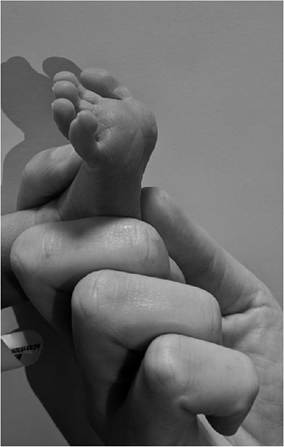
Figure 25.2 Grasping the foot prior to traction
with the first leg and can be grasped and both legs can then be delivered together. Sometimes the first leg delivers and the breech is visible, but the second leg is extended intra-utero: in this case, the breech is almost delivered and a hand can be passed into the vagina, the knee flexed, if needed, by popliteal fossa pressure and the leg delivered by a medial sweeping motion with the hand cupping the shin: the Pinard manoeuver (Aldolphe Pinard (18441934)). Once both legs and the breech are delivered the torso is gently grasped in a dry towel and steady traction is applied along the uterine axis: such traction should be slow and controlled. A nuchal arm is present in 0.5% of singleton breech deliveries and 9% of breech extractions - the higher incidence in breech extractions is likely due to the extraction process, present in one technique and not the other.6 Fast extraction is more likely to elevate the arm and make a nuchal arm more likely. Once both scapulae are visible Lovset's manoeuver is performed (Jorgen Lovset (1896-1981)), rotating the torso and sweeping each arm down separately for delivery of the shoulders: the torso is rotated 90 degrees to one side and the arm is swept medially to deliver the arm and the shoulder and then the procedure is repeated for the other side with a 180 degree rotation, after which the baby is returned to the back-up lie. The head then often delivers spontaneously. The Bracht manoeuver for delivery of the aftercoming head (Erich Bracht (1882-1969)) is where, once the torso is delivered, the fetal hips are grasped between two hands and elevated and rotated towards the mother's abdomen. If the head does not deliver spontaneously and the Bracht manoeuver is not to be performed, the baby's body can be supported on the accoucheur's dominant forearm while the Mauriceau Smellie Veit manoeuver is carried out for delivery of the fetal head.[II] In this procedure the index and forefinger of the operator's dominant hand are used to place flexing pressure on the baby's maxilla while the other hand is used to apply gentle traction to one of the baby's shoulders and can also apply digital pressure with the forefinger to the occiput (increasing the flexion vector). Both the Bracht manoeuver and the Mauriceau Smellie Veit manoeuver can be assisted with supra-pubic pressure: Crede's manoeuver (Carl Crede (1819-92)). A twin second breech delivery is very different than a singleton breech delivery. The pelvis has just delivered one baby and most of another. The aftercoming head is not the same challenge as it can be in a singleton. Forceps almost never need to be applied for the delivery of the fetal head in a second twin.
A breech baby can be delivered in the occiput posterior position, although less orthodox: the Prague manoeuver is for this situation where a hand is inserted into the vagina posteriorly to deliver the shoulders with a lifting upward rotational movement while supra-pubic pressure is applied to facilitate delivery of the head. A planned occiput posterior breech delivery is not recommended.
As noted, a nuchal arm may occur in as many as 9% of breech extractions. This can be dealt with by identifying on which side the nuchal arm is, then rotating the torso to that side, almost to the point of complete rotation, until the shoulder can be identified and the arm reduced by hooking a finger gently over the crook of the elbow and sweeping the arm downward and medially. If unsuccessful the manoeuver can be repeated with everincreasing rotation.
Cephalic/Oblique or Cephalic/Transverse
When the presenting twin is in the cephalic presentation and the second twin is oblique or transverse, careful consideration should be given to delivery planning. This constellation is where most problems or complications occur. An oblique lie can become a transverse lie after delivery of the first twin. If the back of the second fetus is towards the uterine fundus (back up) an internal podalic version and breech extraction can be relatively straightforward. If the fetal back is towards the accoucheur's hand (back down) delivery may be much more challenging (especially if the membranes rupture before a fetal foot is located). In this setting low amniotic fluid volume around the second twin will add to the degree of difficulty of manoeuvres. Such a fetus can be challenging to deliver even by caesarean section. In such cases many factors should be considered in the decision for planned mode of delivery (parity, estimated fetal weight discordance, amniotic fluid volume of the second twin, maternal BMI and provider experience). In these cases, where the fetal back is down, a planned caesarean delivery may not reflect a timid provider but rather demonstrate astute analysis and planning.
If an accoucheur does find themselves in the position of not being able to locate a fetal foot in a back-down transverse lie, the lie can sometimes be changed by cupping either pole of the fetus (head or foot) and attempting to change the lie with rotation. An external hand can aid the process by applying counter-rotational pressure to the opposite fetal pole.
Non-vertex Presenting Twin
The NICE guidelines recommend caesarean delivery for breech-presenting twins, and that is the practice at our hospital.2 However, there is past7 and recent literature8 studying planned vaginal delivery in this setting. If planned or in an emergency presentation (delivering at presentation) the presenting breech is delivered as per a singleton: a passive non-interventionalist approach is recommended. No traction is applied, some manipulation may be needed for the delivery of the legs, Lovset's manoeuver is used for delivery of the shoulders, and the Mauriceau Smellie Veit, Bracht manoeuver or forceps maybe needed for the aftercoming head. It is interesting that the primary reason for the caesarean delivery of breech-presenting twins is the rare incidence of locking of the heads, a phenomenon that cannot occur if the second baby is in the breech presentation.
Mode of Delivery in Triplets and Higher-Order Multiples
The evidence-based literature on triplet delivery is limited. A literature search on vaginal versus caesarean delivery of triplet pregnancy over the past 20 years where the data show the success rate of attempted vaginal delivery produces six studies. Four are very small case control or cohort studies and two are large studies. The four small studies amount to a total of 96 vaginal deliveries from 149 attempts (64%).9,10,11,12 One of these studies had a higher rate of maternal transfusion and a trend towards higher composite neonatal morbidity and did not support vaginal delivery.10 The remaining three were supportive of vaginal delivery. Of the two studies of larger numbers - a matched multiple birth database (1995-8) of 23,38113 and a cohort study of 38614 - the larger reported an increased risk of stillbirth (RR 5.7: 95% CI 3.63, 8.49), neonatal death (RR 2.83: 95% CI 1.91, 4.19) and infant death (RR 2.29 95% C11.61, 3.25) with planned vaginal delivery, and the smaller showed no advantage of Caesarean delivery. In short, in the past 20 years, one large, retrospective database study has shown planned caesarean delivery of triplets to be safer than planned vaginal delivery, one more modest-sized cohort study has shown no advantage, and three very small studies are supportive of vaginal delivery in this setting. A look into the more historic literature found five further controlled studies, the largest with a planned vaginal delivery group of 39. Both the numbers and ages of these studies have led to their not being included in this monologue. The remaining literature is cases series and reviews. There have been no randomised trials studying route of delivery in triplets to date. A synthesis of this data today makes it challenging to be a champion of planned vaginal delivery of triplet gestations.
A fundamental concern in modern obstetric practice for labouring triplet pregnancies is the issue of fetal monitoring in labour. If the standard of care in a unit is for twins to have continuous electronic fetal monitoring in labour, it should be the same for triplets. It is questionable whether continuous fetal heart traces of adequate quality can reliably be obtained for this population throughout labour. The shorter labours associated with multiparity and higher chance of success with a previous vaginal delivery would make this a preferred population for those obstetricians wanting to provide this service. From current twin practice, it would seem intuitive to limit the practice to pregnancies with a presenting triplet in the cephalic presentation, and a constellation of the manoeuvres listed earlier in this chapter can be used after the delivery of the first baby. Proponents of the practice often state that after the first delivery it is the same as twins; however, external manipulation after delivery of the first twin, with two fetuses still present, will be more challenging. Regardless of case selection, in an age of evidence-based medicine it would seem both from the paucity of data and the historical context of the literature reviewed here that if vaginal delivery of triplet pregnancy is to be carried out it would perhaps be most appropriately carried out in a prospective research setting with appropriate ethics approval and with a randomised design. There appears to be no literature reporting or advocating vaginal delivery of quadruplets and higher-order multiple pregnancies in the US National Institutes of Health's National Library of Medicine. As such, the topic is not be explored further here.
Uterine Incision
There is very little in the literature, and nothing with robust numbers or design, regarding optimal uterine incision in multiple pregnancy. Our preference is lower-segment transverse incision in both twins and triplets unless the lower segment is diminutive (such as in significant prematurity).
The Issues
The issue with twin delivery over the past 30 years has been the increased use of caesarean section. Our leading professional organisations and many champions in the field are supportive of offering vaginal delivery for those who so choose. As such, departments of obstetrics should be advocating vaginal delivery of twins. A number of resources and interventions are available to institute in an attempt to increase the percentage of twin mothers having vaginal deliveries. Resources for patient information and education in addition to real-time counselling by their obstetric care provider include handouts and internet sources. Aids to help obstetricians include a questionnaire needs assessment (to identify areas of concern or weakness), expert clinical lectures, clinical protocols, webpages with videos, simulation sessions, establishing a dedicated twin clinic and availability of an experienced back-up team. The simulation approach has proven successful in at least a trainee population.15 An experienced provider back-up programme may seem to be a challenging enterprise; however, our experience has been that expertise becomes swiftly adopted and multiplies quickly through the department. In our department such a programme changed the twin vaginal delivery rate from 32% to 44% over six years.
Key Points
• Current evidence shows no benefit of caesarean delivery if the presenting fetus is in the vertex presentation. A mother with twins with the first twin in the vertex presentation should be counselled on the safety of vaginal delivery.
• The data regarding safe delivery of triplet pregnancies are limited and the largest study supports planned caesarean delivery over planned vaginal delivery.
• Vaginal delivery of multiple pregnancies greater than triplets is not supported by scientific evidence.
• There are a number of different techniques for delivering twins and the accoucheur should be aware of all and use the most appropriate to the case and the moment.
• A programme of needs assessment, education, simulation and backup support can increase a hospital’s vaginal delivery rate of twins.
References
1. Caughey AB, Cahill AG, Guise JM et al. Safe prevention of the primary cesarean delivery. Am J Obstet Gynecol 2014;210:179-93.
2. Gibson JL, Castleman JS, Meher S, Kilby MD. Updated guidance for the management of twin and triplet pregnancies from the National Institute for Health and Care Excellence guidance, UK: what’s new that may improve perinatal outcomes? Acta Obstet Gynecol Scand 2020;99:147-52.
3. Leftwich HK, Zaki MN, Wilkins I, Hibbard JU. Labor patterns in twin gestations. Am J Obstet Gynecol 2013 Sep;209(3):254.e1-5.
4. Peaceman AL, Kuo L, Feinglass J. Infant morbidity and mortality associated with vaginal delivery in twin gestations. Am J Obstet Gynecol 2009;200:462 e1-6.
5. Houlihan C, Knuppel RA. Intrapartum management of multiple gestations. Clin Perinatol 1996;23:91-116.
6. Cheng M, Hannah M. Breech delivery at term: a critical review of the literature. Obstet Gynecol 1993 Oct;82(4 Pt 1):605-18.
7. Blickstein I, Goldman RD, Kuofermic M. Delivery of breech first twins: a multicenter retrospective study. Obstet Gynecol 2000;95:37-42.
8. Korb D, Goffinet F, Bretelle F et al. First twin in breech presentation and neonatal mortality and morbidity according to planned mode of delivery. Obstet Gynecol 2020 May;135(5):1015-23. https://doi.org/ 10.1097/AOG.0000000000003785
9. Alran S, Sibony O, Lutun D et al. Maternal and neonatal outcome of 93 consecutive triplet deliveries with 71% vaginal delivery. Acta Obstet Gynecol Scand 2004;83:554-9.
10. Lappen JR, Hackney DN, Bailit JL. Maternal and neonatal outcomes of attempted vaginal compared with planned cesarean delivery in triplet gestations. Am J Obstet Gynecol 2016;215:493e 1-6.
11. Peress D, Dude A, Peaceman A, Yee LM. Maternal and neonatal outcomes in triplet gestations by trial of labor versus planned cesarean delivery. J Matern Fet Neonatal Med 2019;32:1874-9.
12. Machtinger R, Sivan E, Maayan-Metzger A, Moran O, Kuint J, Schiff E. Perinatal, postnatal, and maternal outcome parameters of triplet pregnancy according to the planned mode of delivery: results of a single tertiary center. J Matern Fetal Neonatal Med 2011;24:91-5.
13. Vintzileos AM, Ananth CV, Kontopoulos E, Smulian JC. Mode of delivery and risk of stillbirth and infant mortality in triplet gestations: United States, 1995 through 1998. Am J Obstet Gynecol 2005;192:464-9.
14. Mol BW, Bergenhenegouwen L, Velzel J et al. Perinatal outcomes according to the mode of delivery in women with a triplet pregnancy in the Netherlands. J Matern Fetal Neonatal Med 2019;32:3771-7.
15. Easter SR, Gardner R, Barrett J, Robinson JN, Carusi D. Simulation to improve trainee knowledge and comfort with twin vaginal birth. Obstet Gynecol 2016;128:34s-39s.