Risks of prolonged pregnancy
Perinatal risk index
When expressed as risk per 1000 total births, the perinatal mortality rate raises after about 42 weeks (Figure 31.1, red circles). But such graphs mislead because the denominator for later deaths includes babies who are already safely delivered.
This makes no sense if we are concerned about stillbirth because a delivered baby cannot be stillborn. The correct denominator should be babies still undelivered at the particular gestational age. As this proportion falls after 37 weeks so the risk of stillbirth per undelivered baby starts to rise. But plotting only stillbirth risk is also misleading because babies may also die after birth from complications of labour or prematurity; delivery at 24 weeks would prevent all stillbirths but would hardly be sensible. The most informative data for the risks of prolonged pregnancy the rates of all deaths per 1000 undelivered babies by gestational age at delivery— the perinatal risk index (Figure 31.1, blue circles) (6). These show that the safest gestation to be born naturally is between 38 and 39 weeks.Macrosomia
Although fetal growth tends to level off after about 36 weeks, it is rarely flat. This means that the rate of babies born with a birth weight
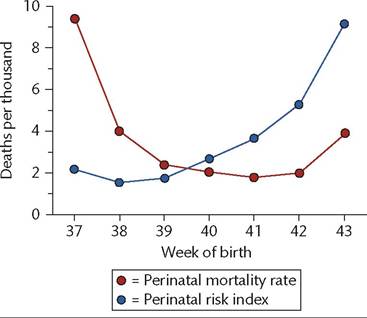
Figure 31.1 Risks of prolonged pregnancy.
Advanced maternal age
The overall cumulative risk of antepartum stillbirth throughout gestation (from 20 to 41 completed weeks) for women of all ages is 6.5 per 1000 pregnancies (12). The cumulative risks of stillbirth for women younger than 35 years, 35-39 years, and older than 40 years old were 6.2, 7.9, and 12.8 respectively.
The largest increase in cumulative risk of stillbirth for women over 35 years of age starts at 39 weeks and peaks at 41 weeks. Women over 40 years old have a similar stillbirth risk at 39 weeks as women who are between 25 and 29 years old at 41 weeks, and once they pass 40 weeks' gestation their risk of stillbirth exceeds that of all women less than 40 years old at term (12).