CHILD HEALTH INDICATORS IN INDIA
Knowledge of the vital statistics or health indicators in a population is important not only to know the present
TABLE 28.2: National Health Policy 2017 (Targets and Year of Achievement)
Disease elimination/control
*90% PLHA know their HIV status, 90% receive sustained antiretroviral therapy and 90% on antiretroviral therapy have viral suppression.
status but also to: (a) comparing the health status of two different populations, (b) assess the effectiveness of socioeconomic and cultural changes in a population as well as effectiveness of health interventions, and (c) identify the need for further high priority areas, requiring attention
Two most reliable sources of health indicators in India are: (a) National Family Health Surveys (NFHS) conducted country-wide every 5-7 years; and Sample Registration Surveys (SRS) conduced periodically in a pre-defined sample. Table 28.3 provides current status of some important health indicators related to child health in India.
Some important national health indicators are as follows: Infant mortality rate (IMR) is considered as the most reliable indicator of child health and MCH care in the community.
Definition: IMR is defined as quot;the ratio of deaths regis tered in a given year to the total number of live birthsquot;, expressed as a rate per 1000 live births, i.e.
IMR = Total deaths lt;1 year of age/Total live births ? 1000.
Current status: Current IMR in India is estimated to be
28/1000 live births (SRS 2020) or 35.2 (NFHS-5 2019-21),
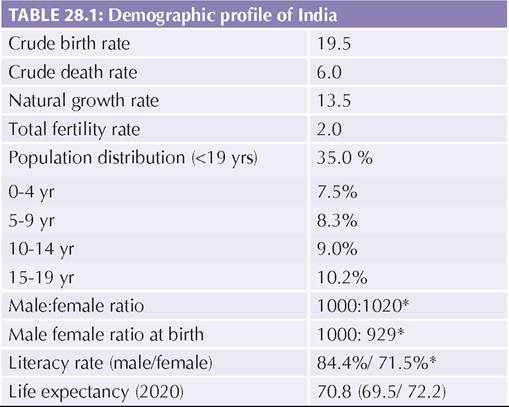
source: *SRS Statistical report 2022 (reference 2020 data)
**NFHS-5 Fact sheet 2021 (reference 2019-21 data)
as compared to the 5-8/1000 in developed countries.
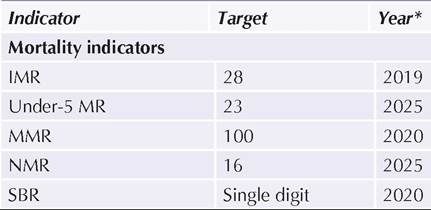
Within the country too, IMR varies from state to state and in urban vs. rural population due to socioeconomic and healthcare factors. IMR is lowest Puducherry and Kerala, moderate in Maharashtra and highest in Bihar and Chhattisgarh (Table 28.4).| #9632; | ||
| Social Pediatrics | 831 |
TABLE 28.5: Major causes of infant mortality in India
TABLE 28.4: States-wise distribution of key mortality indicators*
*Source: NFHS-5 Fact sheet 2021 (reference 2019-21 data)
Infancy includes two crucial periods of human life- neonatal period and post-neonatal period. IMR denotes a sum total of Neonatal mortality rate or NMR, i.e. deaths lt;28 days and Post-neonatal mortality rate or PNMR, i.e. deaths from 28 days 1 year (Ch 1.1). Analysis of data reveals that NMR accounts for gt; 70% of deaths in infancy. Interestingly, NMR is higher in males (? biologically
• Neonatal period
- Low birth weight and prematurity
- Birth asphyxia
- Congenital malformations
- Perinatal and neonatal infections
- Others: HDN, placental malformations
• Post-neonatal period
- Acute respiratory infections
- Diarrheal disorders
- Vaccine preventable diseases, e.g. measles
- Malnutrition
- Others: Accidents, congenital malformations
HDN: Hemolytic disease of newborn
fragile sex), while PNMR is higher in females due to sociocultural neglect.
Causes: Leading causes of infant mortality vary in neonatal and postneonatal period (Table 28.5). According to SRS report on causes of deaths 2017-2019, neonatal problems (53%), pneumonia (17%), diarrheal disease (5%) and other severe infections (4%) are leading cases of IMR in Indian children.
While most neonatal deaths are due to endogenous factors, e.g. prematurity, birth asphyxia and congenital malformations; majority of post-neonatal deaths may be attributed to exogenous factors, e.g.
infection and nutrition. As most of these post-neonatal deaths are preventable, the sharp decline in IMR during last century in India (204 in 1911 to 58 in 2006) is predominantly due to decline in PNMR (preventable), rather than NMR (difficult to prevent).Determinants: Infant mortality is multi-factorial in origin, affected by various biological, socioeconomic and environmental factors. Some important high-risk factors for IMR include:
• Biological factors: Low birth weight, maternal age lt;19 years or gt;30 years, first-born child, repeated pregnancies (gt;3rd birth order), short birth spacing (lt;1 year), etc.
• Socioeconomic factors: poverty, large family size, maternal illiteracy, girl child, illegitimate pregnancies, top feeding or other harmful customs/practices, etc.
• Environmentalfactors: overcrowding, lack of safe water supply, poor excreta disposal and hygiene, etc.
• Healthcare factors: unattended/untrained deliveries, inadequate perinatal care, poor immunization coverage, limited health care and IEC activities, specially in rural regions, etc.
Interventional strategies: A multi-pronged approach is essential to reduce IMR in a given population, comprising following main measures:
• General measures:
- Socioeconomic development of community
- Improvement in environmental sanitation
- Promotion of female literacy
- Preconception family planning
• Specific measures:
- Antenatal care
- Deliveries by trained birth attendants
- Breastfeeding
- Immunization for vaccine preventable diseases
- Growth monitoring and promotional activities
- Promotion of oral rehydration therapy
- Early diagnosis and treatment of illnesses
• Strengthening of primary health care to manage common problems and identify at-risk cases for referral.
Under-5 mortality rate (child mortality rate) is considered as the best single indicator of overall socioeconomic development and well-being of the community, as majority of its causes, e.g. malnutrition and infection are dependent on the socio-economic status, environmental hygiene and health awareness in the population.
Internationally, child mortality rate is defined as the annual deaths lt;5 years of age (IMR included) out of per 1000 live births in the same year. However, in India, it calculated as annual deaths lt;5 years of age out of per 1000 under-5 children.
In India, Under-5 mortality has shown exemplary decline in last few decades (242 in 1960 to 32 in 2020 as per SRS or 41.9 as per NFHS-5), largely due to decline in IMR and reduction in vaccine-preventable deaths.
Leading cause of childhood mortality beyond infancy include Injuries (218%), Pneumonia (18%), noncommunicable diseases (14%) and diarrheal diseases 13%. (SRS-COD report 2017-19)
Two other important child health indicators Neonatal Mortality rate (NMR) or Perinatal Mortality rate (PNR) have been discussed in Ch 12.2.
28.3
More on the topic CHILD HEALTH INDICATORS IN INDIA:
- Agrawal M.. Textbook of Pediatrics. 3rd ed. — CBS Publishers,2025. — 973 p., 2025
- FREE RADICALS IN HEALTH AND DISEASE
- INDIA NEWBORN ACTION PLAN (INAP)
- CONCLUDING REMARKS