CONCLUDING REMARKS
There has been a remarkable improvement in the availability of information for distributive analysis in the last decades due to increasing efforts by researchers, national governments, and international organizations.
To be sure, the picture of inequality and poverty in the developing world is substantially sharper now than in the late 1990s, when the first volume of this Handbook was written. There remain, however, enormous data limitations that make that picture only a very rough approximation of reality. Household surveys are lacking in some countries and are carried out very occasionally in others. Changes in methodology over time are frequent, a fact that generally implies improvement in the data collection, but that at the same time introduces comparability issues with previous surveys that are difficult to deal with. Household surveys have endemic problems in capturing some income and consumption items and in dealing with selective compliance and underreporting issues. The gaps with National Accounts aggregates, usually variable over time, are a disturbing sign of measurement errors. Comparability across countries is another big problematic issue; there are few efforts among national agencies to standardize surveys or at least some criteria to gather and process information. Another issue of concern is the difficulty in obtaining statistical confidence intervals for the distributive statistics, either because agencies do not report them, or do not provide information on sampling issues, or do not release the microdata.[572] In sum, to be able to characterize and track distributive changes with more accuracy, we need more efforts to extend the coverage and frequency of household surveys and improve their reliability and comparability across countries. There is still a long way to go to get an accurate assessment of poverty and inequality in the developing world.From the data available, some general facts emerge. High poverty and inequality are pervasive characteristics of the developing world, but are not immutable features of these economies. The evidence suggests a robust decline in the levels of absolute income poverty in the developing world, driven mainly by East Asia in the 1980s and 1990s and generalized to the rest of the developing countries in the 2000s. Income poverty has been reduced in most countries and in the world as whole, making the achievement of the first MDG possible. Despite these positive results, there are reasons for concern. The task of fighting poverty continues to be very challenging: Around 1.2 billion people survive with less than $1.25 a day, an extremely low standard. Also, most of the people who succeeded in jumping the $1.25 line in the last decades are still poor by the standards of middle-income developing countries and remain highly vulnerable if economic conditions worsen. Moreover, due to economic growth, concerns about relative poverty may be increasingly important, and the evidence in that sense is less optimistic.
The evidence on relative income inequality suggests that on average the developing countries are somewhat more unequal than three decades ago. The patterns have been different by period and region. Inequality rose in the late 1980s and in the 1990s; the changes were larger in Eastern Europe and Central Asia, probably as a result of the transition from a central-planned to a more market-oriented economy; in East Asia, likely as a consequence of the economic takeoff; and in Latin America probably as the result of recurrent macroeconomic crises and some structural transformations. Distributive changes became more equalizing in the 2000s, but the changes were rather moderate and with considerable heterogeneity across countries. In fact, in this decade of widespread social improvement around a third of the countries did not experience falling inequality levels. Reducing inequality certainly remains a top concern in the developing world.
ACKNOWLEDGMENT
F. A. is with Nuffield College and INET-Oxford, Paris School ofEconomics and CONICET; L. G. is with Centro de Estudios Distributivos, Laborales y Sociales (CEDLAS), Facultad de Ciencias Econcomicas, Universidad Nacional de La Plata, and CONICET. This chapter was completed while L. G. was visiting professor at the University of British Columbia. We are grateful to participants to the conference “Recent Advances in the Economics of Income Distribution” (Paris), the AAEP Meetings (Rosario), Thomas Piketty, and especially Anthony Atkinson and Francois Bourguignon, for valuable comments and suggestions. We are also grateful to DavidJaume, Dario Tortarolo, Carolina Lopez, Julian Amendolag- gine, Santiago Garganta, Florencia Pinto, Pablo Gluzmann, Leopoldo Tornarolli, Javier Alejo, Juan Zoloa, and Carolina Garcia Domench (all at CEDLAS) for outstanding research assistance. We alone are responsible for any errors. Financial support from the ESRC-DFID joint fund and INET is gratefully acknowledged.
APPENDIX
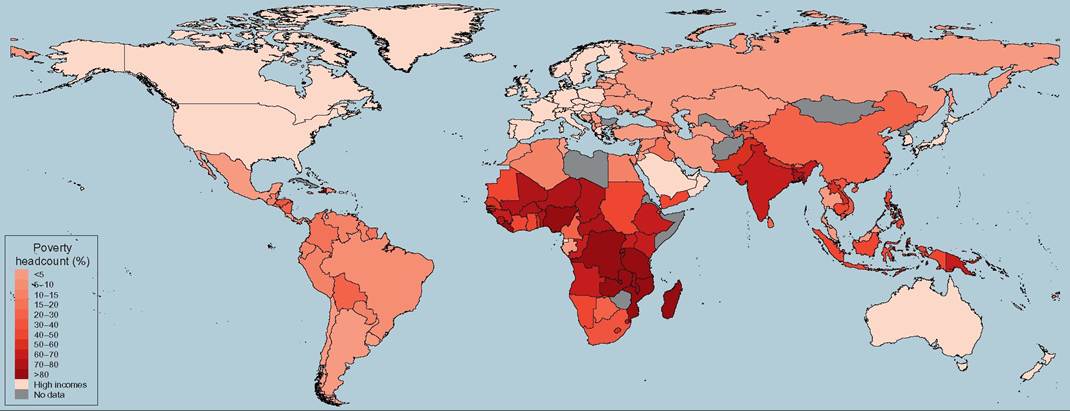
Figure A.1 Mapofpoverty in the developing world, circa 2010. Note: Poverty computed over the distribution of consumption/income per capita with the PPP-adjusted $2-a-day line. Source: Own calculations based on PovcalNet (2013).
| Countries | Pop. | Data |
| East Asia and Pacific | ||
| American Samoa | 0.066 | |
| Cambodia | 13.823 | X |
| China | 1324.655 | X |
| Fiji | 0.844 | X |
| Indonesia | 234.951 | X |
| Kiribati | 0.097 | |
| Korea, Dem. Rep. | 24.126 | |
| Lao | 6.022 | X |
| Malaysia | 27.502 | X |
| Marshall Islands | 0.053 | |
| Micronesia | 0.110 | X |
| Mongolia | 2.667 | X |
| Myanmar | 47.250 | |
| Palau | 0.020 | |
| Papua New Guinea | 6.549 | |
| Philippines | 90.173 | X |
| Samoa | 0.182 | |
| Solomon Islands | 0.510 | |
| Thailand | 68.268 | X |
| Timor-Leste | 1.078 | X |
| Tonga | 0.103 | |
| Tuvalu | 0.010 | |
| Vanuatu | 0.228 | |
| Vietnam | 85.122 | X |
Eastern Europe and Central Asia
| Albania | 3.181 | X |
| Armenia | 3.079 | X |
| Azerbaijan | 8.763 | X |
| Belarus | 9.602 | X |
| Bosnia and Herzegovina | 3.774 | X |
| Bulgaria | 7.623 | X |
| Croatia | 4.434 | X |
| Czech Republic | 10.424 | X |
| Estonia | 1.341 | X |
| Georgia | 4.384 | X |
| Hungary | 10.038 | X |
| Kazakhstan | 15.674 | X |
| Kosovo | 1.747 | |
| Kyrgyz Republic | 5.319 | X |
| Latvia | 2.266 | X |
| Lithuania | 3.358 | X |
| Countries | Pop. | Data |
| Macedonia | 2.053 | X |
| Moldova | 3.570 | X |
| Montenegro | 0.629 | X |
| Poland | 38.126 | X |
| Romania | 21.514 | X |
| Russian Federation | 141.950 | X |
| Serbia | 7.350 | X |
| Slovak Republic | 5.407 | bgcolor=white>X|
| Slovenia | 2.021 | X |
| Tajikistan | 6.691 | X |
| Turkey | 70.924 | X |
| Turkmenistan | 4.918 | X |
| Ukraine | 46.258 | X |
| Uzbekistan | 27.303 | X |
Latin America and the Caribbean
| Antigua and Barbuda Argentina | 0.087 39.714 | X |
| Belize | 0.322 | X |
| Bolivia | 9.618 | X |
| Brazil | 191.543 | X |
| Chile | 16.796 | X |
| Colombia | 45.006 | X |
| Costa Rica | 4.522 | X |
| Cuba | 11.267 | |
| Dominica | 0.068 | |
| Dominican Republic | 9.665 | X |
| Ecuador | 14.057 | X |
| El Salvador | 6.130 | X |
| Grenada | 0.104 | |
| Guatemala | 13.691 | X |
| Guyana | 0.752 | X |
| Haiti | 9.736 | X |
| Honduras | 7.303 | X |
| Jamaica | 2.687 | X |
| Mexico | 110.627 | X |
| Nicaragua | 5.636 | X |
| Panama | 3.406 | X |
| Paraguay | 6.230 | X |
| Peru | 28.463 | X |
| St. Kitts and Nevis | 0.051 | |
| St. Lucia | 0.170 | X |
| St. Vincent and G. | 0.109 |
Continued
Table A.1 List of developing countries by region and population, 2010—cont'd
Countries Pop. Data
| Suriname | 0.515 | X |
| Trinidad and Tobago | 1.331 | X |
| Uruguay | 3.334 | X |
| Venezuela | 27.935 | X |
Middle East and North Africa
| Algeria | 34.428 | X |
| Djibouti | 0.856 | X |
| Egypt | 78.323 | X |
| Iran | 72.289 | X |
| Iraq | 30.178 | X |
| Jordan | 5.787 | X |
| Lebanon | 4.167 | |
| Libya | 6.150 | |
| Morocco | 31.321 | X |
| Syria | 19.638 | X |
| Tunisia | 10.329 | X |
| West Bank and Gaza | 3.937 | X |
| Yemen | 22.627 | X |
South Asia
| Afghanistan | 32.518 | |
| Bangladesh | 145.478 | X |
| Bhutan | 0.701 | X |
| India | 1190.864 | X |
| Maldives | 0.308 | X |
| Nepal | 28.905 | X |
| Pakistan | 167.442 | X |
| Sri Lanka | 20.217 | X |
Sub-Saharan Africa
| Angola | 18.038 | X |
| Benin | 8.356 | X |
| Botswana | 1.955 | X |
| Burkina Faso | 15.515 | X |
| Burundi | 7.943 | X |
| Cameroon | 18.759 | X |
| Cape Verde | 0.487 | X |
| Central African R. | 4.238 | X |
| Chad | 10.654 | X |
| Comoros | 0.697 | X |
| Congo, Dem. R. | 62.475 | X |
| Congo, Rep. | 3.836 | X |
| Cote d’Ivoire | 18.987 | X |
| Countries | Pop. | Data |
| Eritrea | 4.948 | |
| Ethiopia | 79.446 | X |
| Gabon | 1.450 | X |
| Gambia | 1.636 | X |
| Ghana | 23.264 | X |
| Guinea | 9.559 | X |
| Guinea-Bissau | 1.454 | X |
| Kenya | 38.455 | X |
| 2.127 | X | |
| Liberia | 3.658 | X |
| Madagascar | 19.546 | X |
| Malawi | 14.005 | X |
| Mali | 14.460 | X |
| Mauritania | 3.295 | X |
| Mauritius | 1.269 | |
| Mozambique | 22.333 | X |
| Namibia | 2.200 | X |
| Niger | 14.450 | X |
| Nigeria | 150.666 | X |
| Rwanda | 10.004 | X |
| Sao Tome amp; P. | 0.160 | X |
| Senegal | 11.787 | X |
| Seychelles | 0.087 | X |
| Sierra Leone | 5.612 | X |
| Somalia | 8.922 | |
| South Africa | 48.793 | X |
| South Sudan | 8.977 | |
| Sudan | 32.438 | X |
| Swaziland | 1.032 | X |
| Tanzania | 42.268 | X |
| Togo | 5.777 | X |
| Uganda | 31.339 | X |
| Zambia | 12.380 | X |
| Zimbabwe | 12.452 |
Note: An “X” in the Data column marks that the country has distributive information in PovcalNet. Source: Population (in millions) is taken from the United Nations Demographic Yearbook.
REFERENCES
Acar, S., Dogruel, F., 2012. Sources of inequality in SelectedMENA countries. Struct. Chang. Econ. Dyn. 23 (3), 276-285.
Adams, R., 2004. Economic growth, inequality and poverty: estimating the growth elasticity of poverty. World Dev. 32 (12), 1989-2014.
AdamsJr., R., Page, J., 2003. Poverty, inequality and growth in selected Middle East and North Africa countries, 1980-2000. World Dev. 31 (12), 2027-2048.
Ahluwalia, M., Cartner, N., Chenery, H., 1979. Growth and poverty in developing countries. J. Dev. Econ. 6 (3), 299-341.
Ahuja, V., Bidani, B., Ferreira, F., Walton, M., 1997. Everyone’s miracle? Revisitingpoverty andinequality in East Asia. Directions in Development. The World Bank, Washington, D.C.
Alatas, V., Bourguignon, F., 2000. The evolution of the distribution of income during Indonesian fast growth: 1980-1996. Princeton University, Princeton (unpublished).
Alejo, J., 2012. Educacion y Desigualdad: una metodologia de descomposicieon basada en dos interpreta- ciones de la ecuacieon de Mincer. Evidencia para Argentina. In: Anales de la XLVII Reunicon Anual de la Asociacicon Argentina de Economia Politica, Trelew, Argentina.
Alejo, J., Bergolo, M., Carbajal, F., 2013. Las Transferencias Phblicas y su impacto distributivo: La Experi- encia de los Paises del Cono Sur en la decada de 2000. CEDLAS working paper 141 (February, 2013).
Altimir, O., 1979. La Dimensieon de la pobreza en America Latina. Cuadernos de la CEPAL, vol. 27. United Nations, Santiago.
Altimir, O., 1996. Cambios de la desigualdad y la pobreza en la America Latina. Trimest. Econ. 61 (1), 85-133.
Alvaredo, F., Cano, L., Can personal tax records be used to study income concentration in Ecuador? (Forthcoming).
Alvaredo, F., 2011. A note on the relationship between top income shares and the gini coefficient. Econ. Lett. 110 (3), 274-277.
Alvaredo, F., Atkinson, A.B., 2010. Colonial Rule, Apartheid and Natural Resources: Top Incomes in South Africa 1903-2007, CEPR DP 8155; series updated in the World Top Incomes Database.
Alvaredo, F., Londofio, J.V., 2013. High Incomes and Personal Taxation in a Developing Economy: Colombia 1993-2013, Commitment to Equity-CEQ Working Paper n. 12.
Alvaredo, F., Piketty, T., 2014. Measuring Top Incomes and lnequality in the Middle East: Data Limitations and Illustration with the Case of Egypt. Working paper 832, The Economic Research Forum (ERF) 2014, Egypt.
Amiel, Y., Cowell, F., 1999. Thinking About Inequality: PersonalJudgment and Income Distributions. Cambridge University Press, Cambridge.
Anand, S., Kanbur, R., 1993. The Kuznets process and the inequality-development relationship. J. Dev. Econ. 40, 25-52.
Anand, S., Segal, P., 2008. What do we know about global income inequality? J. Econ. Lit. 46 (1), 57-94. Anderson, E., 2005. Openness and inequality in developing countries: a review of theory and recent evidence. World Dev. 33 (7), 1045-1063.
Aron, J., Kahn, B., Kingdon, G., 2009. South Africa Economic Policy under Democracy. Oxford University Press, Oxford.
Artadi, E., Sala-i-Martin, X., 2003. The Economic Tragedy of the XXth Century: Growth in Africa, NBER Working Paper 9865.
Asian Development Bank (ADB), 2012. Asian Development Outlook 2012. Confronting Rising Inequality in Asia. ADB, Mandaluyong City, Philippines.
Asian Development Bank, 2012a. Key Indicators for Asia and the Pacific 2012, 43rd ed. Asian Development Bank, Mandaluyong City, Philippines.
Asian Development Bank, 2012b. Asian Development Outlook 2012. Confronting Rising Inequality in Asia. ADB. Mandaluyong City, Philippines.
Atkinson, A., 1987. On the measurement of poverty. Econometrica 55 (4), 749-764.
Atkinson, A., Bourguignon, F., 2001. Poverty and inclusion from a world perspective. In: Stiglitz, J.E., Muet, P.A. (Eds.), Governance, Equity and Global Markets. Oxford University Press, Oxford.
Atkinson, A., Brandolini, A., 2001. Promise and pitfalls in the use of “secondary” data-sets: income inequality in OECD countries as a case study. J. Econ. Lit. 39 (3), 771—799.
Atkinson, A., Brandolini, A., 2004. Global world inequality: absolute, relative or intermediate? In: Paper Presented for the 28th Generation Conference of the International Association for Research in Income and Wealth, Cork, Ireland.
Atkinson, A., Brandolini, A., 2010. On analyzing the world distribution of income. World Bank Econ. Rev. 24 (1), 1-37.
Atkinson, A.B., Lugo, M.A., 2010. Growth, Poverty and Distribution in Tanzania, LSE Research Online Documents on Economics. London School of Economics and Political Science, LSE Library.
Atkinson, A., Marlier, E., 2010. Income and Living Conditions in Europe. Eurostat Statistical Books, Publication Office of European Union, Luxembourg.
Atkinson, A.B., Micklewright, J., 1992. Economic Transformation in Eastern Europe and the Distribution of Income. Cambridge University Press, Cambridge. Cambridge Books.
Atkinson, A.B., Morelli, S., 2011. Economic Crisis and Inequality, Human Development Research Paper 2011/06, UNDP.
Atkinson, A.B., Morelli, S., 2012. Chartbook ofEconomic Inequality: 25 Countries 1911-2010. No 15, INET Research Notes. Institute for New Economic Thinking (INET).
Atkinson, A.B., Piketty, T., 2007. Top Incomes Over the Twentieth Century: A Contrast Between Continental European and English-Speaking Countries. Oxford University Press, Oxford, UK.
Atkinson, A.B., Piketty, T. (Eds.), 2010. Top Incomes: A Global Perspective. Oxford University Press, Oxford.
Azevedo, J., Inchauste, G., Sanfelice, V., 2011. Decomposing the Recent Inequality Decline in Latin America. World Bank, manuscript.
Banerjee, A., Duflo, E., 2003. Inequality and growth: what can the data say? J. Econ. Growth 8 (3), 267-299.
Banerjee, A., Piketty, T., 2010. Top Indian incomes 1922-2000. In: Atkinson, A.B., Piketty, T. (Eds.), Top Incomes: A Global Perspective. Oxford University Press, Oxford, pp. 1-39, Chapter 1.
Barros, R.P., Carvalho, M., Franco, S., Mendoqa, R., 2006. Uma analise das principais causas da queda recente na desigualdade de renda brasileira. Rev. Econ. 8 (1), 117-147.
Barros, R., de Carvalho, M., Franco, S., Mendonqa, R., 2010. Markets, the state, and the dynamics of inequality in Brazil. In: Llt;5pez Calva, L., Lustig, N. (Eds.), Declining inequality in Latin America: A decade of progress?. Brookings Institution and UNDP.
Bastagli, F., Coady, D., Gupta, S., 2012. Income Inequality and Fiscal Policy, IMF Staff Discussion Note, SDN/12/08, June.
Benabou, R., 1996. Inequality and growth. NBER macroeconomics annual 1996, vol. 11, NBER. (Chapter in NBER book NBER Macroeconomics Annual 1996, Volume 11 (1996), Ben S. Bernanke and Julio J. Rotemberg, Editors (p. 11-92), Conference held March 8-9, 1996, Published in January 1996 by MIT Press, in NBER Book Series NBER Macroeconomics Annual.).
Besley, T., Burgess, R., 2003. Halving global poverty. J. Econ. Perspect. 17 (3), 3-22.
Bhalla, S., 2002. Imagine There’s No Country: Poverty, Inequality and Growth in the Era of Globalization. Institute for International Economics. Washington, D.C.
Bibi, S., Nabli, M., 2010. Equity and inequality in the Arab Region: Policy Research Report 33. Economic Research Forum. Cairo, Egypt.
Bigsten, A., Shimeles, A., 2003. Prospect for Pro-Poor Growth Strategies in Africa, WIDER Research Paper 42/2004.
Birdsall, N., Nellis, J., 2003. Winners and losers: assessing the distributional impact of privatization. World Dev. 31 (10), 1617-1633.
Bleaney, M., Nishiyama, A., 2003. Convergence in inequality: differences between advanced and developing countries. Econ. Bull. 4, 1-10.
Bourguignon, F., 2003. The growth elasticity of poverty reduction: explaining heterogeneity across countries and time periods. In: Eichler, T., Turnovsky, S. (Eds.), Inequality and Growth: Theory and Policy Implications. MIT Press, Cambridge, MA, pp. 2-26.
Bourguignon, F., Bussolo, M., 2012. Income distribution and computable general equilibrium models: macro-micro modelling. In: Dixon, Peter B., Jorgenson, Dale W. (Eds.), In: Handbook of Computable General Equilibrium Modeling, vol. 1A. North Holland Press.
Bourguignon, F., Morrison, C., 2002. Inequality among world citizens: 1820-1992. Am. Econ. Rev. 92 (4), 727-744.
Bourguignon, F., Levin, V., Rosenblatt, D., 2004. Declining international inequality and economic divergence: reviewing the evidence through different lenses. Econ. Int. 100, 13-25.
Bourguignon, F., Ferreira, F., Lustig, N., 2005. The Microeconomics of Income Distribution Dynamics in East Asia and Latin America. The World Bank, Washington, DC.
Bourguignon, F., Bussolo, M., Pereira da Silva, L., 2008a. The Impact of Macroeconomic Policies on Poverty and Income Distribution. Macro-Micro Evaluation Techniques and Tools. The World Bank, Washington, DC.
Bourguignon, F., Ferreira, F., Leite, P., 2008b. Beyond OaxacaBlinder: accountingfordifferences inhouseholds income distributions. J. Econ. Inequal. 6 (2), 117-148.
Burkhauser, R., Feng, S., Jenkins, S., Larrimore, J., 2012. Recent trends in top income shares in the United States: reconciling estimates from March CPS and IRS Tax Return Data. Rev. Econ. Stat. 94 (2), 371-388.
Cameron, L., 2002. Growth with or without equity? The distributional impact of Indonesian development. Asia. Pac. Econ. Lit. 16, 1-17.
Caselli, F., Michaels, G., 2013. Do oil windfalls improve living standards? Evidence fromBrazil. Am. Econ.J. 5 (1), 208-238.
Caselli, F., Esquivel, G., Lefort, F., 1996. Reopening the convergence debate: a new look at cross-country growth empirics. J. Econ. Growth 1, 363-389.
Chakravarty, S., 1987. Development Planning: The Indian Experience. Oxford University Press, New Delhi. Chen, S., Ravallion, M., 2001. How did the world’s poorest fare in the 1990s? Rev. Income Wealth 47 (3), 283-300.
Chen, S., Ravallion, M., 2008. China is Poorer than We Thought, but no Less Successful in the Fight against Poverty. World Bank Policy Research Working Paper No. 4621.
Chen, S., Ravallion, M., 2010. The developing world is poorer than we thought, but no less successful in the fight against poverty. Q. J. Econ. 125 (4), 1577-1625.
Chen, S., Ravallion, M., 2012. More Relatively-Poor People in a Less Absolutely-Poor World, The World Bank Policy Research Working Paper 6114.
Chotikapanich, D., Valenzuela, R., Prasada Rao, D., 1997. Global and regional inequality in the distribution of income: estimation with limited and incomplete data. Empir. Econ. 22 (4), 533-546.
Christiansen, L., Demery, L., Paternostro, S., 2002. Growth, Distribution and Poverty in Africa: Messages from the 1990s, The World Bank Policy Research Paper 2810.
Chusseau, N., Hellier, J., 2012. Globalization and Inequality: Where do We Stand? ECINEQ Working Paper 279.
Cockburn, J., Duclos, J., Zabsonre, A., 2012. Is the Value of Humanity Increasing? A Critical-Level Enquiry, FERDI Working Paper 52.
Conte, A., Vivarelli, M., 2007. Globalization and Employment: Imported Skill Biased Technological Change in Developing Countries, IZA Discussion Paper 2797.
Cornia, G., 1996. Transition and Income Distribution: Theory, Evidence and Initial Interpretation, UNU- WIDER Research in Progress 1.
Cornia, G., 2011. Economic integration, inequality and growth: Latin America vs. the European economies in transition. Rev. Econ. Inst. 2 (2), 1-31
Cornia, G., Kiiski, S., 2001. Trends in Income Distribution in the Post-WorldWar II Period: Evidence and Interpretation, UNU-WIDER Discussion Paper, 2001/89.
Cornia, G., Reddy, S., 2001. The Impact of Adjustment Related Social Funds on Income Distribution and Poverty, UNU/WIDER Discussion Paper 2001/1.
Cruces, G., Gasparini, L. 2012. Politicas sociales para la reduccion de la desigualdad y la pobreza en America Latina y el Caribe. Diagncastico, propuesta y proyecciones en base a la experiencia reciente. Premio FundacicanVidanta 2012, Contribucionesalareduccion de lapobrezayla desigualdad enAmerica Latina y el Caribe, Fundacieon Vidanta, Mexico.
Cruces, G., Garcia Domench, C., Gasparini, L., 2014. Inequality in education: evidence for Latin America. In: Cornia, G. (Ed.), Falling Inequality in Latin America. Policy Changes and Lessons. Oxford University Press, pp. 318-339.
Datt, G., Ravallion, M., 1992. Growth and redistribution components of changes in poverty measures: a decomposition with applications to Brazil and India in the 1980s. J. Dev. Econ. 38 (2), 275—295.
Deaton, A., 1997. The Analysis of Household Surveys: A Microeconometric Approach to Development Policy. The World Bank, Washington, DC.
Deaton, A., 2003. How to monitor poverty for the millennium development goals. J. Hum. Dev. 4 (3), 353-378.
Deaton, A., 2005. Measuringpoverty inagrowingworld (ormeasuring growth inapoorworld). Rev. Econ. Stat. 87 (1), 1-19.
Deaton, A., 2010. Price indexes, inequality, and the measurement of world poverty. Am. Econ. Rev. 100 (1), 5-34.
Deaton, A., Dupriez, O., 2008. Poverty PPPs Around the World: An Update and Progress Report. Development Data Group, World Bank, Washington, D.C.
Deaton, A., Heston, A., 2010. Understanding PPPs and PPP-based national accounts. Macroeconomics 2 (4), 1-35.
Deaton, A., Zaidi, S., 2002. Guidelines for Constructing ConsumptionAggregates forWelfare Analysis. The World Bank, Living Standards Measurement Study Working Paper 135.
De Ferranti, D., Perry, G., Ferreira, F., Walton, M., 2004. Inequality in Latin America, Breaking with History? The World Bank, Washington, DC.
Deininger, K., Squire, L., 1996. A new data set measuring income inequality. World Bank Econ. Rev. 10 (3), 565-591.
Devarajan, S., Nabi, I., 2006. Economic Growth in South Asia: Promising, Un-Equalizing,...Sustainable? The World Bank South Asia Region, Washington, D.C.
Dhongde, S., Miao, X., 2013. Cross-Country Convergence in Income Inequality, ECINEQ Working Papers 290.
Dhongde, S., Minoui, C., 2010. Global Poverty Estimates: Present and Future, ECINEQ Working Papers 181.
Dollar, D., Kraay, A., 2002. Growth is good for the poor. J. Econ. Growth 7 (3), 195-225.
Dollery, B., 2003. A history of inequality in South Africa, 1652-2002. South African Journal of Economics, Economic Society of South Africa 71 (3), 595-610, 09.
Essama-Nssah, B., 2012. Identification of Sources ofVariation in Poverty Outcomes, The WorldBankPolicy Research Working Papers 5954.
Feenstra, R., 2008. Offshoringin the global economy: lecture 1: microeconomic structure; lecture 2: macroeconomic implications. In: The Ohlin Lectures, presented at the Stockholm School of Economics on September 17-18, 2008.
Ferreira, F., 1999. Economic transition and the distributions of income and wealth. Econ. Transit. 7 (2), 377-410.
Ferreira, F., 2010. Distributions in Motion: Economic Growth, Inequality, and Poverty Dynamics, The World Bank Policy Research Working Paper 5424.
Ferreira, F.H.G., Paes de Barros, R., 1999. The slippery slope: explaining the increase in extreme poverty in Urban Brazil, 1976-1996. Brazilian Review of Econometrics 19 (2), 211-296.
Ferreira, F.H.G., Leite, P.G., Litchfield, J.A., 2006. The Rise and Fall of Brazilian Inequality: 1981-2004. World Bank Policy Research Working Paper 3867. World Bank, Washington, DC.
Ferreira, F.H.G., Leite, P.G., Wai-Poi, M., 2007. Trade Liberalization, Employment Flows and Wage Inequality in Brazil. Research Paper, UNUWIDER, United Nations University (UNU), No. 2007/58.
Ferreira, F., Ravallion, M., 2009. Poverty and inequality: the global context. The Oxford Handbook of Economic Inequality. Oxford University Press, Oxford.
Ferreira, F., Leite, P., Wai-Poi, M., 2010. Trade liberalization, employment flows, and wage inequality in Brazil. In: Nissanke, M., Thorbecke, E. (Eds.), The Poor Under Globalization in Asia, Latin America and Africa. Oxford University Press, Oxford.
Fields, G., 2002. Distribution and Development: A New Look at the Developing World. MIT Press, Cambridge.
Fiszbein, A., Schady, N., 2009. Conditional cash transfers. Reducing present and future poverty: The World Bank Policy Research Report.
Fleisher, B.M., Sabirianova, K., Wang, X., 2005. Returns to skills and the speed of reforms: evidence from Central and Eastern Europe, China, and Russia. J. Comp. Econ. 33 (2), 351—370.
Foguel, M., Azevedo, J.P., 2007. Uma decomposi^ao da desigualdade de rendimentos no Brasil: 1984—2005. In: Barros, R., Foguel, M., Ulyssea, G. (Eds.), Desigualdade de Renda no Brasil: uma analise da queda recente. IPEA, Brasilia.
Forbes, K., 2011. Inequality in Crisis and Recovery: Revealing the Divides: The Case ofBrazil. International Labour Organization, ILO Working Papers 469849.
Fortin, N., Lemieux, T., Firpo, S., 2011. Decomposition methods in economics. In: Ashenfelter, O., Card, D. (Eds.), In: Handbook of Labor Economics, vol. 4, Part A.
Fosu, A., 2009. Inequality and the impact of growth on poverty: comparative evidence for Sub-Saharan Africa. J. Dev. Stud. 45 (5), 726—745.
Fosu, A., 2010. The Global Financial Crisis and Development: Whither Africa? UNU-WIDER Working Paper 2010/124.
Fosu, A., 2011. Growth, Inequality, and Poverty Reduction in Developing Countries. Recent Global Evidence, UNU-WIDER Working Paper 2011/1.
Galbraith,J., Kum, H., 2005. Estimating the inequality of household incomes: toward a dense and consistent global data set. Rev. Income Wealth 51 (1), 115-143.
Garcia, M., Moore, C., 2012. The Cash Dividend: The Rise of Cash Transfer Programs in Sub-Saharan Africa. The World Bank, Washington, DC.
Gasparini, L., Gluzmann, P., 2012. Estimating income poverty and inequality from the Gallup World Poll: the case of Latin America and the Caribbean. J. Income Distrib. 21 (1), 3-27
Gasparini, L., Lustig, N., 2011. The rise and fall of income inequality in Latin America. In: Ocampo, J.A., Ros, J. (Eds.), The Oxford Handbook of Latin American Economics. Oxford University Press, Oxford, Chapter 27.
Gasparini, L., Cruces, G., Tornarolli, L., 2011a. Recent trends in income inequality in Latin America. Economia 10 (2), 147-201.
Gasparini, L., Galiani, S., Cruces, G., Acosta, P., 2011b. Educational Upgrading and Returns to Skills in Latin America: Evidence from a Supply-Demand Framework, 1990-2010, IZA Discussion paper 6244.
Gasparini, L., Cicowiez, M., SosaEscudero, W., 2013. Pobrezay desigualdadenAmericaLatina. Conceptos, herramientas y aplicaciones. Editorial Temas. Buenos Aires, Argentina.
Gentilini, U., Sumner, A., 2012. Poverty Where People Live: What do National Poverty Lines Tell Us About Global Poverty? International Policy Centre for Inclusive Growth Working Paper 98.
Gertler, P., 2004. Do conditional cash transfers improve child health? Evidence from PROGRESA’s control randomized experiment. Am. Econ. Rev. 94 (2), 336-341.
Ghani, E., 2010. The Poor Half Billion in South Asia. What is Holding Back Lagging Regions? Oxford University Press, Published in India by Oxford University Press, New Delhi.
Gluzmann, P., 2012. Desigualdad del ingreso y del bienestar subjetivo. Analisis y comparaciones internacio- nales. PhD dissertation, Universidad Nacional de La Plata.
Go, D., Nikitin, D., Wang, X., Zou, H., 2007. Poverty and inequality in Sub-Saharan Africa: literature survey and empirical assessment. Ann. Econ. Fin. Soc. 8 (2), 251-304.
Gofii, E., Lopez, H., Serven, L., 2008. Fiscal Redistribution and Income inequality in Latin America. Policy Research Working Paper 4487, World Bank.
Goldberg, P., Pavcnik, N., 2007. Distributional effects of globalization in developing countries. J. Econ. Lit. 45 (1), 39-82.
Gorodnichenko, Y., Sabirianova, K., 2005. Returns to schooling in Russia and Ukraine: a semiparametric approach to cross-country comparative analysis. J. Comp. Econ. 33 (2), 324-350.
Gosh, J., 2012. Unequal in Asia. Frontline 29 (15), 127-128, Jul 28-Aug 10.
Harrison, A., McLaren, J., McMillan, M., 2011. Recent perspectives on trade and inequality. Annu. Rev. Econom. 3 (1), 261-289.
Hellier, J., Lambrecht, S., 2012. Inequality, Growth and Welfare: The Main Links, ECINEQ Working Paper 258.
Helpman, E., Trajtenberg, M., 1998. A time to sow and a time to reap: growth based on general purpose technologies. In: Helpman, E. (Ed.), General Purpose Technologies and Economic Growth. MIT Press, Cambridge.
Heston, A., Summers, R., Aten, B., 2012. Penn World Table Version 7.1, Center for International Comparisons of Production, Income and Prices at the University of Pennsylvania, July.
Hoffmann, R., 2006. Queda da desigualdade da distribuiqao de renda no Brasil, de 1995 a 2005, e delimi- taqao dos relativamente ricos em 2005. In: Barros, R., Foguel, M., Ulyssea, G. (Eds.), Desigualdade de Renda no Brasil: uma analise da queda recente. IPEA, Brasilia.
Hussain, A., 2008. Power Dynamics, Institutional Instability and Economic Growth: The Case of Pakistan. The Asia Foundation.
IDB, 1999. America Latina frente a la desigualdad. Informe de Progreso Economico y Social, Banco Interamericano de Desarrollo.
ILO, 2010. World Social Security Report 2010/11: Providing Coverage in Times of Crisis and Beyond. International Labour Office, Geneva.
Inchauste, G., Olivieri, S., Saavedra, J., Winkler, H., 2012. What is Behind the Decline in Poverty Since 2000? Evidence from Bangladesh, Peru and Thailand, The World Bank Policy Research Working Paper 6199.
Iqbal, F., 2006. Sustaining Gains in Poverty Reduction and Human Development in the Middle East and North Africa. The World Bank, Washington, DC.
Ivaschenko, O., 2002. Growth and Inequality: Evidence from Transitional Economies, CESIFO Working Paper 746.
Jain, S., 1975. Size Distribution of Income. A Compilation of Data. The World Bank, Washington, DC. Jomo, K.S., Baudot, J., 2007. Flat World, Big Gaps. Economic Liberalization, Globalization and Inequality. Zed Books, London.
Kakwani, N., 2000. On measuring growth and inequality components of poverty with application to Thailand. J. Quant. Econ. 16, 67-68.
Kakwani, N., Subbarao, K., 1990. Rural poverty and its alleviation in India. Econ. Polit. Wkly. 25 (3), 2-16
Kanbur, R., Sumner, A., 2011. Poor Countries or Poor People? Development Assistance and the New Geography of Global Poverty, Cornell University Working Paper 2011-08.
Karshenas, M., 2003. Global poverty: national accounts based versus survey based estimates. Dev. Chang. 34 (4), 683-712.
Khan, A.R., 2008. Measuring inequality and poverty in Bangladesh: an assessment of the survey data. Bangl. Dev. Stud. 31 (3/4), 1-34.
Klasen, S., 1997. Poverty, inequality and deprivation in South Africa: an analysis of the 1993 SALDRU survey. Soc. Indic. Res. 41 (1-3), 51-94.
Klasen, S., 2005. Measuring poverty and deprivation in South Africa. Rev. Income Wealth 46 (1), 33-58.
Korinek, A., Mistiaen, J., Ravallion, M., 2006. Survey nonresponse and the distribution of income. J. Econ. Inequal. 4 (2), 33-55
Kraay, A., 2006. When is growth pro-poor? Evidence from a panel of countries. J. Dev. Econ. 80 (1), 198-227.
Kuznets, S., 1955. Economic growth and income inequality. Am. Econ. Rev. 45 (1), 1-28.
Langoni, C.G., 2005. Distribuiqao de Renda e Desenvolvimento Economico no Brasil. Editora FGV, Rio de Janeiro.
Leibbrandt, M., Woolard, I., Woolard, C., 2009. A long-run perspective on contemporary poverty and inequality dynamics. In: Aron, J., Kahn, B., Kingdon, G. (Eds.), South Africa Economic Policy Under Democracy. Oxford University Press, Oxford, Chapter 10.
Leibbrandt, M., Woolard, I., McEwen, H., Koep, C., 2010a. Better employment to reduce inequality further in South Africa. In: OECD, Tackling Inequalities in Brazil, China, India and South Africa: The Role of Labour Market and Social Policies. OECD Publishing.
Leibbrandt, M., Woolard, I., Finn, A., Argent, J., 2010b. Trends in South African Income Distribution and Poverty since the Fall of Apartheid, OECD Social, Employment and Migration Working Papers n. 101.
Leigh, A., 2007. How closely do top income shares track other measures of inequality? Econ. J. 117, F619-F633.
Lewis, A., 1954. Economic development with unlimited supplies of labor. Manch. Sch. Econ. Soc. Stud. 22, 139-192.
Li, H., Squire, L., Zou, H., 1998. Explaininginternational andintertemporalvariations in income inequality. Econ. J. 108 (446), 26-43.
Li, S., Chuliang, L., Sicular, T., 2013. Overview: income inequality and poverty in China, 2002-2007. In: Shi, L., Sato, H., Sicular, T. (Eds.), Rising Inequality in China: Challenge to the Harmonious Society. Cambridge University Press, New York.
Lind, J., Mehlum, H., 2010. With or without U? The appropriate test for a U shaped relationship. Oxf. Bull. Econ. Stat. 72 (1), 109-118.
Loayza, N., Raddatz, C., 2010. The composition of growth matters for poverty alleviation. J. Dev. Econ. 93 (1), 137-151.
Londof#953;o,J., Szekely, M., 2000. Persistentpoverty and excess inequality: LatinAmerica, 1970-1995.J. Appl. Econ. 3 (1), 93-134.
Lopez Calva, L., Lustig, N. (Eds.), 2010. Declining Iinequality in Latin America: A Decade of Progress? Brookings Institution and UNDP.
Lustig, N., 1990. Economic crisis, adjustment and living standards in Mexico, 1982-85. World Dev. 18 (10), 1325-1342.
Lustig, N., 1995. Coping with Austerity: Poverty and Inequality in Latin America. Brookings Institution, Washington, DC.
Lustig, N., 2012. Fiscal Policy and Income Redistribution in Latin America: Challenging the Conventional Wisdom, Tulane University Economics Working Paper 1124.
Lustig, N., Lopez-Calva, F., Ortiz-Juarez, E., 2012. Declining Inequality in Latin America in the 2000s: The Cases of Argentina, Brazil, and Mexico. Working paper 307, Center for Global Development.
Mahmoudi, V., 2001. Growth-Equity Decomposition ofa Change in Poverty: An Application to Iran. University of Essex, Colchester, UK.
Mazundar, D., 2012. Decreasing poverty and increasing inequality in India. In: OECD, (Ed.), Tackling Inequalities in Brazil, China, India and South Africa: The Role of Labour Market and Social Policies. OECD Publishing, pp. 157-207, Chapter 4.
McGrath, M.D., 1983. The Distribution of Personal Income in South Africa in Selected Years over the Period from 1945 to 1980. PhD thesis, University of Natal, Durban.
McGrath, M.D., Whiteford, A., 1994. The Distribution of Income in South Africa. Human Science Research Council, Pretoria.
Milanovic, B., 1998. Income, Inequality, and Poverty During the Transition from Planned to Market Economy. World Bank Regional and Sectoral Studies, The World Bank, Washington, DC.
Milanovic, B., 1999. Explaining the increase in inequality during transition. Econ. Transit. 7 (2), 299-341.
Milanovic, B., 2002. True world income distribution, 1988 and 1993: first calculation based on household surveys alone. Econ. J. 112 (476), 51-92.
Milanovic, B., 2003. Is Inequality in Africa Really Different? The World Bank Policy Research Working Paper 3169.
Milanovic, B., 2005. Worlds Apart: Measuring International and Global Inequality. Princeton University Press, Princeton.
Milanovic, B., 2012. Global Income Inequality by the Numbers: History and Now. An Overview, The World Bank Policy Research Working Paper 6259.
Milanovic, B., Ersado, L., 2010. Reform and Inequality During the Transition. An Analysis using Panel Household Survey Data, 1990-2005. UNU/WIDER Working Paper 62.
Minoiu, C., Reddy, S.G., 2008. Chinese poverty: assessing the impact of alternative assumptions. Rev. Income Wealth 54 (4), 572-596.
Miranti, R., Vidyattama, Y., Hansnata, E., Cassells, R., Duncan, A., 2013. Trends in Poverty and Inequality in Decentralising Indonesia, OECD Social, Employment and Migration Working Papers No. 148.
Mitra, P., Yemtsov, R., 2006. Increasing Inequality in Transition Economies: Is There More to Come? The World Bank Policy Research Working Paper 4007.
Moradi, A., Baten, J., 2005. Inequality in Sub-Saharan Africa: new data and new insights from anthropometric estimates. World Dev. 33 (8), 1233-1265.
Mosberger, P., 2014. Capital and Labor: Top Income Shares in Hungary, 1915-2010. PhD thesis.
Nattrass, N., Seekings, J., 1997. Citizenship and welfare in South Africa: deracialisation and inequality in a labour-surplus economy. Can. J. Afr. Stud. 31 (3), 452-481.
Nissanke, M., Thorbecke, E. (Eds.), 2010. The Poor Under Globalization in Asia, Latin America and Africa. Oxford University Press, Oxford, UK.
Okojie, C., Shimeles, A., 2006. Inequality in Sub-Saharan Africa. The Inter-Regional Inequality Facility. DFID, London.
Page,J., 2007. Boom, bust, and the poor: poverty dynamics in the Middle East and NorthAfrica, 1970-1999. Q. Rev. Econ. Finance 46 (5), 832-851.
Palma, J., 2011. Homogeneous Middles vs. Heterogeneous Tails, and the End of the “Inverted-U”: the Share of the Rich is What it's all About, Cambridge Working Papers in Economics 1111.
Parker, S., Skoufias, E., 2001. Conditional cash transfers and their impact on child work and school enrollment: evidence from the PROGRESA program in Mexico. Economia 2 (1), 45-96
Paukert, F., 1973. Income distribution at different levels of development: a survey of evidence. Int. Labour Rev. 108, 97-125.
Piketty, T., Qian, N., 2010. Income inequality and progressive income taxation in China and India, 19862015. In: Atkinson, A.B., Piketty, T. (Eds.), Top Incomes: A Global Perspective. Oxford University Press, Oxford and New York.
Pinkovskiy, M., 2013. World welfare is rising: estimation using nonparametric bounds on welfare measures. J. Public Econ. 97 (1), 176-195.
Pinkovskiy, M., Sala-i-Martin, X., 2009. Parametric Estimations of the World Distribution of Income, NBER Working Paper 1543.
Pissarides, C., 1997. Learning by trading and the returns to human capital in developing countries. World Bank Econ. Rev. 11 (1), 17-32.
PovcalNet, 2013. PovcalNet: An Online Poverty Analysis Tool. The World Bank. http://go.worldbank. org#8725;WE8P1I8250.
Rama, M., 2003. Globalization and Workers in Developing Countries, The World Bank Policy Research Working Paper 2958.
Ravallion, M., 1997. Can high-inequality developing countries escape absolute poverty? Econ. Lett. 56 (1), 51-57.
Ravallion, M., 2001. Growth, inequality and poverty: looking beyond averages. World Dev. 29 (11), 1803-1815.
Ravallion, M., 2003. Inequality convergence. Econ. Lett. 80 (3), 351-356.
Ravallion, M., 2004. Competing Concepts of Inequality in the Globalization Debate, The World Bank Policy Research Working Paper 3243.
Ravallion, M., 2007. Inequality is bad for the poor. In: Jenkins, S., Micklewright, J. (Eds.), Inequality and Poverty Re-Examined. Oxford University Press, Oxford.
Ravallion, M., 2010. Price Levels and Economic Growth: Making Sense of the PPP Changes Between ICP Rounds, The World Bank Policy Research Working Paper 5229.
Ravallion, M., 2012. Why don’t we see poverty convergence? Am. Econ. Rev. 102 (1), 504-523.
Ravallion, M., Chen, S., 1997. What can new survey data tell us about recent changes in distribution and poverty? World Bank Econ. Rev. 11 (2), 357-382.
Ravallion, M., Chen, S., 2007. China’s (uneven) progress against poverty. J. Dev. Econ. 82 (1), 1-42.
Ravallion, M., Chen, S., 2011. Weakly relative poverty. Rev. Econ. Stat. 93 (4), 1251-1261.
Ravallion, M., Datt, G., van de Walle, D., 1991. Quantifying absolute poverty in the developing world. Rev. Income Wealth 37 (4), 345-361.
Ravallion, M., Chen, S., Sangraula, P., 2009. Dollar a day revisited. World Bank Econ. Rev. 23 (2), 163-184.
Reddy, S., Pogge, T., 2010. How not to count the poor. In: Anand, S., Segal, P., Stiglitz, J. (Eds.), Debates on the Measurement of Poverty. Oxford University Press, Oxford.
Robinson, J., 2009. The Political Economy of Inequality, ERF Working Paper 493.
Sala-i-Martin, X., 2006. The world distribution of income: falling poverty and... convergence, period. Q. J. Econ. 121 (2), 351-397.
Sala-i-Martin, X., Pinkovskiy, M., 2010. African Poverty is Falling... Much FasterthanYou Think! NBER Working Paper 15775.
Salehi-Isfahani, D., 2010. Human Development in the Middle East and North Africa, UNDP Human Development Research Paper 2010/26.
SEDLAC, 2013. Socio-Economic Database for Latin America and the Caribbean. CEDLAS and the World Bank. http://sedlac.econo.unlp.edu.ar/eng/index.php.
Sen, A., 1976. Real national income. Rev. Econ. Stud. 43 (1), 19—39.
Sen, A., 1983. Poor, relatively speaking. Oxf. Econ. Pap. 35 (2), 153-169.
Sharma, M., Inchauste, G., Feng,J., 2011. Rising Inequality with High Growth and Falling Poverty. An Eye on East Asia and Pacific, vol. 9, The World Bank, Washington, D.C.
Shorrocks, A., Wan, G., 2008. Ungrouping income distributions: synthesising samples for inequality and poverty analysis. In: Basu, K., Kanbur, R. (Eds.), The Oxford Handbook of Arguments for a Better World: Essays in Honor of Amartya Sen. In: Ethics, Welfare and Measurement, vol. I. Oxford University Press, Oxford.
Simai, M., 2006. Poverty and Inequality in Eastern Europe and the CIS Transition Economies, DESA Working Paper No. 17.
Simkins, C., 1991. The Urban Foundation Income Distribution Model: Phase One. Urban Foundation, Johannesburg, Mimeo.
Skoufias, E., Suryahadi, A., 2000. Changes in Regional Inequality and Social Welfare in Indonesia Between 1996 and 1999, Working Paper, Social Monitoring and Early Response Unit (SMERU) Research Institute, Jakarta.
Soares, S., Guerreiro Oslt;5rio, R., Veras Soares, F., Medeiros, M., Zepeda, E., 2009. Conditional cash transfers in Brazil, Chile and Mexico: impacts upon inequality. Estudios Econcomicos, niamero extraordinario 0 (Special issue), 207-224.
Solt, F., 2009. Standardizing the world income inequality database. Soc. Sci. Q. 90 (2), 231-242.
Standing, G., Vaughan-Whitehead, D., 1995. Minimum Wages in Central and Eastern Europe: From Protection to Destitution. International Labour Office. Central and Eastern European Team, Budapest, Central European University Press.
Sumner, A., 2012. From Deprivation to Distribution: Is Global Poverty Becoming a Matter of National Inequality? IDS Working Paper 2012-394.
Szekely, M., Hilgert, M., 1999. What’s Behind the Inequality We Measure: An Investigation using Latin American Data, Inter-American Development Bank, Research Department Working Paper.
Terreblanche, S., 2002. A History of Inequality in South Africa, 1652-2002. University of Natal Press, Pietermaritzburg.
Tinbergen, J., 1975. Income Differences: Recent Research. North Holland Press, Amsterdam.
Todd, P., Wolpin, K., 2006. Assessing the impact of a school subsidy program in Mexico: using a social experiment to validate a dynamic behavioral model of child schooling and fertility. Am. Econ. Assoc. 96 (5), 1384-1417.
van der Berg, S., Louw, M., 2004. Changing patterns of South African income distribution: towards time series estimates of distribution and poverty. S. Afr. J. Econ. 72 (3), 546-572.
Van de Walle, N., 2008. The Institutional Origins of Inequality in Sub-Saharan Africa, Cornell University Mario Einaudi Center for International Studies Working Paper 6-08.
Veras Soares, F., Perez Ribas, R., Guerreiro Osoe rio, R., 2007. Evaluating the Impact of Brazil’s Bolsa Familia: Cash Transfer Programmes in Comparative Perspective. International Poverty Centre, IPC Evaluation Note 1, 2007.
Voitchovsky, S., 2009. Inequality, growth and sectoral change. In: Salverda, W., Nolan, B., Smeeding, T.M. (Eds.), Oxford Handbook of Economic Inequality. Chapter 22.
Whiteford, A., Van Seventer, D., 2000. South Africa’s changing income distribution in the 1990s. Stud. Econ. Econ. 24 (3), 7-30.
WIDER, 2008. World Income Inequality Database. User Guide and Data Sources. UNU-WIDER, Helsinki.
Winters, A., McCulloch, N., McKay, A., 2004. Trade liberalization and poverty: the evidence so far. J. Econ. Lit. 42, 72-115.
Wodon, Q., Castro, R., Lee, K., 2001. Poverty in Latin America: trends (1986-1998) and determinants. Cuad. Econ. 38 (114).
Wood, A., 1997. Openness and wage inequality in developing countries: the Latin American challenge to East Asian conventional wisdom. World Bank Econ. Rev. 11 (1), 33—57.
World Bank, 1990. World Development Report 1990: Poverty. The World Bank, Washington D.C.
World Bank, 2000. World Development Report: Attacking Poverty. Oxford University Press, New York.
World Bank, 2005. ECAPOV II. Growth, Poverty and Inequality in Eastern Europe and Former Soviet Union. The World Bank, Washington, DC.
World Bank, 2006a. World Development Report: Equity and Development. World Bank and Oxford University press. Washington, D.C.
World Bank, 2006b. Can South Asia Reduce Poverty in a Generation? http://go.worldbank.org/ NF9FFJTM20.
World Bank, 2008. Global purchasing power parities and real expenditures. In: 2005 International Comparison Program. The World Bank, Washington, DC.
World Bank, 2009. The World Development Report 2009: Reshaping Economic Geography. The World Bank, Washington, DC.
Zin, R.H.M., 2005. Income distribution in East Asian developing countries: recent trends. Asia. Pac. Econ. Lit. 19 (2), 36-54.
This page intentionally left blank
More on the topic CONCLUDING REMARKS:
- Concluding Remarks
- CONCLUDING REMARKS
- Concluding Remarks
- Backhouse Roger, Baujard Antoinette. Welfare Theory, Public Action, and Ethical Values: Revisiting the History of Welfare Economics. Cambridge University Press,2021. — 301 p., 2021
- Concluding comment
- Oberauer Norbert, Prief Yvonne, Qubaja Ulrike (eds.). Legal Pluralism in Muslim Contexts. Brill,2019. — x, 258 p., 2019
- Harker C., Horschelmann K. (Eds.). Conflict, Violence and Peace. Springer,2017. — 456 p., 2017
- Endnotes
- Abeyratne Rehan. The Law and Politics of Unconstitutional Constitutional Amendments in Asia. Routledge,2021. — 311 p., 2021
- Some Concluding Observations