Contribution of Phonatory Dysfunction to Speech Disorders
Speech disorders related to phonatory dysfunction are generally classified as voice disorders, and include dysphonia (abnormal voice quality) and aphonia (loss of voice). Dysphonia is an impairment of voice secondary to cranial nerve involvement, laryngeal pathology or tracheostomy, and is characterized by varying degrees of breathiness, harshness, and vocal strain.
Dysphonia may be a prominent feature of dysarthria related to cranial nerve involvement. Laryngeal pathologies resulting in dysphonia may include polyps, granulomas, nodules, or other lesions affecting the vocal fold mucosa. A common vocal fold trauma resulting in dysphonia is traumatic intubation following serious injury requiring assisted ventilation.Articulation/Resonance
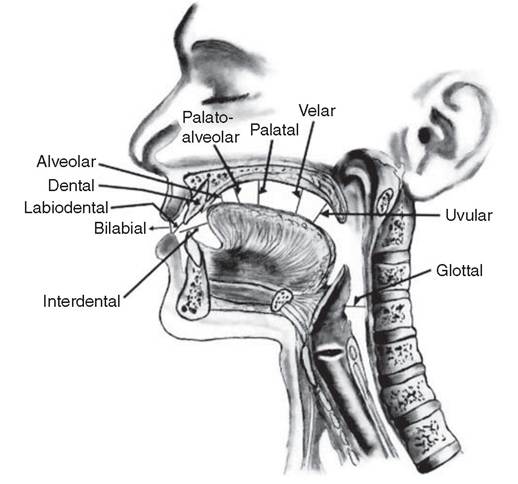
The articulatory/resonatory system is composed of the structures of the oral and nasal cavities, which modulate the airstream into the acoustic waveforms perceived as speech. Articulators responsible for production of speech sounds include the lips, tongue, and palate.
In addition to the placement of articulators, successful production of accurate speech sounds requires adequate functioning of the oral and nasal cavities as resonating chambers (resonance). Modulation of the airstream by these structures is a complex process that relies on intact structures as well as precise neuromuscular coordination. Fig. 4.3 illustrates where various articulators are located, as well as places of articulation for various speech sounds. Impairment in one or more of these components is likely to result in a disorder of articulation/resonance.