Ground Ambulance Operations
Most patient transport activity occurs in ground ambulances traveling short distances. Ground ambulance operations pose serious transportation hazards. In fact, the vast majority of vehicular crashes involving transport teams occur with ground ambulances.
It is a surprise to many involved in medical transport that the ground ambulance vehicle is not built by the automotive safety industry, nor is it required to be subjected to automotive occupant protection safety testing for the occupants of the rear compartment beyond the captain's chair.Unlike passenger vehicles, ground ambulances are not built by the automotive industry, but rather, are constructed by after-market retrofitted. Thus, ground ambulances of the “box chassis” design, such as the standard ambulance vehicles and the larger freightliner trucks, do not have crumple zones or injury biomechanics or occupant-protection technical expertise integrated into the design and construction of the rear compartment. Furthermore, there are limited, if any, safety performance standards for the occupants of an ambulance rear compartment. Ambulance vehicles are exempt from the Federal Motor Carrier Safety Administration (FMCSA) oversight as well as much of the Federal Motor Vehicle Safety Standards (FMVSS). Thus, in such a setting, it is paramount that the people responsible for medical direction and oversight of a patient transport fleet are aware of the key issues that pertain to transport safety, have a comprehensive understanding of effective safety strategies and solutions, and know how to implement them.
In addition to the issues mentioned previously pertaining to vehicle design and lack of safety performance standards, there is one other very key issue that separates ground transport from air transport from a safety perspective. When an air medical vehicle has a crash, the majority of the fatalities and injuries are in the air medical vehicle; however, when a ground ambulance crashes, two thirds of the fatalities are not in the ambulance but are members of the public, usually completely unrelated to the transport.
It is for this reason that is paramount that a comprehensive approach is taken to system safety, dispatch policies, and ground transport safety performance and safety data management that address the system as a whole for the patients, providers, and the public.
Key initiatives to optimize safety for ground transport (Table 9.1), not unlike air transport, are focused on a systems approach to safety and risk management. This includes ground vehicle selection for safer, more compact vehicles with nonhostile interiors; practical policies on vehicle operation; integration of intelligent transportation systems (ITS) technology for fleet and driver performance monitoring and feedback (in vehicle telematics); use of personal protective equipment (PPE) that addresses identified injury hazards; and implementation of a structured safety program with formal safety management oversight. A number of innovative pediatric transport services across the United States and internationally have adopted this systems-based approach rather than just focusing on the pediatric patient in isolation.
The recently developed American National Standards Institute/ American Society of Safety Engineers Z15.1 Fleet Safety Standard (Table 9.2) is possibly the only nationally approved safety standard in the United States that is now applicable to the safety management of ground emergency medical services (EMS) vehicle fleets and that proscribes accepted formulae for recording transport system safety data. It is likely that the implementation of this standard will provide more emphasis on EMS vehicle safety, enhance data collected regarding EMS vehicle safety, and assist in bringing EMS vehicle safety more in line with state-of-the-art automotive safety practices.
Table 9.1: Key Points for Optimizing Ground Patient Transport Safety Management
| Safety Management: | |
| Fleet Management | Safety program ANSI/ASSE Z.15 Fleet safety monitoring and feedback |
| Practice and Policy | Tiered dispatch Safe driving policy and practice Seat belt use policy—for providers, patients, and passengers Stop at red lights, stop signs Telematics based driver/vehicle performance monitoring and feedback devices Impaired and distracted driver management plan Emergency vehicle operator training (EVOC, etc) Secure all equipment Use portable communications Notify driver if rear occupants are in vulnerable positions |
| Vehicle Safety and PPE: | |
| Occupant Protection | Compact OEM vehicles, ie vans Nonhostile interiors Crumple zones Ideally—forward and rearward facing seating Lock down positions for routine equipment Use of age-appropriate child restraints secured to stretcher Seat belts for all seated occupants Over-shoulder belts for all patients on the stretcher |
| Operational design PPE | Attention to ergonomics—patient and equipment in easy reach Minimize lifting and moving hazards Head protection Visibility—providers and vehicles Biohazard protection |
PPE indicates personal protective equipment.
Forward- and rear-facing seating are identified by the automotive safety experts as optimal in the rear patient compartment for attendants. Any occupant restraint device that is complex to secure, or worse, encourages the occupant to stand or move about in a vehicle in motion, should be avoided. Pediatric patients, if medically appropriate, should be in age-appropriate car safety seats secured to the stretcher, with ideally at least 2 belt paths in the line of force (ie, horizontally) and one vertically between the bottom of the car seat and the stretcher (Fig 9.1). If the child's age indicates a need for
159
Table 9.2: Transport Safety Performance Data Capture as Outlined in the ANSI Z.15 Standard
| Sample Incident Rates and Methods of Calculation Incident rates should be based on all motor vehicle incidents occurring during the reporting period. Rates should be updated periodically as revisions are made to the database. Incidents may be tracked on a rolling interval (eg, rolling 12-month) in order to accumulate additional exposure units. | |
| Incident rate based on number of vehicles operated: | Incident rate = Number of incidents x 100 Number of vehicles |
| Incident rate based on vehicle mileage: | Incident rate = Number of incidents x 1,000,000 Vehicle mileage |
| Injury incident rate based on vehicle mileage: | Injury incident rate = Number of incidents with injury x 1,000,000 Vehicle mileage |
| Incident rates based on service activity: | Incidents per 10,000 deliveries = Number of incidents x 10,000 Number of transports |
| Motor vehicle passenger injury rates: Or a rate based on vehicle mileage: | Passenger injury incident rate = No. of incidents resulting in passenger injury x 1,000,000 Number of passengers carried |
| Motor vehicle injury rates based on work hours: | Vehicle incidents per 200,000 hours = Number of incidents x 200,000 Number of hours worked |
Adapted from Levick.
SAFETY
Fig 9.1.
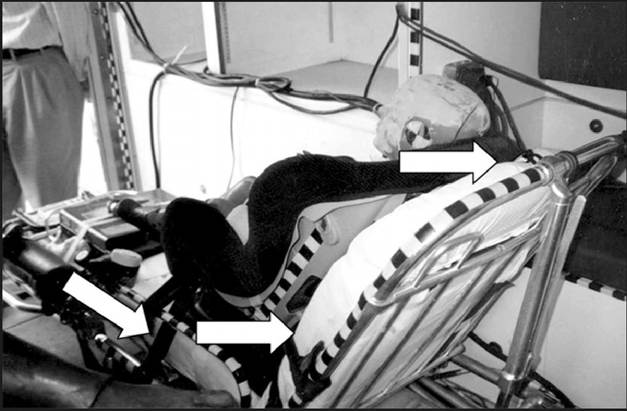
Two horizontally oriented belt paths and one vertical belt path for securing the car safety seat to a stretcher. (Photo, EMS Safety Foundation, Nadine Levick, MD, MPH)
a car safety seat but the child is intubated and ventilated and/or cannot be managed medically in a car seat, then having the child in a full-body immobilization device secured to the stretcher may be preferable.
In any situation in which the restraint of the child or any other occupant is suboptimal, this must be factored into the risks taken, and driving style should be modified to attempt to mitigate this risk. For example, an unsecured adult occupant in the rear compartment is a serious projectile risk to a child passenger. Children should not be transported on the rear-facing captain's chair for a number of reasons. First, this is the optimal seat for a provider to access the airway of the patient on the stretcher. Second, if the child is placed in the captain's chair, then an adult provider must be forced into another less optimal seating position, which may further compromise system safety. Third, if a child is placed in the rear-facing captain's chair and that child needs any form of medical attention, then the provider of that care is unrestrained and at risk to himself/herself and others. Fourth, if the child is restrained in the captain's chair, then he or she is at substantial risk from any loose projectiles (because that is the direction any projectiles will fly), from which he or she would have no protection. Also, if there were a second patient on the stretcher and that patient were to slide forward, even in a sudden deceleration, he or she would strike the unprotected child in the head and chest.
Numerous devices are available that are stated by their manufacturers to be effective for pediatric patient occupant protection in the ambulance environment; however, independent data regarding these devices are lacking. It appears from the limited independent technical data available that a routine car safety seat secured to the stretcher provides effective age-appropriate occupant protection for pediatric patients, and for the older child, being secured to the stretcher with shoulder belts and 2 horizontal belts (ideally and if medically appropriate) with the head of the stretcher at 45 degrees upright provides effective protection.
Neonatal transport incubators are not only very heavy, they are also complex to secure safety, and there have been a number of tragic events and enough testing to highlight the inevitable outcome of a crash involving a neonatal ground transport units. While driving, emergency response teams should minimize sudden decelerations, especially when transporting neonates. In many parts of the world outside the United States, ground neonatal transport utilizes compact vans, which are not only crashworthy (ie, relatively well able to handle a crash), but also have a much smoother ride and better ergonomics for providing patient care more safely (Fig 9.2).
Access to the patient while seated is a constant challenge in larger EMS trucks, hence the preference for the more crashworthy and ergonomic compact vans. For the larger ground transport trucks, the design of a seat that slides toward the patient can offer enhanced access to the patient while still allowing medical personnel to remain securely belted in the seat.
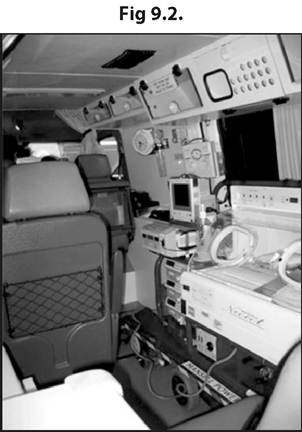
Forward- and rear-facing seating in an Australian dedicated pediatric/neonatal transport vehicle (Photo EMS Safety Foundation, Nadine Levick, MD, MPH)
The peer-reviewed literature on automotive safety engineering testing conducted for the EMS environment has clearly identified the benefit of using existing restraints (lap belts) for all seated occupants, preferentially to have forward- and rear-facing seating; the importance of over-the-shoulder belts for the recumbent patient (with the stretcher back in an upright or 45-degree angle when medically acceptable); and the need to firmly secure all equipment at all times.
Studies have also specifically identified hostile interior surfaces and hazardous head strike zones, poor design and interior layout of the rear compartment, and a noncrashworthy rear compartment, as well as a need for head protection. Additionally, high-visibility clothing will optimize the safety of providers at an emergency scene and should be a routine practice for all providers.Various accepted air medical practices (eg, ensuring and confirming before ‘take off that all equipment and passengers are safely secured) can be effectively translated for the ground ambulance setting to optimize ground transport safety. In addition, should any occupants become vulnerable or unsecured during transport (ie, to attend to specific patient care needs), it is important to notify the driver of the vehicle of this situation immediately so that he or she can drive with extra caution until the occupant is again secured. Currently, it appears that the reverse practice occurs in ground ambulance transport, with largely predictable consequences.
It is crucial for the leadership of a pediatric patient transport service to reach out to the diverse transport partners with whom their service collaborates to have an integrated working relationship with the decision makers. A close and trusting relationship among the leadership, air and ground personnel, and management is essential. Many services do not have a dedicated ground fleet, so working closely with the ground fleet partners on a regular basis to ensure that safety expectations are well outlined and understood is a valuable practice. The smooth and consistent translation of safety practice and oversight from air to ground should equally address patient and provider safety as well as public safety.
Conclusions
In summary, in contrast to the safety culture and the comprehensive safety oversight of air medical transport, the ground ambulance component is lacking in both national safety standards and safety oversight. Therefore, it is important that the pediatric transport medical director be familiar with the risks and hazards involved in ground transport and have the knowledge and resources to minimize these hazards and optimize safety, with design and practice as well as policy aspects. Transport safety is part of a system of safety for the patient, provider, and public.
Risks and hazards that have been identified include failure to use seatbelts for providers and other seated occupants, failure to use over-the- shoulder belts for the patient, and failure to secure equipment. Additionally, there are current challenges in the design, layout, and crashworthiness of ambulance vehicles. Other risks identified relate to excessive speed, the use of lights and sirens, failure to stop the vehicle at a stop sign or red light, and driver performance history.
There are now numerous effective solutions available to address safety technology, practice, and policy as well as optimized design. Use of technologies, such as in-vehicle telemetry monitoring and feedback devices to optimize safe driving and vehicle handling, have been demonstrated to be highly effective.
Implementation of a comprehensive safety program and basic policies— such as those that ensure optimal use of seatbelts, safe driving practices, strict intersection safety policies, and policies that ensure that all equipment is secured—are key and cost-effective enhancements to safety performance. In addition to these safety initiatives, use of personal protective equipment, such as head protective devices and high-visibility clothing, should be implemented.
The new Z15 standard is a valuable tool in designing and maintaining a safety program, culture, and safety oversight for the ground vehicle component for a patient transport system. These are useful tools to optimize system safety relevant to ground transport of pediatric and neonatal patients with an approach focused on strict safety oversight as is routine for the air component.