Information Processing and Documentation During Transport
Administrative Protocols
Each transport system differs in the policies and procedures used to guide operations and decision making. Examples of topics that should be covered in a comprehensive set of administrative protocols for the dispatch center include the following:
• Identification of the MCP
• Notification tree for specific types of patients (eg, trauma, surgical emergencies, suspected child abuse)
• Criteria for ground versus rotor-wing versus fixed-wing transport
• Procedures to follow when the primary or preferred transport team
is unavailable
• Weather-related policies and procedures
• Patient triage and disposition
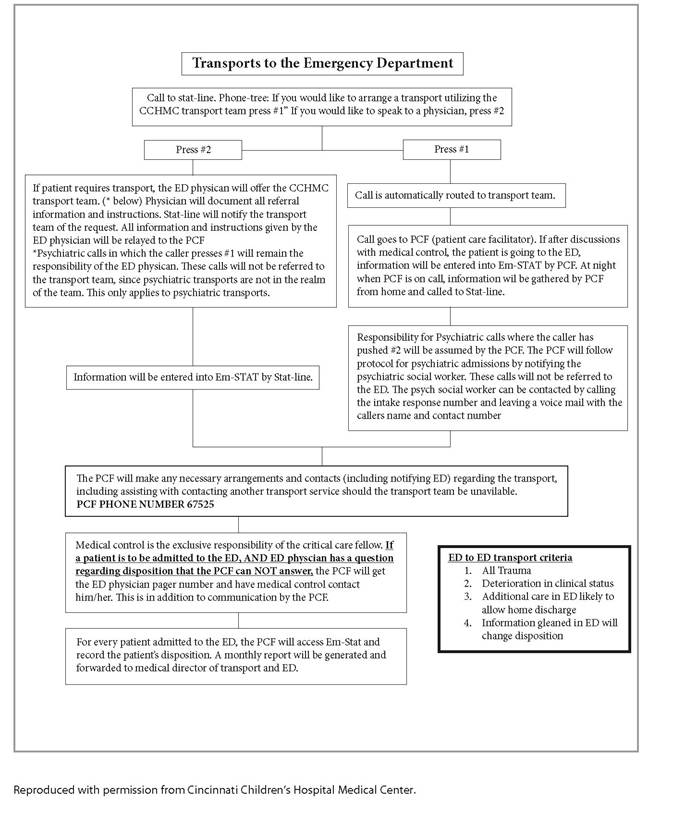
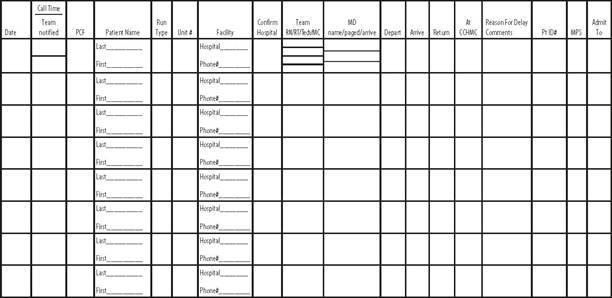
Several sample flow diagrams for communication and decision-making are included in Fig 5.3 and 5.4.
The Intake Process
Essential information that should be obtained by the communications specialist at the time of a transport request is as follows:
• Name of caller and referring provider and facility
• Patient's name, age, date of birth, allergies, and weight
• Call-back phone numbers, including the unit where patient is located and the referring provider's pager, if indicated
• Landing zone information, if indicated
• Name of receiving facility and destination within the receiving facility, if known
• Name of accepting physician, if known
• Patient's presenting condition and preliminary diagnosis
• Differences in time zones between the referring and accepting facility
• Time sensitivity (eg, emergency, urgent, nonemergency, elective)
Additional information that should be exchanged during contact between the MCP (or medical intake provider if a registered nurse or other professional) and the referring provider is as follows:
• Concise description of the current problem and pertinent medical history
• Patient's physiologic status, including full set of current vital signs
• Pertinent laboratory and radiologic data
• Current treatment (eg, vascular access, mechanical ventilation, medications)
• Interventions and response to interventions
• Special equipment, medications, or personnel requested (eg, incubator, inhaled nitric oxide, perfusionist)
• Infection control issues
• Family or social considerations, including custody issues
• Ability of family to accompany the team (with appropriate identification, weight restrictions, if present)
Figure 5.3: Sample Dispatch Intake Record Cincinnati Children's Hospital Medical Center
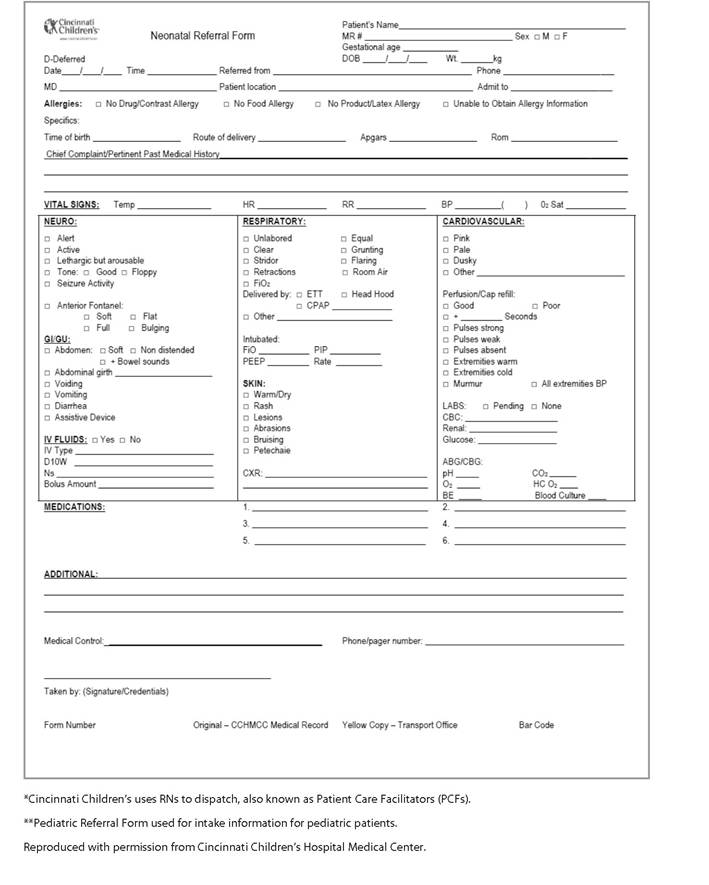
Figure 5.4: Sample Flow Sheets
CCHMC Transport Team Log Sheet
Reproduced with permission from Cincinnati Children's Hospital Medical Center.
It is essential that the MCP provide recommendations for evaluation and management during the time that the transport team is mobilizing and responding to the referring facility. The transport team should be advised of these recommendations so as to anticipate a possible change in the patient’s status on arrival. If the referring provider indicates that he or she plans not to follow such recommendations, the transport team should be notified.
After the transport team has been mobilized, the communications specialist should contact the referring facility to obtain additional demographic information that might be necessary to process the admission. In general, access to insurance information is not necessary when ground or rotor-wing transport is being requested under emergency circumstances. For elective or scheduled transports or for long-distance fixed-wing transports, preauthorization of payment by third-party payers might be required for the transport program and/or the receiving facility to be reimbursed for their services.
To facilitate an expeditious departure from the referring facility, the communications specialist should remind the referring personnel of the need for copies of medical charts, laboratory results, and results of imaging studies (eg, radiography, computed tomography, magnetic resonance imaging, ultrasonography) to accompany the patient.
The Call-Back Process
Once the transport team has had the opportunity to assess the patient and begin the stabilization process, there should be contact with the MCP. This contact updates the receiving institution about the patient's status and provides an opportunity to discuss management issues and patient disposition with the responsible physician. Essential data points are as follows:
• Patient's current condition
• Interventions and results of interventions performed prior to arrival of the transport team and following arrival of the transport team
• Special needs on arrival to the receiving facility (eg, high-frequency oscillatory ventilation, vasopressors, blood products, an isolation room) or immediate availability of the operating room, surgeons, diagnostic imaging (eg, computed tomography scan), or the resuscitation or trauma team
• Estimated time of arrival
Documentation
A standardized transport form (paper or electronic) can be used to distinguish care provided during interfacility transport from subsequent inpatient care. The form should concisely summarize interventions the patient has already received, the condition in which the patient is found by transport personnel, events and interventions during stabilization at the referring facility as well as care rendered throughout the transport process. This form should also provide a place to document information that the transport team might be in a unique position to obtain (eg, primary care physician, parent, or guardian contact numbers).
More on the topic Information Processing and Documentation During Transport:
- Information Processing and Documentation During Transport
- Triage
- AAP. Guidelines for Air and Ground Transport of Neonatal and Pediatric Patients. 4th edition. — American Academy of Pediatrics,2015. — 488 p., 2015
- Documentation
- Perfect Information and Perverse Incentives: Publish salaries, education availability
- INFORMATION SECURITY GOVERNANCE OBJECTIVES
- Information about accomplices
- Survival of MAP During Dairy Processing
- THE ETERNAL FIG TREE
- From its early days as a mechanism used to perform data processing, the digital is becoming the de facto medium for transmitting information, communicating and for sharing social life.