Mobility Aids
Transfer Aids
There are a number of commercially available patient care lifts to assist caregivers and/or health care professionals
| Upper Extremity Orthoses | |||
| UPPER EXTREMITY | SPECIAL CONSIDERATIONS | ||
| ORTHOSIS | COMMON NAME | FUNCTION (REF.) | (REF.) |
| STATIC | |||
| Finger | Neoprene thumb abductor | Places thumb in abduction to promote functional use of the hand | Will not overcome severe cortical thumb position |
| Static metal orthosis | Places thumb in abduction | Not recommended for fluctuating edema in the joint areas | |
| Hand | Short opponens | Places thumb in abduction and rotated under the second metacarpal. Wrist and fingers are freely mobile. | Allows for full wrist flexion and extension. Should be worn at all times, removing only for hygiene and exercise. |
| Wrist-hand | Thumb spica | Immobilizes and protects the thumb, positioning it in opposition. Provides a stable post against which the index finger can pinch. | Need to allow for full MCP flexion of the fingers, especially the index finger, and full IP flexion of the thumb. |
| Resting hand | Preserves a balance between extrinsic and intrinsic musculature and provides joint support when the hand is put at rest. Prevents deformity. | Should preserve the MCP joint descent and palmar arch following the contour of the distal palmar crease. Pressure at the MCP joint or proximal phalanx should be avoided, as this could cause injury to the MCP joint. | |
| Wrist cock-up | Supports, immobilizes, or stabilizes the wrist in extension. Increases mechanical advantage for grasp | Must maintain full MCP flexion and CMC motion of the thumb. Monitor the area over the styloid process for pressure changes if a dorsal splint is used. | |
| Anti-spasticity ball | Positions the wrist, abducts the fingers and thumb, and maintains the palmar arch in a reflex-inhibiting position | Should not to be used for minimal spasticity. (16) | |
| Elbow | Elbow extension | bgcolor=white>Increases extensor range of motion and prevents flexionNot recommended for severe flexor contracture or fluctuating tone in either flexor or extensor patterns | |
| Elbow-wrist-hand Full elbow/hand | Promotes supination at the forearm and provides a long stretch of the limb near end range to decrease tone | Not recommended for flexor tightness | |
| Shoulder | Humeral orthosis | Stabilizes the shaft of the humerus circumferentially | May shift position if not appropriately anchored by straps |
| Gunslinger | Supports the shoulder girdle and prevents shoulder subluxation | Make sure the edges around the base of the splint do not cut into the hip area. Check the fitting both in standing and supine positions to accommodate the shift of the splint. | |
| Clavicle | Harness strap | Proximally stabilizes shoulder girdle movement and limits shoulder flexion and abduction movement beyond 90 degrees | Must mark settings for appropriate fit due to increased adjustability. Keep a check on skin integrity around the underarm area. |
| Continued | |||
| UPPER EXTREMITY ORTHOSIS COMMON NAME | FUNCTION (REF.) | SPECIAL CONSIDERATIONS (REF.) | |
| DYNAMIC | |||
| Hand | MCP flexion assist splint | Gradually lengthens or gently stretches soft tissue structures that limit joint flexion | Ensure that the traction applied is gentle to guard against soft tissue hemorrhages around the joints, which can cause edema, pain, and increased scarring |
| MCP extension assist splint | Passively pulls the proximal phalanx into extension while allowing active flexion | Do not position the proximal phalanx in either radial or ulnar deviation when using dynamic traction | |
| LMB Finger Spring—PIP extension assist | Gives dynamic traction of the PIP joint without limiting motion at the MCP joint. Assists in reducing tightness or contractures of the PIP joint. | Not recommended for severe spasticity | |
| Elbow | Dynasplint | Brace adjusts to lock out undesired flexion and extension. Settings are adjusted in increments of 10 degrees. | Not recommended for severe spasticity |
| Power | Smart-WHO (wrist-hand orthosis) | Flexor-hinge hand orthosis that immobilizes the thumb in opposition and semiflexes the IP joints of the index and middle fingers to allow the index and middle fingers to move simultaneously toward the thumb. Variations include using an external power battery pack, SMA actuators, ratchet hand position, and shoulder driven cables (15). | Although design is lightweight and simple, a disadvantage can be the actuator’s bulkiness as well as the unsightliness of the orthosis |
| CMC, carpometacarpal; IP, interphalangeal; MCP, metacarpophalangeal; PIP, proximal interphalangeal; SMO, supra-malleolar orthosis. | |||
6.2
Lower Limb Orthoses
| ORTHOSIS | COMMON NAME | FUNCTION (REF.) | LIMITATIONS |
| Solid ankle foot orthosis | AFO, MAFO | Reduces tone, prevents joint contracture, and provides knee and ankle stability. Most appropriate for a child with severe tone, ankle joint hypermobility, and rigid deformities. | Does not allow any ankle movement and therefore limits smooth progression from heel strike to push off |
| Hinged or articulated ankle foot orthosis | HAFO | A hinged AFO with a plantarflexion stop and free motion into dorsiflexion allows the tibia to translate over the foot in stance. This orthosis allows the foot to dorsiflex for balance reactions and improves ambulation on uneven surfaces and stairs. Posteriorly, a dorsiflexion stop strap can be added to limit the amount of dorsiflexion. A plantarflexion stop in 2-5 degrees of dorsiflexion may assist to control genu recurvatum at the knee. | Does not control “crouched” posture allowing increased dorsiflexion and knee flexion. Children with strong extensor posturing may break the ankle joint. May allow hindfoot to slip, causing midfoot break if insufficient hindfoot dorsiflexion is present. |
| ORTHOSIS | COMMON NAME | FUNCTION (REF.) | LIMITATIONS |
| Anterior floor reaction or ground reaction ankle foot orthosis | GRAFO | Limits a “crouch” posture (stance posture with hip flexion, knee flexion, and ankle dorsiflexion). At heel strike, it encourages a force up through the anterior cuff of this orthosis, giving the knee an extension torque. Knee extension is maintained throughout stance. | A child with significant hamstring or hindfoot tightness or tone will not benefit from this orthosis |
| Rear-entry hinged floorreaction AFO | Dorsiflexion stop limits a “crouch” posture while allowing for plantarflexion during the loading phase of stance and at push-off | Active dorsiflexion is required to restrict foot drag during swing | |
| Posterior leaf spring | PLS | The trimlines of this solid AFO are posterior to the malleoli. The slender posterior portion of this AFO gives it flexibility to allow for some dorsiflexion in stance and plantarflexion at push-off. | Does not allow full motion into dorsiflexion or plantarflexion. For medial-lateral ankle stability and arch control, another orthosis may be more appropriate. Does not control foot deformity or extensor tone. Excessive torque on spring may cause skin problems. |
| Dynamic ankle foot orthosis | DAFO | A supramalleolar orthosis that uses a footboard to support the arches of the foot. Provides medial-lateral ankle stability with control for pronation/ supination. Allows some ankle dorsiflexion/plantarflexion. | Difficult to fit into shoes. Difficult for self-donning. Child may quickly outgrow this splint, since it is finely contoured to the foot. |
| Knee hyperextension splint | Maintains neutral knee and limits knee hyperextension. Uses three points of pressure: superior-anterior surface of the knee, inferior-anterior surface of the knee, and posterior to the knee joint (6,11). | Controls only the knee. Does not control extensor posturing well. It is bulky under clothes and difficult to sit with. | |
| Swedish knee cage | KO | Controls genu recurvatum with the same three points of pressure a knee hyperextension splint and works the same. Uses metal uprights and straps instead of plastic material (7). | Controls only the knee. It is difficult to fit to smaller children, and it is difficult to maintain correct positioning. |
| Knee ankle foot orthosis | KAFO | Molded plastic upper and lower leg components, usually with a locked or unlocked hinged knee joint. Four most common knee locks are free, drop lock, bail lock, and dial lock. Free knee allows full motion at the knee axis. Knee axis may be straight or offset. Offset axis has an increased extensor moment at the knee joint. The drop lock is a metal collar that slides into place to maintain the knee in extension. The bail lock is a springloaded lock that has a trip mechanism to unlock the knee. The dial lock is a lock that may be set in varying degrees of flexion, used to accommodate or decrease a knee flexion contracture (13). | It is bulky and difficult to don/doff. Free knee at times allows too much motion. Drop lock requires fine motor control to lock and unlock. The child must be able to get the knee fully extended to engage the drop lock. Bail locks at times become easily disengaged. Dial locks do not allow free movement through the available range. |
| ORTHOSIS | COMMON NAME | FUNCTION (REF.) | LIMITATIONS |
| Hip knee ankle foot orthosis | HKAFO | Hip belt and joint. Hip and knee joints may be locked or unlocked. Able to progress child to an increasing number of free joints at a time. | Bulky, difficult to don/doff. Difficult to manage clothing for toileting. |
| Reciprocating gait orthosis | RGO | HKAFOs that are connected by a cable system that links hip flexion on one side with hip extension on the other. This device assists children with active hip flexion and no hip extension to advance legs with a more normalized gait. Allows the child to ambulate with a reciprocal or swing-through gait (13). | Bulky, expensive. Difficult to don/doff. Not appropriate for a child with hip and/ or knee flexion contractures. Difficult to manage clothing for toileting. |
| Hip spica/hip abduction splint | An orthosis made of thermoplastic material and Velcro to position a newborn's legs in abduction and flexion. This splint is used to maintain the femoral head in the acetabulum to mimic normal hip formation. Use of this splint helps to avoid hip subluxation and dislocation. Used from birth up to a year. | Requires frequent repositioning. May need frequent adjustments for growth. Difficult for caregivers to maintain appropriate fit. | |
| Pavlick harness | A soft splint used for children with the diagnosis of congenital hip dislocation. This splint is generally used in the first 9 months of age. Bilateral lower limbs are positioned with hips abducted and flexed to 90 degrees in an attempt to maintain the hips in a reduced position. | Careful positioning required. Caregivers must be vigilant in checking splint positioning. | |
| Parapodium or Variety Village Stander | This device allows the child to stand without upper extremity support, freeing bilateral arms to do activities. Walking with this device and crutches can be quicker than with the Parapodium with a swivel device (13). | More energy expenditure than with the swivel device. Children are unable to independently don/doff or to independently transfer supine to stand and stand to supine. Device is heavy. | |
| Parapodium with ORLAU swivel modification | This orthosis allows the child to walk without use of a gait aid and to use the arms for other activities. Less energy expenditure than with a Parapodium and crutches (14,16). | Same as above. Slower than walking with Parapodium and crutches. | |
| Twister cables | Cables are attached to a pelvic band and traverse the lower limbs to attach on shoes or AFOs. These cables provide control for increased internal rotation. Work well with children with normal to floppy tone to control internal rotation (13). | Do not work well with children with extensor spasticity. They may need to be frequently readjusted as the child grows. |
6.2
Continued
Trunk Orthoses
| TRUNK ORTHOSIS | COMMON NAME | FUNCTION | SPECIAL CONSIDERATIONS |
| STATIC | |||
| Trunk ASIS, anterior superior illiac | Thoracic-Iumbosacral orthoses Theratogs/Benik spine. | This device is used to stabilize the spine after surgery, fractured vertebrae, or used therapeutically to provide the trunk with upright support during static or dynamic activities This orthotic undergarment and strapping system gives users with sensorimotor impairment tactile positioning cues for improving postural alignment, postural and joint stability and movement, skill and precision | Can affect respiratory function Brace will not correct spinal deformity, but may alter the progression of the curve Can cause pressure along axilliary line, breast bone, or ASIS area Monitor wear time secondary to heat intolerance |
6.3
with performing safe transfers for children. The TransAid and Hoyer lift are two examples of patient care lifts. They are designed to transfer children from bed to wheelchair, off the floor, onto a toilet, into a car, and through an 18-inch doorway. Slings are available with heavy-duty support options to further minimize the effort of the caregiver while maximizing safety during the transfer. There are also institutional lifters available, which offer a 400-pound and 600-pound weight capacity, as well as portable home-care lifts, which are lightweight, portable, and designed for home doorways and narrow halls.
Powered overhead transfer lift systems provide families with a unique transfer method. This system enables users to transfer from bed to wheelchair, toilet, or bath using a motorized lift and either manual or motorized lateral movement along a permanent ceiling-mounted track or a free-standing semipermanent rack. However, this transfer system is expensive and usually not covered by insurance.
In addition to patient lifts, there are other smaller devices that can assist children with ease of transfers. One option is a transfer board, while another is an overhead trapeze bar attached to an over-bed frame. The most commonly used transfer board is constructed of maple wood measuring approximately 8 inches wide by 24 inches long. It is ideal for all types of transfers (bed, car, bath bench, commode, etc.). Trapeze bars may be attached overhead to bed frames to assist the child with bed mobility skills and positioning changes. The position is individually set and can be altered as needed. Typically, trapeze bars assist with supine to sitting transfers and initiating rolling side to side. They are often appropriate for use initially, but are soon removed after the child's strength and bed mobility skills improve.
Standers
Numerous passive standing devices are available. These devices offer many potential benefits for the child, including the provision of a sustained muscular stretch, maintenance of trunk and lower limb passive range of motion, facilitation of co-contraction of muscles, decreasing tone, and improvement in trunk and head control. Standers should be used a couple of times a day for up to one hour total. The child should progressively work to increase tolerance in the standing position. However, passive standing should not take the place of the child exploring his or her environment and body.
Three types of standers will be discussed here: supine, prone, and upright. Supine standers go from a horizontal position to approximately 90 degrees upright, depending on the model chosen. Laterals, kneepads, adduction/abduction supports, and head supports all assist to maintain the child's posture while in this stander. Bilateral upper extremity strengthening can be performed in this position, with or without a tray. However, it does not provide for any upper extremity weight bearing. A further limitation is that it will not work to improve head and trunk control. This stander is recommended for a child with significant extensor tone and posturing and/or a child with poor or absent head control. It is also preferred over the prone stander for the larger child due to the increased ease in positioning.
Prone standers support the child anteriorly. Postural support is supplied through trunk laterals, hip guides, abductor blocks, knee blocks, and shoe holders. These standing devices do come with a chin support to aid children who have limited head control or fatigue easily. However, the child should not be permitted to “hang” on this support; a supine stander is more appropriate if the child lacks fair head control. The stander can be used to improve antigravity head control and promote bilateral upper extremity weight bearing. Its tray may serve as a functional surface for stimulation. This stander may not be appropriate for some children with increased extensor tone. In these cases, gravity increases the work required for neck and trunk extension as well as shoulder retraction, thus feeding into primitive posturing.
Upright standers, such as the Evolv by EasyStand (Fig. 6.1) maintain the child in an erect position through supports at the hips, knees, and trunk.
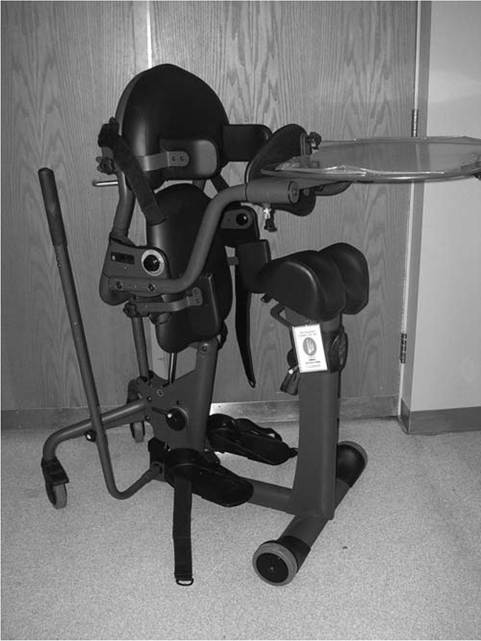
Figure 6.1 EasyStand Evolv.
Certain standers are available with a hydraulic or manual lift, making positioning of the larger child easier. This stander mimics a normal standing position and permits the child to work on head control and upper extremity strengthening. The seat swings to the side for ease of transfer.
Gait Aids
Gait aids are assistive devices designed to improve functional independence and/or expand exercise options through standing and walking. In pediatrics, gait aids assist children to explore and interact with their environment. Improved balance, decreased energy expenditure, decreased impact on joints, improved posture, and decreased pain are all potential benefits of gait aid usage. The most common gait aids are canes, crutches, and walkers.
Canes are available in different sizes with a variety of handles and supports (ie, straight cane versus quad cane). A quad cane provides a better base of support, but a normal gait cycle is more easily mimicked using a straight cane. A hemicane is a combination of a cane and a walker. It has a four-point base and the largest base of support of all the canes. It gives the greatest amount of stability among the canes, but also encourages the child to lean laterally when ambulating.
Crutches generally fall into two categories: axillary and Lofstrand. Axillary crutches are usually constructed of wood or aluminum and have limited adaptability. Some crutches may be modified to offer a forearm support to decrease weight bearing through wrists and hands. The child and family should be cautioned about possible nerve impingement from sustained axillary pressure with improper use. A “Kenney” crutch, not often used in the rehabilitation setting, is an axillary crutch without an underarm support. In place of the underarm support is a leather armband that fits around a child's arm.
Lofstrand crutches are much more flexible. They have a variety of forearm cuff styles, including circumferential or half cuff. Functional independence is increased with the use of Lofstrand crutches because the child is able to reach with his or her hands and the circumferential cuff will stay on the forearm. Half cuffs require less reliance on the cuff for balance, but they will not stay on the forearm if the handgrip is released. Handles may be wide and flat, pistol, or rounded. Rounded handles are the most commonly prescribed. The flat, wide handles may be helpful with tonal issues as well as with carpal tunnel inflammation. Pistol grips provide grooves for finger placement. Newer varieties of Lofstrand crutches are lightweight for children who have limited strength or need shock absorption for their joints.
Another adjustable option for all crutches is the crutch tip. Crutch tips may be constructed with materials of various flexibilities and in different widths to make the crutches more stable. Tips may include a gel, providing some shock-absorbent qualities. In addition, studded cups, which cover crutch tips, are available to make ambulation in rain and snow easier.
Three varieties of walkers are appropriate for the pediatric population: forward, reverse, and gait trainers. Forward walkers are the traditional type of walker. They can be purchased with or without wheels. Children can grip flat handles or use platforms on one or both sides to weight bear through the elbows and forearms. It should be remembered that forward walkers promote trunk flexion in many children.
Reverse walkers, also called posture control walkers, promote an erect posture. The child has increased extension at the trunk and hips when his or her hands are positioned to the sides or slightly in front. A pelvic support can be added to assist with lateral pelvic control and to facilitate trunk extension. Platforms can also be attached to allow forearm weight bearing. These walkers are widely used in the pediatric population. However, due to increased width, adult-sized children may have difficulty with accessibility. Other accessories available with some walkers are swivel wheels, forearm attachments, hip guides, hand brakes, baskets, and seats.
Gait trainers make ambulation a viable option for children who are unable to ambulate with other aids. Intensive body weight-supported treadmill training may be an effective intervention for some children with cerebral palsy who are ambulatory (14). A gait trainer is an assistive device that provides significant trunk and pelvic support (Fig. 6.2). It consists of a metal frame with adjustable-height metal uprights that support the trunk and arms. Adjustable-height seats, which are either slings or a bicycle-type seat,
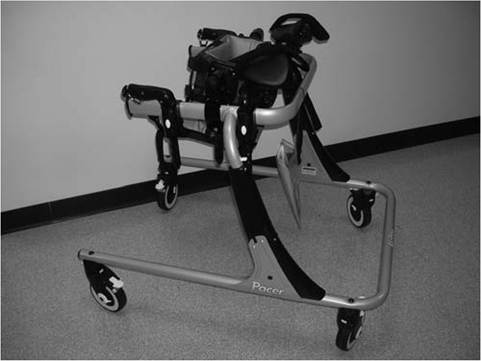
Figure 6.2 Rifton gait trainer.
are attached. The seat is not used to support the entire body weight, but rather to keep the child erect. This gait device has been used to teach a more normal reciprocal gait pattern. It may function as a stepping stone to walking with a walker or crutches. Some limitations of gait trainers include decreased transportability, difficulty with positioning, and decreased accessibility. They are wider and longer than traditional walkers are. Gait trainers do have a place in therapeutic rehabilitation—to provide a child with independent means of ambulation when no other assistive device is appropriate and as a therapeutic tool toward ambulation with a more accessible assistive device. Accessories available with gait trainers are trays, wheel locks, harnesses, forearm supports, and differing lower extremity supports.
For facility use, weight bearing and ambulation aids are available. The Lite Gait is a partial weight bearing gait therapy device. It allows the therapist to control the amount of weight bearing by supporting the patient in a harness system over a floor treadmill. With other therapeutic modalities, this has been shown to improve ambulation and endurance levels (18).
The EVA Walker is a heavy duty walker that has a manual or hydraulic lift that is easily adjustable for a variety of patients. It allows for significant upper extremity weight bearing to assist and improve ambulation for more moderately dependent patients.