NUTRITIONAL PROFILE OF INDIAN FOODS
Due to geographic variations in India, it is important to consider local food preferences, availability and
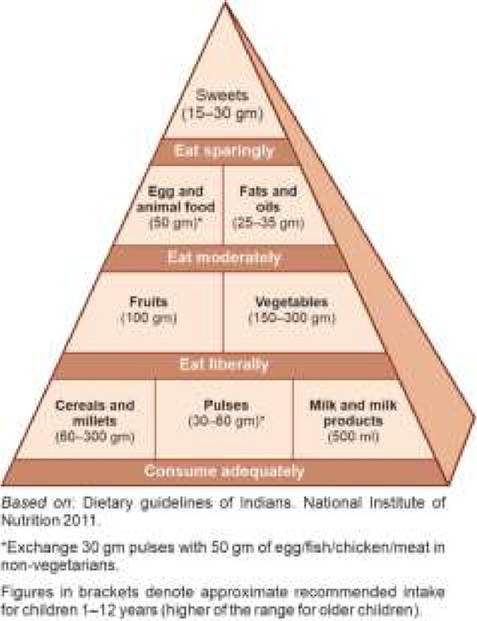
Fig.
5.8: Indian food pyramid (For children 1-12 years).affordability, while offering nutritional counseling. Nutritive values of common cooked ready-to-eat food items in Indian diet are given in Table 5.9. Nutritional values of common raw foods items are given in Table 5.10, though some important features are discussed here. All protein and caloric values in the following discussion are given as in 100 gm or ml of foodstuff, unless specified otherwise.
Cereals form the bulk of diet and contribute gt;70% andgt;50% of daily calories and protein intake, respectively. In general, cereals are rich sources of energy (300-350 cal), proteins (8-10 gm), vitamin B complex and minerals. However, cereal proteins are deficient in lysine.
• Rice is the staple food for over half of the world population. Although it contains less protein (7 gm %) than other cereals, rice protein is of better quality due to higher lysine content. Milling and cooking with excessive water significantly reduces its vitamin B complex content (present in its outer coating) which may be avoided by promoting the use of un-husked or parboiled rice. Thiamine deficiency, e.g. beri-beri is more common in rice-staple population.
Parboiling is a process to preserve the nutritive value of rice by moving its vitamin content from outer coating to inner endosperm. It involves soaking the unhusked rice in hot water (65-70) for 3-4 hours, followed by steaming for 5-10 minutes, before drying and storing/milling.
TABLE 5.9: Nutritive values of ready-to-eat foods
| Food items | Cooked weight[‡]/ number | Calories | Proteins (grams) |
| Chapati (1) | 25 gm | 80 | 2.5 |
| Paratha (1) | 30 gm | 170 | 2.5 |
| Puri (2) | 25 gm | 90 | 2.5 |
| Bread (1 slice) | 30 gm | 75 | 2.5 |
| Dal/Sambar (1 katori) | 100 gm | 100 | 6 |
| Poha/Upama (1 Katori) | 50 gm | 170 | 2 |
| Corn flakes | 50 gm | 200 | 6 |
| Idli/Vada (1 piece) | 25 gm | 100 | 5 |
| Chicken/Mutton (1 Katori) | 100 gm | 200 | 18 |
| Fish (2 pieces) | 50 gm | 190 | 2 |
| Rice (1 katori) | 25 gm | 90 | 2 |
| Khichri (1 katori) | 25 gm | 85 | 3 |
| Daliya /Porridge (1 katori) | 25 gm | 80 | 2.5 |
| Green veg (1 katori) | 200 gm | 50 | 4 |
| Other Veg (1 katori) | 200 gm | 120 | 3 |
| Milk (1 glass) | 200 ml | 150 | 6.5 |
| Curd (1 cup) | 100 ml | 60 | 3 |
| Biscuit (1) | 5 gm | 25 | 0.5 |
| Egg (1) | 45 gm | 90 | 6 |
| Banana (1) | Medium | 70 | 0.5 |
| Ghee/Oil (1 tsf) | 5 ml | 45 | — |
| Sugar (1 tsf) | 5 ml | 20 | - |
| Tea (1 cup) | 150 ml | 75 | 1.5 |
| Coffee (1 cup) | 150 ml | 110 | 1 |
^Approximate values, may vary with cooking practices and size of utensils.
Standard size of utensils: Teaspoon: 5 ml, Tablespoon: 15 ml, Cup/ katori: 200 ml, Glass: 250 ml.
Compiled from Dietary guidelines for Indians, National Institute of Nutrition 2011/2017 and other sources.
Nutritional value of pulses may be further enhanced by germination that increases vitamin B and C content. However, pulse-proteins are deficient in methionine and cysteine. In addition, uncooked pulses also contain some anti-nutrient factors, e.g. phytates and tannins, which inhibit absorption of other nutrients, e.g. iron.
• Soyabean is a very rich source of protein (42 gm), though deficient in methionine. Soya-milk is also used as infant feed during lactose intolerance.
Vegetables are considered as protective foods (along with fruits) due to their high vitamin and mineral content.
• Green leafy vegetables are essential in diet due to: (a) high vitamin B (except B12), A and C content; (b) high iron and calcium content, (c) high fiber and water content, and (d) low caloric value (25-50 cal) with anti-obesity effect.
• Other vegetables, e.g. potato, carrots, onion, radish, etc. are of limited nutritive value, except to increase palatability of diet. However, some of them are good sources of vitamins, e.g. carrot (vitamin A) or minerals, e.g. iron (radish, drum sticks). Roots and tubers, e.g. potato, sweat-potato and tapioca are rich in carbohydrates.
Fruits are valuable due to: (a) high vitamin content, e.g. vitamin A (papaya and mango), vitamin C (amla), (b) high mineral content, e.g. calcium (custard apple) and potassium (coconut water), (c) high caloric value, e.g. banana (100 cal), custard apple, etc., (d) high cellulose content (anti-constipating effect). Dry fruits, e.g. dates, raisins and apricot are rich sources of calories, iron and calcium.
Nuts and oilseeds, e.g. groundnut, coconut, mustard or sunflower seeds are rich sources of fats.
• Groundnut is a very rich source of calories (~550 cal) and proteins (25-30 gm), also called poor man's cashewnut.
Even after oil extraction, groundnut flour retains its protein value and has been used to make supplementary foods, e.g. balahar.• Dry nuts, e.g. cashew nut, walnut, almonds, pistachio contain more fat than groundnut (35-65%), but less proteins. These nuts are good but costly source of minerals, e.g. calcium, phosphorus and iron.
Milk is the wholesome food for all ages, being rich and quality source of most nutrients. Breastfeeding is the best source of nutrition in early infancy. Other milks may be divided into two categories: (a) animal milk, (b) modified milk preparations, e.g. skimmed milk, toned milk, evaporated milk, dried milk powders, etc.
Animal milk: Composition of various animal milks differs significantly, as follows:
• Cow milk has a composition nearest to human milk with some differences (Table 5.4) and hence, commonly used for top feeding in infants, if necessary.
TABLE 5.10: Nutritive values of common Indian foods
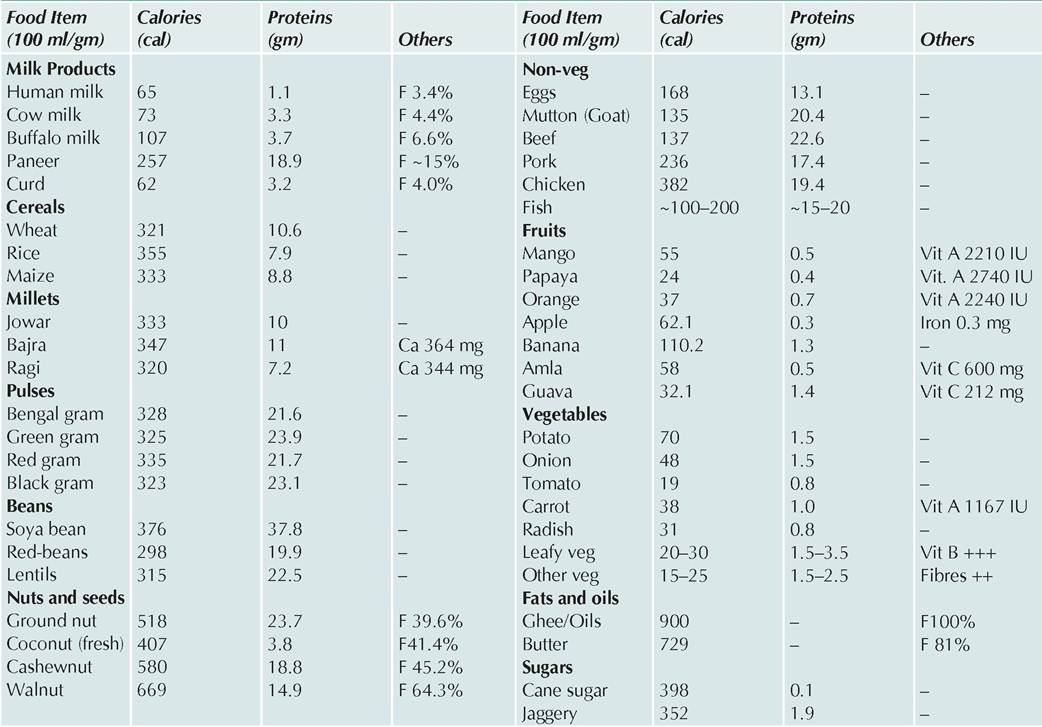
Source: Indian food composition tables, National Institute of Nutrition, 2017, F: Fat
• Buffalo milk has very high fat and caloric content and hence, should be used only after proper dilution, especially in infancy.
• Goat milk, though better digestible than the cow milk (less curd formation), is deficient in folic acid (megaloblastic anemia) and carries additional risk of causing brucellosis, if used without boiling.
As animal milk is regularly contaminated, boiling is essential before consumption. Currently all marketed milks are pasteurized for this purpose.
Pasteurization involves heating of raw milk at 63 for 30 minutes (or 72 for 15 seconds) followed by rapid cooling, to eliminate all pathogenic bacteria and reduce non- pathogenic bacterial count lt;50,000/ml. Pasteurization also improves digestibility of casein with less curd formation.
Modified milk preparations include:
• Skimmed milk is available in liquid and dried form (milk powders), prepared after removing most of the cream from animal milk, with fat content of 0.5% in full-skimmed milk or 1.5% in half-skimmed milk.
• Toned milk, cheapest milk, is prepared by mixing natural milk, water and milk powder (1:1:8) followed by pasteurization before packaging. It has composition similar to cow milk.
• Evaporated milks are commercial available as concentrated milk in liquid form, with long shelf-life for many months.
Skimmed milk and evaporated milk should not be used for infant feeding due to high protein and mineral content that may cause dehydration. However, these milks are useful as a dietary supplement for older children during fresh milk shortage.
Commercial milk formulas, modified according to the age-related requirements and fortified with various nutrients are available for top feeding, though costly and require careful reconstitution.
Eggs are known for their quality protein content (6 gm/ egg), containing all essential amino acids. Egg protein is considered as ideal or reference protein (NPU ~96), with whom other proteins are compared. Milk and meat protein has an NPU of 75 and 80 respectively, while vegetable proteins have even lower NPU, i.e. ~ 60-65%.
Boiled egg is better than raw egg as boiling destroys avidin—a substance that prevents biotin absorption. Eggs
are also rich sources of energy (70 cal), vitamins (except vitamin C) and minerals.
Sea-foods including fishes, are rich in quality proteins (15-25 gm%), unsaturated fatty acids, fat-soluble vitamins and minerals, e.g. calcium, phosphorus and fluorine. Sea fish/foods also contain iodine, which is deficient in fresh-water fishes. However, fish contains very little carbohydrates.
Meat and animal organs, e.g. liver, are good sources of quality proteins (15-20 gm%), vitamins, e.g. vitamin D and B complex, minerals, e.g. iron, zinc (but deficient in calcium).
Fats and oils are good sources of energy (9 cal/gm) and increase palatability of diet.
• Vegetable oils are rich in EFA and PUFA (except coconut and palm oil), but contain little vitamins A and D, unless fortified (vanaspati ghee). High PUFA content in vegetable oils limits hypercholesterolemia, obesity and consequent health problems. Coconut oil is rich in triglycerides, which is absorbed directly without micelles formation (bile-based absorption) and hence, useful source of energy in preterms and chronic liver disease.
• Animal fats lack EFA and mainly contain saturated fatty acids with obesity-effect. However, animal fats are useful source of energy in malnourished children and contain plenty of fat-soluble vitamins.
Other food products, e.g. sugar, condiments/spices and beverages have very limited dietary value, except to increase its palatability.
5.9