Stimulating Electrodes
For neonates and young infants, small stimulators with short interelectrode distances are commercially available and simplify the testing of short nerve segments over small extremities (Fig.
7.2). The stimulation intensity may be reduced by the use of a small monopolar needle electrode as the stimulatingTIBIAL MEDIAN ULNAR
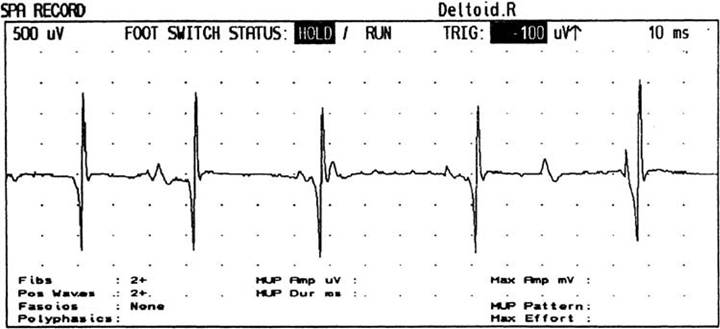
Figure 7.1 Neuropathic recruitment of the deltoid in a 12-month-old child with a brachial plexus injury sustained at birth. The initial recruited motor unit action potential is 2,500 μV,
and it is firing at 25 Hz.
cathode, with a more proximal surface anode in close proximity. For example, for ulnar orthodromic sensory studies, the author has utilized ring electrodes on the fifth digit and recording electrodes over the ulnar nerve at the elbow. Generally, a standard bipolar stimulator may be utilized for children 6 months of age and older.