Recording Electrodes
Sensory Conduction
Generally, sensory nerve action potentials are easily recorded in newborns. The standard ring electrodes, needle recording electrodes, and/or pediatric-size finger-clip electrodes may be used.
While for adults, a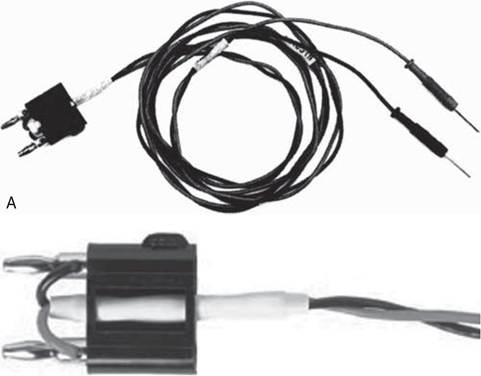
B
Figure 7.2 Pediatric nerve stimulator (A). The interelectrode distance between cathode and anode is less than
2 centimeters (B).
4-cm Interelectrode distance is optimal, this is not possible in small children. Hence, the pediatric electrodiagnostic clinician should attempt to obtain as much distance as possible between active and reference electrodes. Every attempt should be made to obtain at least a 2-cm interelectrode distance. Stimulation of the digits, palm, or wrist, with electrodes located more proximally at the elbow for median and ulnar sensory studies provide longer distance and less measurement error. In general, normative data for sensory nerve conduction velocities are more readily available than normative data for distal latencies at specific distances.
Motor Conduction
Generally, standard 6-mm silver disc surface electrodes are used as active and reference electrodes for motor conduction studies. Some electrode diagnosticians prefer the use of ring electrodes on digits as the reference electrode and a standard surface electrode over the Moro point at the muscle as the active electrode (Fig. 7.3). Often, 4-6-cm distances are used from the stimulator to active electrode. Conduction velocities and CMAP amplitudes are generally more relevant data in infants than motor distal latencies because distal nerve entrapments are rare. Thus, the distances used from distal stimulation to active electrode are less critical.