name=bookmark2992>B. Multiple Pledges
a. Prior tempore potior iure
CASE 171
D 20.4.11.4 (Gaius libro singulari de formula hypothecaria)
Si paratus est posterior creditor priori creditori solvere quod ei debetur, videndum est, an competat ei hypothecaria actio nolente priore creditore pecuniam accipere.
et dicimus priori creditori inutilem esse actionem, cum per eum fiat, ne ei pecunia solvatur.Translation: (Gaius in his monograph On the Action for Secured Property)[404]
If the later creditor is ready to pay the earlier creditor what he is owed, we must consider whether the actio hypothecaria is available to [the later creditor], even if the earlier creditor does not want to receive the money. And we say that the actio is not available to the earlier creditor, if it is due to him that the money is not paid.
Note on the Text:
Especially with respect to acquiring property rights, the legal position of a party accords with the chronological sequence of events. The earlier in time has the better right: prior tempore, potior iure (“first in time is stronger in right”). For violations of this rule, see Cases 182 and 185.
Discussion Questions:
1) Why might a later secured creditor offer to satisfy the claim of an earlier creditor?
2) Can an earlier creditor be compelled to accept the offer?
3) The later creditor has satisfied the claim of the earlier creditor.
Is the latter's right to claim against the debtor thereby extinguished? Has the later creditor acquired the earlier creditor's claim and/or his security interest?4) The claim of the first creditor falls due before that of the second creditor. The first creditor sells the security. Does the second creditor have a claim against the buyer? Against the first creditor?
5) What risk attaches to the later creditor with his ius offerendi [“right of offering to pay the earlier creditor”]?
Literature:
Schanbacher (Case 160) 36.
D 20.4.20 (Tryphoninus libro octavo disputationum)
Quaerebatur, si post primum contractum tuum, antequam aliam pecuniam tu crederes, eidem debitori Seius credidisset quinquaginta et hyperocham huius rei, quae tibi pignori data esset, debitor obligasset, dehinc tu eidem debitori crederes forte quadraginta: quod plus est in pretio rei quam primo credidisti utrum Seio ob quinquaginta an tibi in quadraginta cederet pignoris hyperocha. finge Seium paratum esse offerre tibi summam primo ordine creditam. dixi consequens esse, ut Seius potior sit in eo quod amplius est in pignore, et oblata ab eo summa primo ordine credita usurarumque eius postponatur primus creditor in summam, quam postea eidem debitori credidit.
Translation: (Tryphoninus in the eighth book of his Legal Controversies)[405]
After your initial security contract and before you lent more money, Seius lent the debtor 50 and the debtor pledged to him the hyperocha [“excess”] of the property that he had earlier given to you in pledge.
Then you gave the same debtor another loan of 40. Should the hyperocha (i.e., the surplus from the sale of the security after paying off your first loan) go to Seius for his claim of 50, or to you for your claim of 40? Assume that Seius is ready to repay you the sum of your initial loan. I replied that Seius properly has the better right to the surplus value that he gets in the security. After he has paid off the initial loan amount plus interest, he is placed in the position of first creditor over the whole amount that he subsequently lent to the same debtor.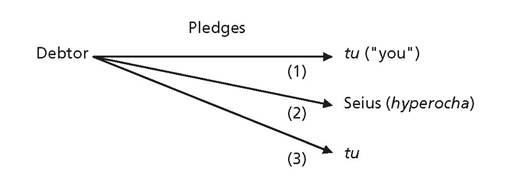
Discussion Question:
Write an analysis of the text. Examine especially the question of to what degree the decision of Tryphoninus rests on interpretation of the parties' agreements.
Literature:
Kaser M. “Über mehrfache Verpfändung im römischen Recht,” in Studi in onore di Giuseppe Grosso I.Torino: G. Giappichelli, 1968-1969, 27-76 (reprinted as Ausgewählte Schriften II [1976] 198 ff.)
Schanbacher, Dietmar. “Beobachtungen zum sog. ‘pignus Gordianum.'” ZRG 114 (1997) 233-271, 248 ff.
D 20.1.15.2 (Gaius libro singulari de formula hypothecaria)
Qui res suas iam obligaverint et alii secundo obligant creditori, ut effugiant periculum, quod solent pati qui saepius easdem res obligant, praedicere solent alii nulli rem obligatam esse quam forte Lucio Titio, ut in id quod excedit priorem obligationem res sit obligata, ut sit pignori hypothecaeve id quod pluris est: aut solidum, cum primo debito liberata res fuerit.
de quo videndum est, utrum hoc ita se habeat, si et conveniat, an et si simpliciter convenerit de eo quod excedit ut sit hypothecae? et solida res inesse conventioni videtur, cum a primo creditore fuerit liberata, an adhuc pars? sed illud magis est, quod prius diximus.Translation: (Gaius in his monograph On the Action for Secured Property)[406]
Someone who has already pledged his property and wishes to pledge the same property to a second creditor, is obliged to make clear (in order to avoid the risk of penalty that is incurred by a person who pledges the same property more than once) that the property is pledged to no one else unless perhaps Lucius Titius, so that the property is pledged to the second creditor only to the extent that its value exceeds the amount of the first debt, so that the excess is pledged, or the whole value, once the first debt has been satisfied. The question arises whether the last point is valid only if it is expressly agreed to, or also if simply the pledge of the excess value is agreed to; and whether the whole property counts as included within the agreement, once it has been freed from the claim of the first creditor, or only part? But what we said earlier is much more the case.
Note on the Text:
On videtur (“counts as”), see on Case 72.
Discussion Questions [with model answers]:
size=1 color=black face="Book Antiqua">1) What is the periculum (“risk of penalty”) incurred by the pledgor, who does not notify the second creditor that the property has already been pledged?
2) What possibilities for multiple pledges of a piece of property does Gaius here consider?
3) What are the legal consequences for the second creditor, if the first creditor loses the property to a third party?
4) What is the legal position of the second creditor after satisfaction of the debt to the first creditor?
5) What is the legal position of the second creditor after his exercise of the ius offerendi [“right of offering to pay the prior creditor”]?
6) What is the legal position of the second creditor after disposal of the property by the first creditor?
7) Explain the problem that Gaius puts and his decision.
8) Find a justification for this decision.
Answers:
1) If he has acted with fraudulent intent, he commits the crimen stellionatus (“crime of deceitful conduct”).
The maximum penalty for this was opus metalli (forced labor in the mines). Members of higher social classes were condemned to motio ab ordine (loss of social rank) or relegatio ad tempus (banishment for a specified period). Alternatively (or even in addition to criminal process), the pledgor can be sued with the actio pigneraticia contraria.2) (a) Pledge of the property to the degree its value exceeds the amount of the first pledge; (b) conditional pledge of the entire property in the future.
3) “2(a)” gives the second creditor a security interest, pursuant to which he can demand the property from the third party. “2(b)” gives the second creditor only an expectancy interest until the condition is satisfied (extinction of the security interest of the first creditor). This interest cannot be made effective in the interim.
4) On the basis of “2(b)” the security interest of the second creditor now encompasses the entire property. He acquires the ius vendendi [“right of sale”].
5) As in the answer to question “3”, the second creditor acquires a security interest in the entire property with respect to his own claim. With respect to the first claim, which he has satisfied, he has only a right based on the payment, not a security interest in the property (security interests are only accessory, they do not arise from the transfer of a claim.)
6) The security interest of the second creditor is extinguished. (The buyer of the secured property does not assume the obligation.)
style='font-size:8.0pt;line-height:120%'>7) The security contract with the second creditor contains only the first provision (pledge of the property to the degree its value exceeds the amount of the first claim).
The first creditor is satisfied by the debtor. Does the second creditor thereby acquire a security interest in the whole property, although this was not expressly agreed to? Gaius says he does (interpretation in favor of the second creditor).8) Existing practice in contracts allows the imputation of the parties' consent.
Literature:
Kaser (Case 172) 182 ff.
D 20.4.9.3 (Africanus libro octavo quaestionum)
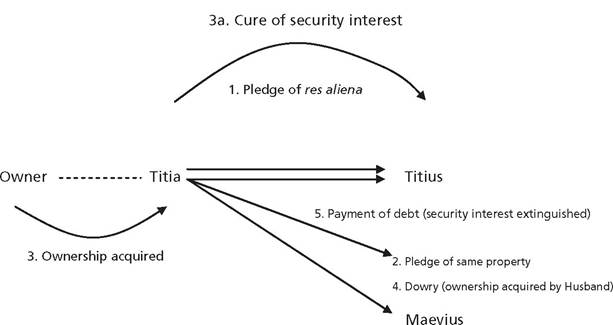
Titia praedium alienum Titio pignori dedit, post Maevio: deinde domina eius pignoris facta marito suo in dotem aestimatum dedit. si Titio soluta sit pecunia, non ideo magis Maevii pignus convalescere placebat. tunc enim priore dimisso sequentis confirmatur pignus, cum res in bonis debitoris inveniatur: in proposito autem maritus emptoris loco est: atque ideo, quia neque tunc cum Maevio obligaretur neque cum Titio solveretur in bonis mulieris fuerit, nullum tempus inveniri, quo pignus Maevii convalescere possit, haec tamen ita, si bona fide in dotem aestimatum praedium maritus accepit, id est si ignoravit Maevio obligatum esse.
Translation: (Africanus in the eighth book of his Legal Questions)[407]
Titia pledged first to Titius and then to Maevius a plot of land belonging to another. Later she became the owner of the secured land and gave it to her husband at an assessed value in the dowry. decided: if the debt to Titius was paid, the security interest of Maevius was still not cured. After discharge of the first creditor, the security interest of the subsequent creditor would be confirmed only if the property was in the bonitary ownership[408] of the debtor. Under the proposed facts, however, the husband was in the position of a buyer. Since the land was in the wife's bonitary ownership neither at the time of the pledge nor at the time of the payment to Titius, there was no point in time when the security interest of Maevius could have been cured. This opinion, however, assumes that the husband obtained the assessed property in the dowry bona fide: i.e., if he did not know that it was pledged to Maevius.
Note on the Text:
On placebat (“Julian decided”), see under Case 90.
Discussion Questions [with model answers]:
1) What is the legal position of Titius before Titia acquires ownership?
2) What legal position would Maevius have acquired under the contract of pledge, if Titia had been the owner from the beginning?
3) Was the security interest of Titius cured by the subsequent acquisition of ownership by Titia?
4) What would have been the effect on the legal position of Maevius, if Titia had paid Titius prior to establishing the dowry?
5) Why was the security interest of Maevius not cured?
size=1 color=black face="Book Antiqua">6) What legal position did the husband attain? What would have been the effect of his mala fides on the legal position of Maevius?
Answers:
1) Titius has no security interest in a res aliena pignori data [“another's property given in pledge”]—nemo plus iuris transferre potest... [“No one can transfer a greater right than he himself possesses”]—but he does have claims arising from the contract of pledge (actio pigneraticia contraria, and possibly also an actio de dolo and crimen stellionatus).
2) A conditional security interest that becomes effective only when the first creditor is removed but otherwise creates no “anticipatory consequences” relating to the property (mere expectation interest).
3) Yes.
4) Emergence of an unconditional security interest senior to all others (curing and advancement), which can be enforced by means of the actio pigneraticia utilis.
5) Because at the time of the emergence of the (suspended, conditional) right of Maevius (i.e., when the first creditor’s interest was extinguished) the property was not in bonis [“in the property”] of the woman who alienated it. During the period of Maevius’ mere expectation interest, curing cannot take place.
6) The husband becomes the owner. The husband’s bad faith, however, is no grounds for curing the security interest of Maevius. The latter could possibly proceed against the husband with an actio de dolo.
Literature:
Schanbacher (Case 160) 21 ff.
Wieling (co-editor) in Sturm, Fritz. Römisches Recht, WEX 12 (1977) 78 ff.
Ankum, Hans and Eric Pool. “Rem in bonis esse and rem in bonis meam esse: Traces of the Development of Roman Double Ownership,” in New Perspectives in the Roman Law of Property: Essays for Barry Nicholas, P. Birks ed. Oxford: Oxford University Press, 1989, 5-42, at 19 ff.
Ankum (Case 130) 448, 453.
D 20.4.12 pr. (Marcianus libro singulari ad formulam hypothecariam)
Creditor qui prior hypothecam accepit sive possideat eam et alius vindicet hypothecaria actione, exceptio priori utilis est ‘si non mihi ante pignori hypothecaeve nomine sit res obligata’: sive alio possidente prior creditor vindicet hypothecaria actione et ille excipiat ‘si non convenit, ut sibi res sit obligata,’ hic in modum supra relatum replicabit. sed si cum alio possessore creditor secundus agat, recte aget et adiudicari ei poterit hypotheca, ut tamen prior cum eo agendo auferat ei rem.
Translation: (Marcian in his monograph On the Action for Secured Property)[409]
style='text-indent:0cm;line-height:125%'>If the creditor, who has obtained an earlier security interest, possesses the property, and another person sues him with the actio hypothecaria, he can defend the suit with the defense “unless the property has been pledged to me earlier.” If another person possesses the property and the senior creditor brings the actio hypothecaria, and if the defendant raises the defense “unless it was agreed that the property is pledged to me,” the senior creditor will use a replicatio as related above. But if the second creditor sues a different possessor, he will sue rightfully, and the security will be awarded to him, subject, however, to the senior creditor’s right to take the property in a suit with him.Discussion Question:
Can the second creditor take the pledged property away from the debtor? Can he claim it from a third creditor? Can he get the property from another possessor?
Literature:
Wacke, A. “Prozeßformel und Beweislast im Pfandrechtsprätendentenstreit.” TR 37 (1969) 395 ff.
D 20.1.10 (Ulpianus libro septuagesimo tertio ad edictum)
Si debitor res suas duobus simul pignori obligaverit ita, ut utrique in solidum obligatae essent, singuli in solidum adversus extraneos Serviana utentur: inter ipsos autem si quaestio moveatur, possidentis meliorem esse condicionem: dabitur enim possidenti haec exceptio: ‘si non convenit, ut eadem res mihi quoque pignori esset.’ si autem id actum fuerit, ut pro partibus res obligarentur, utilem actionem competere et inter ipsos et adversus extraneos, per quam dimidiam partis possessionem adprehendant singuli.
Translation: (Ulpian in the 73rd book of his Commentary on the Praetor’s Edict)[410]
If the debtor has pledged his property to two creditors at the same time, such that the entirety of it is secured for each of them, each creditor may bring the actio Serviana against a third party for the whole property. If, however, a suit arises between the two creditors themselves, the position of the possessor is better, because the possessor will have the defense “unless it was agreed that the property is pledged to me.” But if it was intended that the property be pledged proportionally, an actio utilis is available both between the creditors and against a third party, by which each creditor can obtain possession of half of it.
Note on the Text:
Roman pledge contracts note the applicable day and year, but not the time of day. “At the same time” therefore means “on the same day.”
Discussion Question:
Analyze the decision. On the melior condicio possidentis [“the position of the possessor is better”], see Case 132 and Case 178a.
Literature:
Wacke (Case 175) 395 ff.
Schanbacher (Case 160) 64 ff.
Sirks, A.J.B. “La pluralite des creanciers hypothecates sans rang en droit romain classique et Paul.5 ad Plaut. D.20.4.13.” Bulletino dell’Istituto di Diritto Romano 89 (1986) 305-326.
D 20.4.9 pr. & 1 (Africanus libro octavo quaestionum)
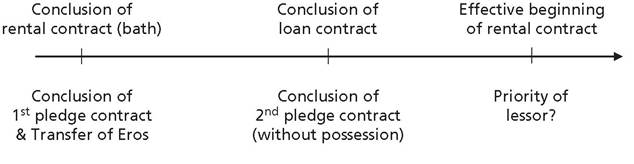
(pr.) style='font-style:italic'>Qui balneum ex calendis proximis conduxerat, pactus erat, ut homo Eros pignori locatori esset, donec mercedes solverentur: idem ante calendas Iulias eundem Erotem alii ob pecuniam creditam pignori dedit. consultus, an adversus hunc creditorem petentem Erotem locatorem praetor tueri deberet, respondit debere: licet enim eo tempore homo pignori datus esset, quo nondum quicquam pro conductione deberetur, quoniam tamen iam tunc in ea causa Eros esse coepisset, ut invito locatore ius pignoris in eo solvi non posset, potiorem eius causam habendam.
(1) Amplius etiam sub condicione creditorem tuendum putabat adversus eum, cui postea quicquam deberi coeperit, si modo non ea condicio sit, quae invito debitore impleri non possit.
Translation: (Africanus in the eighth book of his Legal Questions)[411]
(pr.) Someone, who rented a bath from the start of the following month, agreed that the slave Eros would be pledged to the lessor until payment of the rent. The same man, before the beginning of July, pledged the same Eros to a third party for a loan. (Julian) was asked whether the Praetor should protect the lessor against the suit of the creditor, who was suing for Eros. He answered that the Praetor should protect him. For although the slave was given in pledge at a time when there was nothing yet owed on the rental contract, the legal position of the lessor was stronger, since Eros had already come into the matter such that the security interest in him could not be extinguished without the lessor's consent.
(1) Additionally, he thought that the creditor on the basis of his conditional claim, also must be protected against any later creditor, assuming the condition was not one that could not be fulfilled without the debtor's consent.
Discussion Question:
Do Julian and Africanus break the fundamental principle of the accessory nature of the security interest?
Literature:
Schanbacher (Case 160) 56 ff.
Wacke (Case 160) 456 ff.
D 20.4.11.2 (Gaius libro singulari de formula hypothecaria)
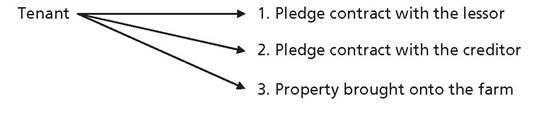
Si colonus convenit, ut inducta in fundum illata ibi nata pignori essent, et antequam inducat, alii rem hypothecae nomine obligaverit, tunc deinde eam in fundum induxerit, potior erit, qui specialiter pure accepit, quia non ex conventione priori obligatur, sed ex eo quod inducta res est, quod posterius factum est.
Translation: (Gaius in his monograph On the Action for Secured Property)[412]
If a tenant has agreed that the property brought onto the farm and the fruits [of that property] are given in security, and [then] he pledged one item to another person before he brought it in, then the latter has the stronger right, the one who obtained the property on the basis of an unconditional special pledge, since he [the tenant] is obligated to the first creditor [regarding this property] not on the basis of his agreement, but because of bringing it in, which is an action that took place later.
Discussion Question:
Analyze the positions in connection with Afric. D 20.4.9. pr. and 1 (Case 177).
D 20.4.14 (Paulus libro quarto decimo ad Plautium)
class=a6 style='text-indent:0cm;line-height:125%'>Si non dominus duobus eandem rem diversis temporibus pigneraverit, prior potior est, quamvis, si a diversis non dominis pignus accipiamus, possessor melior sit.Translation: (Paul in the 14th book of his Commentary on Plautius)[413]
If a non-owner at different times pledges the same property to two creditors, the first has the stronger position; but if we assume the pledges to be from different non-owners, then the possessor is in the better position.
Discussion Question:
Clarify the distinction Paul is making. In doing so refer back to Ulpian D 6.2.9.4 (Case 132) and Neratius D 19.1.31.2 (Case 133). For application of the rule in pari causa melior est condicio possidentis [“in a case of equal claims the position of the possessor is better”] also see Case 176.
Literature:
Schanbacher (Case 160) 150 ff.
Apathy (Case 130) 174 ff.
Ankum/Pool (Case 174) 23.
b. Substitution
CASE 179
D 20.3.3 (Paulus libro tertio quaestionum)
Aristo Neratio Prisco scripsit: etiamsi ita contractum sit, ut antecedens dimitteretur, non aliter in ius pignoris succedet, nisi convenerit, ut sibi eadem res esset obligata: neque enim in ius primi succedere debet, qui ipse nihil convenit de pignore: quo casu emptoris causa melior efficietur. denique si antiquior creditor de pignore vendendo cum debitore pactum interposuit, posterior autem creditor de distrahendo omisit non per oblivionem, sed cum hoc ageretur, ne posset vendere, videamus, an dici possit huc usque transire ad eum ius prioris, ut distrahere pignus huic liceat. quod admittendum existimo: saepe enim quod quis ex sua persona non habet, hoc per extraneum habere potest.
Translation: (Paul in the third book of his Legal Questions)[414]
Aristo wrote [as follows] to Neratius Priscus: if it has been contractually agreed that the temporally earlier creditor is satisfied, the new creditor succeeds to his security interest only if it was agreed that the same property would be pledged to him. A person who has not himself concluded a security agreement cannot succeed to the right of the first creditor, which is why the buyer's position will be stronger.
If the earlier creditor had made an agreement with the debtor concerning sale of the security, but the later creditor omitted a term concerning sale, not through forgetfulness, but because it was foreseen that he could not sell, we must examine whether it can be said that the right of the earlier passes to the later creditor to the degree that he is authorized to sell. I think that must be recognized. For frequently it happens that one acquires from another a right that he does not have in his own person.
The Facts:
Debtor and new creditor agree to pay off the old creditor. The new creditor advances credit expressly to make this possible, but he omits from the agreement that he succeeds to the security interest of the satisfied prior creditor.
Discussion Questions [with model answers]:
color=black face="Book Antiqua">1) How does one frame the legal issue?
2) Is the issue about the ius offerendi [“right of offering to pay the earlier creditor”]?
3) Try to justify Aristo's decision.
4) What is meant by emptoris causa melior efficietur [“the buyer's position will be stronger”]?
5) Is it permissible to have a contract for a security interest that excludes the ius vendendi [“right of sale”]?
6) How would the jurist have decided if the ius vendendi had been forgotten in the security agreement?
7) What possibilities of satisfaction might a secured creditor have without the ius vendendi?
Answers:
1) Does the [subsequent] creditor acquire the security interest [of the former creditor]?
2) No, since that does not require the consent of the debtor.
3) Without a security agreement there is no security interest. The construction of pignus tacitum is an exception that is based on special justification.
4) If the debtor sells the property, the buyer acquires it without having to fear that he can be evicted by the secured creditor using the actio Serviana (Gai. D 20.6.7 pr.: Si consenserit venditioni creditor, liberatur hypotheca [“If the creditor consents to the sale, the security interest is removed”]).
5) Yes.
6) In the same way (i.e., permissibility of selling the security). Justification: tacita conventio [“tacit agreement”].
7) Forfeiture of the security; agreement to take the fruits; agreement that the debtor will sell the security. The so-called “protective” or “custodial” security confers no possibility of satisfaction.
Literature:
Kaser (Case 172) 174 ff.
size=1 color=black face="Book Antiqua">D 20.4.12.9 (Marcianus libro singulari ad formulam hypothecariam)
Si tertius creditor pignora sua distrahi permittit ad hoc, ut priori pecunia soluta in aliud pignus priori succedat, successurum eum Papinianus libro undecimo responsorum scripsit. et omnino secundus creditor nihil aliud iuris habet, nisi ut solvat priori et loco eius succedat.
Translation: (Marcian in his monograph On the Action for Secured Property)[415]
If a creditor in the third rank agrees to the sale of his security in order for the first creditor to be paid off so that he [the third creditor] can succeed him [the first creditor] in another security agreement, he will succeed him, Papinian writes in the twelfth book of his Legal Opinions. And the creditor in the second rank will only have the right of satisfying the creditor in the first rank and succeeding to his place.
The Facts:
The owner pledges a piece of property to Primus, then to Secundus, and finally to Tertius, who already has other secured property from the same debtor. Tertius allows the owner to sell his security and to satisfy Primus with the proceeds, if he himself can succeed to the security rank of Primus.
Discussion Questions [with model answers]:
1) Why might the debtor be interested in this transaction?
2) How is the bar against advancement of the second creditor justified?
3) Assess the risk and the possible interest of Tertius in this transfer of secured debt.
4) Is it assumed that the claims of Primus and Tertius are equally high?
5) According to PS 2.13.8 [ = Pauli Sententiae 2.13.8] the senior creditor can also exercise the ius offerendi against the junior creditor. What considerations might lead a first creditor to take this step?
Answers:
1) Consolidation of his debts; especially getting a more favorable loan from Tertius than Primus and Secundus gave; higher return than could be got from disposal of the secured property. (Secured creditors for the most part reserve the right to alienate the security by sale without a “guarantee of good title”—pactum de non praestanda evictione, which drives the price down considerably.)
2) The possibility of transferring the debt should not be taken from the debtor. The rights of the junior pledgee seem to be sufficiently protected by the ius offerendi.
3) The risks are high: the creditor gives up his own security interest in the property to be sold and must count on the debtor actually using the proceeds for satisfaction of the first creditor. Possible motives of the creditor: concentration of his own security interest in a more valuable and more easily transferable security; act of friendship.
4) No, although the secured interest of Tertius is limited to the amount of the secured claim of Primus.
5) Perhaps he himself has a further junior interest, e.g., in the third rank, and he pays off the creditor in the second rank in order to avoid his exercise of the ius offerendi; investment loan; right of use; right of possession (in place of security without possession up to this point).
Literature:
Kaser (Case 172) 205 ff.
D 20.4.12.8 (Marcianus libro singulari ad formulam hypothecariam)
A Titio mutuatus pactus est cum illo, ut ei praedium suum pignori hypothecaeve esset: deinde mutuatus est pecuniam a Maevio et pactus est cum eo, ut, si Titio desierit praedium teneri, ei teneatur: tertius deinde aliquis dat mutuam pecuniam tibi, ut Titio solveres, et paciscitur tecum, ut idem praedium ei pignori hypothecaeve sit et locum eius subeat: num hic medius tertio potior est, qui pactus est, ut Titio soluta pecunia impleatur condicio, et tertius de sua neglegentia queri debeat? sed tamen et hic tertius creditor secundo praeferendus est.
Translation: (Marcian in his monograph On the Action for Secured Property)[416]
Someone who received a loan from Titius agreed that his land would be pledged to him. Thereafter he obtained a loan from Maevius and agreed with [Maevius] that the land would be security for his claim if it ceased to be secured in favor of Titius. Finally a third person gives you [i.e., the same debtor] a loan of money with which you satisfy Titius and agree that the same land should be pledged to [the third creditor] and that he should take the place of Titius. In this case is the middle creditor, who agreed that the condition [of his security interest] would be fulfilled if Titius were paid his money, in a better position than the third, and the third creditor has only his own negligence to complain about? But here too the third creditor is to be preferred over the second.
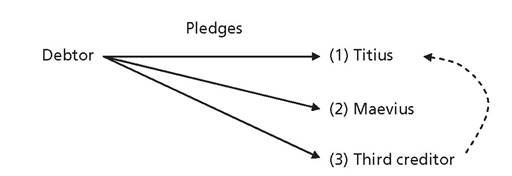
Discussion Question:
Write an analysis of this case, taking into account Marcian D 20.4.12.9 (Case 180).
Literature:
Kaser (Case 172) 204.
c. Statutory Security Rights and Priority Privileges
CASE 182
D 20.4.5 (Ulpianus libro tertio disputationum)
Interdum posterior potior est priori, ut puta si in rem istam conservandam impensum est quod sequens credidit: veluti si navis fuit obligata et ad armandam eam vel reficiendam ego credidero.
Translation: (Ulpian in the third book of his Disputations)href="#_ftn417" name="_ftnref417" title="">[417]
Sometimes the later secured creditor is in a better position than the earlier: e.g., if the loan of the later creditor is used for preservation of the property, say, if a ship has been pledged and I obtain a loan for its arming or refitting.
Discussion Questions:
1) For this privilege of priority should the contracted purpose of the loan be decisive, or its actual use?
2) What is the justification for this privilege?
3) What are the dangers for the legal and economic order of breaking the temporal priority (on the rule prior tempore potior iure, see Case 171)?
D 27.9.3 pr. (Ulpianus libro trigesimo quinto ad edictum)
Sed si pecunia alterius pupilli alteri pupillo fundus sit comparatus isque pupillo vel minori traditus, an pignoris obligationem possit habere is, cuius pecunia fundus sit emptus? et magis est, ut salvum sit ius pignoris secundum constitutionem imperatoris nostri et divi patris eius ei pupillo, cuius pecunia comparatus est fundus.
Translation: (Ulpian in the 35th book of his Commentary on the Praetor’s Edict)[418]
If with the money of one pupillus [“ward”] a piece of land is purchased for another pupillus and is transferred to the [latter] pupillus or minor, can the one whose money purchased the property have a security interest? And rather it must be decided, on the basis of a constitution of our emperor and his deified father, that the security interest of the pupillus whose money purchased the property is safe.
C 7.8.6 Imp. Alexander Augustus Auctori.
Si tutor tuus de pecunia tua servos emptos manumisit, quoniam huiusmodi servi sicut ceterae res pupillaribus pecuniis emptae iure pignoris ex constitutione divorum parentium meorum obligati sunt favore pupillorum, liberi facti non sunt.
Translation: (Caesar Alexander to Auctor)[419]
If your tutor [“guardian”] manumits slaves that were purchased with your money, they are not free, since slaves of this kind, just like other property that is purchased with a ward's money, are subject to a security interest in favor of the ward, pursuant to a constitution of my deified parents.
Discussion Questions:
1) Is the tutor the owner of the slaves that he wishes to manumit?
2) Try to formulate a precise rule based on the decision of Severus and Caracalla [i.e., “the deified parents”] and also a justification for it.
3) Why does Ulpian hesitate to use the decision of the two emperors in his case?
4) The security interest of the pupillus enjoys a privilege of priority. Make up a fact-situation that would serve as an example.
Literature:
Wagner, Herbert. Die Entwicklung der Legalhypotheken am Schuldnervermögen im römischen Recht: bis zur Zeit Diokletians. Wien: Böhlau, 1974, 74 ff.
C 8.14.2 Imp. Antoninus A. Proculo
Certum est eius qui cum fisco contraxit bona veluti pignoris titulo obligari, quamvis specialiter id non exprimitur.
Translation: (Emperor Antoninus to A. Proculus, 214 CE)67
It is certain that the property of the person who has contracted with the fisc is subject to an obligation like a security interest, even if this has not been specifically expressed.
Note on the Text:
On certum est (“it is certain”), see on Case 27.
Discussion Question:
Referring also to Ulp. D 49.14.28 (Case 185 ), try to clarify the justification, type, and rank of the security interest in favor of the fisc.
Literature:
Wagner (Case 183) 76 ff.
Wieling Hans-Josef. “Privilegium fisci, praediatura und Protopraxie.” ZRG 106 (1989) 404-433, at 417 ff. [420]
D 49.14.28 (Ulpianus libro tertio disputationum)
Si qui mihi obligaverat quae habet habiturusque esset cum fisco contraxerit, sciendum est in re postea adquisita fiscum potiorem esse debere Papinianum respondisse: quod et constitutum est. praevenit enim causam pignoris fiscus.
Translation: (Ulpian in the third book of his Disputations)[421]
If someone, who has pledged to me “what he has and will have in the future,” contracts with the fisc, one must recognize that Papinian has issued an opinion that the fisc should have the stronger right in property acquired thereafter. That is also established by imperial constitution. For the fisc takes precedence in the establishment of security.
Discussion Questions:
1) At what point in time does the general pledge of present and future property create a secured interest in the property of the goods of the debtor that are still not acquired? See on this question Case 159b.
2) Is the principle prior tempore [“first in time is stronger in right”] violated by Papinian’s decision? Cf. on this question C 8.14.2 (Case 184).
3) Does a general pledge block the alienation of individual items by the debtor without the creditor’s consent? Cf. Paul D 47.2.67 pr. (Case 164).
Literature:
Wagner (Case 183) 180 ff.
Wieling (Case 184) 426 ff.