A. Creation and Extinction of Secured Interests
a. Pignus tacitum [“silent pledge"]
CASE 155
D 20.2.7 pr. (Pomponius libro tertio decimo ex variis lectionibus)
In praediis rusticis fructus qui ibi nascuntur tacite intelleguntur pignori esse domino fundi locati, etiamsi nominatim id non convenerit.
Translation: (Pomponius in the 13th book of his Florilegium)[351]
With [leased] rural property the fruits that grow there count as silently pledged[352] to the landowner, even if this has not been expressly agreed to.
Note on the Text:
On intelleguntur (“count as”), see Case 72.
Discussion Questions:
1) By what route does the jurist come to the construction of a security interest without express agreement: is he working from interpretation, legal fiction, customary law, etc.?
2) Justify the economic and the juristic need for this construction.
3) Can one impute to the tenant that he wanted to pledge the fruits?
4) Do the fruits count as pledged, if the tenant clarifies by contractual clause that he does not want this?
5) At what point in time and in what manner can the lessor put himself in possession of the fruits?
D 20.2.4 pr. (Neratius libro primo membranarum)
Eo iure utimur, ut quae in praedia urbana inducta illata sunt pignori esse credantur, quasi id tacite convenerit: in rusticis praediis contra observatur.
Translation: (Neratius in the first book of his Legal Notes)[353] name="_ftnref354" title="">[354] [355] [356]
We use the rule that movables which are brought onto an urban property count as pledged, just as if there had been a silent pledge to that effect.
The opposite is understood in the case of rustic properties.Note on the Text:
Eo iure utimur (“we use the rule that”) indicates a firmly established legal doctrine, just like constat (“it is established that”) and receptum est (“it is accepted that”).
Discussion Question:
Analyze and explain this distinction in comparison with D 20.2.7 pr. (Case 155).
Compare with this Text:
§ 1101 Austrian Civil Code:
(1) As a guarantee for continuation of the rent-payment, the lessor of immovable property has a security interest in the furnishings and goods that have been brought in and belong to the lessee and his family members who dwell in the same household...
(3) To the lessor of land there belongs, to the same extent and effect, the security interest in livestock present on the property and in the industrial equipment and in the fruits that are still on the property.[357]
§ 562 German Civil Code:
The lessor of land has from the lease relationship a security interest in property of the tenant that is brought in there.... It does not extend to property that is immune to distraint.[358]
§ 592 German Civil Code:
The security interest of the lessor of agricultural land can be made applicable to the entire amount of the lease agreement.............................................................................
It extends also to the fruits of the land aswell as to property that according to § 811 Nr. 4 of the Civil Process Rules is not immune to distraint.[359] [360]
Art 272 Swiss Law of Obligations:
The lessor of immovable property has, for rent that is in arrears for a year and a half, a right of distraint [ZGB 895 ff.] on the movable property [ZGB 713] that is located on the premises and that pertains to their furnishings or use....7
lang=EN-US style='font-size:8.5pt; line-height:115%'>Art 274 Swiss Law of Obligations:
If the lessee wishes to remove or discard property located on the leased premises, the lessor can, on the basis of his right of distraint, with the help of a person from the appropriate office, withhold as much of the property... as is required for his security. ...[361]
Literature:
Schuller W. “Zum pignus tacitum.” Labeo 15 (1969) 267-284, at 272 ff.
D 20.2.3 (Ulpianus libro septuagesimo tertio ad edictum)
Si horreum fuit conductum vel devorsorium vel area, tacitam conventionem de invectis illatis etiam in his locum habere putat Neratius: quod verius est.
Translation: (Ulpian in the 73rd book of his Commentary on the Praetor’s Edict)[362]
If a warehouse is taken in lease, or an inn or a building site, Neratius believes that also in these cases there is a tacit agreement concerning the property that is carried in or brought in; and this is the better view.
Discussion Questions:
Verius est [“this is the better view”] signals a controversy (see Case 8).
Try to make an economic argument in favor of each juristic position.Literature:
Schuller (Case 156) 275 ff.
D 20.2.2 (Marcianus libro singulari ad formulam hypothecariam)
Pomponius libro quadragesimo variarum lectionum scribit: non solum pro pensionibus, sed et si deteriorem habitationem fecerit culpa sua inquilinus, quo nomine ex locato cum eo erit actio, invecta et illata pignori erunt obligato.
Translation: (Marcian in his monograph On the Action for Secured Property)[363]
Pomponius writes in the 40th book of his Florilegium: not only for the payment of rent but also if the tenant damages the dwelling through his own fault, for which reason the lessor can bring suit against him on the basis of the lease agreement, the property that has been carried or brought onto the premises counts as pledged.
Discussion Questions:
1) The renter is in arrears with the rent shortly before expiration of the lease agreement, or he has wrongfully damaged the leased property. What steps can the lessor take?
2) The renter has paid for all damage. The lessor does not release the property that was brought in. What can the renter do?
3) During the lease relationship, the renter alienates one of the items he brought onto the premises.
Is the transfer valid? class=61 style='text-indent:0cm;page-break-after:avoid'>Compare with this Text:§ 1101 (2) Austrian Civil Code:
If the lessee leaves or property is removed without payment of the rent or guarantee of payment, then the lessor can keep the property in his own custody, though he must within three days apply for a security designation or else surrender the property.[364]
§ 562b I German Civil Code:
The lessor, so long as he has a right to make opposition, may hinder the removal of the property underlying his security interest, even without recourse to court, and, if the lessee departs, take the property into his own possession.[365]
Literature:
Frier (Case 107) 135 ff.
D 43.32.1 pr. (Ulpianus libro septuagensimo tertio ad edictum)
Praetor ait: “Si is homo, quo de agitur, non est ex his rebus, de quibus inter te et actorem convenit, ut, quae in eam habitationem, qua de agitur, introducta importata ibi nata fac- tave essent, ea pignori tibi pro mercede eius habitationis essent, sive ex his rebus est et ea merces tibi soluta eove nomine satisfactum est aut per te stat, quo minus solvatur: ita, quo minus ei, qui eum pignoris nomine induxit, inde abducere liceat, vim fieri veto”
Translation: (Ulpian in the 73rd book of his Commentary on the Praetor’s Edict)[366]
The Praetor says: “If the slave that is the subject of this action does not belong to the property concerning which there was between you and the plaintiff an agreement that everything that was led into or carried onto the premises, or was born or made there, would be a pledge to you for his payment of rent for the dwelling, or if it was indeed part of that property, but payment has already been made to you, or security has already been given on that account, or it is because of you that it has not been paid, then I forbid force to be used to prevent the person, who brought the slave onto the premises as pledged property, from leading him [the slave] away.”
Discussion Questions:
Ulpian refers to the text of the interdictum de migrando [“interdict concerning change or residence”].
Consider whether it is applicable to the following situations:a) Titius lives for free in the house of Seius and has caused damage to his dwelling. Because Seius believes that Titius will soon leave without payment of compensation, he confiscates some valuable furniture belonging to Titius, thinking that this counts as silently pledged.
b) Seius erroneously confiscates not only the property of his tenant Titius, but also the luggage of Marius, who lives there as a guest of Titius.
Literature:
Kaser, M. Studien zum römischen Pfandrecht: Neudrucke mit Nachträgen. Napoli: Jovene, 1982, 138 ff.
Frier (Case 107) 105 ff.
face="Segoe UI">b. General Hypothecs and Pledges of Entire Property
CASE 159a
D 20.1.6 (Ulpianus libro septuagesimo tertio ad edictum)
Obligatione generali rerum, quas quis habuit habiturusve sit, ea non continebuntur, quae verisimile est quemquam specialiter obligaturum non fuisse. ut puta supellex, item vestis relinquenda est debitori, et ex mancipiis quae in eo usus habebit, ut certum sit eum pignori daturum non fuisse. proinde de ministeriis eius perquam ei necessariis vel quae ad affectionem eius pertineant.
D 20.1.7 (Paulus libro sexagesimo octavo ad edictum)
vel quae in usum cottidianum habentur Serviana non competit.
Translation: (Ulpian in the 73rd book of his Commentary on the Praetor’s Edict)[367]
With a general hypothec of all property that someone has or will have, there will not be included anything that it is probable he would not have hypothecated specifically: for example, his house furniture. Also the clothing must be left to the debtor; and from the slaves, any who are used in such a way that it would be certain he would not have pledged them: namely, those who are directly necessary for his personal service or to whom he is especially attached.
(Paul in the 68th book of his Commentary on the Praetor’s Edict)[368]
nor does the actio Serviana[369] apply to the property that is kept for his daily use.
Discussion Questions:
1) When will the creditor not be satisfied with the pledge of individual objects, but require the pledge of an entire property?
2) When will the debtor agree to the pledge of his entire present and future property?
3) The debtor, who has pledged his entire present and future property, sold his cow. What claim is available to the secured creditor? Compare Cases 159b and 164.
4) Debtor sells his toga. Does the creditor have a security interest in the sale proceeds?
Literature:
Wagner, Herbert. Voraussetzungen, Vorstufen und Anfänge der römischen Generalverpfandung, Bd. 16, 151. Marburg: N. G. Elwert, 1968, 125 ff.
D 20.1.34 pr. & 2 (Scaevola libro vicesimo septimo digestorum)
(pr.) Cum tabernam debitor creditori pignori dederit, quaesitum est, utrum eo facto nihil egerit, an tabernae appellatione merces, quae in ea erant, obligasse videatur? et si eas merces per tempora distraxerit et alias comparaverit easque in eam tabernam intulerit et decesserit, an omnia quae ibi deprehenduntur creditor hypothecaria actione petere possit, cum et mercium species mutatae sint et res aliae illatae? respondit: ea, quae mortis tempore debitoris in taberna inventa sunt, pignori obligata esse videntur.
(2) Creditor pignori accepit a debitore quidquid in bonis habet habiturusve esset: quaesitum est, an corpora pecuniae, quam idem debitor ab alio mutuam accepit, cum in bonis eius facta sint, obligata creditori pignoris esse coeperint. respondit coepisse.
Translation: (Scaevola in the 27 th book of his Digesta)[370]
(pr.) When a debtor had pledged his shop to his creditor, it was asked whether he had accomplished nothing thereby, or if under the designation “shop” all the wares on the premises counted as pledged. And if in the passage of time these wares are sold and others bought and brought into the shop and then he dies, can the creditor sue with an action on the hypothec to take possession of all the property on the premises, although the kinds of wares have changed and new property has been brought in? Scaevola responded: what is in the shop at the time of the debtor's death counts as pledged.
(2) A creditor has accepted from a debtor a pledge of “everything that he has or will have among his property.” It was asked whether a sum of money, which the debtor received from another person as a loan, had been pledged to the creditor as soon as it came into the property of the debtor. Scaevola said it did.
Discussion Questions:
1) Evaluate Scaevola's interpretation of the word taberna (“shop”)—its consequences and method.
2) When does the security interest arise in individual wares that are bought, processed, and alienated? When is it extinguished?
3) Does the money that comes in [from the sale of goods] also count as pledged?
4) Try to argue for and against Scaevola's decision with regard to the money on loan.
Literature:
Schlosser, Hans, Fritz Sturm, and Hermann Weber. Die rechtsgeschichtliche Exegese: römisches Recht, deutsches Recht, Kirchenrecht, 2., neubearbeitete Aufl., Heft 10, 166. München: Beck, 1993, 26 ff.
Wagner H. “Zur wirtschaftlichen und rechtlichen Bedeutung der Tabernen,” in Studi in onore di Arnaldo Biscardi, III. Milano: Istituto editoriale Cisalpino, La Goliardica, 1982, 391-422, at 391 ff.
Daubermann (Case 149) 116 ff.
Löffelmann, Arnd. Pfandrecht und Sicherungsübereignung an künftigen Sachen: Rechtsvergleich zwischen deutschem und römischem Recht. Köln: Böhlau,1996, 172 ff.
c. Res aliena pignori data [“Property of Another Given in Pledge"]
CASE 160
D 20.1.22 size=1>(Modestinus libro septimo differentiarum)
Si Titio, qui rem meam ignorante me creditori suo pignori obligaverit, heres exstitero, ex postfacto pignus directo quidem non convalescit, sed utilis dabitur creditori.
Translation: (Modestinus in the seventh book of his Distinctions)[371]
If I become heir to Titius, who without my knowledge has pledged my property to his creditor, granted that the security interest is not directly cured after the fact, the creditor will nevertheless be given an utilis actio pigneraticia [“a policy action on the pledge”].
(1)
Titius
> Secured Creditor

(2)
Succession
Pledge
Discussion Questions:
1) What legal consequences ensue through the pledge of another's property?
2) What considerations lead the jurist to give the creditor a [policy action] (actio pigneraticia utilis) [rather than just an action on the pledge itself]?
3) Why does Modestinus refuse to recognize a “direct” curing of the security interest?
Compare with this Text:
Art. 884 Swiss Civil Code:
Movable goods, where the law does not make an exception, can be pledged only in a way that the possession of the pledged property is delivered to the secured creditor [992 ff.].
The good faith receiver of the pledged property acquires the security interest, to the extent that third parties do not have rights from earlier possession, even if the pledgor is not authorized to dispose of the property [933]...[372]
Literature:
Schanbacher, Dietmar. Die Konvaleszenz von Pfandrechten im klassischen römischen Recht. Berlin: Duncker & Humblot, 1987, 122 ff.
Wacke, Andreas. “Die Konvaleszenz von Pfandrecht nach römischem Recht.” ZRG 115 (1998) 438-461, at 446 ff.
Ankum (Case 130) 455.
D 13.7.41 (Paulus libro tertio quaestionum)
Rem alienam pignori dedisti, deinde dominus rei eius esse coepisti: datur utilis actio pigneraticia creditori. non est idem dicendum, si ego Titio, qui rem meam obligaverat sine mea voluntate, heres extitero: hoc enim modo pignoris persecutio concedenda non est creditori, nec utique sufficit ad competendam utilem pigneraticiam actionem eundem esse dominum, qui etiam pecuniam debet...
Translation: (Paul in the third book of his Legal Questions)[373]
You have given the property of another for a pledge, then you became the owner of this property: the creditor gets the actio pigneraticia utilis [“a policy action on the pledge”]. This does not apply, however, if I become heir to Titius, who has pledged my property without my consent. In the latter case the creditor does not receive the right to act on the pledge, and the fact that the owner and debtor have become the same person is not sufficient for the actio pigneraticia utilis...
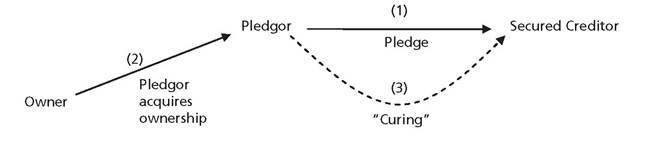
Discussion Questions:
1) Create some concrete examples of the curing of a security interest.
2) Why does the creditor acquire only an actio utilis in the first fact-situation?
3) Justify why Paul recognizes curing in one case but denies it in the other. Compare on this question Mod. 20.1.22 (Case 160).[374]
Literature:
Schanbacher (Case 160) 113 ff., 122 ff.
Wacke (Case 160) 445 ff.
D 13.7.9 pr. & 4 (Ulpianus libro vicensimo octavo ad edictum)
(pr.) Si rem alienam mihi debitor pignori dedit aut malitiose in pignore versatus sit, dicendum est locum habere contrarium iudicium.
(4) Is quoque, qui rem alienam pignori dedit, soluta pecunia potest pigneraticia experiri.
Translation: (Ulpian in the 28th book of his Commentary on the Praetor’s Edict)[375] [376]
(pr.) If the debtor has pledged to me the property of another person, or he has conducted himself fraudulently with respect to the pledge, it must be said that there is a place for using the actio contraria.22
(4) Also the person who has given another person's property in pledge can use the actio pigneraticia after the money has been paid.
Discussion Questions:
1)style='font:7.0pt "Times New Roman"'> What are examples of fraudulent conduct of the security-debtor?
2) What claims can the creditor validly make by means of the actio contraria?
3) What does the debtor seek with the actio pigneraticia?
Compare with this Text:
§ 456 Austrian Civil Code:
If another's movable property is pledged without the owner's consent, he [the owner] in general has the right to demand it back; but in those cases in which the ownership suit does not lie against a reasonable possessor (§ 367), he [the owner] is obliged either to hold the reasonable security-holder harmless, or to let the secured property go and be satisfied with his right of compensation against the pledgor.[377]
§ 458 Austrian Civil Code:
If the worth of the secured property through the fault of the security-debtor, or because of a defect of the property that just became visible, is no longer found sufficient to cover the debt, the creditor is entitled to demand another appropriate security from the security-debtor.[378]
Art. 890 Swiss Civil Code:
The creditor is liable for damage caused by the diminishment in the value of the secured property or for its loss, to the degree that he fails to show that it occurred without his fault [Law of Obligations 97 ff.].
If the creditor alienates the secured property or pledges it to another, he is liable for all the damage that results therefrom.[379]
d. Consensual Termination of a Security Interest
CASE 162
D 20.6.8.14 (Marcianus libro singulari ad formulam hypothecariam)
Quod si concesserit decem vendere, ille quinque vendiderit, dicendum est, non esse repellendum creditorem: in contrarium non erit quaerendum, quin recte vendit, si pluris vendiderit, quam concessit creditor.
Translation: (Marcian in his Monograph On the Action for Secured Property)[380]
But if the secured creditor has allowed the security-debtor to sell the property for 10 and the latter sold for five, it must be said that the creditor is not to be barred: conversely, there is no question that he sold validly if he sold for more than the creditor allowed.
Discussion Questions:
1) What reasons might cause the creditor to allow the debtor to sell the secured property?
2) How does granting permission [to dispose of the property] affect the security interest?
3) Is the sale for five valid?
4) What measures can the creditor take?
5) Why is the sale for a higher price valid?
6) How might the secured creditor assure himself, if he fears the security-debtor will not obey him in the sale?
D 20.6.8.15 (Marcianus libro singulari ad formulam hypothecariam)
Non videtur autem consensisse creditor, si sciente eo debitor rem vendiderit, cum ideo passus est veniri, quod sciebat ubique pignus sibi durare. sed si subscripserit forte in tabulis emptionis, consensisse videtur. nisi manifeste appareat deceptum esse. quod observari oportet et si sine scriptis consenserit.
Translation: (Marcian in his Monograph On the Action for Secured Property)[381]
The creditor is not understood to have agreed, if the debtor sold the property with the creditor’s knowledge, provided the creditor allowed the sale to be made because he knew the security interest would endure anyway. But if he happens to have signed the sales contract, he is deemed to have agreed—unless it is obvious that he was deceived, which ought to be noted even if he agreed without a writing.
Note on the Text:
On videtur (“is understood”), see on Case 72.
Discussion Questions:
What legal effects are brought about by the sale of the pledged property under the following fact-situations (cf. on this Paul. D 47.2.67 pr. [Case 164]).
a) The creditor allows the sale with a reservation of his security interest.
b) The creditor does not know about the sale. Later he finds out and keeps silent, or agrees, or expresses his disapproval.
c) The creditor forbids the sale, but the debtor sells the property anyway.
Literature:
Wacke, Andreas. “Zur Lehre vom pactum tacitum und zur Aushilfsfunktion der exceptio doli. Stillschweigender Verzicht und Verwirkung nach klassischem Recht, II.” ZRG 91 (1974) 251-284, at 264 ff.
Wacke, A. “Max Kasers Lehren zum Ursprung und Wesen des römischen Pfandrechts.” ZRG 115 (1998) 168-202, at 197 ff.
face="Book Antiqua">D 47.2.67 (66) pr. (Paulus libro septimo ad Plautium)
Si is, qui rem pignori dedit, vendiderit eam: quamvis dominus sit, furtum facit, sive eam tradiderat creditori sive speciali pactione tantum obligaverat: idque et Iulianus putat.
Translation: (Paul in the seventh book of his Commentary on Plautius)[382]
If someone who has given property for a pledge sells it, even though he is the owner, he has committed theft, whether he delivered the property to the creditor or only pledged it without possession under a special agreement. And Julian thinks the same.
Discussion Questions:
1) Is the sale by the debtor valid?
2) What claims can the secured creditor make effective against the debtor? What claims against the buyer?
3) The expression speciali pactione (“special agreement”) refers to the pledge of a specific item. Do you think that the same legal consequences would follow in the case of a general pledge (cf. on this Ulp. D 49.14.28, under Case 185).
Literature:
Kaser (Case 150) 204 ff.
D 13.7.3 (Pomponius libro octavo decimo ad Sabinum)
Si quasi recepturus a debitore tuo comminus pecuniam reddidisti ei pignus isque per fenestra id misit excepturo, quem de industria ad id posuerit, Labeo ait furti te agere cum debitore posse et ad exhibendum: et, si agente te contraria pigneraticia excipiat debitor de pignore sibi reddito, replicabitur de dolo et fraude, per quam nec redditum, sed per fallaciam ablatum id intellegitur.
Translation: (Pomponius in the 18th book of his Commentary on the Ius Civile of Sabinus)[383]
If you, expecting to receive the money from your debtor in his presence, returned the security to him, and he threw the security out the window to someone whom he placed there deliberately, Labeo says that you can proceed against him with an actio furti [“action for theft”] and an actio ad exhibendum [“action for production of the property”]. And if, when you bring an actio contraria pigneraticia [“reverse action on the pledge”], the debtor raises the defense that the security was returned, you have a replicatio [“reply”] for dolus [“deceit”] and fraus [“fraud”], according to which it was not returned, but is deemed to have been carried off by deception.[384]
Discussion Questions:
1) What rights can the creditor assert with the actio furti and the actio ad exhibendum?
size=1 color=black face="Book Antiqua">2) Could he also proceed against the debtor with the actio Serviana or the interdictum utrubi?
3) What does the creditor achieve with the actio pigneraticia contraria?
4) Explain the exceptio de pignore sibi reddito [“affirmative defense that the security was returned”] of the debtor.
5) Could the creditor proceed against a third party with the actio Serviana?
Literature:
Kaser (Case 159) 91 ff.
Wesener (Case 131) 124.
e. Repayment of the Debt
CASE 166
D 20.1.19 (Ulpianus libro vicesimo primo ad edictum)
Qui pignori plures res accepit, non cogitur unam liberare nisi accepto universo quantum debetur.
Translation: (Ulpian in the 21st book of his Commentary on the Praetor’s Edict)[385]
The person who has accepted multiple things as security is not required to release one of them unless the entire amount of the debt has been received.
Note on the Text:
Up until complete repayment of the debt the entire property or all the pledged items remain subject to the security interest. Partial repayment does not free individual parts or pieces of the property from the security interest: pignoris causa indivisa est (“the security interest is indivisible”). cf. Pap. D 21.2.65.
Discussion Question:
Justify Ulpian's opinion. What are the arguments for and against the indivisibility of the security-lien?
Compare with this Text:
§ 469 Austrian Civil Code:
The security interest ends by payment of the debt....[386]
§ 1252 German Civil Code:
The security interest expires with the claim for which it exists.[387]
class=61 style='text-indent:0cm;page-break-after:avoid'>Art. 889 Swiss Civil Code:If the security interest is extinguished as a consequence of payment of the claim or on other grounds, the creditor is to return the secured property to the person entitled to it. Before his complete satisfaction he is not required to return the security entirely or in part.[388]
Literature:
Wacke, A. “Ungeteilte Pfandhaltung.” Index 3 (1972) 454-502, at 456 ff.
f. Disposition of Security
CASE 167
D 20.5.8 (Modestinus libro quarto regularum)
Creditors arbitrio permittitur ex pignoribus sibi obligatis quibus velit distractis ad suum commodum pervenire.
Translation: (Modestinus in the fourth book of his Rules)[389]
It is left to the creditor’s judgment which of the pledged goods he wishes to sell in order to receive satisfaction of the debt.
Discussion Questions:
1) May the creditor, upon non-payment of the debt, sell the entirety of the pledged property?
2) May the creditor, if only a small amount of the claim is still outstanding, sell the most valuable piece of the pledged property?
3) Must the creditor take special effort to get the best possible sale price?
Compare with this Text:
§ 1230 German Civil Code:
When there are several pieces of secured property, the secured creditor, to the extent something else is not specified, may select those which should be sold. He can bring to sale only as many of the secured items as are required for his satisfaction.[390]
Literature:
Wacke (Case 166) 457 ff.
D 20.5.12 pr. (Tryphoninus libro octavo disputationum)
Rescriptum est ab imperatore libellos agente Papiniano creditorem a debitore pignus emere posse, quia in dominio manet debitoris.
D 20.1.16.9 (Marcianus libro singulari ad formulam hypothecariam)
Potest ita fieri pignoris datio hypothecaeve, ut, si intra certum tempus non sit soluta pecunia, iure emptoris possideat rem iusto pretio tunc aestimandam: hoc enim casu videtur quoddammodo condicionalis esse venditio. et ita divus Severus et Antoninus rescripserunt.
Translation: (Tryphoninus in the eighth book of his Disputations)[391]
When Papinian headed the office a libellis,[392] the emperor issued a rescript that the creditor could buy the security from the debtor, since it remained in the debtor's ownership.
(Marcian in his monograph On the Action for Secured Property)[393]
The giving of security can take place in a way that the creditor, if the money is not paid within a specified time, can lawfully possess the property with the right of a buyer, at a price that is a fair evaluation of its worth at that time. In this case there is a kind of conditional sale, and the emperors Severus and Antoninus so decided in rescripts.
Discussion Questions:
1) Explain the reasoning of quia in dominio manet debitoris (“since it remained in the debtor's ownership”).
2) Why was there a need for an imperial rescript in order to allow purchase of the security by the creditor?
3) Is it permissible to set [in advance] the purchase price at which the creditor will purchase the property secured by the security contract?
Compare with this Text:
§ 461 Austrian Civil Code:
If the secured creditor after passage of the specified time is not satisfied, he is authorized to demand a judicial sale of the security.... [394]
§ 463 Austrian Civil Code:
Debtors have no right, when there is an auction of the property they have pledged, to take part in bidding.[395]
§ 1371 Austrian Civil Code:
All terms that are contrary to the nature of contracts for security and loans and all side contracts are invalid. Among these are agreements that after expiration of the time for payment of the debt the secured property will pass to the creditor; that he may alienate the property however he wishes or at a price that has already been previously specified, or that he can keep it for himself; that the debtor never redeem the security, or that he assign a piece of real property to no one else, or that the creditor, after the time of foreclosure, may not demand the alienation of the security.[396]
class=61 style='text-indent:0cm;page-break-after:avoid'>§ 1228 German Civil Code:I The satisfaction of the secured creditor from the security takes place through [its] sale.
II The secured creditor is entitled to the sale, as soon as the claim is due
entirely or in part.............. [397]
§ 1229 German Civil Code:
An agreement made prior to commencement of the right to sell, according to which the ownership of the property will pass or be transferred to the secured creditor, in case he is not satisfied or not timely satisfied, is a nullity.[398] [399]
Art. 891 Swiss Civil Code:
In the case of non-satisfaction, the creditor has the right to pay himself from the proceeds of the security....46
Art. 894 Swiss Civil Code:
Any agreement, according to which the secured property will become the property of the creditor, if he is not satisfied, is invalid.[400]
Literature:
Peters F. “Der Erwerb des Pfandes durch den Pfandgläubiger im klassischen und nachklassischen Recht,” in Studien zum römischen Recht, Max Kaser zum 65. Geburtstag gewidmet von seinen Hamburgern Schülern, D. von Medicus D. and H. H. Seiler eds., Berlin: Duncker und Humblot, 1973, 137-168, at 142 ff.
Kaser (Case 159) 20, 37.
Wacke, Max Kasers Lehren (Case 163) 187 ff.
D 13.7.4 (Ulpianus libro quadragensimo primo ad Sabinum)
Si convenit de distrahendo pignore sive ab initio sive postea, non tantum venditio valet, verum incipit emptor dominium rei habere. sed etsi non convenerit de distrahendo pignore, hoc tamen iure utimur, ut liceat distrahere, si modo non convenit, ne liceat. ubi vero convenit, ne distraheretur, creditor, si distraxerit, furti obligatur, nisi et ter fuerit denuntiatum ut solvat et cessaverit.
Translation: (Ulpian in the 41st book of his Commentary on the Ius Civile of Sabinus)[401]
If an agreement has been made concerning the sale of the security, whether from the beginning or afterward, the sale is not only valid, but the buyer acquires ownership of the property. But even if there is not an agreement about sale of the security, we use the rule that it may be sold, unless there is an agreement that it may not be sold. When it has been agreed that it not be sold, the creditor, if he sells it, is liable for theft, unless demand for payment has been made to the debtor three times, and he [the debtor] has failed to make payment.
Discussion Question:
Write an analysis. Assume in doing so that the first sentence comes from Sabinus. For the expression hoc iure utimur [“we use the rule”], see on Case 156.
Literature:
Kaser (Case 159) 72 ff.
Wacke, Max Kasers Lehren... (Case 163) 182 ff.
g. Loss of Secured Property
CASE 170
D 20.1.29 (Paulus libro quinto responsorum)
Domus pignori data exusta est eamque aream emit Lucius Titius et exstruxit: quaesitum est de iure pignoris. Paulus respondit pignoris persecutionem perseverare et ideo ius soli superficiem secutam videri, id est cum iure pignoris: sed bona fide possessores non aliter cogendos creditoribus aedificium restituere, quam sumptus in exstructione erogatos, quatenus pretiosior res facta est, reciperet.
Translation: (Paul in the fifth book of his Legal Opinions)[402]
A house that had been given as security burned down. Lucius Titius then bought the plot and built on it. A question was asked about the security interest. Paul answered that the security interest remained in effect and the building followed with the right to the land: i.e., the security interest. However, the good faith possessor could only be forced to surrender the building to the creditor, if he received compensation for as much of his building costs as were covered by commensurate increase in the value of the property.
Notes on the Text:
With the loss of the property the security interest is extinguished: re extincta pignus perit (cf. Marcian D 20.6.8 pr.). The principle applies to all property rights.
Discussion Questions:
1) Did Lucius Titius acquire ownership of the land that was sold?
2) Does this opinion contradict the principle that with the loss of the secured property, the security interest is extinguished?
3) With what kind of action could the creditor claim the house? What defenses could a good faith possessor raise? Explain.
4) The value of the land alone is 50; with the originally pledged house it is 80; with the new house it is 90. How high is the limit on the compensation for costs that the good faith builder gets from the secured creditor?
5) Could the possessors also receive compensation for luxury additions (e.g., wall paintings)? On this question, cf. Case 107.
face="Book Antiqua">6) Could the possessors, after the loss of the land to the security creditor, make a valid claim against the seller?
7) The debtor has pledged a forest. Trees fall on it and a boat is made from then. Does the creditor have a security interest in the boat?
Literature:
Bürge (Case 107) 148 ff.
Meissel, Franz-Stefan.“Die Prüfungsexegese im römischen Recht. Dargestellt an D 20.1.29.2: Pfandrecht am abgebrannten Haus?” JAP 3 (1992/93) 198 ff.
D 13.7.18.3 (Paulus libro vicensimo nono ad edictum)
Si quis caverit, ut silva sibi pignori esset, navem ex ea materia factam non esse pignori Cassius ait, quia aliud sit materia, aliud navis: et ideo nominatim in dando pignore adiciendum esse ait: “quaeque ex silva facta natave sint.”
Translation: (Paul in the 29th book of his Commentary on the Praetor’s Edict)[403]
If someone has made an agreement that a forest should be pledged to him, Cassius says that a ship made from the wood taken from the forest is not pledged, since the lumber is one thing and the ship another. Therefore, he says, one must expressly add in the security agreement: “and whatever is taken from or made from this forest.”
Discussion Questions:
1) Do you think that Cassius would recognize a security interest in fallen trees?
2) Why does the ship not count as part of the security?
3) Does the person who built the ship come into the question? What suit does the security creditor have against him?
4) The debtor sells the lumber to a good faith shipbuilder, who does not know about either the pledge of the forest or about the special contract term. Does the creditor have a security interest in the ship?
Literature:
Schermaier (Cse 118) 458 ff.
Schermaier (Case 115) 224 ff.
Löffelmann, Arnd. Pfandrecht und Sicherungsübereignung an künftigen Sachen: Rechtsvergleich zwischen deutschem und römischem Recht. Köln: Böhlau, 1996, 158 ff.
More on the topic A. Creation and Extinction of Secured Interests:
- A. Creation and Extinction of Secured Interests
- Introduction
- Creation and the Nature of the World
- Hausmaninger H., Gamauf R.. A Casebook on Roman Property Law. Oxford University Press,2013. — 371 p., 2013
- Resource extinction and quasi-extinction in MacArthur’s model
- III LENDING AND BORROWING
- Acquiring Fruits
- Norms and interests
- The polity and humankind on the island
- The Origins of the Roman Empire