The Origins of the Roman Empire
As one of the greatest and most durable powers in European history, the mature Roman Empire is the subject of a separate chapter (Chapter 9 in this volume). Yet it also belongs here: just like Athens and Carthage, Rome started out as a city-state that set up an increasingly complex imperial edifice.
Owing to the long duration of Rome’s imperial development, the core polity underwent massive transformations until it could no longer be regarded as a city-state in control of other similar communities. Even as some of the political institutions of the original Roman citystate—such as the Senate and certain senior offices—survived as relics well into late antiquity, Rome itself became the capital city of a vast state without which it was no longer viable.In the mid-first millennium bce, Rome was both part of the Latin city-state culture and located at the margins of another cluster of city-states to the north, that of the Etruscans.[382] All over this region, independent city-states had been formed by absorbing smaller neighbors, which often survived as subordinate secondary settlements. The city-states of the Latin heartland ranged from about 40 to a few hundred square kilometers in size, while the Etruscan city-states in Tuscany tended to be somewhat larger, from several hundred to over 1,000 square kilometers. By 500 bce, Rome’s territory had grown to around 800-900 square kilometers with a population of perhaps around 35,000, larger than any of its Latin peers and more similar in size to the biggest Etruscan polities. By regional standards, the size of its urban center was likewise exceptionally large. The reasons for Rome’s early relative preeminence are unclear: for what it is worth, (much) later Roman historiography sought to explain it with reference to the activities of its sixth-century bce rulers, about whom little if anything can reliably be ascertained.
Taken together, Rome’s Latin neighbors controlled about twice as much territory (and presumably also population), thereby constricting its scope for unilateral expansion.As in the case of Athens (and perhaps also Carthage), external pressures allowed Rome to assume a hegemonic position in an alliance with adjacent city-states.[383] From the early fifth century bce, Rome came to lead military operations jointly with its Latin neighbors and other regional allies that were directed against incursions from the Apennines. Land captured in these campaigns was settled by colonists from the Roman and allied communities. This process created a template for subsequent expansion, which critically relied on the pooling of Roman and allied military forces and the subsequent distribution of the fruits of conquest, both under Roman supervision.
Two shocks perturbed the balance of power within this regional alliance system in the early fourth century bce. First, after repeated conflict with Veii, the closest of the Etruscan city-states, Rome managed to defeat and absorb this rival polity, a success that almost doubled its territory to 1,600 square kilometers, thereby matching the aggregate possessions of its Latin allies. These new resources that were external to Rome's native city-state cluster could now be brought to bear on power politics within Latium. This expansion was closely followed by Rome's sack by raiding Gauls, a common occurrence in Italy at the time. This event, less dramatic than the Persian sack of Athens but perhaps comparable in psychological impact, provided a strong incentive for renewed military mobilization and war-making and boosted demand for hegemonic coordination among exposed Italian city-states and other small agrarian communities.
Rome swiftly recovered, but the size of its territory was already approaching the limits of what could be centrally administered by existing city-state institutions. Further expansion created an increasingly multilayered periphery not dissimilar to that observed in the—roughly contemporary—case of Carthage.
The principal goal was the extraction of military labor rather than of tribute in cash or kind. Compared to the Athenian Empire(s), the Roman model in the fourth and third centuries bce was more cooperative in terms of military mobilization and what we might call more “archaic” in economic terms, differences that may be attributable to lower levels of commercial development and the terrestrial character of military power that favored militia levies over capital-intensive naval investment. Co-opted city-states retained self-government and indeed full internal autonomy, as Rome merely controlled foreign policy and coordinated levies and military operations.Empire-building proceeded on three distinct tracks. One entailed the formal incorporation of subjugated Italians into the Roman citizenry (with or without suffrage). This process caused the citizen body to expand from perhaps 50,000 in the 390s bce to at least 10 times as many by 290 bce and some 900,000 by 225 bce, creating a fairly solid bloc of Roman territory across the central Italian Peninsula (see Map 5.3). A revolt by the Latin allies resulted in their absorption into the Roman citizenry in 338 bce, turning the entire city-state cluster into a formally unified—if locally fragmented—core region. Enfranchised communities were organized as self-governing municipia, an arrangement that preserved the integrity of the city-state core, represented by the city of Rome, and its effective hinterland by obviating the need for institutional change.
A second strategy revolved around the creation of alliances with otherwise autonomous polities in northern and southern peninsular Italy. As the total number of allied entities (socii) rose to around 200, their population increased from maybe 100,000 to 2 million during the same period. These allies were not technically part of the Roman citizen-state and were responsible for their own governance and funding their military contingents. Colonization—the founding of settlements on conquered land—was the third mechanism of imperial consolidation.
These new settlements were mostly of non-citizen (“Latin”) status, requiring Romans who joined them to relinquish their citizenship. The Roman citizenry thus effectively splintered into the residents of the metropolitan core, a growing periphery of municipia, and disenfranchised colonists.As with Athens and Carthage, Roman imperial expansion went hand in hand with bargaining processes (both among elements of the ruling class and between elite and commoners) and the development of revenue collection. If the sources are to be trusted, both pay for the troops (stipendium) and a property tax levied to cover military expenditure (tributum) were first introduced at the time of the war against Veii, and indemnities imposed on defeated communities are likewise first reported in this period. Institutional reform widened political and military participation among both elites and commoners. The extension of Roman control over the entire Italian Peninsula between the 380s and 270s bce coincided with improved access to political, military, and religious leadership positions for members of the landowning elite, positions that all came to be allocated by popular vote in assembly meetings held in the city of Rome. The underlying compromises broadened and increased cohesion within the ruling class, and helped accommodate and co-opt the local elites of enfranchised communities.
Bargaining between elite and commoners can be discerned in a variety of reported measures: a tax on the manumission of slaves (which affected the wealthy), laws that affirmed the primacy of decisions of the assembly and ended aristocrats' right to overturn decisions based on technicalities, and perhaps most importantly the abolition of debt-bondage in 326 bce, a reform likely to increase the potential for military mass mobilization. It has been conjectured that military conscription may have been reorganized and expanded in the same period, which witnessed campaigning against a rival confederation in the Apennine region led by the Samnites.
Bargaining and popular voice are also reflected in the practice of iteration of the most senior state office, the consulate, which in this period was primarily a position of supreme military command: the re-election of seasoned leaders was in the interest of the electorate, which was largely coextensive with the pool for military conscription, but ran counter to the preferences of a ruling class that sought to share power among peers. It is therefore telling that frequent iteration as well as the appointment of extraordinary officials (dictators) were correlated with the intensity of military conflict and abated once pressures subsided, and thus serve as an index for the need to appease the citizen militia in times of heightened commitments.These processes were initiated at a time when a large share of the Roman citizenry was still capable of participating in events such as assembly meetings, elections, and
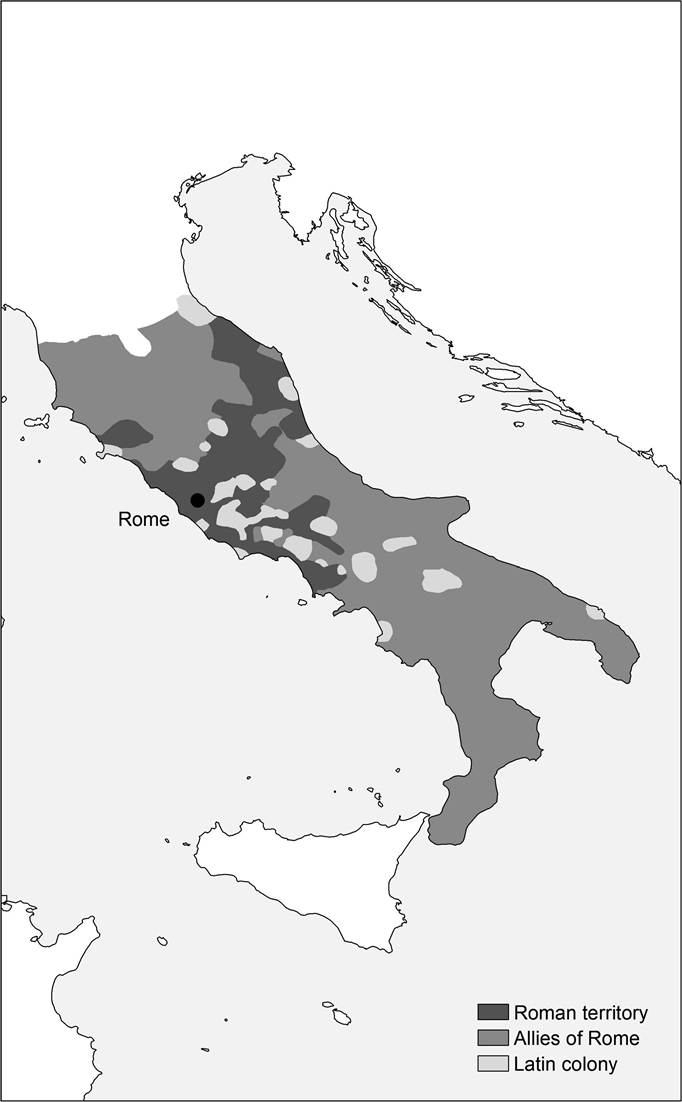
Map 5.3. The Roman State and Alliance System in Peninsular Italy (Third Century BCE).
Source: Scheidel 2019, 60. Copyright: Walter Scheidel with Jonathan Weiland. festivals in the city of Rome. Over time, mass enfranchisement of increasingly remote groups restricted participation in civic affairs to a dwindling minority among the formal citizen body. The citizenry was organized in districts (tribus), four in the city and eventually as many as 31 beyond, many of them at considerable remove from Rome. These tribus represented voting districts but primarily functioned as units of conscription that structured the military contribution of citizen militias. As the number of tribus grew, military service remained the only commonly shared experience for adult male citizens, whereas political and cultic participation became the prerogative of the population in and around the city of Rome (as well as more mobile members of the elite).[384]
This increasing bifurcation contributed to the overall institutional layering of Rome's growing domain.
Different kinds of assemblies convened in the capital to elect officials and vote on war, peace, treaties, and legislation, but in the absence of representative arrangements, the huge expansion of citizen numbers effectively excluded a growing majority of those formally entitled to participate. State offices were monopolized by the members of a few dozen established clans, ensuring narrow aristocratic dominance. Most of the junior and intermediate offices provided governance only for the original city-state core, in spheres ranging from arbitration, infrastructure, provisioning, rituals, and spectacles to protection from elite abuse. Conversely, the most senior officials—the annual pair of consuls and the growing number of praetors—mostly performed military functions that increasingly kept them away from Rome. This de facto separation of areas of operation helped reconcile the massive formal powers of the most senior officials with the preeminence of collective oligarchic and participatory institutions within the city-state core. Alongside other magistrates tasked with command functions, the consuls formed part of an expanding set of officeholders who mobilized citizens for military ventures and controlled and cooperated with the military leadership of the “Latin” colonies and the many allied polities of peninsular Italy. Two strands of government consequently emerged, one for the city-state core and one for the imperial peripheries. They were tied together by the shared practice of election by metropolitan assemblies but more decisively by the council (senate), an aristocratic body increasingly composed of former magistrates that assumed growing responsibilities and powers in dealing with the complexities of imperial rule, especially in the domains of fiscal oversight and foreign relations.The “Romans” of the growing periphery were for most practical purposes the subjects of a tributary empire: they owed tax in labor for war and, if propertied, also monetary contributions for the same purpose. Beyond military obligations, they had little or no direct interaction with the city-state core. In this respect, they had much in common with the members of the allied states. For both groups, incentives for military commitments were heavily skewed in favor of material benefits, both from protection and—as the imperial system expanded—increasingly from pay, plunder, and colonization programs. While there can be little doubt that anarchic environments always provide a strong impetus for military action, key features of the Roman system of rule and treaties in peninsular Italy may have been particularly conducive to ongoing campaigning. In the absence of regular tribute obligations to the core, benefits (beyond security as such) could only be obtained by military operations that generated collective action among Romans and allies.
In this respect, the Roman system approximated the Schumpeterian ideal type of a war machine devoted to “objectless imperialism”: on top of the economic benefits that accrued in the event of victory, the combination of intense fragmentation of the system into numerous self-governing or even largely independent polities, electoral competition among potential military leaders, and the lack of extractive arrangements such as tribute or civilian labor obligations that were decoupled from war-making made continuous military action a vital prerequisite for the maintenance of the imperial network. Moreover, the Roman reward system that held out to the recently conquered the promise of joining future predatory operations against third parties has been likened to a pyramid scheme that required a reliable supply of new enemies to keep it going. For generations, these incentives successfully sustained imperial growth in the context of minimal centralization and persistent city-state autonomy.[385]
Rome's own transformation from a city-state that dominated a conglomerate of comparable entities into the center of a more integrated territorial polity was a drawn- out and in some ways incomplete process. Inasmuch as local self- governance by urban communities and their hinterlands remained the organizing principle even of the mature Roman Empire, the latter always retained some features of the initial arrangement. Rome would no longer have qualified as a city-state in charge of other city-states by the time it was no longer able to function without an imperial periphery. That Athens weathered the loss of its empire on two separate occasions and that even Carthage managed to survive with a much reduced hinterland suggests that neither of them ever passed that threshold.
Rome's ongoing success makes it hard to identify a plausible transition point. By the later stages of the Republican period, when the city of Rome had become home to hundreds of thousands and critically dependent on massive food imports, the loss of empire would surely have been a fatal blow. Yet even under the monarchy, when Rome drew on a catchment area the size of the entire Mediterranean basin, it maintained some characteristics of the city-state. The metropolitan population enjoyed unusual attention in the form of food subsidies, cash gifts, and lavish state expenditure on infrastructure and spectacles. Lesser privileges had been extended to all of Italy, as the heartland of a population of citizens that could be traced back all the way to the original city-state of Rome: it enjoyed centuries of freedom from direct taxation, a rare privilege by world historical standards. For both the capital city and the wider core region, homogenization came only very late, imposed by military rulers of peripheral origin in the late third century ce. This resilience of formal privilege is best understood as a legacy of the city-state features of the original power structure, a legacy that withstood centuries of imperial growth and integration.
Bibliography
Afzelius, A. 1942. Die Romische Eroberung Italiens (340-264 v. Chr.). Copenhagen.
Ameling, W 1993. Karthago: Studien zu Militär, Staat und Gesellschaft. Munich.
Ameling, W 2013. “Carthage.” In P. F. Bang and W Scheidet, eds., The Oxford Handbook of the State in the Ancient Near East and Mediterranean, 361-382. New York.
Bang, P. F., and W Scheidel, eds. 2013. The Oxford Handbook of the State in the Ancient Near East and Mediterranean. New York.
Charlton, T. H. and D. L. Nichols. 1997. “The City- State Concept: Development and Applications.” In D. L. Nichols and T. H. Charlton, eds., The Archaeology of City-States, 1- 14. Washington, DC.
Cornell, T. J. 1995. The Beginnings of Rome: Italy and Rome from the Bronze Age to the Punic Wars (c. 1000-264 BC). London and New York.
Cornell, T. J. 2000. “The City-States in Latium.” In M. H. Hansen, ed., A Comparative Study of Thirty City-State Cultures, 209-228. Copenhagen.
Dreher, M. 1995. Hegemon und Symmachoi: Untersuchungen zum Zweiten Attischen Seebund. Berlin. Eckstein, A. E. 2006. Mediterranean Anarchy, Interstate War, and the Rise of Rome. Berkeley, CA. Hansen, M. H., ed. 2000. A Comparative Study of Thirty City-State Cultures. Copenhagen.
Hansen, M. H. 2000a. “Introduction: The Concepts of City- State and City- State Culture.” In M. H.
Hansen, ed., A Comparative Study of Thirty City-State Cultures, 11-34. Copenhagen.
Hansen, M. H. 2000b. “Conclusion: The Impact of City-State Culture on World History.” In M. H.
Hansen, ed., A Comparative Study of Thirty City-State Cultures, 597-623. Copenhagen.
Hansen, M. H. 2003. “95 Theses about the Greek Polis in the Archaic and Classical Periods.” Historia 52: 257-282.
Hansen, M. H. 2006. Polis: An Introduction to the Ancient Greek City-State. Oxford.
Hansen, M. H., and T. H. Nielsen, eds. 2004. An Inventory of Archaic and Classical Poleis. Oxford. Harris, W V. 1979. War and Imperialism in Republican Rome, 327-70 BC. Oxford.
Huss, W 1985. Geschichte der Karthager. Munich.
Kehne, P 2014. “Das attische Seereich (478-404v. Chr.) und das spartanische Hegemonialreich (nach 404 v. Chr.): Griechische Imperien?” In M. Gehler and R. Rollinger, eds., Imperien und Reiche in der Weltg eschichte: Epochenübergreifende undglobalhistorische Vergleiche, 329-362. Harrassowitz: Wiesbaden.
Mackil, E. 2013. Creating a Common Polity: Religion, Economy, and Politics in the Making of the Greek Koinon. Berkeley, CA.
McGregor, M. 1987. The Athenians and Their Empire. Vancouver.
Meiggs, R. 1972. The Athenian Empire. Oxford.
Morris, I. 2009. “The Greater Athenian State (478-404 BC).” In I. Morris and W. Scheidel, eds., The Dynamics of Ancient Empires, 99-177. New York.
Morris, I. 2013. “Greek Multicity States.” In P. F Bang and W Scheidel, eds., The Oxford Handbook of the State in the Ancient Near East and Mediterranean, 279-303. New York.
Pilkington, N. 2019. The Carthaginian Empire: 550-202 BCE. Lanham.
Pritchard, D. M. 2010. “The Symbiosis between Democracy and War: The Case of Ancient Athens.” In D. M. Pritchard, ed., War, Democracy and Culture in Classical Athens, 1-62. Cambridge.
Raaflaub, K. A. 1990. “Expansion und Machtbildung in frühen Polis-Systemen.” In W Eder, ed., Staat und Staatlichkeit in der frühen romischen Republik, 511-545. Stuttgart.
Raaflaub, K. A. 1991. “City-State, Territory, and Empire in Classical Antiquity.” In A. Molho, K. A. Raaflaub, and J. Emlen, eds., Athens and Rome, Florence and Venice: City-States in Classical Antiquity and Medieval Italy, 565-588. Stuttgart and Ann Arbor, MI.
Raaflaub, K. A. 2011. “From City- State to Empire: Rome in Comparative Perspective.” In J. P Arnason, and K. A. Raaflaub, eds., The Roman Empire in Context: Historical and Comparative Perspectives, 39-66. Chichester, UK.
Raaflaub, K. A. 2016. “Arche,’ ‘Reich' oder ‘athenischer Groß-Staat'? Zum Scheitern integrativer Staatsmodelle in der griechischen Poliswelt des 5. und frühen 4. Jahrhunderts v. Chr” In E. Baltrusch, H. Kopp, and C. Wendt, eds., Seemacht, Seeherrschaft und die Antike, 103-132. Stuttgart.
Rhodes, P. 1985. The Athenian Empire. Oxford.
Runciman, W 1990. “Doomed to Extinction: The Polis as an Evolutionary Dead- End.” In O. Murray. and S. Price, eds., The Greek City, 347-367. Oxford.
Scheidel, W 2006. “The Demography ofRoman State Formation in Italy” In M. Jehne and R. Pfeilschifter, eds., Herrschaft ohne Integration? Rom und Italien in republikanischer Zeit, 207-226. Frankfurt.
Scheidel, W 2013. “Studying the State.” In P. F Bang and W Scheidel, eds., The Oxford Handbook of the State in the Ancient Near East and Mediterranean, 5-57. New York.
Scheidel, W 2019. Escape from Rome: The Failure of Empire and the Road to Prosperity. Princeton. Schuller, W 1974. Die Herrschaft der Athener im Ersten Attischen Seebund. Berlin.
Terrenato, N. 2019. The Early Roman Expansion into Italy: Elite Negotiation and Family Agendas. Cambridge.
Tilly, C. 1992. Coercion, Capital, and European States AD 990-1992. Cambridge, MA.
Torelli, M. 2000. “The Etruscan City-State.” In M. H. Hansen, ed., A Comparative Study of Thirty City- State Cultures, 189-208. Copenhagen.
More on the topic The Origins of the Roman Empire:
- Roman law entered medieval political reflection in the late eleventh century as the law of the universal Roman empire, an organization foretold by Old Testament prophecy as the last empire to rule the world before Apocalypse and hallowed by Christ himself who had lived under the Caesars.
- The Conquest of the Eastern Roman Empire
- Christianising the Roman Empire: the evidence of the Code
- The Disintegration and Collapse of the Western Roman Empire
- A sourcebook on women and the law in the Roman Empire: marriage, divorce, and widowhood
- Grubbs J.E.. Women and the Law in the Roman Empire. Routledge,2002. — 374 p., 2002
- Two The Roman Empire
- 9 The Roman Empire
- Warfare, Empire and Roman Militarism
- The Slavs and the Roman Empire
- The Graeco-Roman Ottoman Empire
- CHAPTER TWENTY-EIGHT The Roman Empire
- 14 THE OTTOMAN ROMAN EMPIRE, c. 1680-1900
- Given ancient life expectancy and the fact that most wives were younger than their husbands, the marriages of many women in the Roman Empire were ended by their husband's death rather than by divorce.
- .. the Roman Empire... is now regarded in spite of all the barbarism, all the superstition, and all the misery, as one of the most interesting of all historical phenomena.