The Carthaginian Empire
The city-state of Carthage in North Africa was founded near present-day Tunis by settlers from the Phoenician city-state culture (in present-day Lebanon) probably in the late ninth century bce.
It grew faster than other Phoenician settlements in the region, assuming a leadership role within the emerging “Punic” city-state culture. Early state formation and expansion were likely driven by conflict with herder populations in the hinterland.We may distinguish among five periods of Carthaginian imperial growth and retrenchment: expansion into Sicily, Sardinia, and Libya in the sixth and fifth centuries bce; more ambitious operations in Sicily in the fourth century bce alongside some peripheral expansion into Morocco and Corsica; a period of retreat impelled by conflict with Epirus (under King Pyrrhus) and especially Rome; followed by a final phase of expansion in the Iberian peninsula (237-206 bce). Defeat in the Second Punic War and subsequent Numidian encroachment on its remaining African territory reduced Carthage to a large city-state that survived until its annihilation by the Romans in 146 bce.[379]
The earliest origins of Carthaginian hegemony over other Phoenician city-states in what is now Tunisia remain unclear. By the end of the sixth century bce, Carthage had established control over existing Phoenician settlements in western Sicily and over the island of Sardinia. An invasion of the Greek eastern part of Sicily having failed in 480 bce, Carthage launched multiple military campaigns in this theater between 410 and 306 bce. Operations took the form of invasions preceded by levies and the stockpiling of financial resources. In this period, war-making appears to have relied largely on mass mobilization of Carthaginian citizens for service in the army and navy, complemented by allies and mercenaries. In the absence of a large standing army, military forces had to be mobilized and funded ad hoc to support larger efforts.
The extent of citizen participation is worth noting given that modern scholarship long portrayed Carthage as a commercial city-state run by a mercantile elite that mainly relied on mercenary soldiers. Revisionist work has shown that much like other Greek or Italian city-states in this period, Carthage was endowed with a warlike aristocracy and a citizen army raised through mass mobilization, and relied on its ability to extract tribute rather than on gains from trade.[380]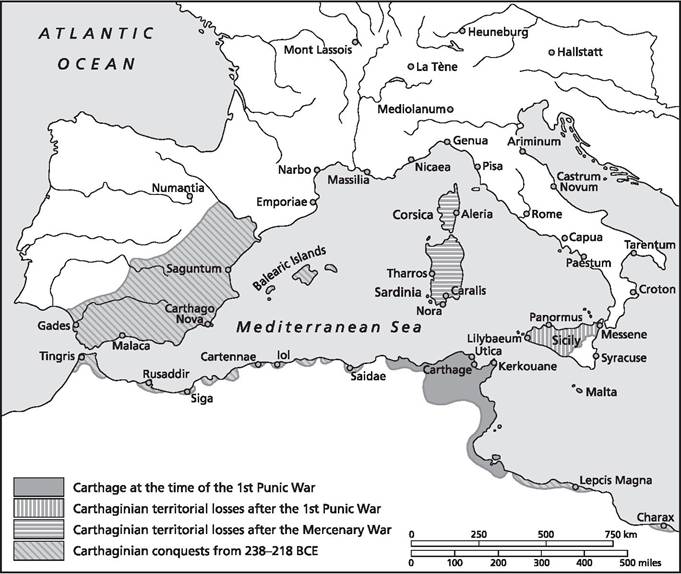
Map 5.2. The Carthaginian Empire from the First to the Second Punic War. Source: Ameling 2013, 362. Copyright: Oxford University Press.
The increasing scale and scope of Carthaginian war-making coincided with political change. Carthage may have started out as a monarchy but came to be run by an aristocratic regime contained by growing popular participation. Early expansion efforts in the sixth century bce were overseen by single elite leaders who campaigned (by land and sea) with the support of their clients and may even have controlled the state more generally. During the fifth century bce, the state asserted control over organized violence through a shift to a clearly defined citizen army and leadership by generals who were in charge of military operations, while domestic power was held by two senior magistrates (suffetes).
Intensifying mobilization of the citizenry was accompanied by curbs of elite power and increasing empowerment of the citizen assembly. The latter enjoyed freedom of speech and the right to banish officials. Elite-commoner bargaining unfolded in stages, as generals were first made accountable to an aristocratic court and later came to be elected by the assembly, alongside civilian officials. Material benefits accrued to the citizen militia from plunder and land allocations outside the core territory. For about a century from the end of the fifth century bce, mass conscription of citizens is regularly reported alongside levies of subjects and employment of foreign mercenaries.
Unlike in Athens, this did not result in outright democratization: effective political leadership rested largely with an elite council that decided on war and peace and organized levies. Even so, the existence of elections and the repeatedly voiced notion that “the people” had gained (too much?) influence point to considerable popular bargaining power even within the constraints of an aristocratic system.[381]Foreign-policy stakes and consequent military efforts greatly increased when Rome and its Italian allies (see later discussion in this chapter) replaced the Sicilian Greeks as Carthage’s principal state-level opponent. Protracted conflict over possession of Sicily (264-241 bce) compelled Carthage to field exceptionally large fleets. This led to a doubling of the tribute imposed on its African subjects. Backlash against this measure greatly amplified the threat created by a mercenary uprising in the wake of defeat against the Romans: most of the subject territories and even some Punic cities joined the rebellion (241-238 bce). This crisis, together with eviction from the Mediterranean islands and the obligation to pay reparations to Rome, provided a strong incentive for developing new resources. From 237 bce, military operations on the Iberian Peninsula (possibly expanding an earlier presence there) generated plunder and provided access to rich mineral deposits and local mercenaries. These efforts triggered renewed war with Rome (218-202 bce) during which Carthage raised troops on an unprecedented scale: Hannibal’s invasion of Italy was only the most famous of several overlapping campaigns conducted in various theaters. As the resultant demand for manpower exceeded the demographic resources of the imperial core, Carthaginian war-making heavily drew on African subjects and allies as well as mercenaries from all over the western Mediterranean.
Defeat by Rome resulted in the loss of most subject territories and the imposition of large reparations.
Carthage survived intact as a city-state until its destruction by the Romans in 146 bce, and the loss of tributary revenue prompted political reforms that favored popular “voice.” The resilience of city-state institutions at the core is consistent with the layered character of imperial control. Full citizenship was limited to the people of Carthage (whom Greek sources labeled the kyrioi Karchedonioi, or “Carthaginian masters”), who owed military service and had access to the assembly. There is no evidence for taxation. The citizens of other Punic city- states in North Africa constituted the innermost layer of the imperial periphery. They enjoyed local autonomy and the right to intermarry with Carthaginians and generally “lived under the same laws” but were required to pay tribute and provide soldiers. Like most Athenian allies, they lacked their own navies.The second layer consisted of indigenous Africans under direct Carthaginian rule. The subject Libyan territories were organized into rural districts whose population supposedly owed one-quarter of the harvest as tribute and had to provide soldiers. Each district had its own civilian administration. It was only at a fairly late stage, probably at the time of the wars against Rome, that these districts were brought under the unified control of a territorial governor.
The third layer was formed by overseas territories. The various cities and tribes of western Sicily formed a province (epikrateia) under a governor who exercised military control via permanent garrisons funded by coins that were minted specifically for them. Tribute was due (at least by Greek cities) but there is no sign of superordinate civilian administration beyond local government. Sardinia was more directly controlled and settled by Carthaginians, and an important source of grain for the city of Carthage. The most recent acquisitions, on the Iberian Peninsula, were under purely military control: the local governor/general (strategos) gathered tribute and troop contingents; hostages ensured a measure of control but locals otherwise retained full autonomy.
The outermost tier was a penumbra of autonomous principalities in Numidia ruled by local “kings.” Depending on location and circumstances, they were either tied to Carthage as allies and provided troops for pay or could be reduced to tributary status. Treaties specified their status, which varied with Carthaginian strength. Much of the Carthaginian sphere of operations on the Iberian Peninsula belonged in the same category.
Carthage thus shared key features with other Mediterranean city-state empires such as Athens and, as we will see, Rome. The imperial structure was centered on a single city-state core endowed with a set of self-contained civic institutions including annually elected officials, a council, and an electoral assembly. Leadership by a warlike aristocracy was contained by a formally privileged citizenry of kyrioi. An inner periphery of allied yet tributary city-states of ethnic co-specifics and a tightly controlled layer of tribal subjects in the African hinterland and in Sardinia generated the surplus that in the fifth and fourth centuries bce sustained military operations in Sicily, operations that absorbed large resources without ever yielding stable gains. The revenues of empire accrued to Carthage’s elite and citizenry alike. In the later part of the third century bce, after its forced retreat from the Mediterranean islands, Carthage expanded into the Iberian Peninsula for the purpose of seizing new resources for future war-making. Roman interference with this project triggered war on an unprecedented scale that led to the loss of most of Carthage’s tributary periphery and thus most of its war-making capabilities.
It is emblematic of the institutional layering of Carthaginian rule that the citystate core weathered these massive perturbations well and appears to have thrived until the city’s final destruction. Carthage never quite became the “capital” of an imperial “state”: rather, it maintained a rigid institutional separation of the city-state core from its multilayered periphery that helped manage both expansion and retreat. While empire can be expected to have had a considerable impact on the core’s economy and demography, it is noteworthy that Carthage survived as a large city for half a century following the loss of most of its imperial possessions and even generated enough public income to pay off its war reparations early. This was an outcome comparable to Athens’s ability to function as a polity with or without an imperial periphery. Proper understanding of the nature of these city-state empires therefore demands particular attention to their aftermath. Athens and Carthage’s contribution to this understanding is made all the more valuable by the fact that the most successful ancient Mediterranean city-state empire, Rome, cannot offer similar insights because it did not fail at this stage of its development.
More on the topic The Carthaginian Empire:
- The Achaemenid Persian Empire was something new in history: a hyper-power without serious rival, a world empire on an unprecedented scale.
- An overseas empire gained is not necessarily an empire retained.
- Historians have traditionally regarded the Ottoman Empire's failed second siege of Vienna in 1683 as a turning point in the empire's long history, bringing to an end centuries of military success and expansion.
- Roman law entered medieval political reflection in the late eleventh century as the law of the universal Roman empire, an organization foretold by Old Testament prophecy as the last empire to rule the world before Apocalypse and hallowed by Christ himself who had lived under the Caesars.
- The Qing Empire (1636-1912) was one of a set of very large, long-lived Eurasian empires ofthe early modern period, and like any ofits contemporaries the empire raises a number of questions regarding the sources of its stability, expansion, and durability.
- The Austrian Empire
- The Other(Secular) Empire
- Britain and empire
- Conclusion: A Christian Empire
- Ur III Empire
- Durability of Empire: The Self-Reinforcing Bundle
- THE THEORY AND PRACTICE OF EMPIRE-BUILDING
- The Byzantine Empire and Its Attitude toward Kievan Rus'
- The Rise of the Ottoman Empire
- The Ottoman Empire and Its Dissolution
- Sargonic Empire
- Pax Britannica: from empire to peace
- 1900: The Dilemma of Empire